New Dimensions in Drone Applications LAPIS Aerospace Technologies
Defence Turkey: I’d like to start off our interview with an overview of Lapis Aerospace Technolgies. Could you briefly introduce the company and touch on the reasons why this company was established, its accompliments over the last five years, and to what extent have you achieved targets thus far?
Osman SEVGİ: We believed we could provide much faster and particularly indigenous and national solutions in unmanned systems and air vehicles in our country both for the defense industry and civilian purposes. On that note, in 2015, we launched the journey of Lapis Aerospace Technologies. Since then, as a result of a process which focused mostly on R&D we developed our indigenous products at the İvedik Teknopark facilities in Ankara. We launched our production facility within the Ankara Organized Industrial Site (AOSB) for the manufacturing of our indigenous products which we produce via serial production. Throughout this process, we have never compromised on the targets we identified when we started our journey. Therefore, we can say that we fully achieved our targets at the point we have reached now. From now on, our target will be to strive to maintain the utilization of our products and meeting the requirements of our country. We trust our products and are able to provide any type of support necessary. I look forward to the days ahead as we build upon our sucesses.
Defence Turkey: Could you speak about the current organizational structure of Lapis Aerospace Technologies, its 2020 performance shadowed by the COVID-19 pandemic, as well as turnover and expectations for 2021?
Osman SEVGİ: At Lapis Aerospace Technologies, we have a quite young, enthusiastic and dynamic staff. Besides, our experienced and competent colleagues are leading design, project management and production teams. Therefore, at Lapis, we do not experience organizational inertia due to a vertical hierarchical structure. We are capable of adopting decisions rapidly and swiftly actualize our projects through agile project management models. While we accomplish all these objectives, we keep in line with specific standards and quality management system as we manufacture products for the defense industry. We have been granted the ISO-9001, Production License, Facility Security Clearance, SSB EYDEP certificates required for such design and production activities. Accordingly, we endeavor to institutionalize our organizational structure further by reinforcing our human resources, procurement, quality, information technologies departments and our executive staff in 2020. While we address the bottlenecks caused by the COVID-19 pandemic, we strive to strengthen our team through a more corporate structure and providing employment opportunities. We even increased the number of our staff to 35 during the pandemic and we did not experience a drop in our turnover in 2020 despite being faced with many challenges and difficulties. We took certain steps that were quite critical for us in the last quarter of 2020, and signed contracts as part of the prototype system deliveries regarding the sales of our first UAV products. In 2021, we will work intensely especially on our contractual obligations and our products which we continue to develop with our own resources and on our R&D Projects that are being supported by TÜBİTAK. In relation with these activities, we raised our turnover targets for 2021 and we have confidence in achieving them. We believe 2021 will be a year full of success for us and our entire country. As I mentioned earlier, in 2021, we will continue our R&D activities without slowing down and we are eager to introduce our products that are available for serial production to the service our country’s users in defense and other fields.
Defence Turkey: What are your comments on the current infrastructure, production capacity and technologies utilized at Lapis Aerospace Technologies’ production facilities in İvedik and Temelli?
Osman SEVGİ: Lapis Aerospace Technologies will continue its R&D activities on the development of unmanned air systems with its strengthened team of engineers at Ankara İvedik Teknopark facilities. This design team features mechanic, hardware, software and system design engineers competent in developing rotating wing, fixed wing and VTOL unmanned air vehicles and 3 axes/2 axes gimbals. Our design team has been indigenously developing all the design processes of our products, including the flight, navigation, stabilization and autopilot algorithms within our company.
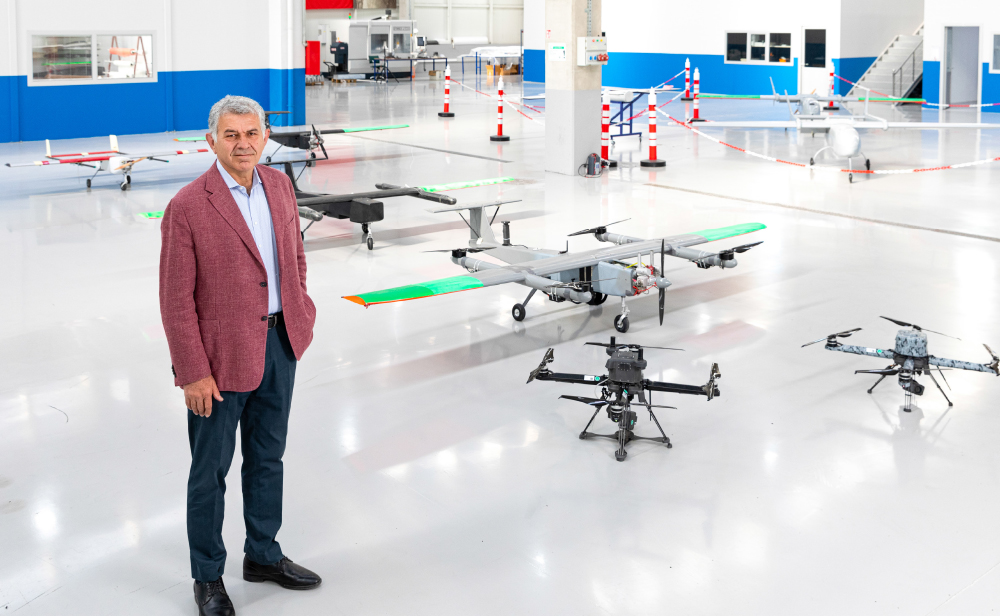
Our production facility spans an indoor area of 3,500m2 within the Temelli AOSB campus and features infrastructural capacity for machining, CMM measurement, industrial three-dimensional printing infrastructure for prototypes and end-products (HP 5200 MJF), composite production, electronic / mechanic / electro-mechanic integration. This facility is capable of manufacturing 150 LAP60 multi-rotor platforms monthly, which are available for serial production and 50 VTOL platforms annually. By the way, I would like to underline that we can produce all the systems we developed without outsourcing any services.
Defence Turkey: Lapis Aerospace Technologies owns technical infrastructure and know-how in Unmanned Systems and Electric Vehicles, including Fixed and Rotating Wing / VTOL type various drone solutions under 100 kg. Could you inform us on the company’s position in the domestic market? What are Lapis’ strengths? Could you tell our readers about the company’s unique characteristics and superiorities that differentiate it from competitors in the market?
Osman SEVGİ: Though we are a young company established in 2015, we have developed a variety of indigenous products that entirely belong to us, and we have managed to achieve this in a relatively short span of time due to our experienced workforce. With the help of the investments I mentioned earlier, we reached a remarkable level in terms of production capacity. We hope to fulfill our expectations and achieve a better domestic market position with our existing infrastructure, product range and know-how. We introduce our products by demonstrating them or through other various methods with different users and customer satisfaction and feedback proves to us that we are on the right track. We are constantly improving our products in line with the feedback we receive and update products by adding new features. We look forward to offering our products to more users as soon as possible.
Lapis’ most critical strength is its indigenous and national products which we fully believe in. We will make no compromise on this target.
Defence Turkey: Regarding Unmanned Systems, you also deliver various indigenously designed and manufactured systems such as fixed wing VTOL-01 and various drone systems such as the multi-rotor VTOL type CR-01 TROGON, CR-02 LAP60 and VTOL-02 ULAK as well as the 2-3 axes gyro stabilized Payload systems employed by these systems, and the indigenous Autopilot System with artificial intelligence and Ground Control Stations. Could you briefly talk about Lapis Aerospace Technologies’ Unmanned Systems product portfolio? What would you like to tell us about the deliveries you have accomplished in line with the contracts you signed?
Osman SEVGİ: Well, as I can see, you know almost our entire product portfolio. As you have also mentioned, our company develops rotating wing and VTOL unmanned flying systems and the sub-systems they contain. Our product portfolio is comprised of such products. Therefore, we do not procure any products besides engines, propellers, battery cells, sensors and basic electronic equipment. We design and manufacture the smart battery systems and the battery charging stations specific to Lapis. In addition, we design and manufacture our Pan-tilt systems where the directed antenna that is the sub-system of the UAV systems is integrated to and our mobile ground control stations.
Within the scope of the contracts we signed, we have projects such as the tethered drone to be used for border security, tethered drone integrated to mobile platforms that can perform under challenging conditions, monitor integrated to the vehicles, the mobile ground control station with operator control interface and ground data terminal.
Defence Turkey: Could you briefly tell us about the LAPİS VTOL-02 ULAK UAV that has fixed and rotating wing UAV features and that can operate fully autonomously with indigenous-national software and hardware? Have you received any orders for ULAK or are there any negotiations underway for this product?
Osman SEVGİ: Our VTOL-02 ULAK UAV project is a system we launched in 2018 and introduced at the SEDEC Fair. In the beginning, the entire thrust systems were planned as electric motors, and then there have been changes to increase the endurance and payload capacity. Design and prototype production stages of our ULAK VTOL-02 vehicle have been completed and we aim to have it verified with the flight tests and turn it into a qualified product by the end of 2021. No orders have been received in this respect yet, but we are receiving questions on ULAK’s technical specifications and its completion date from various organizations. Therefore, we are aware of the intense interest in such platforms and the high expectations on them. When our product is mature enough to be utilized, we will run the necessary promotion activities and we certainly expect to be noticed.
Defence Turkey: Could you inform us on the 5G Assisted Indigenous Drone Project, which Lapis Aerospace Technologies is a part of? This groundbreaking project in 5G technology is being executed by the cooperation between Turkcell and Huawei Turkey, what involvement is there for the drone market?
Osman SEVGİ: Within the context of this demonstration project realized with Turkcell and Huawei, the Turkcell 5G Drone can be controlled by 5G technology and provides viewers at different locations the capability to view live images transmitted via a 360 degree 4K camera over 5G with virtual reality goggles.
Here at Lapis Aerospace, we rapidly prepared our drone systems regarding this project and carried out demonstrations with the enterprises we act together in this project. We fulfilled the task assigned to our company in line with the identified program. If this project is launched in different fields, a new dimension can be added to Drone applications, more secure, faster and more economically efficient execution of the control of oil and natural gas pipelines in industrial areas and supervision of the fields in the agriculture sector would certainly be possible.
Defence Turkey: I personally first heard the name Lapis during the IDEF ‘17 Fair, as part of the Tethered Multi-Rotor Unmanned Aerial System Cooperation Agreement signed on May 11, 2017. Together Aselsan, Nurol Makina Sanayi (NMS), BİTES, Altınay and Lapis Aerospace Technologies companies developed the Tethered Multi-Rotor Unmanned Air Vehicle System named TEPEGÖZ and integrated it over the EJDER KUNTER Armored Personnel Carrier vehicle manufactured by NMS. Has the serial production of TEPEGÖZ started? Have you received any orders from abroad since then?
Osman SEVGİ: Exactly, yet the serial production has not been launched nor has there been any additional developments on this issue. Then again, as Lapis, we have been working on some different projects regarding tethered multi-rotor systems.
Defence Turkey: Within the scope of the 5G Assisted Indigenous Drone Project, will new capabilities be added to the TEPEGÖZ System, such as enabling the viewers / users at different locations to watch live images via virtual reality (VR) goggles with 360 degrees 4K camera that was proven with the flight conducted on February 12, 2019? What can you tell us about the tethered drone system projects you have been conducting with the Presidency of Defense Industries?
Osman SEVGİ: Indeed, we have two ongoing tethered drone projects with the Presidency of Defense Industries. Both projects are being executed in line with the project schedule.
Defence Turkey: Could you inform us on Lapis Aerospace Technologies’ R&D perspective, the number of its R&D staff, the budget allocated to R&D activities and its ongoing R&D projects? Which new products and technologies will we see a demand for in the Unmanned Systems Sector in the next 5-10 years?
Osman SEVGİ: As a company well aware of the importance of R&D, Lapis Aerospace is a company that uses nearly all of its revenue in R&D and it will continue to do so. We believe that unmanned systems will be indispensable in almost all civilian and military areas such as healthcare, transportation, communication, disaster management and daily domestic utilization in the next 5-10 years or longer.
According to research, between the years 2019-2025, with a 15.5% Compound Annual Growth Rate, the UAV Market is expected to reach US$45.8 billion in 2025 from US$ 19.3 billion in 2019. The increasing use of UAVs in various commercial areas such as reconnaissance and surveillance, measuring and mapping, disaster management, airborne remote sensing and cargo activities contribute to the growth of the UAV market.
Depending on various utilization areas of UAV systems, technological developments are occurring in many areas ranging from auto-pilot algorithms and flight control systems to payload sensors, from communication systems to power management units and platforms.
Demand for systems that operate in environments without GPS, systems with higher endurance, systems that can travel to considerably far distances, systems that minimize operator dependence by enabling operational ease of use will increase in the short term. To fulfill requirements in this area, many technological innovations will have to be integrated to our systems; elements such as herd algorithms capable of task sharing during the operation, artificial intelligence software that can make decisions based on received images and direct operations, wireless charging stations that support long flights, tethered UAV utilization that perform as relays that enable line of sight in long distance flights, deception and spoofing resilient sensors and algorithms, as well as optical navigation systems that facilitate landing and take-off and flights in environments without GPS. We have already launched activities regarding some of these technologies as we move forward in step with emerging technologies.
Defence Turkey: How is Lapis Aerospace Technologies currently positioned in the global market? Could you touch on its competitive power and ongoing export projects / activities, if any?
Osman SEVGİ: We believe we will have a say in the global market and achieve competitive power as long as we have genuinely indigenous and national products. Since our products do not contain any materials that require export licenses, we are not facing any restrictions. Particularly, I can easily say that when we compare our LAP60 multi-rotor product to similar products in the same category developed abroad, it has quite similar features, it even contains certain features that are better, and this product has now reached the level of being available for export activities. We will start work on this issue.
Defence Turkey: Through the perspective of future of SME companies such as Lapis Aerospace Technologies, how do you evaluate Turkish Main Contractor companies such as Aselsan and Baykar Makina’s access to the drone market under 100 kg and their production activities in this area?
Osman SEVGİ: The companies you mentioned are quite successful companies that have already proven themselves in the sector and that have competitive power in the international arena. The increase in the number of SME companies such as our company and their development of indigenous products will eventually boost our country’s global competitive power. From this point of view, the survival and development of companies that are dedicated to such services in current circumstances will be possible with the prevention of monopolization. After all, the resulting eco-system that will be created will serve as a source for the companies you have mentioned as well.
Defence Turkey: Could you share Lapis Aerospace Technologies’ vision, targets and expectations for the decade with our readers?
Osman SEVGİ: Our vision is to become a leading aerospace and space technologies company with global competitive power and indigenous products by fulfilling the indigenous criteria, which is our founding purpose. To this end, we will strive to cover the present requirements and expectations particularly in unmanned air vehicles area with indigenous solutions. We expect our activities not to be ignored and to be supported by our government.
Defence Turkey: What would you like to mention regarding Lapis Aerospace Technologies’ participation in the upcoming IDEF’21 Fair? How many products will you be demonstrating at the fair and will any new vehicles be unveiled as well?
Osman SEVGİ: We wish to display the latest version as well as the additional features of the LAP60 which is presently available for serial production, the new version of the VTOL 02 product that I mentioned previously, our smart battery system and Lapis battery charging station to visitors and potential users at IDEF’21.
Defence Turkey: Would you like to make any final comments for our readers?
Osman SEVGİ: We thank you for giving us the opportunity to talk about our company and vision, and thank your readers for reading this interview. We’d like them to follow us and watch our solutions for the needs of today and of the future