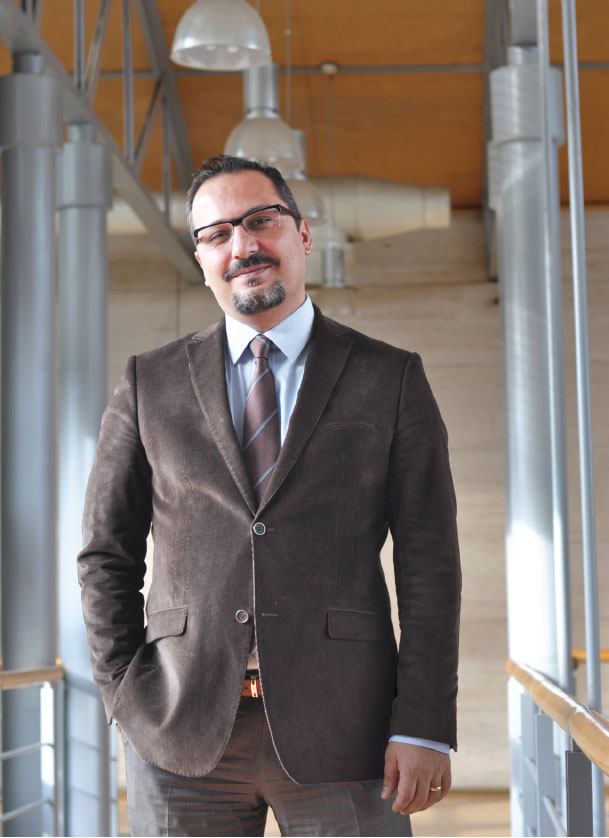
ODTU Teknokent is a Hub Where Research that is Done at the University and in Companies is Transferred to Industry and Commercialized
Defence Turkey: Please accept our very special thanks for devoting your time to answer our questions. As a start, could you please tell us about ODTU Teknokent in terms of the activities and projects being carried out?
When talking about ODTU Teknokent, we have to start with our main source of power, ODTU (Middle East Technical University), which is the first and biggest campus university in Turkey with 24.500 students. ODTU is an international university with more than 1.400 international students coming from 68 different countries. Approximately, 2500 researchers are working in 40 undergraduate programs within 5 faculties. The university has 93 Ms, 60 Phd programs and 5 institutes. 40 research centers, 24 of which are centers of excellence and 365 laboratories are giving services to industry as well as academia. It is the leading party for Turkey in projects funded under 6th and 7th framework programs, and we believe to sustain our position in the league for Horizon 2020 programs. Combining ODTU’s research capacity and know-how with the innovative capacity of entrepreneurs, ODTU Teknokent has provided momentum to our country’s technology accumulation. Our model has become successful with its management experience and the projects undertaken, and has set an example for the development of other technology parks in Turkey. Our reputation has crossed borders and we are providing consulting services for institutions willing to set up technology parks abroad. ODTU Teknokent holds 300 firms, %89 of which are SME’s that employ approximately 4100 personnel carrying out R&D activities in a 120.000 m2 enclosed area.
ODTU Teknokent is constantly developing new policies and supporting programs in these areas; the biggest telecommunication company of Turkey, Turk Telekom, is going to be hosted in new incubation (telecommunication) center where will share know-how and projects with smaller companies. This model will give smaller companies the chance to develop deeper know-how in very specific areas and will give bigger companies the chance to share the risk and avoid being oversized.
In general ODTU Teknokent’s policy is to create incubation programs and/or environments around anchor companies; key players of the international market, and place smaller, flexible, capable SME’s around these companies. This model is going to be applied to consumer electronics, telecommunication and ICT and it is already in use for Defence industry and digital gaming. ODTU Teknokent also has pre-incubation program for digital gaming and animation technologies.
University-industry collaboration which covers consultancy from academia to the industry, co-development and co-research projects, usage of research infrastructure efficiently, training candidate engineers as per the request of industry, direct technology transfer via start-ups, spin-offs and patent licensing is the main duty of ODTU Teknokent. Since 2002, ODTU Teknokent and ODTU collaborated on 900 R&D projects, signed 1600 contracts with more than 500 different academics in 44 different academic departments. In 2012, 85 new projects were initiated at Teknokent to facililtate university-industry collaboration.
To enable technology development in accord with the strategic plan of the Undersecretariat for Defence Industries (SSM), ODTU Teknokent is giving support to a joint program called Recruitment of Researchers for Defence Industry (SAYP), between ODTU, SSM, and Aselsan, Roketsan, Tusaş. Within the scope of the program, post-graduate researchers at ODTU, who are at the same time employed in these main contractors are oriented for research projects that are strategically chosen by SSM. Hence, the know-how and research capacity is transferred from the university to the industry to help develop indigenous defence technologies. There is also another program called MIGEP (Collaboration Development Program for Centers) that aims to facilitate the use of the infrastructure at the University’s thematic research centers for R&D activities on projects that are agreed upon by both the University and industry. This program is supported by the thesis of the post-graduate researchers who are at the same time employed in private sector. For 2013, the privileged sectors for MİGEP were defined to be electrics and electronics and IT, energy, biomedical and automotive sector. Under the Teknokent Project Office we are supporting companies and academicians in managing and writing FP7 and Horizon 2020 projects. Within the scope of TTO (Technology Transfer Office) we are financing and conducting patent applications for the inventions coming from the Teknokent companies and ODTU (and any other candidate which seems suitable for commercialization). The process includes commercialization of these inventions. ODTU Teknokent is trying to build up its reputation in the international market; we are using accelerator programs to present successful companies to the international market. ODTU Teknokent is continuously communicating with the international key players of the prioritized sectors and eagerly inviting them to conduct their R&D projects in the technology park. In a similar vein, clustering activities and cooperation in international projects are carried out. We have one ICT and one defence industry cluster
Defence Turkey: You have mentioned a cluster for the defence industry companies; could you please provide some details about this?
Middle East Technical University (METU) technology park, ODTÜ Teknokent hosts more than 70 Defence industry companies doing R&D and has clustered them into Teknokent Defence Industry Cluster (TSSK) as of 2010. These companies have complementary vertical expertise that provide added value to each other’s capability and are developing new technology products and services for Defence and security.
The cluster aims at providing added value to generate more synergy and cooperation among its members, with universities for applied research in Defence sector, and with major contractors. The ultimate goals are to fulfill the requirements of Turskish Armed Forces and to position Turkish Defence industry as a significant player in the world market through high technology solutions, products and services that are presented to international market.
The cluster’s mission is to provide added value to generate synergy and cooperation among its members, with universities for applied research in defence sector, and with major contractors. The ultimate goal is to position Turkish defence industry as a significant player in the world market through high technology solutions, products and services that are presented to international market.
Offset is a powerful tool for establishing international cooperation. The companies that produce high value added solutions, products and services with high technology are considered to be the most efficient options for cooperation through offset. Owing to the merits that are mentioned about Teknokent Defence Industry Cluster (TSSK) companies, and the fact that ODTÜ Teknokent is one of the key actors of technological development in our nation, TSSK cluster is considered to be one of the most significant strategic partners of SSM.
Defence Turkey: How do you facilitate defence companies to work together and how is the cluster activities financed?
Currently, the cluster is financed by the Turkish Ministry of Economy for a $3.6 million project named Ur-Ge (Development of International Competitiveness), which aims at internationalization and improving the export capabilities of the cluster with its members by creating sustainable, competitive advantage for the firms in Defence sector. Within the scope of this project, TSSK members are trained and certified on technical requirements, managerial and marketing issues; the cluster attends international trade shows and fairs, visits other high-technology Defence cluster(s), organizes trade missions to countries of interest and hosts foreign trade missions made to the cluster in search for opportunities of cooperation. Financed and supported by the Turkish Ministry of Economy, last February, TSSK attended IDEX 2013 in Abu Dhabi with BTT Information Technology, EDA Engineering Design Analysis, infoTRON, Labris Technology, SimSoft and Verisis as well as Aselsan, Ayyazılım, Bites, ETC-IS, Figes, Havelsan, Milsoft, SDT, and TAI.
Turkish Ministry of Economy has special programs and incentives to support SMEs and clusters of various sectors. The ministry intends to boost export by SMEs and clusters through increasing the international competitiveness of the companies. The project is initiated by a needs analysis that enables the companies taking part in the project to develop a road map throughout the project cycle. The needs analysis puts forward the cooperation network among the project participants, namely the cluster members; the training needs, the improvement areas and the leverage points of the companies in terms of competitiveness. For a duration of three years, the companies receive training and consultancy on their selected technical and managerial topics and receive the funds to attend five business development events such as trade shows, fairs or B2B meeting organizations abroad. The ministry supplies funds to host 10 delegations from abroad to finance the travelling expenses of these delegations and the costs associated with organizing B2B meetings with these delegations. The Ministry of Economy provides generous funds to enable Turkish companies in all sectors, especially SMEs to meet with foreign firms to develop cooperation and realize transactions through export.
Defence Turkey: Could you please enlighten us about ODTU Teknokent R&D activities of Defence Industriy companies?
TSSK is comprised of SMEs operating in the fields of manned and unmanned vehicles; advanced materials, CBRN technologies, protective vehicle and material technologies; human-machine interface; cryptography, coding and encryption, electronic intelligence systems; modeling and simulation, simulation systems; communication, electronic and information systems; sensors and electronic systems, dataLink technologies as well as the various related engineering services such as testing, calibration, modeling and maintenance. The driving force of the cluster is the R&D projects stimulated by the synergy between university, industry and research. The cluster members employ around 1000 R&D personnel and currently, there are approximately 150 active R&D projects being conducted for Defence industry by the members of TSSK.
Defence Turkey: Are there any other points that you would like to mention to the readers of Defence Turkey?
It is worth to mention the significance of dual use of technologies developed in companies, universities, research centers and technology development regions such as ours. As ODTU Teknokent, we effort to facilitate this by bringing together companies that serve for different sectors, especially defence, medical and automotive, by organizing Project Fairs, company meetings and proctor our companies’ new projects in order to determine whether a critical technology is being developed and can be utilized for different sectors. We try to inform our companies to notify us about their progress and their new technologies, so that the dissemination of these can be done to facilitate dual use.
Finally, I would like to state, once again, that ODTU Teknokent is a hub where research that is done at the University and in companies is transferred to industry and commercialized. The University is a magnificent supply of both academic know-how and premium quality human resource for companies in the technology development region. We would like to welcome more international companies, with their research centers and cooperate in joint research programs and facilitate collaboration with the University.





