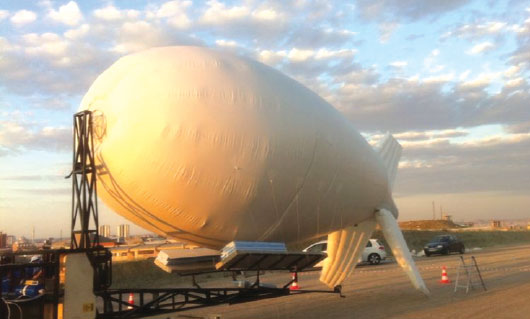
Otonom Teknoloji’s Doruk Aerostat System Makes First Flight
In its first flight conducted on 16 July 2014, the Otonom Teknoloji’s Doruk Aerostat System successfully completed tests for operational altitude, payload, the tethering system, the mooring station and the ground control station.
The aerostat vehicle body has been designed by Otonom Teknoloji and constructed through indigenous capabilities and materials. The useful load for the two-hour test was an electro-optical camera; video and image transmission was implemented using 802.11n based wireless access devices. The mooring station used was also designed and set up by Otonom Teknoloji. The testing was carried out in two stages, over altitudes 65 meters and 155 meters above ground level. Video and images acquired at various altitude levels were transmitted wirelessly to the ground station.
A total of nine personnel participated in the testing of the system, which included pre-flight transportation and assembly, operational flight and post-flight activities. The Doruk Aerostat System prototype vehicle is 10 meters in length and has a 12 kg useful load capacity. Although being a first-prototype, the system exceeded expectations; a useful load capacity of up to 20 kg has been identified for real-flight conditions subject to varying wind speeds. Based on the test results, the Doruk Aerostat System is expected to perform long-term endurance missions while carrying a variety of useful loads such as thermal imaging cameras as well as radar and LIDAR devices. The system is well-suited for operations involving remote sensing technologies, such as security-related observational activities and early detection of environmental incidents (including early detection of forest fires and search and rescue activities), precision agriculture, airborne early warning, TV and radio broadcasts, road traffic management and naval traffic control, critical facility security, mobile communications, and expansion of communications during disaster and emergencies. The Doruk Aerostat System can implement these tasks in a cost-effective manner.
Development is on-going for the Doruk Aerostat System, which is identified as a tethered unmanned aerial vehicle. Two models, named D300 and D1000, are planned to operate at altitudes of 300 meters and 1,000 meters, respectively. The system uses a winch which raises and lowers the aerostat, and the lighter-than-air vehicle can operate at weeks on end. The D300 model, whose design has been completed, can carry up to 15 kg of useful load. Tethered to the ground at an altitude of 300 meters, it provides an observational range of 40 km. The D1000 model, whose development will commence in 2015, is planned to carry useful loads of up to 100 kg and operate at an altitude of 1,000 meters, offering an observational range of 70 km.
Flight of Solar-Powered Aerial Vehicle TepeGöz-S Targeted for Q4 2014
Another project on which Otonom Teknoloji is fast at work is the TepeGöz, a solar-powered unmanned aerial vehicle with capability for vertical takeoff and landing, autonomous navigation, and an operational altitude of 3,000 meters. The first flight for the TepeGöz, still under development, is targeted for the fourth quarter of 2014.
Otonom Teknoloji started its R&D activities in May 2013. Current outstanding projects include MiniSteer, an electronic control unit for use in UAVs and unmanned ground systems that complies with JAUS (Joint Architecture for Unmanned Systems) standards, and ground control station systems.
Otonom Teknoloji is located at Teknokent, the Middle East Technical University’s research park in Ankara, Turkey, where its R&D activities take place. Production and testing for all systems and sub-system components for the aerostat system and unmanned aerial vehicles are carried out at the İvedik industrial park in Ankara.