Point Air Defense Needs of the Turkish Air Force

A layered air and missile defense structure should include at least several air defense systems in which each system protects a certain range and altitude in the designated air space from very short range-low altitudes to very long range-high altitudes. All systems must work together under a joint command-and-control system architecture to effectively control and defend air space. The core of air and missile defense capabilities of the Turkish Air Force (TurAF) are composed of over 30 fixed and mobile 3D air surveillance radar sensors that are located at remote sites around Turkey to provide a real-time picture of air space inside and around the country. These early warning radar systems are supported by 4 E-7T Airborne Early Warning and Control (AEW&C) aircraft serving under the Airborne Warning Control Group Command in Konya, Turkey. Ground-based air and missile defense systems of the TurAF consist of one battery of recently purchased long-range S400 Systems, four batteries of medium-ranged HAWK XXI Systems, 3-4 batteries of Nike Hercules (about to be retired), at least 80+ Rapier launchers for low altitude air defense and 32 units of ZIPKIN Stinger PMS and sufficient numbers of 35mm/40mm air defense guns for very short-range air defense needs.
We will focus our attention on the point air defense segment of the TurAF's air and missile defense structure and discuss why it is important to establish a robust point air defense system to protect valuable assets against evolving air threats in the region. This focus is based on the recent developments in missile and drone technologies and their proliferation in the region and around the world. These missiles and drones can range from simple hand-thrown remote-controlled drones to very sophisticated kamikaze drones or long-range cruise missiles. Recent technological advances in electronics such as miniaturization of a lot of missile and drone subsystems including IIR/ TV gimbals/seekers, IMU (Inertial Measurement Units) units, smaller warheads, widely available propulsion systems (some from hobby aircraft), and guidance control systems make these weapons a major threat to the military and economic installations around the world. Some of these drones and missiles are built using composites or other non-metal materials that decrease their radar signatures and make them difficult to detect if they are flying at very low altitudes.
In fact, we have seen the effective deployment of these small, and in some cases, slow drones, and missiles in recent conflicts between Yemen and Saudi Arabia. On several occasions, more than 20-25 drones and cruise missiles flew hundreds of km inside Saudi Arabian air space and struck oil storage facilities and refineries in Saudi Arabia. Obviously, there must be some gaps in the air defense and command and control systems of Saudi Arabia that could not stop or intercept these drones and missiles in a timely manner before hitting the oil facilities. We have also seen the effective use of loitering drones in the Armenia-Azerbaijan conflict, which took place in the spring of 2021. Several loitering or kamikaze drones used by the Azerbaijan Army destroyed Armenian armored vehicles and artillery pieces even though they were protected by the SA-10 Grumble (S300), Sa-15 TOR, SA-8 Gecko, and SA-13 Gopher air defense systems, which were supposed to engage and destroy these slow-flying drones, but they mostly failed. Of course, we cannot underestimate the presence of the Baykar TB2 drones, which greatly influenced the outcome of the conflict in favor of Azerbaijan.
Turkey's historical rival Greece is located on the western front of Turkey, and the relations remain sour due to some disputes between both countries. Some of the disputes involve Greece's claims of 10 miles of air space over 6 miles of territorial waters in the Aegean Sea, Greece's constant threat of increasing its territorial waters to 12 miles even though the Turkish mainland is only a couple of km away from many Greek islands and militarization of some of Aegean Islands even though these islands are given to Greece on the condition of keeping them in a demilitarized status. The Cyprus problem and sharing of Exclusive Economic Zones (EEZ) in the Eastern Mediterranean Sea are also main disputes between both sides. All these current and historical disputes create mistrust in both countries. As a result, Turkey and Greece deploy some of their best military equipment near their borders. It should be noted that Turkey has other military and border security issues near the Syrian border and has deployed many tanks, artillery, and commando brigades away from Greek borders. On the other hand, Greece deploys their armed forces solely against Turkey.
Greece's military operates a considerable number of naval ships, including frigates, fast attack boats, submarines, and at least 250 highly capable of F-4Es, F-16s, Mirage-2000s, and the recent purchase of 4th generation Rafale fighter aircraft. Some of these aircraft can use AFDS (Autonomous Free-flight Dispenser System with a range of 20km), AGM-65Maverick, AGM-154 JSOW, and SCALP-EG stand-off missiles (currently in the inventory) that can reach important military and economic installations located in Western Turkey or even deep inside the Turkish mainland depending on how they are employed. The Greek Air Force's recent acquisition of 4th generation Rafale fighters could extend Greece's military strike capability towards the Eastern Mediterranean Sea and give them the range to reach deep inside the Turkish mainland. Moreover, Greece is modernizing 84 of its F-16 Block-52+ aircraft to the latest Block-70 standards, including AESA radars, new avionics, and link-16 systems. These F-16s already have CFT (Conformal Fuel Tanks) that gives them over a 1,000km strike radius with significant air-to-ground loads. If Greece acquires AGM-158 JASSM cruise missiles for the modernized F-16s, JASSM will add at least 350-400km strike range on the top of the F-16 Block-70's range. Turkey has been enjoying a geographical advantage over Greece due to the geographical shape (rectangular) and huge size of the Turkish mainland (Anatolia), which has been offering defensive advantages. After getting Rafale and modernized F-16 Block70s in the inventory and arming them with 300-400km range cruise missiles, SCALP-EG, and JASSM (if bought), it is now clear that Turkey's important military installations located well inside Turkey will be within the strike range of the Greek Air Force. Considering Israel's close military relations with Greece, the Greek Air Force could purchase some Israeli weapon systems like Spice Precision Guided kits and HAROP UCAVs for anti-radar SEAD/DEAD missions.
Turkey also faces asymmetric threats from terror groups. In recent years there have been a number of drone attacks towards military installations in Eastern Turkey, mainly from PKK affiliated groups. They mostly used heavily modified remote-controlled hobby drones, including modified quadcopters and fixed-wing model aircraft (1-1.5meter wingspan, foam body) from commercial kits such as Talon-X, which cost about $150 from online hobby stores. Usually, a hand grenade is dropped from these modified model aircraft that can fly several km and follow GPS-controlled waypoints if modified with already available kits on the hobby market.
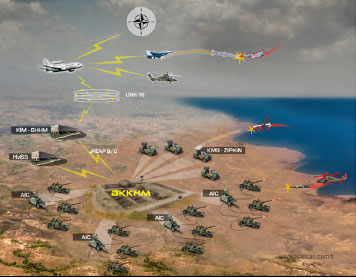
The Turkish Air Force initiated a new project called the Battery Command Control Operations Center (Batarya Komuta Kontrol Harekât Merkezi-BKKHM) and signed a contract with Aselsan in 2018. The scope of the project involves the acquisition of Aselsan produced Korkut Fire Control Systems (FCS/AIC-Ateş İdare Cihazı) to replace older D-IX Super Fledermaus FCSs, modernization of 35mm GDF-001/003 Oerlikon air defense units with new generation smart (called ATOM) ammunitions, and the integration of ZIPKIN Stinger PMS units to the new BCCOC that will be responsible for the point air defense of TurAF military installations such as airbases, early warning radar sites or other important sites.
The TurAF also operates about 80+ Rapier Air Defense Systems, which were first acquired in two batches of 36 units during the 1980s to protect airbases and radar sites from low-level air attacks. The TurAF also inherited about 14 Rapier units from the USAF, who donated to the host country to protect USAF-operated NATO military airbases. Turkish Rapiers went through a midlife update with a replacement of about 800+ Rapier Mk1 missiles to the Rapier Mk2 version during the end of the 1990s. Rapier represents 1970-80s radar (separate search and tracking/fire control radars) and missile technologies (CLOS-Command Line of Sight Guidance). It is possible that the TurAF will not keep the Rapiers in service for long since it would be difficult to maintain the systems. Therefore, it could be this reason that the TurAF did not include Rapiers in the command-and-control structure of the new BCCOC system that will be responsible for the point air defense of its airbases and other important sites.
The information from Aselsan's BCCOC brochure indicates that a typical BCCOC system would be integrated with 4 Korkut-FCS (AIC-Ateş İdare Cihazı) platoons, each controlling 3x 35mm Oerlikon Air Defense Guns, and at least one ZIPKIN Stinger PMS Platoon (4 ZIPKIN Firing Units). From this open-source information, it is not wrong to say that a typical TurAF airbase or military installation will be hosting a BCCOC with these firing units. These units under the command and control of the BCCOC system should protect the airbases from various low-level air attacks such as aircraft, helicopters, cruise missiles, UAVs, stand-off guided munitions, and small loitering drones and primitive remote-controlled drones from terror groups. The point air defense protection area provided with 4 Korkut FCS Platoons with 35mm Oerlikon guns, and ZIPKIN PMSs (assuming that these systems are deployed on the ground using a mathematical model that is optimized for the best possible area coverage) would be about 200km2 (which is almost equal to a 7.5km radius circle from the center of the base) in total with providing up to 3.5-4km altitude coverage.
Most target sets which are low flying such as cruise missiles, kamikaze drones, loitering drones, helicopters, and aircraft can be engaged within this point air defense structure (assuming all Korkut-FCS radars are operational and are also receiving early warning and target information from the higher command and control centers of the TurAF). What about the targets approaching the protected area from medium altitudes and then diving vertically into the targets? For example, one such stand-off system can be the AGM154 JSOW which flies at medium altitudes after release from an aircraft, and flies outside the range of point air defense systems most of its flight, and then dives into the target when it is within the range. Obviously, these targets are difficult for point air defense systems to engage with since their approach profiles follow medium altitudes, and they dive almost vertically to the target with high speeds.
To improve the engagement limits of point air defense capability, one option would be integrating a medium range-medium altitude air defense system to the BCCOC architecture of the TurAF so that airbases or other military installations can be protected from a wide range of targets with a robust coverage from 20-25km horizontal range to a 15km vertical range (altitude). One solution would be integrating Aselsan-Roketsan made HISAR-O+ (with IIR and RF seeker options) with the BCCOC systems to protect the airbases and other military facilities.
KORKUT-Fire Control System [FCS/AIC] and FCS Air Defense Units
A total of 100+ units of Aselsan KORKUT-FCSs will be procured to replace the aging D-IX Super Fledermaus FCSs that fulfill target acquisition and tracking requirements of the 35mm GDF-001/003 Oerlikon modernized towed air defense guns in the inventory of Turkish Armed Forces (TAF-Land, Air and Navy). The KORKUT-FCS is designed for effective low altitude point air defense of military bases and critical assets against modern threats in today's battlefield. In addition to the equipment to execute the command control and fire control functions, three-dimensional (3D) active phased array and electronically scanned Mobile Search Radar (MAR), fire control radar, EO sensors, and communication units exist on the FCS. The design, production, and integration activities of the KORKUT-FCS Platform Prototype weighing nearly 10 tons have been carried out by Nurol Makina ve Sanayi (NMS) Company under an agreement signed with Aselsan.
The KORKUT-FCS System will be able to simultaneously perform the Fire Control and Command & Control functions of up to three modernized 35mm Oerlikon towed air defense guns and ZIPKIN/ATILGAN (Sungur in later years) Stinger PMS.
The live firing tests that composed the final stage of the FCS development activities and were executed in the context of the System Integration and Test Phase were conducted at the Firing Test and Evaluation Center in the Karapınar province of Konya in September 2015 and on December 1, 2015. During the live firing tests, the 35mm Oerlikon modernized towed air defense gun systems with 35mm ATOM airburst ammunitions and integrated with FCS, successfully hit the TURNA Target Drones manufactured by Turkish Aerospace (TA) Company and DT-45 type High-Speed Target Drones produced by the company Airbus Defence & Space (ADS).
Typical KORKUT-FCS Air Defense Platoon is composed of one KORKUT FCS, three towed air defense guns, and at least one ZIPKIN/ATILGAN Stinger PMS. Similar to the KORKUT SPAAG, the KORKUT-FCS Air Defense Unit is capable of accomplishing all functions required for target acquisition, IFF (friend/foe interrogation), target tracking, and engagement of targets using its own subsystems. The FCS Air Defense Unit will be able to form a layered air defense structure with the air defense units of other forces. The KORKUT-FCS Air Defense Unit can be linked to the upper-level Command and Control Center (KIM-BHHM) of Air Force that integrates with all early warning radars, HAWK Air Defense Batteries, E-7T AEW units, and it is also linked to the Land Forces Command Air Defense Command Control Centers using the Land Forces HERIKKS infrastructure.
Modernization of 35mm Oerlikon GDF-001/003 Air Defense Guns in the Inventory of the Turkish Armed Forces
The electronic subsystems on the 35mm GDF-001/003 Oerlikon Towed Air Defense Guns are being replaced with new systems that align with the current technology and feature mechanical improvements; these activities are being accomplished. Indigenously designed and produced 35mm Air Burst Ammunition (Particulate Ammunition [ParM/ATOM]) firing capability is being added to the modernized guns. The 35mm Air Burst Ammunition is smart ammunition equipped with a programmable fuse. The modernization program upgrades the 35mm towed guns in the inventory to be effective against modern threats such as air to ground missiles, cruise missiles, and UAVs using ATOM 35mm Air Burst Ammunition. Together with the ability of precise time counting and the capability of being programmed during firing by taking muzzle velocity into consideration, ATOM 35mm Air Burst Ammunition provides high hit probability against various types of air and land targets. Containing a lethal payload of spin-stabilized tungsten cylinders (there are around 160 sub-projectiles inside the ammunition weighing 1,750gr and having a length of 387mm), the ATOM 35mm Air Burst Ammunition (35mm x 228mm, 90 caliber) significantly enhances the combat effectiveness of 35mm GDF-001/003 Oerlikon Towed Air Defense Guns.
The twin-barrel GDF-001/GDF-003 Oerlikon Towed Anti - Aircraft Guns is an effective Low Altitude Air Defense Weapon with high firepower featuring radar control, electrical and mechanical deployment, and displacement capacity, it is capable of operating with remote and close command and has a high rate of precision and the automatic self-loading capabilities are capable of firing at targets electronically and mechanically.
ZIPKIN/ATILGAN Stinger Very Short-Range Air Defense Missile System
Under the contract signed with Aselsan on November 9, 2001, within the scope of the Pedestal Mounted Stinger (PMS) Project, which was initiated to meet the Low Altitude Air Defense System requirement of the Turkish Armed Forces (TAF), 70 Atılgan (8 ready-to-fire Stinger Missiles mounted on M-113A2 ZPT and) and 88 Zıpkın PMS (4 ready-to-fire Stinger Missiles mounted on the Land Rover Defender 130 Vehicles) were procured and entered the TAF's service. Thirty-two of the ZIPKIN PMS are slated for the TurAF. ZIPKIN and ATILGAN PMS Systems have the capability to operate on the Air Defense Early Warning and Command Control System (HERİKKS) of the Turkish Land Forces.
The Stinger Weapon System, which is a 3rd generation MANPADS with a Passive IR/UV Seeker (on the seeker having a 'rosette scan' type scanning pattern, there is a UV detector in addition to an IR detector), consists of Missile Launching, Internal Communication Cable, IFF Interrogator, Battery Coolant Unit, Detachable Gripstock, and a Reprogrammable Micro Processor. In the Fire-and-Forget type missile, which has a warhead of 3 kg, the seeker is cooled by Argon gas. In open sources, the FIM-92C Stinger RMP Missile System is said to have an effective range of 6 km, a maximum range of 8 km (if the missile does not hit the target, the time clock will detonate the warhead at the end of the 17th second and thus the missile destructs itself), a maximum engagement height of 4.8 km, weight 15.73 kg (the weight of the missile is 10.13 kg), a length of 1.52 m, a diameter of 70 mm and a flight speed of Mach 2.2+ (the missile's maximum speed is claimed to reach Mach 2.6 for a few seconds during flight). The shelf life of the Stinger Missile is said to be ten years in open sources.
The ZIPKIN PMS is a fully automated system that uses Stinger missiles for very short-range air defense roles. The main mission of ZIPKIN is to provide low-level air defense of fixed military or economic facilities such as airbases, radar sites, naval bases, military units, important factories, and logistical centers. ZIPKIN PMS units are remotely integrated into the Air Defense Command and Control Centers via Taffics (Fiber Optic Communications System of the TAF) or radio systems to receive targeting information and to also perform coordinated operations with upper-level air defense systems.
Using the Stinger missile system as a fully automated system like ZIPKIN PMS provides fast reaction times compared to the MANPADS version since MANPADS use of Stinger missile requires operators to perform all procedures of Stinger firing manually. For example, the Stinger MANPADS needs to be activated with a BCU (Battery Coolant Unit) first. After this step, the BCU only provides 45 seconds of electric power and Argon gas to cool the IR/UV seeker and power up the gyros inside the missile. If no firing occurs, the BCU would be taken out and destroyed since it cannot be used anymore. With the ZIPKIN PMS, the Stinger missile can be powered up and provided Argon gas from the ZIPKIN PMS, which contains a larger Argon gas tank in the turret. In addition, the operator of the ZIPKIN PMS can fire multiple Stingers in a short amount of time as soon as IR/UV seeker locks on the target. The ZIPKIN PMS has E/O Day Light TV and Thermal sensors with a laser range finder for passive surveillance, target acquisition, and tracking possible targets. The system can also be integrated with search or fire control radars and can be used at night and in bad weather conditions.
HISAR-O+ Medium Range-Medium Altitude Air Defense System
A complete HISAR-O+ air defense system battery consists of an FCC (Fire Control Center), at least three 6x6 truck mounted MLS (Missile Launch System), each with six ready to fire missiles, KALKAN-II 3D Medium Altitude Air Defense Radar, Electro-Optical Target Tracking System, and battery logistical support units mounted on 6x6 trucks. Depending on the mission requirements, HISAR-O+ missiles can use both IIR (Imaging Infrared) and RF (Radio Frequency) seekers within the same MLS system. The HISAR-O+ system uses midcourse guidance method to guide HISAR missiles during its midcourse flight via uplink systems that provides updated target information to the HISAR missiles, and in the terminal phase of the flight, the HISAR missile activates its IIR or RF seeker to search and lock on it within the field of view of the seeker. The missile activates its warhead when the laser proximity fuse detects a target within a certain distance from the missile's flight path. HISAR-O+ missiles are capable of engaging aircraft, helicopters, UAVs, anti-radar missiles, cruise missiles, and drones up to a 25 km horizontal range with an altitude coverage of 15km. In the live firing test, the HISAR-O+ system demonstrated its maximum performance at the limits against high-speed target drones.
When it is close to the target, the second stage rocket enters the terminal phase of the intercept with high kinetic energy, which helps the HISAR missile perform very high G maneuvers to reach and kill the targets. Using the midcourse guidance method, IIR/RF seekers with advanced target tracking algorithms, laser proximity fuse, and dual pulse rocket motor give HISAR missiles a high probability of success to kill their intended targets.
The HISAR-O+ can provide a robust point air defense capability for the military and economic facilities around Turkey. All branches of the Turkish Armed Forces are responsible for low to medium-altitude air defenses of their military facilities. Therefore, we can expect that Turkish Land, Air, and Naval Forces would be deploying HISAR-O+ systems to be part of their point or local area air defense system around their facilities. Each command has its own Air Defense Battery Command and Control Operation Centers with already integrated 35mm Modernized Oerlikon Guns, KORKUT-FCS (AIC-Ateş İdare Cıhazı), ZIPKIN/ATILGAN PMS systems. Integration of HISAR-O+ to these air defense command centers will provide a layered point air defense capability against incoming aircraft, helicopters, air to ground guided munitions, cruise missiles, kamikaze drones, UAVs within a range of 25km and altitude of 15km. Considering that Turkish military/economic facilities could be targeted with a wide range of smart weapons such as SCALP-EG, JSOW, AGM-65 MAVERICK, AGM-88 HARM, AFDS (Autonomous Free-flight Dispenser System), and the possible addition of JASSM, HARPY/HAROP to the above list would make the job of Turkish defense planners even more difficult. It would be wiser to add a longer-range and highly effective air defense system to the already operated or planned air defense units to expend point air defense capability around important facilities.
Possible Missile or Drone Attack Scenarios Against Turkish Air Force Bases
The below graphic depicts a hypothetical cruise missile strike mission (Scenario-1) en route to the Turkish Air Force's 3rd Main Jet Base in Konya, where Turkey's E-7T AEW fleet is based and a squadron F-16s and CN235/AS-532 Cougars. Greek Rafale and Mirage-2000 Mk5 have enough operational range to approach Turkish air space from the south before launching their SCALP-EG cruise missiles without entering Turkish air space. Point D is the SCALP-EG missiles' release point, which would fly about 250km further to reach its intended target at the 3rd Main Jet Base, Konya, if it is not intercepted. In any military conflicts, the TurAF's E-7T AEW (Airborne Early Warning and Command Control) capability will be an important military asset (also a valuable target for the opposing side) for early detection of such attacks and will also help air defense units to be alerted in time to engage SCALP-EG missiles before reaching their targets. Therefore, one should expect the E-7T base to be a prime target during a possible military conflict.
Of course, no one should expect a single SCALP-EG missile strike mission to a large military base like the 3rd Main Jet Base in Konya. Military mission planners use all available reconnaissance data, evaluate the critical targets, and prioritize them according to their importance. Other important factors also determine how to hit those prioritized targets, such as distance of the target, air defense units, interceptors, early warning radar sites, etc. Obviously, the 3rd Main Jet Base of the TurAF is located almost at the center of Anatolia and reaching that point with conventional strike packages (large packages of aircraft flying together to a target) would be very risky. A less risky approach is to determine highly important points inside the base, such as aircraft hangars, fuel depots, ammunition depots, etc., and strike them with long-range missiles. How many missiles would be needed? It all depends on the mission goal and expected outcome. For example, the US and Allied forces used almost 1 to 2 ratios to strike Al-Shayrat Airbase of the Syrian Government in April 2017. For each target, two cruise missiles had been launched to get a high probability of hit and guarantee the target's destruction. In total, 59 Tomahawk cruise missiles were fired to about 26 targets consisting of openly parked aircraft, hardened aircraft shelters, petroleum and logistical storage, ammunition supply bunkers, and air defense systems. Can Greece perform such an extensive strike mission with its current SCALP-EG missile and aircraft inventory? Of course, the answer is no, but they can still aim for a limited strike (possibly preemptive strike) to destroy E-7T aircraft and a few important facilities on the base with a number of SCALP-EG missiles.
The TurAF's Dalaman Airbase is located on the Aegean coastline of Western Turkey and houses Turkish F16s, ANKA/TB2 UAVs, and other naval aviation units. Its closeness to the Aegean and Mediterranean Seas makes it a strategically important base for the TurAF. Similarly, a hypothetical cruise missile or stand-off missile/munition (AGM-154C JSOW with a 100km range, Greece purchased about 40 units), AFDS (Autonomous Free-Flight Dispenser System to hit runways, certified on F4Es), possible Spice stand-off guided munitions (Spice guidance kits could be purchased from Israel) in addition to the SCALP-EG cruise missiles. One should expect that since there is no long-range required for Dalaman, not many SCALP-EG missiles would be used for this scenario. Greece-Israel military relations could also generate a HAROP type loitering drone purchase by Greece. These long-range drones could potentially be used against Turkish military facilities around Aegean Coastlines.
Dalaman's location and its closeness to Greek Airbases could be an important factor in choosing weapon systems in any strike mission. A selection of weapon systems could include JSOW AGM-154C (100+km range, Greece has 40 units), AFDS (20km range runway destruction dispenser, certified on F-4Es).
An Analytical Assessment of Point Air Defense Systems of the TurAF Against Possible Missile/Drone Strike Scenarios
A queueing model will be used to assess the strength of the point air defense systems currently used at TurAF military bases. The model will consider a number of factors such as the arrival rates of missiles or drones per minute or seconds, the engagement rate of air defense units, and the number of available batteries (service centers). Certain assumptions will be made to run and obtain the result of the queueing model (using the M/M/c model). First, it will be assumed that missiles/drones arrive randomly, air defense batteries receive these missiles from random directions and work independently from each other. The second assumption is that the batteries work like the first-come, first-serve principle. The first missile arriving will be engaged with an appropriate air defense unit in the system. Some of the symbols used in the queueing model can be listed λ parameter indicates average arrival rate of missiles/drones for a strike mission (per/min), µ=average rate of engagements by the point air defense system(per/min), Lq=Average Number of Missiles/Drones in the line (waiting to be engaged), Wq=Average Waiting Time in the line. The probability that the system is busy (utilization factor) is expressed with ρ=λ/(cµ). A higher ρ value (close to 1) means the air defense systems are busy engaging targets, but if ρ >1, the system is totally saturated or unstable to counter the attack. Overall, ρ could indicate the effectiveness of the air defense system if it stays well less than 1. Smaller values of ρ should be preferable.
In our analysis, we assume the M/M/C queueing model where M stands for Markovian process and assumes that arrival rates of the missiles/drones are following Poisson distribution, the second M stands for service rates of each server (each 35mm Oerlikon, ZIPKIN PMS, and HISAR-O+) and considered to have an exponential distribution. C stands for the number of servers (number of air defense units) in the system. We will take C=3 and consider 35mm Oerlikon guns as one server, ZIPKIN PMS units as one server, and HISAR-O+ as another server. Of course, some other models could be considered for this process, but we will stay with the M/M/C model to simplify computations (run in R program) and obtain the results quickly. Our readers should consider that the theory and real-life conditions could not be matched sometimes due to so many outside factors happening in real life, such as human factors (operators of the systems), equipment failures, or weather conditions. All these mentioned conditions can limit the system capacity or availability.
Still, it would be beneficial to analyze what can happen if a number of missiles/drones fired against targets mentioned in possible strike scenarios. So, λ is taken as a set of {5,10, 15,20,25,30} arrival rates per/min, which represent the number of missiles/drones fired towards a protected area by the point air defense systems. µ=8 is considered the average rate of engaged targets per/min by each air defense unit in the system. For example, we will assume that Korkut-FCS Platoon (35mm Oerlikon gun units) can engage eight independent targets within per/minute along with ZIPKIN Stinger PMS units which can engage eight targets per/minute independently. Similarly, we assume that a HISAR-O+ system can engage eight independent targets within a minute. These assumptions satisfy the homogenous servers' assumption in the Queueing Theory. Of course, these assumptions could be modified with real parameters, but this information is classified in most cases. We can only guess it from open sources. Therefore, based on these assumptions, we are assuming a homogenous server rate in the M/M/C model.
As we see in the table, when λ=25 (number of missiles/drones attacking), we have ρ=0.782, the system is getting busier, and the number of targets to be engaged in the system will increase exponentially, Lq=2 means about two missiles/drones are waiting for engagement, Wq=4.824 seconds means each target on average waits 4.824 seconds to be engaged. When λ=30, the systems utilization rate ρ=0.938 is getting close to 1 and becoming very busy to engage targets. Now Lq=13 targets are in the line to the engaged and the average waiting time (to engage) for each target is about Wq=26 seconds. These results mean that the system is about to reach full capacity and will miss some of the targets. In military terms, it could mean losing several important military or economic assets.
Conclusion and Suggestions
Modernization of Turkey's air and missile defense command and control system is extremely important and should be prioritized based on Turkey's threat perception. Even though this article only covers Turkey's point air defense needs, a more comprehensive review of Turkey's air and missile defense needs should be studied, and necessary steps should be taken accordingly. For example, major military powers invest in hypersonic missiles and long-range tactical ballistic missiles with conventional warheads. To counter these high-speed missiles, new rocker motor technologies for higher altitudes, radar technologies such as AESA radars for long-range target detection, and Ka-Band RF/IIR dual-band seekers for the interceptors should be developed. Since we are focusing on the point air defense systems of the TurAF, we will leave this topic to another article.
Several suggestions could be made to improve the effectiveness of the point air defense systems of the TurAF and other branches of the Turkish Armed Forces currently in use or plan to be used.
ZIPKIN PMS systems should be modernized or replaced with a 5th generation, nationally developed Sungur missile system. Sungur missile uses newer technologies than the Stinger, such as the use of IIR seeker, new missile rocket motor, and control system (Sungur is tail controlled whereas Stinger missile uses nose controls). It will provide a longer range and better target discrimination than Stinger missiles IR/UV seeker.
HISAR-O+ and KORKUT-FCS radars should be upgraded with AESA radars to improve their performance to have better target discrimination, longer range, robust ECCM, etc.
HISAR-O+ system should incorporate a mixture of IIR/RF seeker missiles and possibly new missiles in the future to increase its performance in the horizontal and vertical axes.
Each point air defense system should include GPS spoofing/jamming system to reduce the success of missiles and drones by denying GPS in the protected area.
Especially small size loitering/kamikaze drones (HAROP/HARPY or smaller size Orbiter-1K) could penetrate or go undetected by the radars. Passive IR target search and tracking systems (IRSTS) could be developed and used by the point air defense systems. For example, Aselsan's PIRI IRSTS could be modified for land usage. If there is jamming directed towards point air defense systems, a land based IRST system can be used for early warning and target tracking purposes.
EIRS Early Warning Radar and SIPER long-range air defense system (ADS) is currently in the development stages, but when they become operational, SIPER can be deployed in the Aegean, Marmara, Eastern Mediterranean, and Syrian borders to defend the air space around Turkey's borders. The SIPER ADS will establish a strong A2/AD (Anti-Access/Area Denial) over important locations during a crisis or wartime. Deployment of long-ranged SIPER ADS along with medium (HISAR-O+) and low altitude systems (Korkut-FCS Platoons) would provide a robust, layered air defense system from a very low altitude up to long-ranged, high altitudes.
Overall, establishing a layered air defense system architecture will lower the utilization rate (ρ) as seen in the analysis, and therefore, it will improve the success rate of the point air defense system since the system will be encountering lower values of λ (lower rate arrival of missiles/drones)