POWERFUL NEW TANK HUNTERS READY TO ENGAGE ON THE BATTLEFIELD

A precursor to the current anti-tank vehicles, dedicated anti-tank vehicles made their first major appearance in World War II as combatants developed effective armored vehicles and tactics. Throughout the war, several different types of vehicles were designed specifically to engage enemy armored vehicles. Except for most American designs, tank destroyers were all turretless and had fixed or casemate superstructures. Many have been based on a tracked tank chassis mounting an anti-tank gun, while others are wheeled.
Tanks are generally armored fighting vehicles designed for front-line combat, which combine operational mobility and tactical offensive and defensive capabilities and perform all primary tasks of the armored troops on the battlefield; the tank destroyer, on the other hand, is designed mainly for taking on enemy armor.
Since World War II, gun-armed tank destroyers have fallen out of favor as armies have favored multirole main battle tanks. However, lightly armored anti-tank guided missile (ATGM) carriers are commonly used for extra long-range anti-tank work.
With the development of flexible anti-tank missiles, which were capable of installation on almost any vehicle in the 1960s, the tank destroyer concept has morphed into light vehicles with missiles. The FV1620 Humber Hornet armored car armed with the Malkara missile and the FV102 Striker anti-tank guided missile carrier armed with the Swingfire missile were some of the first examples.
In modern use, many military forces utilize dedicated anti-tank vehicles built on ordinary armored personnel carrier platforms due to the close parallels of operational requirements and battlefield capabilities between the two systems. Having a common chassis for the ATGM (Anti-tank Guided Missile) carrier vehicles helps maximize the commonality of the platform while simultaneously reducing the maintenance footprint and variety of logistics support. Examples include the U.S. M901 ITV (Improved TOW Vehicle) and the Norwegian NM142, both on an M113 chassis, several Soviet ATGM launchers based on the BRDM reconnaissance car, the British FV438 Swingfire and FV102 Striker, and the German Raketenjagdpanzer series built on the chassis of the HS 30 and Marder IFV. In addition to the dedicated anti-tank vehicles with very heavy long-range missiles, modern IFVs (Infantry Fighting Vehicles) in infantry platoons can also carry anti-tank missiles, providing additional anti-tank capability on the battlefield.
ATGM (Anti-tank Guided Missile) Carrier Vehicles in the Turkish Armed Forces
The Turkish Armed Forces (TAF) currently have four different tank hunters in its inventory. Before the Anti-Tank Vehicles/Silah Taşıyıcı Araçlar (ATV/STA) project, Turkish Land Forces operated M113 Armored TOW Vehicles (ATV) and ACV-15 ATVs for several years. The M113 ATV is based on the M113A2, an upgraded version of the M113, and it is armed with a standard BGM-71 TOW launcher. The vehicle doesn't have under armor capability, so the personnel use the launcher outside the vehicle, and TAF currently have around 160 of these vehicles.
ACV-15 ATV vehicles are based on the amphibious Armored Combat Vehicle (ACV) family developed by the Turkish defense company FNSS. FNSS developed the ACV-15 to meet the Turkish Land Forces Command's (TLFC's) operational requirements. The first production vehicles were delivered in 1992. The ACV-15 can be fitted with a number of turret choices to tailor to individual customer requirements. ACV-15 ATV vehicles are equipped with the one-man TOW 2 turret developed by the Norwegian company Kværner Eureka. The turret has 2 TOW missiles ready to fire, with 10 spare missiles stored in the vehicle. Both vehicles were extensively used by the Turkish Armed Forces during cross-border operations in Syria (Operation Euphrates Shield, Operation Olive Branch, Operation Peace Spring, Operation Spring Shield).
Following the Anti-Tank Vehicles Project, the ATGM-integrated tank hunters in the inventory of the Turkish Land Forces increased to 4 with the addition of the KAPLAN ATV and PARS 4x4 Anti-Tank Vehicles. Under the project, the first two tracked KAPLAN Anti-Tank Vehicles were delivered to the Turkish Armed Forces on December 25, 2019.
KAPLAN-10 Armored Combat Vehicle and Anti-Tank Vehicles Project
Developed as part of the Anti-Tank Vehicles/Silah Taşıyıcı Araçlar (ATV/STA) project led by the Presidency of Defense Industries (SSB), the KAPLAN-10 is the smallest member of FNSS’s KAPLAN New-Generation Armored Combat Vehicle family. The KAPLAN-10 is capable of accompanying mechanized units and Main Battle Tanks thanks to its low weight. The vehicle's platform design allows it to perform all kinds of missions by integrating different subsystems. The KAPLAN-10's compact silhouette, combined with its twin 5 road wheeled tracks, and an advanced torsion bar suspension system, allows it to operate under adverse weather conditions at high speeds not only on asphalt and stabilized highways but also on soft soil and rough terrain.
The KAPLAN-10 is one of the very few vehicles in its class having amphibious characteristics. The vehicle is fully amphibious without any preparation and propelled in the water by two water jets located at the rear of the hull with a maximum water speed of up to 6.3 km/h. It can perform in deep and fast-flowing waters. In addition, the driver can enter the water without prior preparation.
Developed for carrying an anti-tank weapon system, the KAPLAN-10 is the most modern of its kind among worldwide armies, thanks to its superior protection package against ballistic and mine/improvised explosive threats (NATO STANAG 4569, Protection Level is Classified). The hull of the KAPLAN-10 is manufactured and integrated using a ballistic welding technique. While the power pack and driver are located in the front of the vehicle, the commander and gunner are situated in the center. The rear part also hosts the gunner's aid and room for additional crew members.
The crew can enter and exit the vehicle through the rear access door. Powerpack maintenance and repair operations are carried out via the cabin access hatch. For balance, the two fuel tanks are located at the rear and are fully armored and isolated from the vehicle to increase personnel safety. Laser-protected glass periscopes with a wide field of view provide the driver with high situational awareness. Integrated night vision systems are standard in all variants.
The KAPLAN-10 ACV's standard mission equipment includes the Driver Vision System (thermal and day camera), Command & Control System, GPS Navigation System, Mine-Protected Seats, Communication Equipment (VHF/UHF Radios and Crew Intercommunication System), Electrical System (24V), and the Auxiliary Power Unit (APU). The KAPLAN-10 also features comprehensive Life Support Systems consisting of an Automatic Fire Suppression System, CBRN Protection System, Air Conditioning (A/C), and Heater. In addition, the vehicle is equipped with 16 smoke grenade launchers.
The KAPLAN-10 is 5.6 meters long, 3 meters wide, and has an overall height of 3.1 m. The vehicle is powered by a diesel engine coupled with a fully automatic transmission system. The power pack is located at the front and provides a power-to-weight ratio of 21 Hp/ton, depending on the combat weight. KAPLAN-10 has a maximum road speed of 65 km/h with a maximum cruising range of 525 km. KAPLAN-10 can climb vertical slopes of 70% and can move on horizontal slopes of 40%. It can also easily cross trenches of 1.8 meters and climb vertical obstacles up to 0.75 meters.
Armed with the FNSS Anti-Tank Remote Controlled Turret (ARCT), the KAPLAN-10 is in the service of the Turkish Land Forces in the Anti-Tank configuration. Unveiled at the Eurosatory 2018 Defense Exhibition, FNSS developed the ARCT utilizing state-of-the-art technology and the combat experiences of the end-user.
Anti-Tank Vehicles Project
Launched by the Presidency of Defense Industries (SSB), the Anti-Tank Vehicles (ATV) project covers the development, qualification, and delivery of a total of 260 vehicles (increased to 344 on April 30, 2021), including the, tracked KAPLAN-10 ATV and wheeled PARS 4x4 ATV platforms.
In accordance with the decision of the Defense Industry Executive Committee (DIEC/SSIK) dated March 9, 2016, FNSS was awarded a project to develop a total of 260 vehicles (184 tracked & 76 wheeled), as well as 64 KORNET-E and 196 OMTAS Weapon Turrets. The project contract was signed between the Presidency of Defense Industries (Undersecretariat for Defense Industries at that time) and FNSS on June 27, 2016 and entered into force on October 14, 2016.
The detailed design of both of vehicles was approved by the SSB and Turkish Land Forces in the 15th month of the project, and qualification tests started on December 3, 2018. Within the scope of the test campaign, the following tests were carried out.
EMI/EMC test campaign of the KAPLAN-10 Anti-Tank Tracked Vehicle was carried out between May 6-28, 2019. The Comprehensive Mobility and Durability test campaign was carried out with the KAPLAN-10 ATV between December 2018 and September 2019. Within the scope of the planned program schedule, the KAPLAN ATV successfully accomplished performance tests on snowy terrain and also completed the KORNET Turret qualifications in this period.
The Environmental Condition test campaign was also carried out for the KAPLAN-10 Anti-Tank Vehicle between December 2018 and November 2019.
The Mine/Ballistic Protection and Amphibious capability test campaigns were completed for the KAPLAN ATV in September 2019 simultaneously.
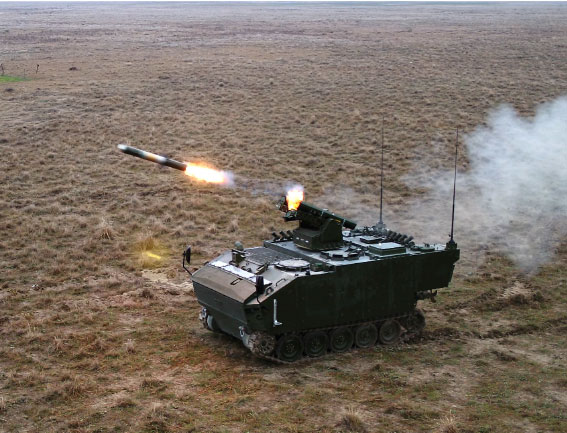
Within the scope of the ATV Project, the integration test of the OMTAS anti-tank missile developed by ROKETSAN onto the KAPLAN-10 ATV was verified by the firing test performed with the participation of the teams of the Presidency Defense Industries (SSB) and Land Forces Command in Karapınar, Konya on February 13, 2019. During the test on April 6, 2019, performed with the OMTAS missile launched from the Remote-Controlled Anti-Tank Turret integrated onto the KAPLAN-10 ATV, the firing test towards a moving target from a stationary vehicle was successfully performed.
The test-firing campaign of the KAPLAN ATV was successfully accomplished in December 2019.
The first two tracked KAPLAN ATV vehicles were eventually delivered to the Turkish Armed Forces (TAF) in the wake of a harsh test campaign on December 25, 2019. Up to date more than 180 Vehicles were delivered to Turkish Armed Forces..
On April 30, 2021, the Ministry of National Defense (MSB) announced via its social media account that under the project, 208 tracked KAPLAN-10 vehicles and 136 PARS 4x4 anti-tank vehicles will be procured. Accordingly, the number of KAPLAN-10 ATVs will increase from 184 to 208, and the number of PARS 4x4 ATVs will increase from 76 to 136. Consequently, the number of vehicles to be delivered under the ATV Project will increase from 260 to 344.
FNSS Anti-Tank Remote Controlled Turret (ARCT)
Working at an intense pace from the beginning of the ATV Program, FNSS managed to complete the design and prototype production phases of the ARCT within a very short period. Verification tests involving the long-range firing of the first anti-tank guided missile were performed in the 18th month of the project calendar. The tests also saw the firing tests of the coaxial machine gun with the platform both stationary and on the move.
Unlike the usual design approaches in which anti-tank missiles are integrated onto an existing remote-controlled weapon system (RCWS) as an add-on capability, the ARCT was designed from the onset as a dedicated ATGM turret. This particular feature has been instrumental in attaining a highly effective solution in terms of missile effectiveness and system survivability.
The FNSS Anti-Tank Remote Controlled Turret (ARCT) can be integrated on wheeled and tracked armored vehicles. It can be equipped with either KORNET-E or OMTAS ATGM missiles. With the two missile systems requiring very different integration approaches, the ARCT is able to meet this challenging requirement through a modular design that relies on a common base structure and modular subsystems for each type of missile. Owing to its design, the ARCT is ready from the very outset for integration with different missiles, which grants the users substantial flexibility.
Capable of performing a continuous 360 degree traverse with +-25 degree elevation axis, the ARCT is armed with two anti-tank guided missiles along with a 7.62 mm coaxial machine gun. By means of its digital fire control system, the turret can automatically perform all the necessary ballistic calculations for achieving the highest hit probability with both the missiles and coaxial machine gun. The gunner's sight system includes a new generation thermal imager, day TV camera, laser rangefinder, and missile guidance electronics, ensuring highly effective use of the turret in day, night, and under all weather conditions. The platform's secondary armament serves to enhance the turret's firepower and expands its mission range. Functions such as charging, firing, electrical extraction of empty MG cartridges can be carried out automatically from inside the vehicle. The turret is equipped with a digital electric gun turret drive system and a two-axis stabilization system to increase accuracy when firing on the move.
The gunner, using his control console inside the vehicle, can carry out surveillance, target detection, identification, and missile lock-on and guidance functions, all the while remaining under ballistic protection. In the event of an emergency, mission batteries and the smart power distribution system inside the turret enable the use of the turret's drive system, firing functions, and electro-optical systems independently of the vehicle's battery status for increased mission endurance.
Unlike conventional manned turrets, the ARCT lacks a basket structure and is installed above the vehicle's roof. This increases the vehicle's internal useable volume, while the ARCT's low silhouette and weight enable its integration into different types of armored vehicles.
KAPLAN-10 and Tactical Missile Launching System (TMLS)
The KAPLAN-10 can also be equipped with the ROKETSAN product Tactical Missile Launching System (TMLS), also knowns as the YALMAN Turret. Based on the Pedestal Mounted CIRIT Missile System, which was qualified in 2014, the TMLS was unveiled in August 2020 at the ceremony for the ROKETSAN Satellite Launch, Space Systems, and Advanced Technologies Research Center, and the Explosive Raw Material Production Facility.
The Tactical Missile Launching System (TMLS) is a stabilized turret system that can be used both while stationary and mobile due to its high mobility, its 360-degree rotation, and its ability to be controlled from inside the vehicle. The TMLS is an advanced weapon system that can launch four different types of missiles, including Laser and IIR-guided missiles, and allows precise target engagements at ranges of up to 8 km.
The TMLS can carry four UMTAS/L-UMTAS missiles or eight CIRIT missiles, or two UMTAS/L-UMTAS and four CIRIT Missiles. The system has high reconnaissance, surveillance, and target tracking capabilities and offers STANAG 3733-compliant autonomous laser marking, full HD IR, TV, and SWIR video with ISR (Intelligence, Surveillance, and Reconnaissance), and day/night operational capability, operator, and command console, and MILSTD-1760 compatibility. It is a weapon system that provides the user with a high level of control and firepower with onboard spare munition storage areas.
FNSS's KAPLAN-10 platform is preferred for the TMLS/YALMAN turret. Thanks to its stabilized turret, the Weapon System can shoot moving targets at speeds up to 40 km/h. The TMLS can also carry out reconnaissance and surveillance at a range of up to 20 kilometers with its high-tech electro-optical system.
On January 14, 2022, the Turkish Ministry of National Defense announced that acceptance tests were carried out successfully with the Tactical Missile Launching System, and it is expected to enter the inventory of the Turkish Armed Forces.
Conclusion
The recent conflicts in Syria, Nagorno-Karabakh as well as the Russo-Ukrainian War have clearly demonstrated the importance of long-range fire support capability. Especially in an asymmetrical battlefield like Syria, lightweight vehicles equipped with ATGMs can effectively serve as multipurpose infantry support platforms besides limited anti-tank purposes. In this context, the new KAPLAN-10 and PARS 4x4 Anti-Tank Vehicles will significantly increase the lethality of the Turkish Armed Forces in symmetric and asymmetric battlefield conditions with their superior mobility, advanced sensors, communication systems, and modern command and control capabilities