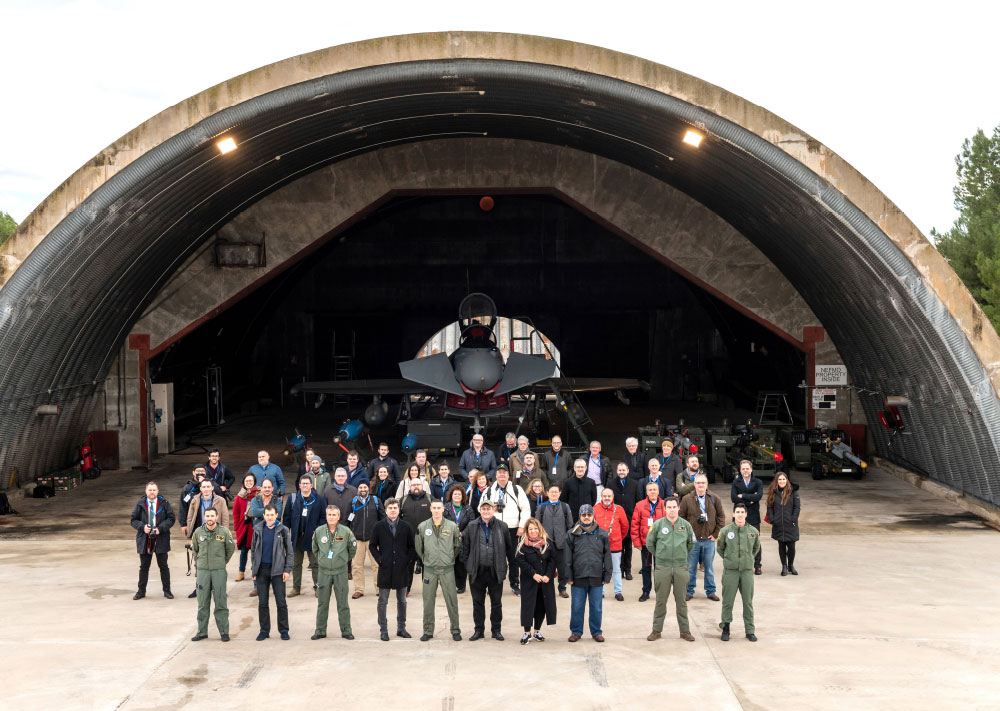
Preparing for the Future: Airbus Trade Media Briefing `22 in Spain
Airbus Helicopters Global Presence
Executive Vice President of Airbus Helicopters Programs, Matthieu LOUVOT, spoke about the global presence of Airbus Helicopters. Airbus' helicopter division is present in around 153 countries with 3,111 Operators. The company has a global network of 30 customer centers and affiliated sites with 20,126 employees worldwide. Each of these centers offers local solutions for the full range of Airbus helicopter services. Airbus Helicopters generated €6,509 billion in revenue in 2021, with a split of 56% in Military and 44% in Civilian sectors. Matthieu LOUVOT then shared information about the ongoing projects of Airbus Helicopters.
VSR700 Unmanned Reconnaissance Helicopter: Flight trials over the sea are currently underway in the south of France, with the VSR700 in its full ISTAR (Intelligence, surveillance, target acquisition, and reconnaissance) configuration. The VSR700's unique autonomous landing and take-off technology was demonstrated at sea in March 2022. Airbus signed an agreement with Korean Air in October 2022.
H135 Lightweight Helicopter: Morocco became the 12th military customer for the H135. Other users include the United Kingdom, Australia, Germany, and Japan. The H135 is equipped with Airbus Helicopters’ 'Helionix' avionics suite. The H135 offers optimal safety conditions for basic and advanced training missions.
H145M/UH-72 Lakota: The H145M is already in service in Hungary (20), Germany (15), Serbia (9), Thailand (5), and Luxembourg (2). The United States Army operates a fleet of more than 460 locally built civilian helicopters in the H145 family under the name UH-72 Lakota. The deliveries of the UH-72B are ongoing in the United States. Also, Cyprus ordered 6 H145M helicopters.
H160M Medium-lift Helicopter: France ordered 169 H160Ms as part of the light joint helicopter program. The first delivery is planned for 2027. The first civil H160 was delivered to a military customer in September 2022. The French Navy to start operations in 2023. The final assembly of the first H160 for the French Gendarmerie began during the summer.
H175M Super-medium Utility Helicopter: The H175M is Airbus Helicopters' solution for the super-medium market. The H175M is a powerful, fast, and agile asset with an unrivaled range and high-and-hot performance to cover the most demanding military missions.
H215M/H225M Multi-role Medium-heavy Helicopter: The combat-proven H215M/H225M is in service across the globe. H225M customers include France, Indonesia, Thailand, Malaysia, Singapore, Mexico, Brazil, Kuwait, Hungary, and the UAE. The first-ever naval combat H225M was delivered to the Brazilian Navy following Exocet firing in November 2021. The upcoming H-Force firing campaign aims to qualify guided rockets on the H225M.
NH90 Multi-role Helicopter: The NH90 has a maximum range of 982 km with internal tanks. It can carry a 4,200 kg payload and up to 23 passengers. France and Germany signed a new support contract in June 2022. The 500th NH90 is due to be delivered in the coming weeks. The NH90 NFHs (NATO Frigate Helicopter) from the Leonardo factory and TTHs (Tactical Transport Helicopter) from Marignane, Marseille have begun deliveries to Qatar.
Tiger MkIII Attack Helicopter: France and Spain launched the Tiger MkIII program in March 2022: 42 aircraft for France (with the possibility to add another 25 helicopters) and 18 for Spain. The first prototype is scheduled for an inaugural flight in 2025. The first delivery to the French Armament General Directorate (DGA) will take place in late 2029, followed by a first delivery to Spain in 2030. The MkIII is a comprehensive upgrade of all the combat systems, including sensors, weapons, communications, and avionics.
ENGRT (European Next-Generation Rotorcraft Technologies): In July 2022, the ENGRT project was selected in the frame of the European Defense Fund 2021 Calls for Proposals. Airbus Helicopters is the coordinator of the project, involving the European Commission, as well as Defense Authorities from Finland, France, Germany, Greece, Italy, the Netherlands, Spain, and Sweden. Twenty-four companies and research centers were involved.
Key streams:
Resilience & Survivability
NATO Interoperability & beyond
Mission versatility, low to high-intensity operations
Collaborative Combat & MUM-T
Affordability & Availability
NGRC (Next Generation Rotorcraft Capability): In June 2022, France, Germany, Greece, Italy, the Netherlands, and the UK committed to assigning €26.7 million to define the future of their helicopter fleets under the Next Generation Rotorcraft Capability project. The NATO Support and Procurement Agency (NSPA) will manage the concept phase of the project.
Airbus Combat Aircraft Systems Eurofighter Typhoon Update
Head of Combat Aircraft Systems, Andreas HAMMER, made a presentation about the Eurofighter Typhoon. Andreas HAMMER first outlined the operational capabilities of the global Eurofighter fleet. The Eurofighter Typhoon aircraft participated in Operation Rapid Pacific 2022 of the German Air Force with a large-scale deployment with 6 EFs. During the operation, the EF System Support Center was on duty 24/7, including embedded Airbus Field Service Representatives. HAMMER also noted pilot feedback from an Airbus Field Service Representative: "Very effective and helped significantly to keep our flight operations steady."
Eurofighter aircraft also was deployed to Romania and the Baltics to secure NATO's Eastern flank on short notice, with stable and high fleet utilization and a resilient supply chain supporting dedicated fast deployment packages.
Eurofighter Typhoon Program Highlights:
The global Eurofighter fleet passed 750,000 flying hours
Spain ordered 20 new Eurofighters with E-Scan radar at ILA Berlin 2022
Spanish Halcon program EFs are based on the German Quadriga EF standard
1st of 38 center fuselages produced for new German Quadriga EF
The upcoming capabilities expected for Eurofighter Typhoon aircraft include new avionics architecture, enhanced cockpit & connectivity, new sensors & weapons, and improved electronic warfare capabilities to enable operations well into the 2060s. Being the bridge to FCAS, the Eurofighter Typhoon will be an integral part of the "System of Systems" network.
Future Combat Air System (FCAS)
Head of the FCAS Program, Bruno FICHEFEUX, shared Airbus' vision for the Future Combat Air System (FCAS). The FCAS will consist of a Next-Generation Weapon System (NGWS) and other air assets in the future operational battlespace, with platforms operating as networked actionable nodes. New Generation Fighters (NGF) teaming with unmanned Remote Carriers as a force multiplier will form the NGWS. Integrating the unique capabilities of other platforms, the NGWS will be fully interoperable with allied forces, collaborating across domains. This unique capability will enable intelligent and operational networking as nodes through the Combat Cloud.
FCAS Development Journey: Joint Concept studies started in March 2019, just after the National Studies ended (Germany, Spain, and France). The Initial Demonstrator Phase began in 2020. This phase covers the Technology Demonstrator Roadmap with long lead time maturation expected to be completed in 2025. Under the Demonstrator Development, Airbus will design (Preliminary Design Review, Critical Design Review), build the New Generation Fighter/Remote Carriers demonstrators, and carry out further studies for Manned Unmanned Teaming & Combat Cloud architecture. The Flight Tests with the demonstrators are expected to begin in 2028/29. The Main Development Phase of the program will start in 2030 and continue until 2035, which is the planned date for the start of the Production Phase. The first New Generation Fighter/Remote Carriers are expected to enter service after 2040.
Expected Capabilities of Unmanned Remote Carriers:
Air launching multiple platforms to deliver Remote Carriers: Launching Remote Carriers from a New Generation Fighter is an envisioned option. For some operational contexts, the New Generation Fighter will be the best launch platform. However, a trade-off would need to be found between Remote Carriers & "classical" weapons. When not using the New Generation Fighter to air launch Remote Carriers, weapon loads, low observability, and endurance would be preserved. Launching from an A400M will bring combat mass closer to the fight with 40-50 Light Remote Carriers or 8-12 Heavy ones. Other platform types, such as Eurofighters & Wingman, can be considered.
Using light & heavy Remote Carriers to surprise, deceive, deter & saturate opponents: Beyond the tactical benefits, operational dimensions & associated trade-offs such as cost-per-effect reduction, risk mitigation for crews, tactical effectiveness, force readiness, and cross-generational interoperability will shape the customer needs.
Modular design for greater reuse between multiple variants: Modular Remote Carriers will enable achieving a high level of modularity with a Wingman. Based on a common fuselage, Remote Carriers can be employed for different roles, such as air-to-air, air-to-ground, and Electronic Attack (EA).
Airbus Military Air Systems
Head of Airbus Military Air Systems, Jean Brice DUMONT, shared information about Airbus' acclaimed A400M and A330 MRTT programs and future roadmaps.
With over 140,000 flight hours, the A400M is becoming the new European & NATO reference for heavy tactical and strategic airlift. 116 aircraft have been delivered to date from a total of 176 orders from 10 nations. The A400M is in service with Germany (41), the UK (21), France (20), Spain (13), Türkiye (10), Malaysia (4), Belgium (6), and Luxemburg (1, as of November 2022).
A400M Development Status: As a modern in-service, highly capable tactical and strategic transport, the development of the A400M still continues with Air-to-Air Refueling (AAR) A400M capability.
A400M is certified for low-level, day/night, and visual/instrumental AAR flights
Helicopter air-to-air refueling (HAAR) flight test campaign completed
Air delivery features near completion, such as automatic combat offload and very high-altitude airdrops (loads, paratroops)
Airbus is concentrating on potential new capabilities such as the Firefighter and UAV mothership. A feasibility/suitability for the Aerial Firefighter demonstration was completed in July 2022. Twenty tons of water was discharged in a single pass. Two Airbus drones were successfully launched as part of UAV mothership development. Excellent separation from the A400M, with the successful in-flight start of UAV engines.
A330MRTT Program Status: Airbus delivered the first A330 MRTT in December 2009 to the Royal Australian Air Force. Since then, a total of 66 A330 MRTTs have been ordered so far by Australia, France, NATO, Saudi Arabia, Singapore, South Korea, the United Arab Emirates, and the United Kingdom, and 54 of them have been delivered as of December 2022, achieving a combined total of more than 250,000 flight hours.
SMART MRTT and A3R have been certified during this year, 2022. The first SMART MRTT entered operation in the summer of 2022 with the first delivery for the Singapore Air Force. This sets a historic milestone for Airbus becoming the pioneer in introducing boom automation.
Three main pillars in the A330 MRTT evolution future roadmap:
Automation towards A4R, the next technological step after A3R, with a demonstrator being developed by Airbus' Upnext' (Auto'Mate)
Self-Protection Systems enhance situational awareness, and aircraft survivability adapted to any mission
Connectivity expanding to new roles and functions in the FCAS' future battlespace
Airbus Begins MRTT Conversion of 3 Former Iberian A330 Aircraft
Jean-Brice DUMONT, Head of Military Air Systems, also shared detail information about the conversion processes of the A330 MRTT, which Türkiye is also evaluating to replace its KC-135R Stratotanker aircraft. Jean-Brice DUMONT, Head of Military Air Systems, explained Airbus Defence and Space’s thoughts on secondhand aircraft for MRTT conversion. “For the second hand, it is a market at the starting for us. So, we worked with Spanish aircraft… and we started converting, it is just the beginning… We see the secondhand market, for the couple of years to come, as a quite promising market. Many customers are considering cheaper green aircraft for the overall cost-efficiency. They consider secondhand aircraft might not last forever, because for this you need an aircraft which is too old, and as they use A330s getting older, so it won’t last forever. We see customers, Spain as we speak and few others asking for secondhand which I think is a sort of parallel avenue to the main one we have with a new aircraft. Well at the end of the day, they converted here in Getafe. We just need a particular handover of a secondhand aircraft which is not a new aircraft with a bit of caution here…”
DUMONT also shared brief information about the world’s first 100% Sustainable Aviation Fuel (SAF) flight carried out with A330MRTT in November. “On the SAF (Sustainable Aviation Fuel) engine, we fly it, we do test flights. Well, if things went perfectly well that means you are not flight tested. So definitely, flight tests with %100 SAF gives you learnings… So what do we do, the answer can be first defined as maximum blend, %50 is the maximum blend of the civil engines. We try to demonstrate further. The other one is to defined potential design adaptations to ensure that %100 SAF flight can actually be qualified. We are not there; we have flown one flight. We have seen the consequences, we see what SAF can bring. There is nothing impossible here, it is about first max blend and then we will define our route for %100 SAF.”
In November 2021, the Spanish Ministry of Defense signed the formal order with ADS to acquire three Airbus A330 MRTT Aircraft equipped with a state-of-the-art hose & drogue refueling system and a specific MEDEVAC kit. Under the agreement, the three A330 aircraft, acquired from Iberia with a value of €148 Million, will be converted into military tanker transport at Getafe, Spain. The first aircraft will be delivered after 10 months; then the rest will be delivered in 9-month periods.
A330 Multi Role Tanker Transport (MRTT)
Developed based on Airbus' famous A330-200 wide-body passenger aircraft, the A330 MRTT Multi Role Tanker Transport has an overall length of 58.80 m, a height of 17.40 m, and a wingspan of 60.3 m. It has a maximum take-off weight (MTOW) of 233 tons and a maximum landing weight (MLW) of 182 tons. It has a maximum payload/cargo capacity of 45 tons and is powered by General Electric (GE) CF6-80E1A3 (320kN) or Rolls-Royce Trent 772B (316kN) engines. The A330 MRTT can carry 111 tons of fuel with the existing fuel tanks on the wings and tail. Thanks to this structural advantage, the A330 MRTT does not need any additional fuel tanks, and there is no need to modify the fuselage. The A330 MRTT can carry up to 45 tons of extra cargo in the cabin. The A330 MRTT can offload 64 tons of fuel to a receiver aircraft during a 5-hour loitering mission at over 500 nm from its take-off point.
During the MRTT conversion process, each A330-200 aircraft is installed with some 16,000 types of new components and approximately 450 new electrical wiring and harness (for a total cabling length of more than 50 km), as well as 6,000 brackets and 1,700 connectors.
In November 2022, The Royal Air Force (RAF), Airbus, and other industry partners carried out the world’s first 100% Sustainable Aviation Fuel (SAF) flight using an in-service military aircraft on both engines, paving the way for a range of possibilities for the future of flying military aircraft. The flight was a joint endeavor between the RAF, aircraft manufacturer Airbus, the UK Ministry of Defence’s Defence Equipment and Support agency, British aircraft leasing company AirTanker and engine manufacturer Rolls-Royce, with the fuel supplied by Air bp.
Potential Candidate to Replace TurAF's Aging Tanker Fleet
The Turkish Air Force (TurAF) is also expected to replace its veteran KC-135R Stratotankers with the new generation A330 Multi Role Tanker Transport (MRTT) Aircraft from Airbus Defence & Space in the coming years. The A330 MRTT was one of two candidates evaluated as part of the TurAF’s need for a New Generation Tanker Aircraft. In this context, the 2nd AMFD/FASBAT Directorate wants to carry out both kit production and structural modification/modernization for the A330 MRTT Aircraft that the TurAF is expected to procure in the near future. If the A330 MRTT Project is finalized, it is planned to build a new hangar for this plane within the 2nd AMFD.
It is said that the Turkish Technic Company, which provides maintenance and repair services to the A330-200 aircraft, including their avionic systems, may also take part in the structural transformation studies. Airbus Defence & Space Company will provide the necessary technical and know-how support for the preliminary preparation, and structural transformation works to be carried out on aircraft. The subsystems to be integrated into the plane under the MRTT transformation works will also be procured from ADS. If the project is implemented, the MRTT conversion work of A330-200 aircraft will be carried out in Turkey for the first time after the UK. As may be remembered, the transformation process of the first 2 FSTA Voyager Tanker/Transport Aircraft under the Royal Air Force (RAF) Future Strategic Tanker Aircraft (FSTA) Program (14 aircraft in total) was carried out in Getafe, Spain, in 2009 and 2010; while the 3rd and 4th planes were converted at Cobham Aviation Services' facilities in Bournemouth, England. However, due to the delay in the process and the RAF's decommissioning of the venerable VC-10 and Tristar tanker aircraft in 2013, it was decided to transform the other 10 A330-200 aircraft also in Getafe. Last year, it was claimed that 7 second-hand A330 aircraft would be purchased from Turkish Airlines (THY) and converted to MRTT, but there has been no official development in this regard yet.
During SAHA EXPO 2022 Defence & Aerospace Exhibition, Airbus Defence and Space (ADS) Vice President & Head of Sales Southern Europe and Israel, Bruno LAMARQUE, shared information about the current status of A330 MRTT discussions with Türkiye. "We are still hoping. We submitted a proposal and had discussions, but for the moment, there is no progress made, and we are waiting. We believe this aircraft is the perfect aircraft for the Turkish Air force. However, we are waiting for the Turkish Ministry of Defence to come back to us so we can continue the discussion which started one year ago





