RAF Pilots “Eye View” from the HAWK Jet Trainer Aircraft
Defence Turkey : BAE Systems has a big presence at ILA Berlin with the RAF’s Hawk T2 advanced jet trainer and its Pilots. Could you please inform us about the show and your activities?
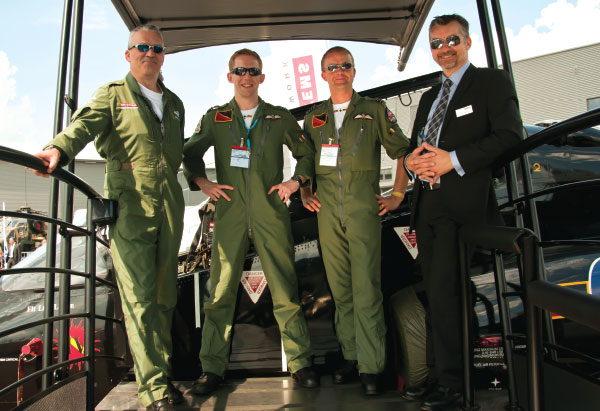
Mr. Steve Harris – Business Development Executive, Turkey : BAE Systems is proud to be a part of the ILA Berlin Air Show and especially so this year given the very clear links and emphasis on the Turkish Aviation Industry. Turkey is a country that we are closely aligned with and we have a keen interest in the air-sector opportunities. We had a significant outdoor display this year including our trailer-mounted displays demonstrating the benefits of the Hawk Synthetic Training Systems and Mission Data Replay; plus some systems that underpin our continual drive for improvement. These include integrating the Link 16 system, and two optical devices for pilot use; Striker, a Fast-Jet or Rotary Visor Projected Helmet Mounted Display and our Q-Sight monocular helmet mounted display.
We were also delighted to be associated with three presentations at the 6th Future Military Pilot Training Conference. Air Commodore Terry Jones MA RAF (UK Director Flying Training) and Wing Commander Dan Beard, (Officer Commanding IV(R) Squadron RAF) briefed on Advanced Jet Training and the subject of “download” while Andy Blythe, (Hawk Test Pilot, BAE Systems) gave his views on pilot training for next-generation aircraft. Finally, Gareth Roberts, (BAE Systems, Head of Training at RAF Valley) presented on the key tenets and requirements for next-generation lead-in-fighter-trainers.
Defence Turkey : I understand you are an instructor at RAF Valley using the Hawk for advanced pilot training. How well does this aircraft fit into the training system and how is it received by your students?
Flt Lt Al Luckins RAF – Instructor Pilot : The Hawk T2 allows us explore concepts and skill sets that hitherto have been unavailable to the students until the front line aircraft, principally through the use of the on-board synthetic training systems. As a result, the course pushes the students’ abilities in disciplines that have a direct read-across to front line training. The data interpretation and management very closely represents the Eurofighter Typhoon’s and so provides a realistic test of a student under representative conditions. The tangible link to front line flying is something that students really enjoy, providing a previously unparalleled realism to all the missions flown on the course. The ability to for the students to look back at their missions and replay them step by step in their own time is also very popular, enhancing the learning experience considerably.
Defence Turkey : You presently use the Hawk to train your students for conversion to Eurofighter Typhoon. How will the RAF approach the advanced standard training for F-35?
Flt Lt John (Dot) Letton RAF – Instructor Pilot : The RAF is currently examining how best to train for the F-35 and the leap in capabilities it brings. However, when analysing the training requirements, there isn’t as big a gap between our current fighter (EF Typhoon) and the F-35 as may be imagined. The overall skills of data management and tactical situational awareness that the T2 has introduced to the current RAF training system apply well to the F-35. Enhancements in the form of software changes to augment the training value could easily and cheaply be introduced to further align the T2 to the F-35 training need.
Defence Turkey : The Hawk family of aircraft have a long provenance. What is it about the new generation of Hawk that seems to make the customer so happy with the aircraft and training systems? How much reliance is now placed on the use of simulators with this aircraft when training students?
Sqn Ldr (Rtd) Gareth Roberts - Head of Training, Hawk UK : The Hawk is a well-proven and trusted training platform both in terms of capability and flying performance. Enhancing such a platform with embedded simulation, modern avionics and navigational and safety systems has now expanded training capability into a completely new and exciting era. This huge jump in capability is already being exploited by several Air Forces to better train and prepare their pilots for the challenges of 4th and 5th generation fighters, by providing skills that are both relevant and transferable.
The complexity and capability of the Hawk’s systems, and the information and systems management skills that the trainee pilot now must learn has significantly elevated the importance of simulator training. The simulator, as a training device, must now be regarded as equally important as the aircraft in a modern training system, as skills learned on the ground in the synthetic environment are fundamental to a trainee’s development and success in the air.
Defence Turkey : You have been the BAE Systems Hawk test pilot for many years now and will have seen a large number of nations use this platform in their training pipeline. What is it that makes Hawk so accomplished as a training platform? Can you give me idea as to how the Hawk aircraft is to be developed further – what is next for this platform? Hawk is in use with many customers worldwide; are there examples of this system being used via a collaborative approach with another company or nation?
Mr. Andy Blythe – BAE Systems Test Pilot (late RAF) : The Hawk is a very simple plane to fly and operate but it needs considerable ability to maximise its potential therefore it is an excellent tool for developing future fast jet pilots. It can easily emulate 90% of the traditional 4th generation flight envelope for a fraction of their operating cost. 500Kts at low level is the equivalent to 845ft/sec which is more than enough speed to assess whether a student pilot is going to be suitable for the front line.
There are many developments being considered. Sensor simulation will continue to be developed to ensure the aircraft continues to emulate the current weapons and sensors that operate in frontline fighters. As technology moves on, especially in screen technology, I am sure Hawk will change to large area touch screen displays with embedded processors. Also, as most Air Forces are struggling with budgetary constraints, aircraft are less likely to have just one role and to that end, I am sure work will be done to integrate a targeting Pod and the latest crop of smart weapons on to the Hawk.
BAE Systems has a history of collaboration spanning over 35 years of Hawk projects working very closely with all of our customers either here in the UK or the customers` country. Recent examples include a collaborative approach and technology offset with the South African Air Force for their latest weapons and multi data-link and with our biggest Hawk user, the Indian Air Force and Navy. Indian Industry (Hindustan Aviation Limited) builds the Hawk Mk 127 aircraft under licence and have been closely involved with the recent aircraft upgrades. We have also collaborated with HAL on many projects such as Jaguar and Sea Harrier.
Defence Turkey: What is the current status of BAE Systems activity in the Turkish air-sector?
Mr. Steve Harris : BAE Systems is a forward-looking company and is seeking to build on its relationship with Turkey. We continue to work with the SSM and Turkish air-sector primes to position BAE Systems as a partner or supplier of choice for future air-sector programmes. We have a significant interest in the T-FX programme and look forward to the opportunity to respond to the RFP for the provision of engineering/technical support to the Development Phase of this programme. Equally, we see opportunity to be a part of the TX project/T-38 replacement programme as it matures and with the Hawk platform, have a great product that could be considered as the basis for a collaborative solution, should this required. In addition, our USA-based business continues to provide support to the Turkish air-sector with the supply of electronic system components and products for the F-16 aircraft while also developing prospects to be a part of the supply chain for Hürkuş.