RAMSYS Displayed RAM Block II Missile at IDEF 2025: ADA Class Corvettes Being Upgraded with RAM Block II G/M

RAM-System GmbH (RAMSYS), the joint venture responsible for program management and marketing of the RAM (Rolling Airframe Missile) naval self-defence missile system in Europe, showcased the RIM-116C RAM Block II Missile at the 17th edition of the International Defence Industry Fair (IDEF 2025). In partnership with Raytheon Missile Systems (RMS), RAMSYS jointly handles the development, production, system improvements, logistics, and global marketing and sales of the RAM ship self-defence weapon system.
A RAMSYS official told Defence Turkey Magazine that the company had completed the delivery of any number of RIM-116C RAM Block II Missiles for the Turkish Naval Forces (TNF) in April 2025. To utilize the missiles’ full potential, RAMSYS plans to carry out a software upgrade on the ADA Class Corvettes. When asked whether the upgrade had begun, the official stated (as of July 24, 2025) that it had not. “We just need to arrange the timing with the fleet, so the ships are available. We will send out a team and complete the upgrade. We had discussions yesterday with the ordnance procurement agency, and a few administrative matters remain. But from my perspective, this should be resolved by the end of August. Then we can perform the upgrade, and the ADA Classes will be state-of-the-art,” the official said.
Regarding the upgrade, the RAMSYS representative explained:
“To upgrade the existing system to the Block II version, modifications are required for both the launcher and the Combat Management System (CMS). Until these modifications are completed, Block II missiles cannot be used. The software portion of the CMS is a minor fix, but the major change involves the launcher system. Previously, the power was artificially reduced and transferred to the LSMU (Launcher System Management Unit), the brain beneath the launcher. For the new system, total power is fully guided, allowing up to four missiles to be fired simultaneously, eliminating delays when engaging multiple targets (a straight attack with 10 or 12 missiles involved). This significantly increases firepower and enables consecutive missile launches without interruption.”
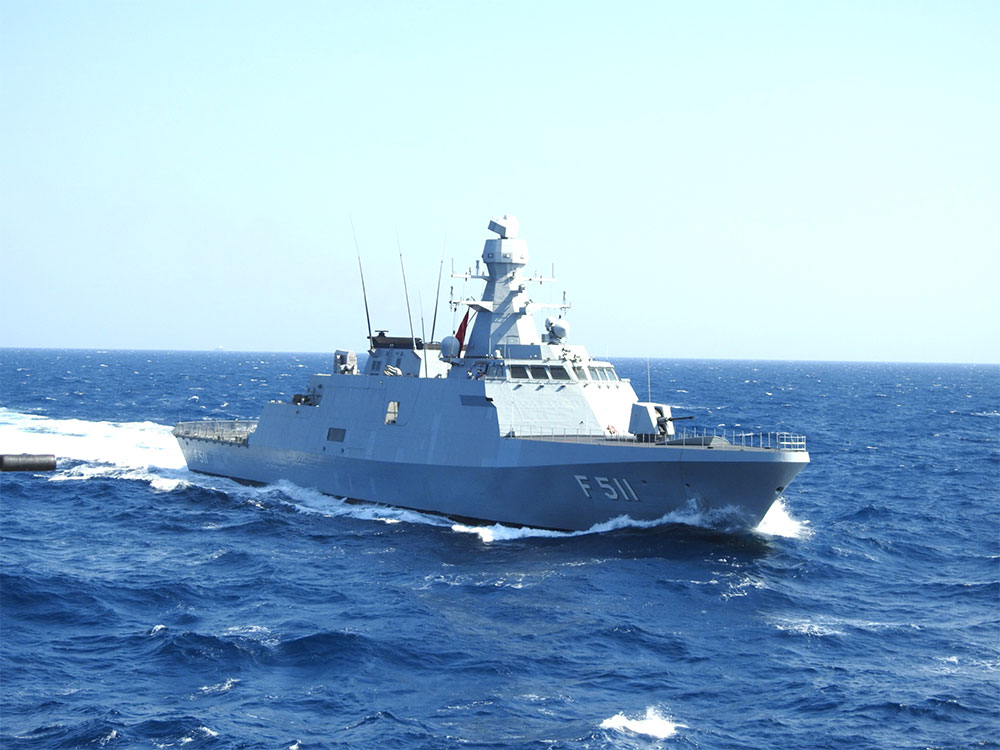
Following IDEF 2025, RAMSYS reportedly initiated the RAM Block II upgrade on the ADA Class Corvettes, with the first modification performed on TCG Heybeliada (F-511). During the Romanian Navy Day 2025 event on August 15, 2025, attended by TCG Heybeliada and TCG Oruçreis, it was observed that the 21-cell Mk49 Mod 3 Guided Missile Launcher System (GMLS) on board was fully loaded. Previously, ADA Class Corvettes could only carry 6 to 9 RIM-116B-1 (Block IA HAS) guided missiles on missions due to limited missile stocks.
Background: RIM-116 RAM Missile in TNF Service
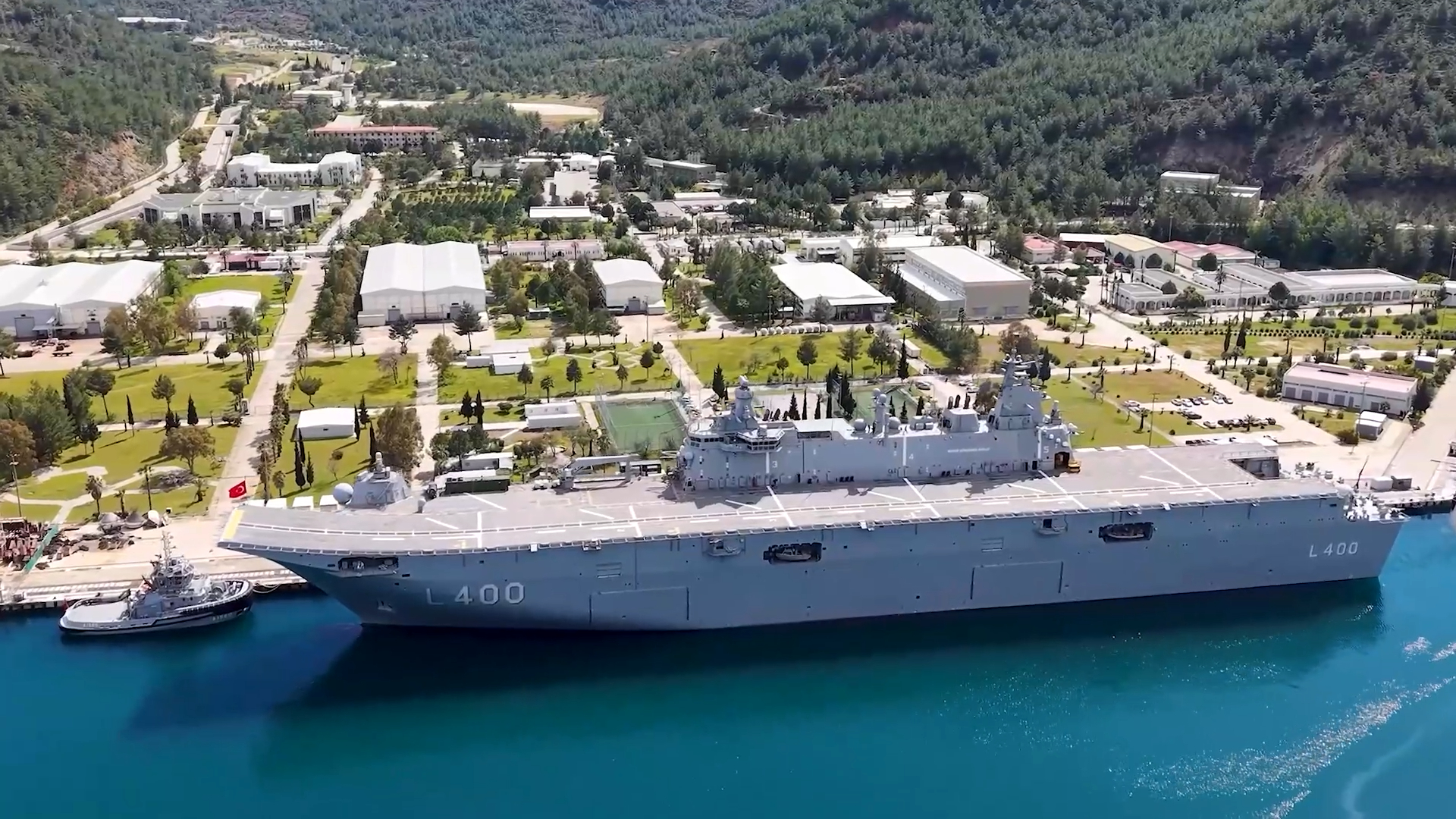
Under the MİLGEM Project, the four ADA Class Corvettes were equipped with the Mk49 Mod 3 GMLS procured from Germany’s RAMSYS GmbH. A €10 Million contract awarded on December 31, 2007, covered the procurement of one 21-cell Mk49 Mod 3 GMLS and electronic sub-systems for integration into TCG Heybeliada. With this acquisition, the Turkish Naval Forces became the seventh operator of the RAM system, after Germany, the U.S., South Korea, Greece, Egypt, and the UAE.
A subsequent €18.4 Million contract signed on December 19, 2008, supplied 25 RIM-116B-1 Block IA/HAS missiles for TCG Heybeliada. RAMSYS also delivered 25 additional missiles for TCG Büyükada under a €17.6 Million contract on July 20, 2011.
The first live RAM missile firing by the Turkish Navy took place from TCG Heybeliada on April 10, 2012. Additional firings occurred during the BARBAROS Turkish Naval Task Group 2014 (TDGG-2014) deployment at South Africa’s Denel Overberg Test Range on May 13–14, 2014. During these trials, TCG Heybeliada conducted multiple RAM firings, while TCG Oruç Reis and TCG Gediz Frigates launched Sea Sparrow and ESSM (RIM-162B) missiles, respectively. At least six RIM-116B-1 Block IA/HAS firings have been recorded, all successfully destroying their targets and establishing the RAM Mk31 GMWS as one of the Turkish Navy’s most accurate and reliable air defence systems.
The last two ADA Class Corvettes, TCG Burgazada and TCG Kınalıada, were intended to be armed with RAM Block II missiles. Negotiations with RAMSYS and Raytheon via the FMS channel took place in 2017–2018, but contracts were delayed. Consequently, TCG Burgazada (F-513), commissioned on November 4, 2018, and TCG Kınalıada (F-514), commissioned on September 29, 2019, entered service with limited stocks of RIM-116B-1 Block IA/HAS missiles.
Due to German export license restrictions, Türkiye procured RAM Block II missiles through Raytheon. On May 10, 2018, Raytheon announced a US$242.1 Million contract with the U.S. Navy to provide RAM Block II missiles to Qatar, Egypt, and Türkiye, with potential options raising the total to US$529.8 Million. After a long procurement process, a U.S. House of Representatives Foreign Affairs Committee report on August 16, 2024, confirmed the U.S. Government approved the sale of 94 RIM-116 Block II (RAM Mk44 Mod 4) guided missiles to the Turkish Naval Forces, including 3 telemetry-equipped Mk47 Mod 9 missiles and 1 detonation test vehicle, valued at approximately US$90 Million.
The procurement of RAM Block II missiles was initially stalled due to CAATSA sanctions and an informal U.S. congressional embargo. As a response, Türkiye pursued indigenous CIWS alternatives, including ASELSAN’s GÖKSUR (featuring TÜBİTAK SAGE’s BOZDOĞAN-DH IIR-guided missile) and ROKETSAN’s LEVENT-I/II (based on the SUNGUR MANPADS platform). Newer TNF naval platforms are expected to feature these indigenous CIWS solutions.
RAM Block II Missiles
Stabilized by rolling through the air, the RIM-116C RAM Block II is designed to counter evolving anti-ship cruise missile threats and perform effectively against complex stream raid scenarios. Slightly larger and heavier than the Block I, it fits within the existing Mk49 GMLS without modifications to the launcher platform. A software update to the ship’s CMS is required for full integration, allowing the system to recognize the Block II missile’s sensor suite and interact with it properly.
Specifications:
RIM-116B (Block I) / B-1 (Block IA HAS): Length 2.819 m, diameter 127 mm, weight 73.4 kg (11.3 kg warhead), speed > Mach 2, max range 5.1 nm.
RIM-116C (Block II): Length 2.88 m, diameter 159 mm, weight 91 kg, max speed Mach 2.8 at sea level, max range 7.5 nm, acceleration +60G.
The RAM Block II improves performance against supersonic anti-ship missiles, including BrahMos, and allows for rapid consecutive firing, significantly enhancing shipboard air defence capabilities