Revolutionary Weapon Testing and Training Instrumentation
Trident Research has designed, developed, and sustained advanced instrumentation systems for the
U.S. military since its founding in 2001. In the area of acoustic-based weapon testing and training products, Trident’s systems are unsurpassed in performance and affordability. Highly portable distributed sensors provide accurate location of any detonating or impacting direct or indirect fire munition – on land or at sea. And unlike shock wave acoustic systems where functionality and performance are determined by how close a supersonic munition passes the sensor, Trident’s technology creates an invisible 2D or 3D region where any direct or indirect fire munition event can be located and/or scored.
Acoustic-Based Weapon Testing and Training
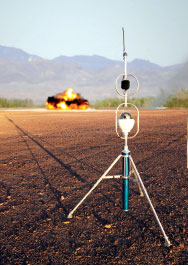
Trident has perfected acoustic-based technologies to serve as a cost-effective and more accurate, reliable, flexible, and simpler means of weapon testing and training. The key is precise timing. The evolution of digital Global Positioning System (GPS) technology has produced miniature GPS receivers capable of cm-level positioning and nanosecond level timing. This provides Trident’s distributed sensors with an accurate and common time and position reference. When a munition detonates in the vicinity of one of the sensors, the impulsive acoustic energy that is released is identified and stamped with a GPS time mark that is accurate to 25 microseconds. The positions and times from each sensor in hearing range of the detonation are radioed to a central location and combined to triangulate the location of the detonation.
Trident’s audio sensors have approximately 100 dB of dynamic range. This means each sensor can accurately capture full signature details with precise timing from a faint detonation from as far away as 6 km, or from a large explosion from as close as 500 m. This level of sensitivity means even inert rounds striking the earth or water may be positioned, as long as the amount of acoustic energy released can be heard by several sensors. If known targeted coordinates are entered, then miss distance or “score” information is displayed to the operator.
The omnidirectional nature of acoustic based localization also means a direct strike into the center of the target area is not necessary. If the artillery round or aircraft released bomb lands outside the test area, it can still be located and reported in near realtime, unlike with optics and radar systems, which must have a clear line-of-sight (LOS) to the object to determine location. This also makes acoustics more applicable for training and testing areas in rough terrain and heavy foliage.
Application and Benefits
Suitable for land or naval gunnery training, forward observer or spotter assessment and training, and weapon testing, Trident’s technology has been deployed for all types of platforms, from crew sized mortars and artillery to rotary and fixed wing aircraft. Trident’s technology can also support multiple direct and indirect fire shooters and targets in a single instrumented range, making it highly affordable for complex training scenarios.
“Train as You Fight, Fight as You Train”
Trident’s acoustic technology is ideally suited to provide munition detonation and inert impact scoring for combat units. Simple single person deployment and realtime automated result displays provide near instantaneous results for in field training. If you can hear it, you can score it. Visual inspection and battery charging are all that’s required to prepare and deploy a highly accurate scoring network in any operational or forward training area. Real time quantifiable results provide an accurate assessment of detonation location or miss distance for training gun crews and support personnel under real world combat conditions.
Tactical Realism
The highly portable sensors can be placed in any topological environment and in desert, arctic, or tropical conditions. Trident’s acoustic sensor technology can also be utilized in the presence of smoke, dust and debris, environments that are challenging for optics or radar-based technologies. Further, Trident’s technology does not require pointing or tracking of objects or explosive events to produce an accurate localization, every firing platform and targeted object can be scored in near realtime, providing quantitative time and position data for every player on the complex training battlefield.
All Weather
Using precision acoustics with sophisticated signal processing, Trident’s technology can localize a munition detonation or impact event in any weather condition, day or night, rain or fog. And unlike radar and optics based technologies, Trident’s acoustic technology is not hampered by moisture or ground reflection, making it ideally suited for real world combat conditions.
Simple to Operate
Trident’s remote sensors are light weight, self-surveying, have an onboard digital compass for orientation, and communicate in an ad-hoc radio network configuration, so the operator simply needs to activate the sensor and place in a desired location. No calibration, surveying, pointing, or precise placement is required. A 10 square kilometer test or training area can be established by vehicle or vessel in 3 hours (land) by a crew of two people or less than 1 hour (sea).
Automated Display Results
Real time communications between the distributed sensors and the central processing unit notifies the operator of status and condition of the training or test area. Single detonation or inert impact events separated by more than one second are automatically scored and displayed in five seconds. For multi- round munition scoring, such as for dispensed munitions, 30 mm cannon, small rocket firing, or multiple firing platforms, each detonation is automatically scored in minutes. Results are distributed via Keyhole Markup Language (KML) in any standard or custom coordinate frame and viewable in Google Earth™ or your custom or proprietary digital mapping system.
Accurate
For single round munition scoring, real time signal processing provides automated +/- 1-2 meter accurate results in seconds and post-mission data processing and analysis tools can provide sub-meter accurate results in minutes. For multi-round munition scoring, such as for dispensed munitions or multiple firing platforms, these same accuracies are achievable by adding the High Speed GPU Module to the command and control system.
Affordable
Complete turn-key systems suitable for 8 square kilometer land or sea ranges can be provided for under
$900,000 USD. Training or testing areas up to 50 square kilometers can be accommodated with additional remote sensors and portable communication repeaters. For weapon testers, advanced Mission Planning and Post-Mission Processing software suites are available to plan and extract sub- meter accurate results in minutes.
Adaptable
Trident Research scientists and engineers have over 20 years of experience designing, developing, fielding, and sustaining specialized, one-of-a-kind military test instrumentation systems. With a proven systems engineering process based on U.S. DOD guidance and a quality system fully compliant with ISO 9001:2008 standards, Trident can augment or adapt the acoustic technology-based system to any land or sea range, platform, or communications environment.
A summary table of benefits over manual spotters and optics and radar technologies are provided in the tables below.
In use by the U.S. military since 2009, Tridents’ acoustic technology is the most accurate automated scoring capability in the world.
ITAR Certified
Export of Trident’s acoustic technology requires licensing by the U.S. Government per the Arms Export Control Act, including the International Traffic in Arms Regulation (ITAR) and the Export Administration Regulation (EAR). Export can only be provided to authorized foreign government agencies through direct or Foreign Military Sales (FMS).