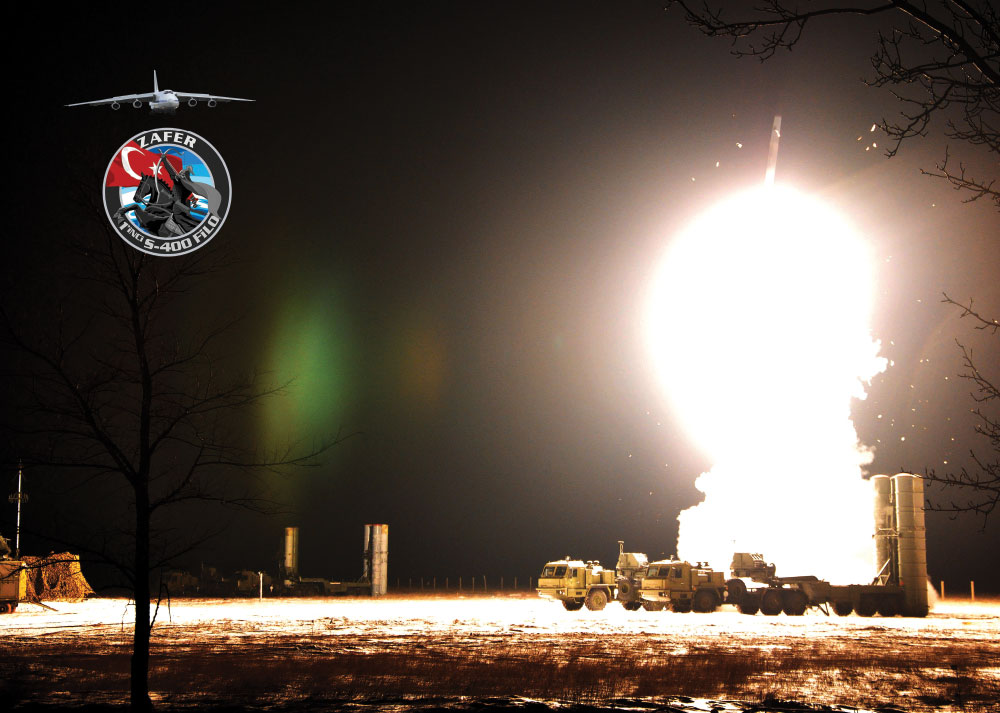
S-400 Triumph Air and Missile Defence System and Turkey’s Air and Missile Defence Capability
The main air and missile defence capabilities of the Turkish Air Force (TurAF) are currently composed of over 30 fixed and transportable 3D air surveillance radar sensors that provide a real-time air picture of Turkey’s Airspace. They are deployed under the Air Control Group Command, 7 Control Warning Centers/Posts (KIM/KIP), 4 E-7T Airborne Early Warning and Control (AEW&C) aircraft serving under Airborne Warning Control Group Command and accepted as force multiplier, ground based air defence missile systems (MIM-14 Nike Hercules Missile Systems operating under four active Nike Hercules Squadron Commands and four HAWK XXI System Batteries) under the 15th Missile Base Command and Tactical Data Link Systems that provide the command and control between such systems. Currently, the TurAF - which does not have a new generation long-range air and missile defence system capable of intercepting ballistic missiles, is one of the few countries in the world and the only member of NATO meeting its air defence requirements with the F-16 Fighting Falcon fighters.
As part of the announcement dated November 17, 2015 made by the Turkish Ministry of National Defence (MoND) on the cancellation of the T-LoRAMiDS Project, it was underlined that activities for fulfilling the related demands with national resources would be continued. To this end, in 2016, the Presidency of Defence Industries (SSB) launched the Indigenous Long-Range Air Defence System (GUMS/HİSAR-U) Project later named as SİPER. The contract regarding the SİPER Project was signed by an Aselsan, Roketsan and TÜBİTAK SAGE Partnership on January 15, 2018 and within the scope of the Project, being executed with national facilities, Aselsan is responsible for the development of the Long-Range Search Radar, Multi-Functional Fire Control Radar and Radar (RF) Seeker. The system design specifications of the Project were completed in 2018 and the activities on System and Sub-System Design are being executed. With a range over 100km, the SİPER Missile is planned to function against only air breathing targets in the first stage, but Anti-Ballistic Missile capability is expected to be gained during the second stage. The first delivery as part of the Project is aimed to be conducted at the end of 2021. Within the scope of the Long-Range Air and Missile Defence System Project, being executed by Aselsan-Roketsan-EuroSam in parallel with the SİPER/GUMS Project, the Contract on the ‘Concept Identification’ Project with a schedule of 18 months was signed on January 5, 2018. In line with the contract, the related ongoing system concept identification study is planned to be completed by October/November 2019. In the press bulletin published on July 19, 2017 by the EuroSam Consortium, it was stressed that the Long Range Air and Missile Defence System would be built based on the technologies and expertise acquired by EuroSam’s ASTER Missile Family in land and naval systems in a period of 25 years and with an investment of EUR 11 Billion. Based on the aforementioned statement, it could be assessed that a naval version (for TF-2000 AWDs) of the Long-Range Air and Missile Defence System will be developed as well.
While the activities towards the SİPER/GUMS and the Long Range Air and Missile Defence System Projects continued, the SAMP/T, Patriot PAC-3 and MEADS Systems came up on the agenda to fulfil urgent requirements and bilateral negotiations were accomplished in various circles in Turkey and abroad by the manufacturer companies and officials of the SSB/MSB. In respect of the urgent requirements, the negotiations on the 4th Generation S-400 Triumph (SA-21 Growler) Air and Missile Defence System was launched with Russia as of October 2016 and the public was informed with the signing of the agreement in April 2017 and the accomplishment of the advance payment in September 2017. The US$2,5 Billion deal covers the purchase of two S-400 Triumph Systems with four Batteries. Instead of U.S. Dollars, Turkey borrowed the loan in the Russian currency (Rubles). Turkey finalized a credit deal with Russia to purchase the S-400 Triumph Air and Missile Defence Systems. The credit deal was signed by Ankara on December 29, 2017. According to President ERDOĞAN, with purchasing on ruble, Turkey will save up to 3% of the total debt. In April 2018 following the ERDOĞAN and PUTIN meeting in Ankara, Turkey, the delivery of the S-400 Batteries had been brought forward from the first quarter of 2020 to July 2019.
TurAF’s First S-400 Triumph Squadron ZAFER (Triumph) Will Be Fully Operational by April 2020!
The Republic of Turkey’s Ministry of National Defence announced via its official Twitter account on July 12, 2019 that the transfer of the first batch of equipment for the S-400 Triumph Long Range Air and Missile Defence System procured in accordance with the contract signed on April 11, 2017 for fulfilling Turkey’s air and missile defence requirements, was initiated on July 12, 2019 at the Mürted Airfield Command in Ankara. Deliveries of the vehicles and equipment of the Turkish Air Force (TurAF)’s 1st S-400 Battery to be operated under Mürted Airfield based 1st S-400 Squadron, dubbed ZAFER (Triumph) continued until July 25, 2019. During July 12-25 a total of 30 flights were carried out from Russia to Mürted Airfield Command by An-124/100s and IL-76TD EMERCOM transport aircraft to deliver components of the TurAF’s. 1st S-400 Battery. The 22T6-2/22T6E2 Transloader (Missile Loader) based on Ural 532361-1012 tactical vehicle chassis, the Polyana D4M1 Mobile Command Control System, the 40V6M Universal Mobile Mast with MAZ-79100 tractor (it elevates the 92N6E and 96L6E radar antennas to the heights of 24m in order to increase the detection performance of the radar, as the world is round, however according to open sources for the S-400 Triumph and S-500 Prometheus Russia developed a revised mast design dubbed 40V6MT to replace the legacy 40V6M/MD series. It appears to be an entirely new design with a different outrigger arrangement, and revised elevating mechanism. It is towed by a BAZ-6403.01 tractor), 91N6E Big Bird Target Acquisition and Combat Management Radar, 92N6E Grave Stone Engagement and Fire Control Radar, 96L6E Surveillance and Tracking Radar, missile canisters and the 5P85TE3 Launchers based on BAZ-64022 tactical vehicle chassis were among the vehicles carried. The 5P85TE3 Transporter Erector Launcher (TEL) with the full-load weight of 41,5 tons is being utilized in the transport and launching of the 48N6E3, 48N6E2 and 48N6E missiles each with a 250km range and 2.6 ton weight (including the canister) and the 40N6E missile could be loaded over this TEL as well. The 40N6E missiles with a 400km range are generally carried over the 51P6E Launcher. About 20 TurAF personnel trained in the Russian Federation in May and June 2019, also take part the acceptance of the equipment and components for the 1st S-400 Battery. Soon after the acceptance certificate is signed, the 1st S-400 Battery will become the property of Turkey and at the same time, the warranty provided by the contract for the S-400 Triumph System by the Russian side will begin to operate within a year and a half.
The emblem of the TurAF’s 1st S-400 Squadron, dubbed ZAFER (Triumph), was publicized on July 22, 2019. The badge, crafted by Turkish graphic designer Ömer ERKMEN, features a Seljuk Empire horseman shooting a bow and arrow. Turkey’s national flag is seen waving in the background of the emblem, which the artist says was inspired by the legacy of the ancient TurksThedelivery of the 2nd S-400 Battery to be operated under the Mürted Airfield based 1st S-400 Squadron, dubbed ZAFER (Triumph) has been launched on August 27, 2019 and expected to last several weeks. The Russian Defence Ministry’s transport planes will make several dozen flights during the second phase of the delivery of air Defence missile systems S-400 to Turkey, the Director of the Federal Service for Military-Technical Cooperation, Dmitry SHUGAYEV, told the media on the sidelines of the 14th International Aerospace Show MAKS 2019. According to SHUGAYEV several dozen flights will be carried out by Defence Minsitry planes to deliver TurAF’s 2nd S-400 Battery components to Turkey. Furthermore, delivery of the third party that contains over 120 missiles (a total of 64 missiles are required to load 16 launchers to be operated by the 1st S-400 Squadron) in various types will be transferred to Derince Port in Turkey from the Russian Federation by sea. The deliveries regarding the TurAF’s 1st S-400 Triumph System/Squadron are planned to be completed in November 2019 and the Initial Operation Capability (IOC) with the 1st S-400 Triumph System/Squadron is expected to be declared by the end of the year. Meanwhile, the 5-month long training of the nearly 100 TurAF staff who went to the Russian Federation started at the end of May in St. Petersburg is expected to be completed in October. In his statement to the Anatolian Agency dated July 12, 2019, Turkish MoND Hulusi AKAR said, “In parallel to our planned activities regarding S-400, the training of our staff in terms of both installation and operation continue in Turkey and Russia”.
On July 14, 2019 while talking to a group of journalists at Vahdettin Mansion in Istanbul, President ERDOĞAN underlined that the establishment and full deployment of the 1st S-400 Squadron will be completed by April 2020 and the System will become fully operational in the same month. “The emerging picture suggests that Turkey’s procurement of the S-400 air defence system is completely for peace keeping purposes in Turkey’s own land and within the region. By procuring the S-400s, we are not getting ready for a war; instead we are trying to maintain the peace and our own national security. The aim of all our other attempts towards developing our defence industry is the same as well. The full process of the S-400 air defence system will be completed by April 2020. I hope some part of the installation of the S-400 will be completed by the end of the year, and everything will be fully completed by April 2020. And after that, we will continue to follow our path with greater confidence… the full control of the S-400s belongs to us. Our Armed Forces will be fully in charge of the control. The software is a process related with joint production. Steps will be taken as part of this process regarding joint production,” he said. According to ERDOĞAN, the 1st S-400 Squadron will contain 2 Batteries and each Battery will have 8 Launchers. ERDOĞAN also disclosed that Turkey will procure the 3rd S-400 System/Squadron and in this context negotiations with the Russian side for the inclusion of local production, technology transfer and technology share are currently ongoing. “We will be following these developments in the upcoming days,” ERDOĞAN stated. President ERDOĞAN also stressed that more TurAF specialists/staff may be sent to Russia to undergo a training course to operate the S-400 Systems. “Their current number is not enough. Now there are 100 specialists, but this number may be increased ten-fold,” he said. On July 26, 2019 while addressing a gathering of his Justice and Development Party (AKP) in Ankara, President ERDOĞAN said that the plan is to start using the Russian made S-400 missile defence system - a bone of contention with the U.S. - in April 2020. “In the coming spring, God willing in April 2020, we will be able to start using this (S-400) system,” he stated. Meanwhile speaking to IHLAS News Agency on July 31, 2019 the SSB’s İsmail DEMİR underlined that the shipment of the Second S-400 System/Squadron might start at the end of 2020. “In the Second System, there is a series of steps including co-production, technology transfer and software integration, and the achievements of the First System should be integrated with the Second System, too,” he added. SSB DEMİR also stressed that control over the S-400 Systems will “absolutely” be carried out by Turnkey. The necessary “processes” to ensure Turkey’s full control over the S-400 Systems will take place in the first months of 2020, he added. The 2nd S-400 Squadron will reportedly be placed in a strategically important location in the eastern and southeastern region of Turkey, yet the reports have not been confirmed.
Russia airlifted the TurAF’s 1st S-400 Battery in July following a long-running spat between Turkey and the U.S., which strongly opposes the deal, claiming the purchase of advanced Russian-made weapons undermines the security of NATO and goes against U.S. interests. As a consequence of the start of the S-400 deliveries to Turkey on July 16, 2019, US President Donald TRUMP announced that the U.S. would not sell F-35 fighter jets to Turkey. With this announcement Turkey’s participation in the F-35 Lightning II Joint Strike Fighter (JSF) Program was suspended indefinitely and Turkish companies have been removed from the F-35 JSF production chain. According to US officials the Russian S-400 Triumph System is not compatible with NATO defence systems and could jeopardize sensitive information about F-35 technologies. It is feared that the F-35’s performance data could be exposed by S-400 tracking. Meanwhile, according to CNN (reported on August 22, 2019) as a retaliation against Turkey’s receipt of the first Russian-made S-400 Triumph System Battery, the Trump administration has formally withdrawn its offer for Turkey to purchase a Patriot PAC-3 IAMDS. While the S-400 Triumph Air and Missile Systems procurement efforts are ongoing, the U.S. Department of State had approved the Foreign Military Sale (FMS) of the Patriot PAC-3 Configuration 3+ Integrated Air and Missile Defence System (IAMDS) with an estimated cost of US$3.5 Billion to Turkey on December 19, 2018. Turkey’s Patriot Air and Missile Defence System request covered a single Patriot PAC-3 Configuration 3+ IAMDS to serve under a Battalion (Squadron) structure. The PAC-3+ System would consist of 4 Patriot PAC-3 Fire Units, each with 5 Launchers and each Fire Unit would be able to operate autonomously. The Package also included; 80 Patriot MIM-104E Guidance Enhanced Missiles (PAC-2 GEM-T, enough for 20 launchers, and does not include spare missiles), 60 PAC-3 Missile Segment Enhancement (MSE, normally requires 240 MSE missiles in total for 20 launchers, with the acquisition of 60 MSE missiles, we assume a mixed-use with the GEM-T in the Launchers is planned) missiles, and related equipment. The formal Letter of Request (LoR) for the Patriot system was submitted by the Turkish Government in September 2017.
In another development in May 2019, Turkish MoND Hulusi AKAR announced that France has proposed to temporarily deploy the SAMP/T air and missile defence systems in Turkey. The SAMP/T Battery of the French Air Force is said to be deployed on Turkey’s southern border. As part of NATO’s Operation Active Fence, which started in January 2013 in response to Turkey’s request to reinforce country’s border against a possible Syrian missile threat, two ASTER-30 SAMP/T Firing Units from the 4th Air Defence Artillery Regiment of the Italian Army have been stationed at Gazi Barracks in Kahramanmaraş since June 6, 2016. Their deployment period has been recently extended (the extension was approved by the Italian Parliament on July 4, 2019) until December 31, 2019.
The Configuration of S-400 Triumph Batteries and Their Deployment Location
According to the information available on open news sources, the S-400 System is composed of four critical components; 30K6E Combat Management System, 98J6E Firing Unit, Surface to Air Missiles (SAM) in various types and the 30TS6E Logistics Support System. The 30K6E Combat Management System contains the 55K6E Mobile Command Center (based on 8x8 Ural 532301 tactical wheeled vehicle) and 91N6E Big Bird Target Acquisition and the Combat Management Radar (based on MZKT-7930 towing vehicle). And in each 98J6E Firing Unit there is a 92N6E Grave Stone Engagement and Fire Control Radar (based on the 8 x 8 MZKT-7930 tactical wheeled vehicle) and up to 12 Launcher Vehicles (Transporter, Erector and Launcher/TEL, 6 x 6 BAZ-64022 towing vehicle or MAZ-79100 series tactical wheeled vehicles; such as 5P85TE3, 5P85SE3 and 51P6E). The threats identified by the 91N6E Big Bird Radar tracked by the 92N6E Engagement and Fire Control Radar. Every S-400 Transporter Erector Launcher (TEL) is capable of carrying four big missiles or 16 small missiles. Within this scope, for instance, eight 9M96E Missiles and two 40N6E Missiles could be loaded over a Launcher. The missiles are launched from the Launcher vertically with the cold launch technique. The 30TS6E Logistics Support System is composed of spare missile transport and loading vehicles (based on the 8 x 8 Ural 532301 tactical wheeled vehicle), missile depots and test and maintenance/repair equipment.
8 Launchers will exist in the S-400 Triumph Batteries to be procured for the Turkish Air Force within the scope of the S-400 Triumph (SA-21 Growler) Air and Missile Defence System Procurement Project valued at US$ 2.5 Billion (US$ 1.5 Billion of this amount is funded through Russian Federation credit) and the 2 S-400 Systems/Squadrons will be composed of a total of 32 Launchers. According to the press, on January 4, 2018, the S-400 Battalion and batteries would be organized under the auspices of the S-400 Regimental Command. Within such framework, 2 Battalions/Systems will remain under the auspices of the Command, 2 Companies/Batteries will exist in every Battalion, and 8 Launchers will remain in every Company/Battery. As a result, a total of 32 Launchers will remain in 4 Companies/Batteries. In the aforementioned organization, with the help of the 4 Batteries/Companies composed of 32 Launchers the S-400 Regimental Command of the Turkish Air Forces (the regimental headquarters is expected to be established in Mürted/Ankara) will be able to engage with a minimum of 64 different targets with 128 missiles within a range of 400 km (on account of the 40N6 Missiles) at the same time. Two missiles are launched to every ballistic missile target for guaranteeing 100% destruction as part of the air engagement doctrine and in respect to air breathing targets, the System offers a destruction guarantee with a single missile of around 80%. According to the information reflected in the press, the TurAF accomplished the assignment of a Commander for the first System and a Colonel from the Air Defence Class was assigned to the task.
The S-400 Triumph Batteries procured through the Direct Procurement method were initially planned to be deployed at the Mürted Airfield Command designed as the ‘S-400 Training and Support Base’ in Ankara. As you will recall, after the July 15th coup attempt, the status of the Akıncı 4th Main Jet Base in Kahramankazan province was reduced to the level of ‘Airfield Command’, three F-16 Fleets located at the Base were closed and around 60 F-16C/D Jets under the service of 141st (including the SoloTürk Acrobatics Team), 142nd and 143rd Fleet Commands were dispatch to the 1st, 3rd and 5th Main Jet Base Commands. It has been disclosed that Mürted Airfield Command was preferred for the maintenance of Ankara’s air defence, featuring very convenient conditions for the S-400 Triumph System such as the existing hangars of the evacuated Base, long runways (in this way, the S-400 Batteries could be easily transferred to Turkey from Russia with heavy air freighters such as An-124) as well as its broad space. Since all the components are formed over tactical wheeled vehicles, the S-400 Triumph Batteries, with high maneuver capability, will be able to be transferred to Turkey’s other regions in times of crisis via land (transferred at 60 km/h on an asphalted road, 25 km/h in field conditions) or by air (by leasing An-124 Heavy Air Freighters) when required.
The S-400 Triumph Systems exported by Russia are expected naturally to own weaker capabilities than the S-400s under the service of the Air – Space Forces of the Russian Federation. Since Russia will be launching the S-500 Prometheus System (stated to have Ballistic Missile Defence – BMD purposes and has interception capability against Intercontinental Ballistic Missiles - ICBMs within a range of 600km and an altitude of 200km), the transfer of a part of the S-400 technology to Turkey at an affordable price seems probable. In contrast with Turkey, as an adequate comparison of Chinas’ existing technology and human resources in engineering cannot be made, Russia is expected to be more generous than China in the sharing of technology.
It seems that the TurAF’s S-400 Batteries will be operated under two (if the contract for the third S-400 System/Squadron is awarded then a third Squadron can be established) Battalion/Squadron Commands. For more effective utilization of the TurAF S-400 Triumph Batteries, which will be the export version of S-400, two different Fire Units should exist in each (similar to Russia’s deployment in Russia) Battery and for their autonomous execution of operations, in addition to the Launchers (4 Launchers/TELs) and related support vehicles, each Fire Unit should have at least an X-Band 92N6E Grave Stone Engagement and Fire Control Radar (with a tracking capability within a 120 degree sector and an engagement capability within a sector of 90 degrees and stated to have a range of 390km and able to guide 20 missiles to 10 different targets simultaneously while controlling a maximum of12 Launchers) and a C-Band 3B 96L6E Surveillance and Tracking Radar (features a 5-300km range and target acquisition capability of a maximum of 100 targets simultaneously, in case the RadNet integration of the S-400 Triumph Systems are actualized the 96L6E radar demand may be removed). Both 92N6E and 96L6E radar vehicles are operated by three staff and three different operator consoles are contained in the vehicles. The 55K6E Mobile Command Center (five operator consoles with 18 inch twin LCD monitors are included and it is stated to be able to conduct the command and control functions of a maximum of six Batteries) and the 91N6E Big Bird Target Acquisition and Combat Management Radar will exist in a Battalion/Fleet structure (the fully digital 3 Dimensional PESA type radar is operated by four staff, which is stated to be able to get ready to start in five minutes and is capable of reflecting 300 targets on the displays at the same time). According to open news sources, while the Big Bird radar and 55K6E Mobile Command Center could be located 1km away from each other, the Launchers could be deployed 30km to 100km away from the 55K6E Mobile Command Center.
Since the acquisition of Ballistic Missile Defence (BMD) against the threat of short and medium range ballistic missile has arisen from neighboring countries, one of the operational requirements identified for the Long Range Air and Missile Defence System, it is essential to equip every battery with the S-Band 91N6E Big Bird Radar with 600km+ acquisition range and Ballistic Missile identification and tracking capability (3,500km range and up to 4,8km/h (Mach 14,1) speed) with PESA antenna structure to include the BMD capability to the S-400 Batteries. In this way, when required, every S-400 Battery will be able to be sent to any region of Turkey and autonomously perform air and missile defence tasks there. Even if this provides a significant BMD capability to the Turkish Air Force (considering the fact that the S-400 Batteries would not be integrated to NATO’s Air Defence Radar Network and NATO Integrated Air and Missile Defence System) and operational flexibility, the 91N6E is an expensive radar system and it will substantially increase the procurement costs of the S-400 System.
Depending on the characteristics of the threats and targets, the S-400 Triumph System could be equipped with 9M96, 9M96E, 9M96E2, 48N6DM, 48N6E2, 48N6E3 and 40N6E Surface to Air Missiles (SAM). According to open resources, utilized against ballistic missiles, the 9M96E missile weighing 333kg and 9M96E2 missile (active radar guided) weighing 420kg have ranges of 40km (interception altitude of 20km) and 120km (30km interception altitude). Four of these missiles could be installed within every launcher similar to the PAC-3 Missiles. The 9M96E Missile Group is known to be based on the principle ‘hit-to-kill’ where the target is destroyed by physical impact. While the ranges of the 48N6E and 48N6E2 Missiles with an interception range of 27 km are indicated respectively as 5-150km and 5-200km, the 48N6E3 Missile which is a more developed version of 48N6E2, with a range of 3,500km and speed of 4.8km/sec (Mach 14,1) is stated to be capable of intercepting the Ballistic Missiles at an altitude of 2km – 27km and a range of 5km – 60km. Weighing 1,835kg, the 48N6E3 Missile is able to reach an altitude of 250km. The 48N6E3 Missile with semi active radar guidance could be utilized at the altitudes of 10m – 30km against air breathing targets. The 40N6 Missile, with the longest range used in the S-400 Triumph System, has active radar guidance capability and weighs 2 tons with a reported effective range of approximately 400km.
How Effective and How Lethal is S-400?
Although the S-400 Triumph System is recognized as one of the most sophisticated SAM Systems in use in technical terms, it has not yet proven itself in a combat. Russia presently has two separate S-400 Fire Units located at the Hmeymim Air Base near Latakia in Syria (80 km South of the Hatay border) and at Masyaf. According to the satellite images, there is one S-400 Fire Unit composed of 4 Launchers located at each station. While there is a long range 91N6E Big Bird Radar in addition to the ESM and ECM systems of various types with the 92N6 and 96L6 Radars in Hmeymim, there are only 92N6 and 96L6 Radars at the emplacement in the mountainous area in Masyaf. Moreover, there is an S-300 Battery located at the Tartus Port. However, due to various reasons, the aforementioned air and missile defence systems were not able to prevent air attacks executed by the U.S. and Israel in November 2015. This case corroborates the claim suggesting that Russia deployed the S-400 and S-300 Systems in Syria in order to protect its interests, therefore in order to prevent a severe conflict with the U.S. and Israel, it tolerated the air attacks that did not damage Russia’s interests and its military staff in Syria in line with the agreements reached between the two countries.
According to the information provided in open sources, the 91N6E Big Bird Target Acquisition and Combat Management Radar is capable of identifying an air target with a 1m2 RKA value (depending on its altitude) from a distance of 338km, a ballistic missile with a 0.4m2 RKA value and 4,800 m/sec speed from a distance of 230km, an air target with a 4m2 RKA value from 390km and a strategic bomber aircraft from 570km. With the 92N6E Grave Stone PESA Radar, the acquisition range of a target with a 3m2 RKA value is estimated to be nearly 277km (150nm), and the acquisition range of a target with a 1m2 RKA value is calculated to be 250km (135nm). It is assessed that the UGM/BGM-109 Tomahawk Cruise Missile with a 0.5m2 RKA value can be identified from a distance of 157km (85 nm). The Grave Stone Radar is claimed to be capable of tracking 100 different air targets simultaneously under the TWS (Tracking While Scanning) mode.
However, due to the round shape of the earth, the maximum range of a radar system decreases as the altitude decreases. The Radar Horizon Line Visibility Range also known as the ‘Radar Horizon’ (the range where the first RF signal is transmitted by the radar depending on the radar and target altitude, this range should not be confused with the acquisition range) depends on how high the radar antenna is located, the altitude of the target, the roughness of the field surrounding it and the performance of the radar (the output power of the signals transmitted from the antenna). According to this, for a target approaching from an altitude of 20m, the Radar Horizon Line Visibility Range of a radar located at an altitude of 20m is 37km, for a target at an altitude of 50m it is 48km, for a target at 100m altitude the Radar Horizon is 60km and for a target at 500m altitude it is 111 km. In respect to a radar positioned at a height of 2,000m, the Radar Horizon Line Visibility Ranges for targets approaching from an altitude of 20m, 50m, 100m and 500m, will be 203km, 214km, 226km and 223km respectively.
Integration of S-400 Triumph Systems
The integration of S-400 Triumph Systems with the existing air defence network of the TurAF and with the other air defence systems related to the C4ISTAR components will be the most complicated aspect of the Project.
The 4+ generation S-400 Triumph Air and Missile Defence System with a mobile structure and expansion potential has an improved ECCM capability enabling it to perform its tasks in an environment of intensive radars and communication and its target classification is maintained via the IFF system integrated to the radars in a combined way. Capable of identifying and tracking multiple targets simultaneously and engaging with them, the 92N6E, 96L6E and 91N6E Radars used in the S-400 System are able to execute the source inquiry of the identified targets via the internal IFF systems simultaneously from quite far distances. The control of the aforementioned radars is fulfilled fully automatically by the 55K6E Mobile Command Center. In addition to the 55K6E Mobile Command Center (for capturing and forwarding the air picture), a data link exists in the Launchers and 92N6E Grave Stone Radars (for mid-course support to the 9M96 Missiles).
The layered air defence architecture is composed of various sensors, command control systems and weapon systems of different types. The continuous intercommunication of the systems forms the basis of this architecture. To enable the aforementioned communication, filtering methods and security measures to be used in various communication protocols and security of the transferred data have been identified and transformed into a standard document. For the existence of the S-400 Triumph Batteries in the national air defence architecture and their efficient performance of tasks, the required integration activities have to be launched in line with the aforementioned standard document.
The S-400 Triumph Batteries can be integrated to the TMRC (Turkish Mobile Radar Complexes) radars engaged to each other over the national Radar Network (RadNet) via the interfaces to be prepared when the required source codes are supplied from Russia. TMRCs are capable of tactical image transfers with the NATO E-3A AWACS, E-7T Air Supply Command and components of the Naval Forces Command via the Link 11B capability they feature, they are able to transfer tactical images with the HERİKKS systems of the Land Forces Command via Link-1 and with the help of the ATDL-1 capability, they can be integrated to the missile systems for the transfer of tactical images and transmission of weapon control commands.
We are receiving different comments on the integration of the S-400 Batteries which will be included in the inventory of the Air Forces Command, with the national systems and with NATO’s Integrated Air and Missile Defence System. Two critical points stand out within this scope; the options besides the digital interface (Man Machine Interface) utilization and full integration. Whether or not they are procured from different sources, digital interface utilization enables the integration of the systems to one another technically. Since NATO’s radar systems and command control systems have an integrated structure, though it is technically possible to integrate a system outside NATO is technically possible, it is not really preferred due to the concerns about security problems. ‘Security walls’ can be formed in order to overcome such concerns and all these integration and security operations can be conducted by a technical staff with NATO security certification. However, as mentioned previously, the S-400 Batteries will not be integrated to the NATO Integrated Air and Missile Defence System network and will be used merely as national systems. The integration of the S-400 Batteries to the national systems (air defence early warning radars/ RadNet, TAFICS, HvBS and HERİKKS) could be accomplished by digital interfaces. In the case that it is prepared with indigenous facilities, a digital data interface with the ‘plug and fight’ capability will enable the smooth and cost-efficient integration of the S-400 Batteries to network based defence command and control systems (both existing ones and the ones to be manufactured in the future). In order to achieve this, the Russian Federation has to share the source codes of the S-400 with Turkey to a certain extent. Even if the main goal of the integration activities is the establishment of full integration, if it could not be achieved (if the S-400 source codes are not shared with Turkey) then the S-400 Batteries can be used autonomously without being integrated to the existing radar and command – control systems as well. However, in that case the S-400 Batteries would not be used in full efficiency.
The integration activities in the Project should be conducted by the Turkish Defence Industry companies in Turkey in a way to protect trade secrets and avoid any confidentiality violations, and the test and verification activities regarding the integration should be performed with the utilization of generic data by the nationally authorized staff in a simulation environment. Following the completion of the test and verification activities of the S-400 Triumph Batteries, the absolute data (national threat data bank) should be installed to task computers and IFF Systems (the existing IFF Systems operate both with national algorithms and NATO algorithms) by the TurAF staff and after that they should be assigned for operation task. If the NATO communication algorithm is not installed with the national algorithms, the S-400 Batteries may identify the NATO aircraft as the enemy and for instance may be engaged to a NATO aircraft operating in the Syrian Air Space.
The news on the written and visual media suggests that a national software would be developed by Turkish Defence Industry Companies to be used in the S-400 Triumph Systems to be procured from the Russian Federation and that the Identification Friend or Foe (IFF) System in the S-400 System would be reprogrammed according to Turkey’s own threat perception. Within this scope, the threat perception (Turkey’s own threat data bank) regarding all air vehicles including missiles, fighter jets, bomber aircraft with high altitude and Unmanned Air Vehicles (UAV) prepared by the Turkish Armed Forces (TAF) will be installed to the IFF System of the S-400s to be procured from Russia, prior to delivery. Then again, as mentioned previously, for the installation of national software to the S-400’s task computer and the IFF System and to update the threat data bank when required, the Russia Federation will have to share the S-400 source codes and Interface Control Documents with Turkey to a certain extent. In this way, the System will feature the capability of operating both with the task data bank identified by the Russian Federation and the task data bank identified by the TurAF. Together we will witness if this will be possible or to what extent it will be successful. It is possible to equip the S-400 Batteries with an indigenous IFF System, but the source codes will again be required for the preparation of the interfaces necessary for the integration of this indigenous IFF System to the S-400 task computer. Regarding this issue, on October 7, 2018, President of Defence Industries Prof. İsmail DEMİR announced that the indigenous IFF System will be integrated to the S-400s.
The IFF Mode 4, Mode 5 and Mode 5/S Systems (Transponder and short/medium range Interrogator) both imported and manufactured under license, based on Mk XII/Mk XIIA(S) and compatible with the national NATO STANAG 4193 are being utilized in the air, land and naval platforms of the Turkish Armed Forces. On the other hand, as part of the contract signed between Aselsan and MoND, the National Mode 5/S IFF Transponder and Interrogator (the studies on the Long Range IFF Transponder continue) devices are being developed with national resources in Turkey and will be launched into service. The IFF Mode 5 Interrogator and Transponder device planned to be manufactured indigenously and with NATO encryption during the serial production and development stage and then to be integrated to the various platforms of the Turkish Armed Forces in line with the IFF Mode 5 Serial Production and Development Project executed under the coordination of the MoND.
The Mode 5/S Long Range Interrogator device manufactured by Aselsan is capable of interrogation up to a range of 400+ kilometers. With the IFF System with the non-rotating type cylindrical Active Phased Array antenna structure developed by Aselsan for the TF-2000 Air Warfare Destroyers are stated to be capable of interrogation up to the range of 400km+ as well. On the other hand, with the IFF Reverse System R&D Project executed again under the coordination of MoND, fulfilling the air-to-ground friend-or-foe identification and situational awareness requirements and enabling all types of air platforms, the aim is the identification of the friendly components in the task zone from a distance compatible with the range of the weapon systems.
On account of the good dialogue between Russian President PUTIN and President ERDOĞAN, we believe that the issue of reprogramming of the IFF Systems of the S-400 Batteries in line with Turkey’s own threat perception will be resolved in the upcoming months. If the IFF Systems are not updated with the national threat data bank and the source codes required for the preparation of the interface software and hardware (that will allow the communication between the systems and transfer of the threat data to the command control centers in a common communication language) required for the communication protocols and algorithms, could not be procured from Russia, the full integration would not be achieved. And in that case the target acquisition will be conducted manually by the operators assigned at the 55K6E Mobile Command Center within the S-400 Batteries resulting in limiting the operational efficiency of the system.
In the event of a failure in the indigenization of the IFF communication protocol and algorithms utilized by the S-400 System, then a vulnerability in the communication and friend-or-foe identification between the fixed and rotary wing air vehicles under the service of the TAF and S-400 Batteries will emerge and the friend-or-foe identification performed in Turkish Air Space, simultaneously by hundreds, and even sometimes thousands of air vehicles, will become more difficult.
Conclusion
Considering the fact that the TurAF has dismissed over 750 experienced pilots (most of them were fighter pilots and according to reports before 15 July 2016 FETO coup attempt there were 1,301 pilot in TurAF service but as of January 2019 the number of pilots was around 730. According to current estimations the ratio of pilots per aircraft has reduced to 0,35 level) and over 500 aircraft maintenance officers/NCOs since FETO’s failed coup attempt in July 2016, the importance of establishing a deterrent air and missile defence system network becomes more understandable. Since the TurAF currently does not have any new generation long range air and missile defence system able to intercept TBM and SRBM threats, Turkey is one of few countries in the world and the only NATO member country that meeting its air defence requirements with the F-16C/D Fighting Falcon jets. With the deployment of the 1st S-400 Squadron in 2019, 2nd S-400 Squadron in 2020 and the indigenous HİSAR-A, HİSAR-O, HİSAR-RF and SİPER Air Defence Missile Systems 2020 onwards the mission load on the F-16C/D Fighting Falcons and TurAF fighter squadrons that currently are enduring pilot shortage issues would decrease to a certain degree by 2023





