Sea Tests with ORKUN-2053 Dipping Sonar will Start on MARLIN USV very Soon
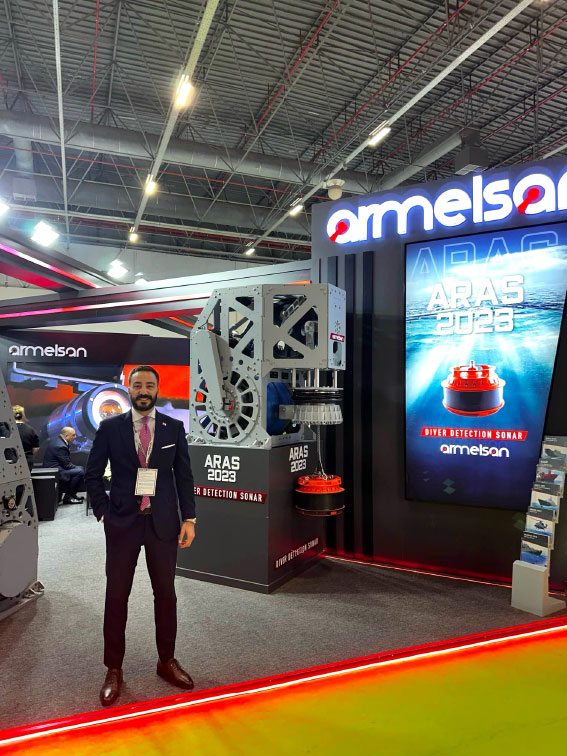
At the SAHA EXPO 2024 International Defence, Aviation, and Space Industry Fair, ARMELSAN showcased its capabilities in naval defence and underwater acoustic systems, drawing significant attention. Integrated with a winch system, the ORKUN-2053 Dipping Sonar (the actual system that will be tested on the MARLİN USV) was displayed in this form for the first time at the fair. The ARAS-2023 Diver Detection Sonar (DDS), which has received double-digit orders from both domestic and international customers, and the KAŞİF Work-Class Remotely Operated Underwater Vehicle (ROV), whose numbers continue to grow steadily, were also among the featured products at the company’s booth.
We had the opportunity to speak with ARMELSAN Defence Director of Business Development and Corporate Communications Erdem TÜMDAĞ at the fair, from whom we received information on the latest status of the ORKUN-2053 Dipping Sonar and ARAS-2023 Diver Detection Sonar Projects, both of which reflect the Turkish Defence and Aviation Industry's engineering prowess and underwater success. Another notable product by the company, the NUSRAT-1915 Mine Hunting Sonar, is expected to enter service for the first time aboard the National Mine Hunting Vessel (to be built by DEARSAN Shipyard), the production decision of which was taken at the last Defence Industry Executive Committee meeting a few months ago.
On the other hand, the Low-Frequency Active Sonar (DÜFAS) System, developed under the DÜFAS Project by ASELSAN and its solution partner ARMELSAN, currently provides the Turkish Naval Forces Command (TNFC) with the greatest Anti-Submarine Warfare (ASW) capability. This system is desired to be integrated into most of the new military shipbuilding projects. In this context, the current configuration, featuring a design with four ceramic elements and representing the most capable (as well as the most powerful/largest/heaviest) version, is expected to be used on TF-2000 AAW Destroyers. Revised versions of this design are anticipated for use on ISTIF-Class Frigates and Offshore Patrol Vessels.
Having rapidly become one of the world's largest producers of Diver Detection Sonars, ARMELSAN is delivering the ARAS-2023 Diver Detection Sonar not only for surface combatants like TCG Anadolu (2x), BARBAROS Class (1x), and ISTIF Class (1x) but also for a total of eight critical facilities in Türkiye, five of which are military bases, including Aksaz and Foça. During our meeting at the second international World Defence Show (WDS 2024, held in Riyadh, Saudi Arabia, between February 04-08, 2024), ARMELSAN Defence Director of Business Development and Corporate Communications Erdem TÜMDAĞ stated that over 25 Diver Detection Sonars were on the production line and noted that this figure would reach 100 by mid-2025. TÜMDAĞ said, "Right now, we are more or less ensuring the protection of all critical facilities located near the sea in Türkiye. This year, we plan to produce around 50 Diver Detection Sonars, both for domestic and international orders."
Defence Turkey: Could you provide information on the latest status of the ORKUN-2053 Dipping Sonar Project, which is being showcased for the first time at the fair integrated with a winch system?
Erdem TÜMDAĞ: As you know, ORKUN-2053 is our dipping sonar. Initially, it was a helicopter-dipping sonar, but due to changing operational conditions and the Turkish Naval Forces Command (TNFC) adopting new concepts, we have completed our work on integrating the ORKUN-2053 Dipping Sonar onto autonomous/unmanned surface vessels. What you see here is the sonar itself. In fact, we will probably begin sea trials in the coming week or the one after that. The component you see on top of the sonar is the very same winch that will be integrated onto the unmanned surface vessels. Essentially, we are offering both the winch system and the sonar system together to our customers. This is the first time we’ve had the opportunity to exhibit them as an integrated system at SAHA EXPO.
ORKUN-2053 was developed entirely by ARMELSAN; we developed 1the signal processing algorithms, and the design, R&D, and production processes were all carried out by our own team. There is significant demand for ORKUN-2053 both domestically and internationally.
We will integrate the sonar, which weighs about 270 kg, and its winch onto the MARLİN Unmanned Surface Vehicle (USV) in cooperation with Sefine Shipyard. Meanwhile, regarding the integration of ORKUN-2053 onto helicopter platforms, we are also conducting technical consultations with both the TNFC and TUSAŞ. We estimate we will begin sea trials of ORKUN-2053 on the MARLİN USV in November. Of course, there are certain certification-related aspects we need to address. We are currently evaluating how to overcome these challenges through a collective and reasoned approach.
Defence Turkey: How will it be used on the MARLİN USV?
Erdem TÜMDAĞ: It has been designed to be fully integrated into the vessel’s interior.
Defence Turkey: Will the arrays fit inside the hull?
Erdem TÜMDAĞ: Yes. It will be lowered into the water from inside the hull. Our product is ready for testing.
Defence Turkey: What material did you use, aluminum?
Erdem TÜMDAĞ: We have aluminum as well as steel components. All of them have been painted with special coatings against corrosive effects. We have been conducting tests on the ORKUN-2053 Dipping Sonar in our own pools for some time now, but sea trials will begin very soon.
Defence Turkey: The sonar emits and detects a target. Will that contact data be sent ashore or to the main ship via the data link on the MARLİN USV?
Erdem TÜMDAĞ: Correct, it will be transmitted to the center via the link.
Defence Turkey: Will there be any operational time constraint for ORKUN-2053 on the MARLİN USV?
Erdem TÜMDAĞ: Actually, the time constraints are relevant in the case of helicopter use as helicopters have a limited “hover” duration influenced by weather conditions. However, we have no such problem with an unmanned surface vessel. It can be used continuously.
Defence Turkey: Is there a separate power amplifier for the sonar’s energy needs, or will it use the MARLİN USV’s electrical power?
Erdem TÜMDAĞ: It will utilize the USV’s own power supply.
Defence Turkey: You mentioned that it would be tested first on a USV, but is there any development regarding helicopter-based tests as well?
Erdem TÜMDAĞ: We have already held various discussions with TUSAŞ, and we’ve mutually agreed that, in its current dimensions, ORKUN-2053 is not suitable for the T625 GÖKBEY-1. Actually, ORKUN-2053 is suitable for use on helicopters weighing 10 tons or more. We reached a mutual agreement on this during technical meetings. Therefore, ORKUN-2053 can be used on the 10-ton Class Utility/Maritime Helicopter GÖKBEY-2 (T925). Our main goal, essentially, is to integrate our product into a domestically produced and nationally developed helicopter. Because when we deal with a foreign platform, we encounter additional certification challenges. Hence, it must be integrated into a slightly heavier helicopter. We are now discussing the details of certification. In fact, just yesterday, we spoke with the relevant sector head at TUSAŞ regarding this matter.
Defence Turkey: Until the T925 is ready, can’t you use the veteran UH-1H or dual-engine AB-212 helicopters in the Naval Forces Command inventory as a test-bed?
Erdem TÜMDAĞ: That’s correct. Our Commander of the Naval Forces also gave a similar directive. We are currently discussing this both with TUSAŞ and the Naval Forces. There is a real and urgent need for the Naval Forces. ORKUN-2053 was designed entirely with our own seas in mind. It has been designed to operate at frequencies that meet our operational needs. For this reason, we are holding discussions at every level. However, our primary objective is to start field testing on an unmanned surface vessel.
Defence Turkey: Could you provide some information about the ARAS-2023 Diver Detection Sonar? Besides being selected for TCG Anadolu and the BARBAROS and İSTİF Class Frigates, it was also ordered for coastal-based use to secure critical facilities. What is the latest status?
Erdem TÜMDAĞ: Indeed, as you are aware, ARAS-2023 is a Diver Detection Sonar used on TCG Anadolu, the MİLGEM Frigates, and within the scope of the Mid-Life Upgrade (MLU) Project on BARBAROS Class Frigates. It is designed to detect and classify open and closed-circuit divers, as well as diver propulsion vehicles. At the same time, we are ensuring the underwater security of critical energy facilities in Türkiye using the ARAS-2023 Diver Detection Sonar. Our related projects for this purpose are currently ongoing. We have signed the contracts and are nearing fruition. The ARAS-2023 system with a winch, which you can see here at our booth, was specially designed for the MARLİN USV. We are actually showcasing it for the first time at SAHA EXPO 2024. Starting next month, it will undergo field tests together with ORKUN-2053. In fact, we have already exported ARAS-2023 abroad, but due to certain contractual restrictions, we have not been able to announce it to the press.
Defence Turkey: Is it just one country or multiple countries?
Erdem TÜMDAĞ: For now, it’s just one country, but a second one will be added very soon. We aim to export to at least two more countries in 2025.
Defence Turkey: Will the export customer use ARAS-2023 on a surface platform or in a coastal configuration?
Erdem TÜMDAĞ: It will be used for facility security. Currently, rather than naval platforms, there is tremendous demand for Diver Detection Sonar systems for facility security purposes, stretching from Latin America to East Asia.
Defence Turkey: ARAS-2023 is not actually a new product; it has been in service for quite some time. Do you consider producing new versions of ARAS-2023, such as Block 1 or Block 2, featuring technological improvements? Or is ARAS-2023, with its current design, capable of serving effectively for many more years?
Erdem TÜMDAĞ: No, every system always needs updating; claiming otherwise would be incorrect. The version you see here is the one we use on our naval platforms. However, taking into account both the power requirements and the fact that it will be actively operating underwater 24/7, the version used at critical facilities is structurally completely different from what you see here. In other words, while the working principle and the algorithms used remain the same and can be updated based on field data, the hardware has been completely changed.
Defence Turkey: Thank you for your time, Mr. Erdem. We wish you a successful Fair.
Additional Information on ORKUN-2053 and ARAS-2023 Sonars
The ORKUN-2053 Dipping Sonar’s Antenna Unit, which can be submerged to a depth of 350 meters and conduct 360-degree omnidirectional transmissions, houses both the transmit arrays (with ceramic transmit arrays at the bottom) and the receive arrays (at the top). The Antenna Unit is approximately 100 kg in weight (heavier once submerged) and about 1.8 meters in length. In ORKUN-2053, whose transmit frequency is stated as 8kHz-11kHz, the data is collected by the receive array/antenna consisting of 24 pneumatically controlled arms and is processed in the central electronic units, then sent upward (to the helicopter/USV) via a fiber-optic cable and displayed on the Operator Console.
The ORKUN-2053 Dipping Sonar will be deployed in a towed configuration on the MARLİN USV built by SEFİNE Shipyard. Just as an ASW Helicopter must hover in place while conducting sonar operations, the MARLİN USV will stop at a fixed point when a submarine threat is suspected, lower its sonar, and perform listening operations. If no detection is made, it will retrieve the sonar and move to another location to listen there.
Developed locally and nationally in cooperation between ASELSAN and SEFİNE Shipyard, the MARLİN Unmanned Surface Vehicle will be able to perform various missions thanks to its different payloads. In this context, besides the ORKUN-2053 Dipping Sonar, it will be possible to integrate the ARAS-2023 Diver Detection Sonar, Light Torpedo, ASW Rocket, Sonobuoy Dispenser Launchers, Sonobuoy Signal Processing System, Imaging System, and a Weapon Station onto MARLİN