Selex ES: An Enduring Relationship with Turkey The New Defence Electronics Champion will Build on a Strong Heritage
Defence Turkey: Finmeccanica has decided to integrate its defence electronics business with the creation of the new "Selex ES" company. Could you please explain who Selex ES is? And what it does?
Selex ES became operational on the 1st of January 2013 following the integration of Selex Galileo, Selex Elsag and Selex Sistemi Integrati. The new Company name, "Selex ES", celebrates the formation of a stronger entity with a proud legacy and a great future ahead. Keeping the name ‘Selex’ indicates that we have joined forces and that together we have the size, the technology, the experience and the critical mass to grow and further develop. The "ES" identifies the core business of the new company: Electronics Systems.
Selex ES is a global business, with a workforce of approximately 17,900, revenues in excess of 3.5 Billion Euros, main operations in Italy and the UK and a strong industrial and commercial footprint in the US, Germany, Turkey, Romania, Brazil, Saudi Arabia and India. Selex ES will develop and increase its market share in domestic and priority countries by providing its unique expertise and technologies in the air, land, sea, security and civil domains. The organisation of the company reflects this position through the creation of three main divisions, each focused on a specific market and customer. Our job is to make the end user aware that we work for him and that we have that base of insight and expertise that can allow us to advise him on the opportunities and challenges he faces".
Defence Turkey: Selex ES has three different divisions as mentioned, could you please describe them?
The Airborne and Space Systems division includes all airborne capabilities, technologies and products ranging from UAS and integrated mission systems to radar, electronic warfare equipment, avionics, simulation systems, target drones and space sensors, payloads and equipment. The Land and Naval Systems division comprises capabilities in the land and naval domains from the design of complex system architectures to tactical integrated systems, naval combat management systems, land and naval radar and situational awareness sensors and military communications infrastructures. The Security and Smart Systems division mainly covers network infrastructure and systems architecture capabilities for homeland protection and the complex urban environment as well as air and vessel traffic management.
The three divisions will be supported by an operations/engineering function led by a Chief Operating Officer that has been organised by capability/technology and will supply the divisions with engineering and supply chain services and a number of staff functions.
Defence Turkey: Why did you decide to integrate with the different companies?
This integration is part of the restructuring plan launched by our parent company Finmeccanica last year; the intention is to consolidate the breadth of competencies and technologies in the group’s defence electronics sector. It has been built focusing on the customer, funnelling our resources and investments to respond quickly to rapidly changing scenarios. With Selex ES we can bring to bear an integrated set of technologies for protection, security, cybersecurity, smart cities etc.
Defence Turkey: How do you work with local Turkish industries, at a glance?
The defence industry in Turkey is strong and has many similarities with ours. We are keen to develop our presence in-country through partnerships and collaborations, not only to respond to internal requirements but also to jointly work on export opportunities. We already have a local company, now called Selex ES Elektronik Turkey S.A. that assembles printed circuit boards and produces soldered electrical and electronic assemblies for airborne and naval platforms.
Defence Turkey: How does Selex ES intend to establish local companies or joint venture agreements? Could you please explain us?
We are very keen to work through Turkish Industry, primarily Foundation Companies, to be successful in Turkish domestic programmes. By offering products, services or capabilities that are unique, we can truly improve the Foundation Companies’ capabilities. At the same time, we must identify products, services or capabilities that Turkish Industry has that we can jointly offer at a national and international level. The emergence of small to medium-sized domestic companies in the Turkish defence market is providing further opportunities for local collaboration that will turn into long term relationships as these companies grow.
Defence Turkey: In the field of UAS, Turkey has made different agreements to set up its own capability. Is there also space for Selex ES?
Selex ES has developed a successful Tactical UAV, the Falco, which is in operation with four international customers and we are currently test flying a new version, the Falco EVO, which features greater autonomy and an increased payload. We have an in-depth understanding of unmanned systems from the platform itself to their sensors and mission systems. Our AESA and M-Scan radar have been selected to equip several unmanned platforms worldwide and we are developing a mission system that is independent from the platform. We know how keen Turkey is to develop an indigenous capability in this field and are also aware of the exciting results that the local industry has in the sector. There could be areas of cooperation in radar and electronic warfare sensors or in mission system development and we would welcome opportunities to work together in this continuously expanding market.
Defence Turkey: Are there any other areas you would consider of interest for our country?
The more reliant that countries become on technology, the more their national security will depend on a stable, protected information network. Securing and safeguarding cyberspace is an area where I believe Selex ES can offer our knowledge and experience. In February 2012 we were awarded, with Northrop Grumman, a contract to establish a NATO Computer Incident Response Capability that will provide the capability to detect and respond to cyber security threats and vulnerabilities rapidly and effectively.
Selex ES also has extensive experience in Air Traffic Management and in the development of integrated airport systems such as at New Doha International Airport that sets a new standard in airport efficiency. We have radars in close to 150 countries and I believe that this is an area of potential interest in your country."
Defence Turkey: Could you please synthesise your presence in country now that you have a single interface? Can you distinguish the heritage of the three different companies?
Selex ES, in its constituent parts, has been in Turkey for over 30 years, mostly in the naval and airborne domains, but also in air and vessel traffic control. The three companies now part of Selex ES (Selex Galileo, Selex Elsag and Selex Sistemi Integrati) have all had significant opportunities in your country and now we can streamline our activities and our effort. Let’s start by summarizing the successful work carried out by Selex Elektronik (previously called Selex Komünikasyon), a wholly owned subsidiary of Selex ES.
Selex Elektronik Turkey has been operating in Turkey since 1989. The company employs around 60 highly-skilled personnel and supplies circuit boards and soldered components to most defence contractors in Turkey as well as abroad. In the nineties, Selex Elektronik manufactured and delivered thousands of secure HF radios for the Turkish Armed Forces; today, it is an important global supplier, having extended its range of products and system solutions for land, naval and air applications. Within the Turkish GENESİS programme, the internal communication systems of the Turkish Navy’s Frigates are being modernised by Selex Elektronik Turkey.
Selex ES is one of the suppliers of message handling systems for military messaging applications. Systems have been supplied for the Turkish Navy’s Shore Station modernization project and for the New Type Patrol Boats project. In addition, Selex ES is one of the major subcontractors of Aselsan. Several others NATO Programs have been implemented by Selex ES such as TFA (CZCS), TSTA (CZCS), BRASS, TASMO, ADCAP, Izmir NATO MWHQ etc..
Sirio Panel, a subsidiary of Selex ES was awarded, in 2005, a contract by Turkish Aerospace Industries (TAI) in support of the Airbus A400M lighting system. In order to comply with the offset requirements and introduce technology and capability in Turkey, Selex ES is acting as Prime Contractor and Sirio Panel, a subsidiary of Selex ES, is acting as subcontractor and technology supplier. As positive result of this partnership, and technology insertion in the country, TAI awarded two additional contracts to Selex ES. The first in support of the lighting system of the Turkish Air Force C-130 and the second in support of the cockpit and lighting system of the Hurkus basic trainer.
Selex ES has also been awarded a contract issued by the Central Finance and Contracts Unit (CFCU) to enhance the technical and operational capacity of Turkish Coastal Radio.
Selex ES offers solutions for emergency communications based on TETRA, GSM-R, ATC and Wide Area Network technologies. In 2007, the first Selex Elektronik turnkey TETRA system was installed on the Edirnekapı-Sultançiftliği train line as part of the Istanbul Light Rail System.
Selex Sistemi Integrati, another component of Selex ES, has also been a technological partner in Turkey for more than 30 years now, both in defence and civil domains. In defence electronics, Selex ES delivered eight air defence radar systems including seven RAT31DL and a RAT31S systems which have been integrated within the NATO NADGE network.
Selex ES’s civil systems have been particularly successful in the country since the second half of the seventies. In the air traffic control domain, most of Turkey’s national radar surveillance network and air traffic planning and control infrastructure (seven control centres and around 20 radio stations) were supplied by Selex ES. Indeed, collaboration in this area dates back to 1974 when the company provided the first air traffic control systems for the airports at Istanbul and Ankara.
More recently (2006), Selex ES was awarded a contract by the Turkish Aviation Authority to fully upgrade and enhance all of the country’s air traffic control centres, under the SMART (Systematic Modernization of ATM Resources in Turkey) programme. The contract included the supply of a national system based in Ankara to manage the entire Turkish air space as well as incoming traffic control centres to be installed at the airports in Istanbul, Izmir, Antalya, Dalaman and Bodrum. The systems supplied by Selex ES are also able to support disaster recovery by enabling air traffic control to be transferred from the national centre in Ankara to the centres in Istanbul and Izmir, thereby making them effective backup centres.
In 2010, Selex ES was awarded a contract to deliver a VTMS (Vessel Traffic Management System) system for the management and control of maritime traffic. The system comprises a national centre based in Ankara, three regional centres in the coastal areas of Izmir, Izmit and Mersin and 24 remote sites connected with the national and regional centres. The contract is currently underway.
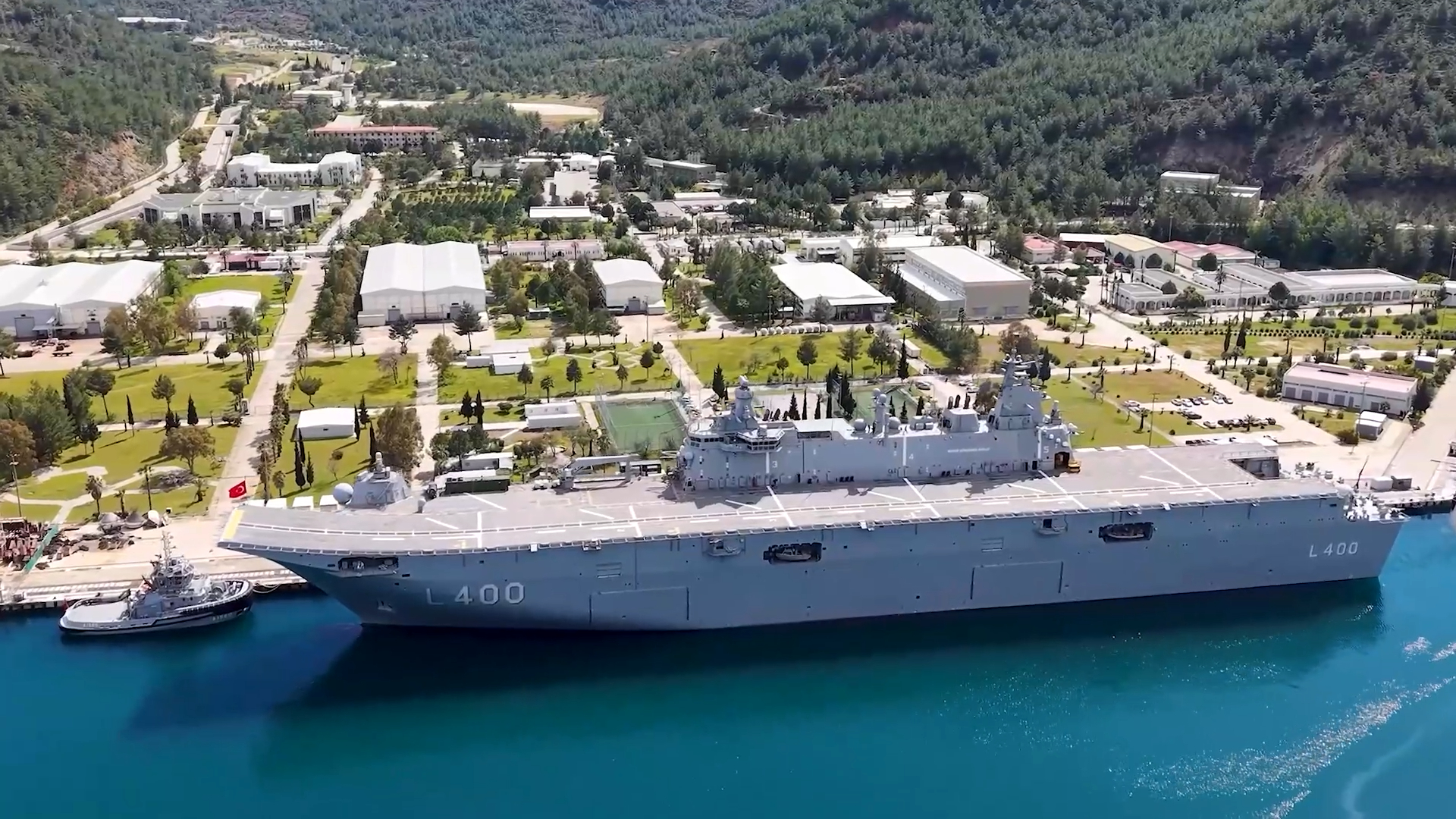
Finally, Selex ES is currently involved in the Turkish Navy’s Landing Ship Tank (LST) programme. Here the requirement is for two SASS (Silent Acquisition Search and Surveillance) systems to be installed on two new vessels. Each SASS features our successful Electro Optical and Infrared Search and Track technology; the system passively scans the area and tracks contacts that are detected. It enables operators to perform visual panoramic surveillance around the platform on which the system is fitted and track low-elevation air and surface threats by their infrared (IR) signature, thus providing an important adjunct to radar in situations where radar performance may be degraded or an alternative where electromagnetic discretion is required.
Selex ES’s product portfolio provides state-of-the-art avionic solutions for all types of fixed and rotary wing platforms thanks to the architectural flexibility built into every single product from the design phase onwards. Turkey has a number of aircraft programmes, fixed and rotary wing. Currently, we are discussing with Turkey’s industrial leaders such as TAI, Aselsan and Havelsan how we might develop the equipment/systems on board several platforms which will need enhanced avionics to cope with the next decade of operational capability requirements.
Defence Turkey: Turkey will be acquiring the Joint Strike Fighter, but there is still the possibility that they could also choose the Eurofighter Typhoon. What is Selex ES role in the Typhoon programme?
Selex ES is a key player in the Eurofighter Typhoon programme. We lead several international consortia to deliver some of the Typhoon’s most critical systems. Finmeccanica’s electronic defence and communication share in the programme is in excess of 60% and Selex ES contributes the dominant part of this.
Specifically, we lead the EuroRADAR consortium which supplies the "Captor-M" radar, the primary sensor of the Typhoon, as well as the EuroFIRST consortium which delivers the advanced "Pirate" InfraRed Search and Track (IRST) sensor. To provide the highest level of protection to the pilots and the platform, we also lead the EuroDASS consortium which supplies the "Praetorian" Defensive Aids Sub System (DASS). The success of the Captor-M, Pirate and Praetorian and the trust pilots place in them was recently highlighted when the four Typhoon partner nations awarded Tranche 3A contracts that stipulated the inclusion of each of these products.