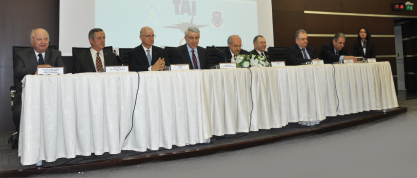
Signature Ceremony of Industry University Cooperation Agreement for FX/TX Project
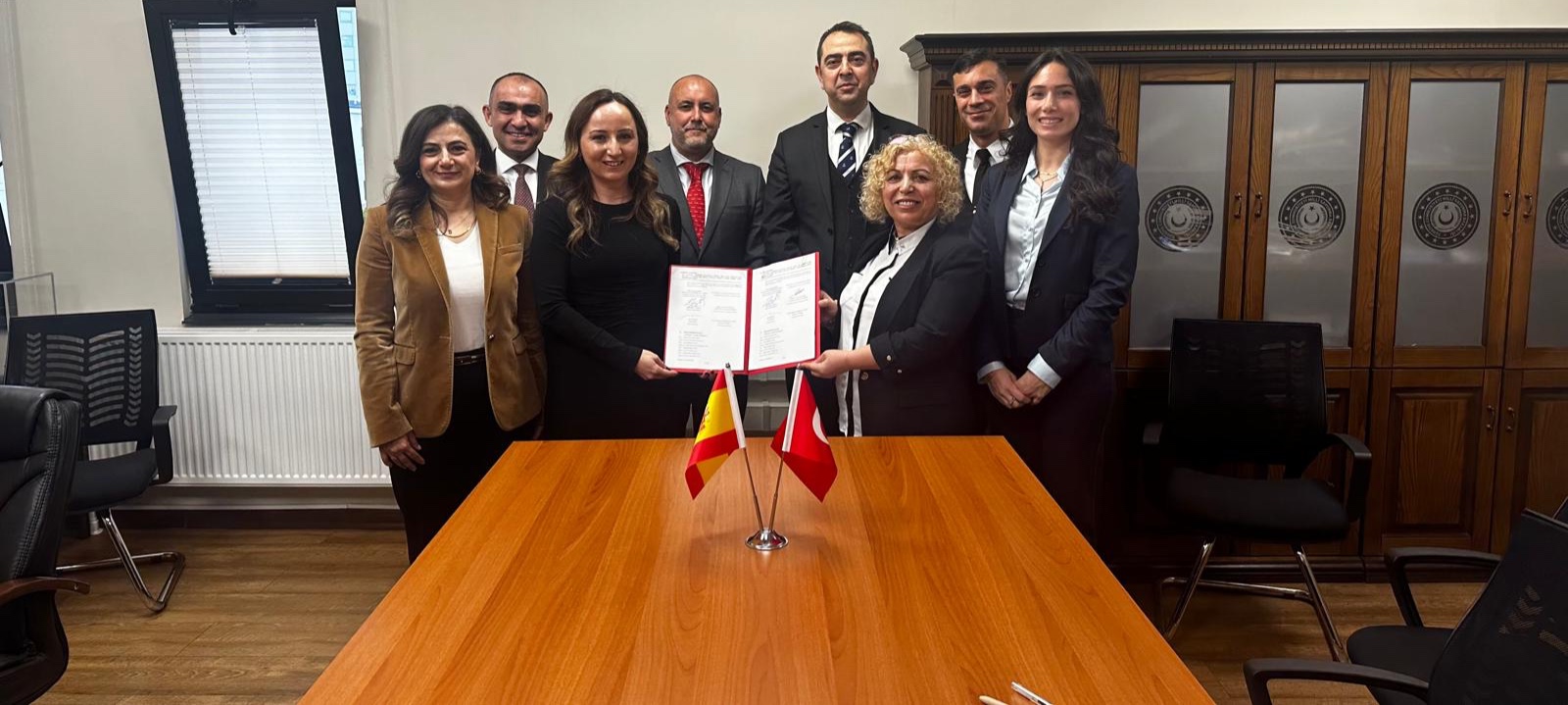
Agreements for a total of six projects within the framework of Conceptual Design of Jet Trainer Aircrafts and Combat Aircrafts were signed with ITU, METU and Bilkent Universities at FX/TX Project Industry - University Cooperation Agreement Signature Ceremony.
The Industry – University Cooperation Meeting within the scope of Conceptual Design of Jet Trainer Aircrafts and Combat Aircrafts was held on February 8, 2013.
Undersecretary for Defence Industries Murad Bayar, Deputy Undersecretary (Platform Projects) Serdar Demirel, ITU Chancellor Prof. Mehmet Karaca, METU Chancellor Prof. Ahmet Acar, Bilkent University Vice Chancellor Prof. Cemal Yalabık, General Manager of the Turkish Armed Forces Foundation Hayrettin Uzun, TAI Chairman of the Board Yalçın Kaya and TAI General Manager Muharrem Dörtkaşlı signed the agreements.
Murad Bayar: "Our endeavour is to reflect all our knowledge and thus gain our country a combat aircraft."
In his speech at the ceremony, Undersecretary for Defence Industries Murad Bayar mentioned that they are exerting efforts to build a combat aircraft within a total period of 50 years composed of phases each lasting for 10 years by reflecting Turkey’s all accumulated knowledge. Reminding the audience of the questions they received on whether Turkey currently has the capacity, knowledge and technology to produce combat aircrafts, Murad Bayar said "We have to answer this question negatively as of today. However, taking the current developments in Turkey into account, we aim to achieve this within 10-year time and that’s why we are conducting these studies".
Stressing the essence of cooperation for producing a national combat aircraft, Murad Bayar added: "TAI could not produce a combat aircraft on its own. Neither the Undersecretariat for Defence Industries together with TAI nor our Air Forces could do this. However if we gather all Turkey’s capacity and knowledge in this specific area then we could achieve this. That’s why joining our forces is of vital importance. So we have to support this study with all Turkey’s brainpower in order to speed up this Project".
Stating the limited academic capacity of aviation and aerospace engineering in Turkey Mr. Murad Bayar said: "As far as I know there are no universities educating on aviation and aerospace engineering besides ITU and METU. Turkish Aeronautical Association has recently started to educate in this area. In fact the number of graduates from the current departments is not sufficient. Indeed we have a small number of graduates and they are positioned in the required fields of the industry. We need to strengthen this area".
Murad Bayar: "We have a Joint Project Office."
Presenting information on how the studies were conducted within the scope of the Project signed, Murad Bayar said: "If we are to accomplish our combat aircraft project, this shall be through this Project’s concept and design. We signed our contract nearly two and a half years ago. We have a joint project office and all Project teams have been working in a single building for year and a half. We in fact have established a great teamwork here. We are conducting this study at a single place as a single team. If I have to elaborate on the future plans, the phase we are currently in is a 2-year conceptual design study. We might as well name this stage "the preliminary project". We are also making plans for 10-year design development and test studies following this stage. This also involves a comprehensive feasibility study as well. By the end of this year, we shall be answering the following questions at our Steering Committee: How would be the future requirement of our Air Forces satisfied by exactly what sort of aircraft? How shall we produce this aircraft, through which project and time schedule? As we encounter in all projects, the last but not the least issue shall be the costs. So if we could answer these questions properly, we could get the support of our Steering Committee and then move onto the next stage. We shall certainly divide the next stage into various sub-stages, so the 10-year would not be a single phase. Within these stages, we shall conduct studies for preliminary design, prototypes, tests, etc. Still we need to see the big picture by the end of this year. We are currently writing the scenario but we need to know the end of the movie in order to start shooting it. I would like to conclude my speech by highlighting the hardship of this journey".
Mehmet Karaca: "We are really proud of the point we reached: Designing our own jet aircraft."
Chancellor of İstanbul Technical University Prof. Mehmet Karaca underlined that the FX/TX project is in fact a conceptual design project which would display the point Turkey reached in the last 30 years and briefed on this historic development: "I believe that the President of that time Turgut Özal would be pleased to see these developments as I think he laid the foundations for the Undersecretariat for Defence Industries during his term. Maybe we lost a lot of years on this journey but still we are proud of the point we stand as of today as we are designing our national jet aircraft. As you may know there are only a few countries that could achieve this like USA, Russia, China and European league. This step of ours could be considered as our move towards this league of champions. I hope these steps could continue increasingly. The importance of the university in these types of projects is undeniable. What actually important in these sorts of strategic projects is design and analysis, materials, electronics, control systems and high speed aerodynamics. The development and accumulation of knowledge is indeed important and I am certain that our technical universities and other schools hold the necessary potential in this field. We are currently witnessing the examples of this case here. We, as an institution, are represented by 4 projects here. Therefore I would like to thank my academic members especially".
Ahmet Acar: "We are pleased to involve in the research activities."
In his speech, METU Chancellor Prof. Ahmet Acar mentioned that they are pleased to participate in such an effort that would both give an impetus to their university as well as the industry.
Prof. Ahmet Acar stated that the skills, which they expect to be further improved in Turkey, were displayed in this Project and added: "The environments, where several institutions join and cooperate under a single roof, are the source of pride for all of us. Therefore I would like to thank the Undersecretariat for Defence Industries and all other institutions involved. Additionally, we are pleased to participate in such a Project with a vision of our security and defence as a country that would exceed 50 years while also taking part in the researches in high technology. I would like to celebrate our Aerospace Engineering Faculty members and wish them success".
Cemal Yalabık: "Only looking at the topics of the Projects is a source of pride."
Bilkent University’s Vice Chancellor Prof. Cemal Yalabık claimed that even the topics of the projects show the point reached in advanced technology applications and thus made them proud. Prof. Cemal Yalabık stated that the related support not only for such aerospace and aviation projects but also for other projects regarding advanced technology shall be encouraged.
TAI Chairman of the Board Yalçın Kaya explained the development phases of Combat Aircrafts.
As a former combat pilot, TAI Chairman of the Board Yalçın Kaya gave information regarding the development of combat aircrafts in his speech at the ceremony. Yalçın Kaya stated that he has over 40 years career in the combat aircrafts in Turkey and said: "As you know, after World War II, the jet aircrafts emerged. In fact, the Germans had tested these planes but arrival of these jet aircrafts in our country started in1950’s. First one of these was the 84G and I started my career in these combat aircrafts with the next model 84F, then after a short while I became the pilot of F35. Five years later, the F4s arrived and obviously the engines of these planes went through lots of changes up to this stage. Also the hulls of these aircrafts changed substantially. Therefore with the changes in wings, engines and velocity, we reached F16s and now we pronounce the FX/TX. Currently, we are envisioning FX. The combat aircraft that will be produced as a result of the efforts of university chancellors, faculty members and the youngsters was my dream and as of today it is beginning to become real".
Dr. Murat Ceran: "The operation strategy of the indigenous combat aircraft shall be defined within 2 years."
Dr. Murat Ceran, Head of Indigenous Aircraft Development Projects at the Undersecretariat for Defence Industries gave information on the Project at the ceremony. Stating that the Project commenced with the signing of an agreement between the Undersecretariat for Defence Industries and TAI on August 23, 2011, Murat Ceran added that the Project duration is 24 months and the goal is to design and develop indigenous combat aircrafts that would meet the future requirements of the Air Forces Command to emerge in 2020s. Murat Ceran stated that through this Project, the operation strategy of the indigenous combat aircraft will firstly be defined within two years and the requirement analysis for such defined operation strategy as well as the system configuration will be accomplished by TAI. Murat Ceran remarked that the international cooperation opportunities are amongst the issues that will be examined within two years as well and stated that they are at the 16th month of 24-month Project duration, that the Project is composed of four phases, that the definition of operation requirements and requirement analysis phases are completed and that they are now at conceptual design phase.
Dr. Murat Ceran stated that they evaluate the scope of Defence Industry – University cooperation under four main topics in the Project and added "Under the first topic, we plan to receive trainings from the universities, experts and faculty members regarding the combat aircraft systems. Within this framework, we want the knowledge base at universities related to this field is enriched. Secondly, we ask for consultancy services from our faculty members during the requirement analysis and conceptual design phases. Under the third topic, we aim to achieve projects in the fields required by the defence and aviation industry following the conceptual design phase. Lastly, we expect the accomplishment of researches that would increase the level of our country’s technologic preparation in the indigenous critical technologies for our combat aircraft. We conduct studies for the definition of indigenous critical technologies and expect the contribution from the universities for the next phases of our Project".
Dr. Murat Ceran: "We wish trainings would further be developed and given by other universities as well."
Dr. Murat Ceran said that until now the trainings organized jointly by Continuing Training Centre and Aerospace Engineering Department of Middle East Technical University were accomplished with the initiatives of Personnel and Training Department of the Undersecretariat for Defence Industries, but more trainings are still needed and that they want other universities to conduct such trainings and studies as well.
In his speech Dr. Murat Ceran said: "I could present the developments regarding the six projects related to the cooperation between the universities. We selected these six projects amongst fifty two projects and while making this selection, we mostly preferred the projects that would serve the conceptual phase. In fact all the projects were of great value but we had to take into account the near future. There are projects that would be fruitful in the medium and long run but we aim to realize those after 2-year period".
Making assessments regarding the Project, Dr. Murat Ceran concluded his speech as follows: "We regard this Defence Industry – University Cooperation within the scope of the Indigenous Combat Aircraft Conceptual Design Project as an opportunity that would provide support for the research experts at the universities working on combat aircrafts, develop the indigineous/critical technologic information infrastructure, enrich the post graduate and doctorate studies, provide training of qualified personnel required by the industry and increase the product oriented studies conducted with the Industry and thus start a long-lasting cooperation".
1st PROJECT
Project for the Development of Aerodynamic Optimization Software in Parallel Calculation Environment via 3-Dimensional Panel Flow Decoder
It is a project to be realized by Prof. İsmail Tuncer, Prof. Yusuf Özyörük and post graduate students from METU. A software tool is planned to be developed by using a 3-dimensional flow decoder. Aerodynamic optimization of Indigenous Combat Aircraft’s wing surface shall be accomplished under subsonic conditions.
2nd PROJECT
Project for Examining the Wing Saddle Temporary Flow and Vortex Dynamics for High Manoeuvre Capability
The objective of this Project is to empirically examine the wing saddle flow vortex three different attack angles. In this Project, Assoc. Prof. Okşan Çetiner, Engineer MSc Berk Zaloğlu and Research Assistant Onur Son from ITU’s Aerospace Engineering Faculty will work together.
3rd PROJECT
Project for Empirical Examination of Shockwave – Boundary Layer Interactions in Supersonic Air Inlets
With this Project, contribution for the realization of experimental studies in the supersonic wind tunnels as well as identification of aerodynamic, structural and control characteristics of the aircraft will be provided. Assoc. Prof. K. Bülent Yüceil and post graduate students will work together in this Project.
4th PROJECT
Project for the Design of Supersonic Air Inlets and Power Pack Integration for Aircrafts with Supersonic Speed
Assoc. Prof. Hayri Acar and post graduate students of ITU’s Aerospace Engineering Department will work together in this Project. Main objective is to design a channel between the air inlet and engine.
5th PROJECT
Project for Examining the Impact Resistance of Carbon Nanotube based Fibre Composites
Dr. Hülya Cebeci and post graduate students from ITU’s Aerospace Engineering Department will work together in this Project. Main objective is the empirical examination of polymer matrix composites’ impact resistance.
6th PROJECT
Project for the Examination of Design Alternatives Regarding Low Visibility
Prof. Levent Gürel and post graduate students from Bilkent University will work together in this Project. Main objective is to perform Radar Cross Sectional Area Calculation, make Scattering Centre Analysis and contribute to designs regarding low visibility.