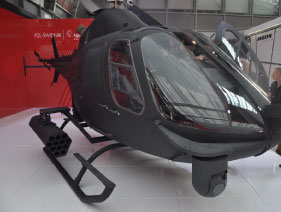
“Solo” SW-4 Rotary Unmanned Air System (RUAS) was Displayed at MSPO 2013
At the 21st MSPO Fair in Kielce, Poland, SW-4 “Solo” developed by Agustawestland and its Polish partner PZL- Świdnik, was displayed for the second time at PZL-Świdnik’s stand. PZL- Świdnik’s Managing Director and Vice President Nicola Bianco made important statements to our magazine regarding the Attack Helicopter Project which is aimed to be launched next month, the development procedure of Solo” SW-4 RUAS that was demonstrated in 2012 for the first time, its capacities and potential markets. Nicola Bianco mentioned that among two tons lighter helicopters “Solo” RUAS SW-4 brought a new solution in its class with its operational piloted flight feature in addition to its unmanned vehicle characteristic and said that it had capabilities which could be used in military and civilian flights for transportation and training. Bianco stressed that SW-4 could function in the disasters such as the nuclear disaster that occurred in Japan and added that it could function in the combat areas as a reconnaissance/surveillance and a weapons carrier for military use. Bianco underlined that SW-4 was an authentic product and said added that in the beginning they were developing this helicopter in line with Italian Army’s needs and then in time Poland’s need for an rotary wing unmanned air systems emerged and now they were getting feedbacks from third countries in this respect.
SW-4 included into the RWUAS CCD Program of the Britain’s Royal Army
PZL-Swidnik’s Managing Director and Vice President emphasized that SW-4 Solo has been included in a program that was initiated for covering the unmanned rotary wing helicopter need of the Royal British Navy and that they were pleased to be selected. A MoD concerning the SW-4 RUAS has been signed in the previous period between the UK Minisrty of Defence and Agustawestland. With this agreement “Solo”, RWUAS (Rotary Wing Unmanned Air System) was included into the Capability Concept Demonstrator (CCD) program. Determination of the requirements for unmanned rotary wing helicopters that could multi-task at the Royal British Navy and developing respective solutions are aimed with the RWUAS program.
Polish Armed Forces in Preparation for the Purchase of 32 Atak Helicopters
Sharing his views on the purchase of 32 Atak Helicopters for replacing the Polish Army’s existing Mi-24 Helicopters, Bianco mentioned that “PZL-Świdnik was the only helicopter manufacturer in Poland and that they would give support if the T-129 helicopters existed in a tender concerning this issue. Bianco added that there were no studies of the decision-making bodies for the purchase procedure for the time being and that the tendering procedure could be initiated within the next few years. According to the information acquired from the Polish defence officials the purchase process is planned to be initiated in 2019. TAI owns the direct sales, marketing and licensing rights concerning the T-129 “Atak” helicopters to a third country other than United Kingdom and Italy. Agustawestland has a business share in various stages if the T-129 “Atak” helicopter is exported to a third country besides United Kingdom and Italy.
SW-D “Solo” RUAS Helicopter
Developed by AgustaWestland and PZL-Świdnik engineering teams and based on the proven SW-4 light single engine helicopter, RUAS (Rotary Unmanned Air System) is designed for both unmanned and piloted operations providing users with maximum operational flexibility. The RUAS version of the SW-4 is capable of performing a number of roles, including intelligence, surveillance and reconnaissance and cargo re-supply. When piloted, it can undertake manned activities including transportation of personnel, surveillance and intervention.
“Solo” Could Carry 610 Kilograms of Disposable Load
Providing options for piloted and unmanned usage SW-4 “Solo” has a take-off weight of maximum 1800 kg. “Solo” has a weight capacity of 610 kg in unmanned flights and could carry 510 kg of disposable load in piloted flights. The speed limit of the helicopter in piloted and unmanned flights varies due to safety. SW-4 RUAS flies 260 km/h in piloted flights, whereas in unmanned flights the limit is 204 km/h because of the safety purposes and operational advantages stemmed by low speed.
SW-4 RUAS could fulfill various tasks in the unmanned configuration. These tasks are as follows; Maritime and Battlefield Intelligence, Surveillance Target Acquisition and Reconnaissance, Coastline and Border Monitoring, Homeland Security/Law Enforcement, Broad Area Surveillance, Spot Surveillance, Environmental Monitoring, Ground Survey and Mapping, Disaster/Battle Damage Assessment, Logistics and Cargo Supply.
During piloted flights it mostly executes the tasks of Manned Intervention Passenger Transport, Training Surveillance, Cargo transport.
SW-4 “Solo” is controlled by the Ground Control Station (GCS) during unmanned flights. The tasks, flight plans are installed before the flight by the Ground Control Station operator. With its automatic pilot feature SW-4 “Solo” could land and take-off automatically and has the capacity to automatically turn-on and turn-off its engine. “Solo” could communicate with the Ground Control Station through data link and in cases of emergency where it loses the contact with the Link, it could accomplish the task according to the flight plan installed in the flight task computer. With the Datalink capacity, “Solo” could conduct video downlink, telemetry and data recording and simultaneously share these with the ground command control station.
Mission equipment contains radar surveillance sensors and communications systems, EO/IR and Customer Specified (EW,ELINT,SIGINT)
PZL-Świdnik and AgustaWestland
Cooperation between the two companies, dating back to 1996, was initially linked to the supply of fuselages for the helicopters produced by Agusta and then AgustaWestland. Under close collaboration, the PZL-Świdnik engineers were also engaged in design work on AgustaWestland helicopters. Ever since launching cooperation with AgustaWestland, PZL-Świdnik has access to the state-of-the-art technology and a chance to take part in expansion of the product range, which strengthens the company’s position in the aviation industry. An example of the integration between PZL-Świdnik and AgustaWestland are two extremely advanced projects.
One of them is the latest generation multi-purpose military helicopter, the AW149. The AW149 is a military medium twin helicopter setting new standard in the market. From combat support, transport of troop and material, medical evacuation, SAR and Combat SAR, command and control or other airborne missions, the AW149 provides the flexibility requested to a modern battlefield support helicopter, and executes all required missions with unequalled cost-effectiveness. A significant number of engineers from Świdnik are involved in design and development works on that helicopter.
The other project is the SW-4 Solo RUAS/OPH (Rotary Unmanned Air System/Optionally Piloted Helicopter), which has been developed by AgustaWestland and PZL-Świdnik engineering teams and is based on the proven SW-4 light single engine helicopter. The SW-4 Solo RUAS/OPH is designed for both unmanned and piloted operations providing users with maximum operational flexibility. The aircraft is capable of performing a number of roles, including intelligence, surveillance and reconnaissance and cargo re-supply. When piloted, the SW-4 can undertake manned activities including transportation of personnel, surveillance and intervention as well as training.





