TAF Shows Off First Peace Eagle Aircraft “KUZEY” “Eyes in the Sky”
The signing ceremony held at the Third Konya Main Jet Air Command was attended by President Abdullah Gül, Prime Minister Recep Tayyip Erdoğan, the Speaker of the Grand National Assembly Cemil Çiçek, Chief of Staff General Necdet Özel, Turkish Air Force Commander General Akın Öztürk as well as a large number of military and defence officials. Speaking at the ceremony, the Commander of the Air Force Gen. Akın Öztürk said, “Today, only a small number of air forces around the world that have this capability have now been gained by the Turkish Air Force as well. Our Airborne Warning and Control System (AWACS) aircrafts have the world’s most advanced and most modern radar systems.” Stating that only few air forces around the globe have this capability and which has now been attained by the Turkish Air Force Command, Öztürk added, “Our AWACS are equipped with the most advanced and modern radar systems in the world. Turkey is the third country to include the AWACS aircraft that has these features in its inventory after Australia and South Korea.”
Öztürk: “Our airspace can be monitored more effectively”
Indicating that the warning and control activities of the Turkish Air Force up to now had taken place nationwide through radar range, Öztürk mentioned that the AWACS would be able to easily see areas that radars on the ground could not and that they would provide the Air Force Command a larger and wider field of vision compared to radars on the ground. “The possibility of AWACS aircraft being affected by the rear of a mountain and land irregularities in the interior of valleys is lower compared to ground radars. The gap that will take place in the event our ground radars are disabled will be swiftly met by AWACS aircraft. Aircraft, helicopters and missiles approaching Turkish airspace will be detected from longer distances with more powerful radar and detection systems and our airspace will be monitored more effectively,” said Öztürk.
Emphasizing that the AWACS aircraft was not just flying radar but that due to its features was a command and control element, Öztürk said, “It can be used in ground-based command and control centre support and where necessary it can be used independently. Our AWACS aircrafts will not only effectively support the Air Force but also our land and naval forces. The airborne forces will continue to provide a more strengthened and rapid manner of support in the planning, execution and control of joint operations.” Öztürk went on to add that the support Turkey provides to the UN and NATO will further increase with the use of this aircraft.
In his remarks at the ceremony Prime Minister Recep Tayyip Erdoğan said the following, “Today, we really are carrying a different pride. It was late but it has turned out well. Of course it was a serious delay; we had a serious disruption during this process. We took the first step in 2003. Unfortunately, certain difficulties outside of our control brought this process to this day with delays. But in the end, God willing, with deliveries at the end of this year and during next year we will have received our four aircrafts and I believe that our Air Force will have access to an enormous strength.” Stating that the aircraft entering the inventory of the Air Force Command compared to the existing AWACS in the world included new generation technologies and was at the forefront with its high command and control capabilities, Erdoğan added that they would receive the second and third aircraft later this year with the fourth due in 2015.
Erdoğan: “We signed a 3.5 billion contract in the Utility Helicopter”
Mentioning that Turkey is in a position where it can produce all its military land vehicles and can realise the modernisation of its aircraft through its own means, Erdoğan said, “We have started producing our ATAK helicopters. Today, we have additionally signed a new contract and this was a very, very significant signing ceremony for us. We have taken a 3.5 billion dollar step today with the Turkish Utility helicopters. With this agreement 109 Turkish Utility helicopters will be included to our Turkish Armed Forces.” In his speech Prime Minister Erdoğan indicated that Turkey had taken great strides in aviation and had put forth its own indigenous products and added, “Our unmanned airborne vehicles have completed the development stages with success; we are launching our national satellites and our naval patrol planes have started their mission. After a long period in the history of our Republic our first national designed aircraft ‘Hürkuş’ is in the sky. Very soon another big project that our country is a partner, as our Air Force Commander mentioned just now, is the first of the A400M transport aircraft that we will receive. We will continue with our defence industry efforts in the coming years with more advanced technology-based projects. On behalf of myself and my nation, I want to express my gratitude to our Defence Industries Undersecretariat that has not let us down in our confidence in them, to private companies and to everyone else that has undertaken a duty in this process. With the on-going and new projects that will commence, God willing we plan to eliminate our foreign dependence in the defence industry near 100 percent in 2023. We see this matter as the most important issue for our future and our independence.”
Following Prime Minister Erdoğan, President Abdullah Gül in his remarks stated that, “As with the F-16 combat aircraft, the AWACS’ have commenced a very important period in Turkish aviation and defence and it has been a very significant phase. Just as the F-16s have raised Turkey’s air force to a more powerful and to a different field and level, in the same way the AWACS’ have taken the Turkish Air Force’s strength to a higher level.” Gül stated that as a very sophisticated and developed airborne vehicle that only a few countries have, the AWACS were also among the indispensable elements of modern combat technologies and as one of the oldest members from the beginning of the NATO defence doctrine. “AWACS are not just airborne vehicles but a very sophisticated aircraft that sees missiles and all other types of airborne objects that can pose a threat and that eliminates them from being threats, said Gül, and pointed out that the AWACS’ not only have the function of a radar but at the same time each of them carry a command and control identity. Gül said, “With these features it almost carries the nature of a force multiplier and adds to our strength.” Stressing that possessing these sophisticated aircraft, which very few countries have in the world, will not only make the Turkish Air Force stronger but also the Turkish army and the Turkish Republic as well and that it will place Turkey in a more different position among its allies, Gül went on to add, “Let us not forget that from time to time we may use these aircrafts with our allies. In that regard owning these aircrafts is no doubt a source of great pride for Turkey.”
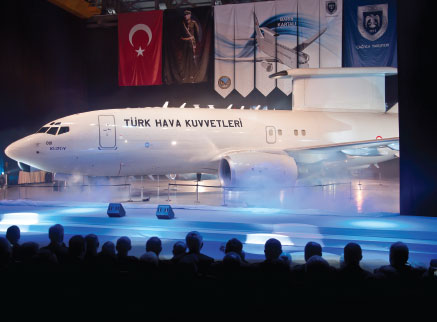
After the completion of the remarks at the official signing ceremony, Turkey’s first AWACS aircraft ‘Kuzey’ was unveiled. The President and his delegation reviewed the aircraft and received information from the authorities.
Murad Bayar: “The cost of the four aircraft to us is 1.4 billion dollars”
The Undersecretary for Defence Industries Murad Bayar made important remarks to members of the press relating to the Peace Eagle programme delivered after a six year delay. Indicating that the cost of the four aircraft was 1.4 billion dollars, Murad Bayar said that with the 600 million dollars in advances they had paid up to now they would make the necessary payments for each plane that was delivered. Bayar emphasized that due to the delay in the contract calendar, 10 percent of the project cost was applied as a late penalty to the Boeing Company and added, “10 percent of 1.4 billion dollars is 140 million dollars and was applied in 2007 when the planes should have been delivered and because the interest continued from that day for a six-year period, we have reflected this in the amount of 183 million dollars as delay penalty. This amount will be met with goods and services. What does this mean? The support period has increased from two to five years. This whole support will be provided to Havelsan and THY. In addition, it will also entail an additional 32 million dollars to the Turkish Air Force in the spare parts contract. As a requirement of the Boeing contract, 99 percent of the operational needs of the Turkish Air Force will be met. However, there are certain elements that have not been met. When we look at the first contract specifications we note that 59 million dollars is excellence compensation and this we will receive in cash.”
Murad Bayar: “The aircraft we have received is the best as of now and will serve our Air Force for at least 40 years”
The Undersecretary for Defence Industries Murad Bayar indicated that the ‘Peace Eagle’ is the best AWACS aircraft in the world today and said that it is only available in Australia, South Korea and Turkey as of now. Emphasizing that the radar mounted on top is an electronic phase array radar, Bayar went on to say that, “Today we are talking about the most advanced radar in radar technology. This aircraft will serve our Air Force for at least 40 years.” Murat Bayar said that many countries were waiting for Turkey’s acceptance to obtain this aircraft with this configuration and with acceptance the market for this aircraft would increase and with this increase the Turkish defence industry firms that took place in this project would have additional tasks.
Murad Bayar: “Local contribution rate since 2003 has increased from 11% to 30%”
Pointing out that the local contribution rate in the programme when the contract was signed in 2003 was around the 11.5 percent rate, the Undersecretary for Defence Industries Murad Bayar added, “When the project got delayed and work became difficult Boeing gave more work to our companies. The volume of work that Turkish firms have done within this programme is around 480 million dollars, in other words, the work share that was around the 11.5 percent level during that period is today approximately at the 30 percent level. If we include the offset obligations, the Turkish defence industry has received one billion dollars in contracts from this programme.”
The 1.5 Tonne Mission Radar can Detect 1,500 Targets
Possessing a wider range than ground-based radars, the AWACS aircraft can back-up ground radars with its continuous air communications capability in situations where ground-based radars are disabled from time to time as a result of uneven terrain. The Peace Eagle aircraft can detect, identify, and undertake reconnaissance and surveillance of all elements over Turkey’s airfield and additionally when entrusted with the task can undertake air traffic control operations for civilian air traffic. With the identification friend- or-foe (IFF) feature that is mounted on the mission radars, the Peace Eagle aircraft can recognise all friend and foe elements.
Modernised with the military avionics and systems of the Boeing 737 aircraft, the AWACS aircraft consists of five sub-systems: the Mission Radar, the Friend-or-Foe Detection System, Mission Computers that enable interface to user personnel, the Electronics Support System and the Communications Data-Link.
A synthesis of the additional capabilities of the Boeing 737-700 and the 737-800, the Boeing 737-700 IGW (Increased Gross Weight) Peace Eagle aircraft carries a 1.5 tonne radar. Aside from the increased payload capacity, the Boeing 737-700 IGW aircraft also possesses reinforced landing gear and Head-Up Display screens as with the F-16 fighter jets in limited visibility conditions. Equipped with the ability to refuel, the Peace Eagle aircraft can jettison its fuel in emergency situations.
Manufactured by Northman Grumman, the mission radar can detect 1,500 targets simultaneously with the help of the mission computers at 360 degrees. The electronic support system, manufactured by the Elta Company, provides detection, diagnosis and the ability to determine location on broadband intervals. The communication and data link capabilities of the Turkish AWACS are provided by Aselsan and Selex companies. Additionally, as the local sub-contractors in the programme, TAI participates with aircraft modifications, Havelsan with software development, Mikes with the EDT system and integration support and THY with pilot and maintenance personnel training and depot level maintenance work.
Undertakes Airborne Missions for 6-10 Hours with Full Fuel
The Turkish AWACS is able to undertake airborne missions between six and ten hours with full fuel and on longer flight missions can be airborne between 18-20 hours with its ability to refuel in the air.
While the NATO AWACS flight crew consists of 4 personnel, the Peace Eagle AWACS crew is made up of the aircraft commander and first pilot. At the rear is the mission team commander, the hunt allocation controller, the prevention controller, the surveillance controller, the surveillance operator and the EH controller.
One of the important components of the Peace Eagle programme, the Ground Support Centre consists of the Mission Control Centre, the Mission Simulator, and the Software Support Centre. The AWACS team can carry out their mission preparations a day before at the Mission Support Centre. The Centre can provide all the vital infrastructure resources for flight planning prior to operations for the flight commander and the mission team commander. The Mission Simulator, on the other hand, creates all possible scenarios to the flight team since it is not always possible to execute ground exercise tasks with large total participation and enables the opportunity to carry exercises on ground through simulation.