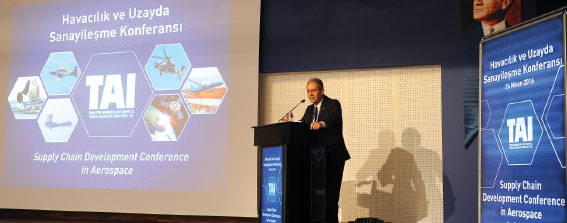
TAI Supply Chain Development Conference in Aerospace
Within the scope of developing the Aerospace and Aviation Systems, with the “Industrialization in Aerospace and Space Conference” held at Turkey’s Technology Center TAI facilities on 26 April 2016, the relevant industrialists and representatives of governmental institutions and private associations gathered in order to make an assessment of the current developments and share the ideas for further growth with the sub-industry. Representatives from the Ministry of Economy, Undersecretariat for Defense Industries, Industry Clusters and Sub-Industry as well as Boeing and Airbus officials attended the conference-taking place at TAI facilities.
In his opening remark, TAI President and CEO Muharrem Dörtkaşlı stated that the volume of work transferred to the sub-industry was increasing each day in parallel with TAI’s development throughout the years and the products it delivered and added, “As TAI, presently we are sharing over 2 million hours of workload with our sub-industry. During the negotiations conducted in 2004 for the sale of TAI shares, in order to identify the value of the company as an asset, we envisioned that we would be executing the distribution of a workload consisting of 1.7 million hours and the value of the company was based on this estimation. I believe that we expanded our company by enjoying the growth power and potential of civil aviation since that day”. Noting that the growth of civil aviation was approximately 5% Dörtkaşlı said, “I assume that the fleet growth of Turkish Airlines would be at the level of 15%. Including the projects conducted with Airbus and Boeing, our growth remains around 24%. Therefore, I believe that we are doing our business well and in my opinion we are quite competitive. But is this enough? No it is not and we have to continue our progress in this path by increasing our achievements. Turkey has an export target of $ 500 billion set for the ambitious 2023 vision. I think that as the aerospace industry, we will be making important contributions toward this goal. For increasing our export volume to $ 500 billion within 7 – 8 years, which is currently at the level of $150 – 160 billion, we have to increase the exports per kilogram from $1.5 to $3. Only by this way, we would be able to achieve the $ 500 billion target.
Muharrem Dörtkaşlı also stressed that throughout the business packages and negotiations conducted with Boeing and Airbus, they always took initiatives with their belief in the sub-industry and continued, “There is a severe competition amongst the OEMs. Everybody is striving to increase his own profits. We are not confronting any problems with respect to quality and timely delivery. Yet, we need to be more competitive in pricing and make improvements. We expect from you to improve your processes as we do in this respect. I believe that only this way would we be able to bring a major and qualified aerospace business package to our country and make our mark with the projects we will accomplish”.
In his speech, Deputy Undersecretary for Defense Industries and TAI Vice President of the Executive Board Celal Sami Tüfekçi stated that as the Undersecretariat while assigning works to the main contractors in indigenous projects, they encouraged collaboration with the sub-industry companies and SMEs that fulfill the quality standards and underlined the severe importance of their taking part in the production and in domestic production’s gaining depth and added, “We will continue to encourage private sector’s participation in our projects in a more aggressive manner. Within the scope of the contracts we currently conduct, the contracts to be signed as part of the effective industry participation and off-set directive and defense industry projects to be executed by the Undersecretariat, domestic participation rate of 70% is demanded from the companies as an off-set commitment. Surely we aim to increase this rate to 100%. Turkey is proceeding towards this aim. Within the scope of the proposals submitted for the tenders, utilization of sub-industry and SMEs is encouraged for increasing the participation of domestic industry and gaining depth to the sector. In this respect, for extending the defense industry, our Undersecretariat stipulated main contractor companies’ cooperation with sub-industry companies and SMEs. Defense industry sector is known for its requirement of high quality production standards and utilization of advanced technologies. Although, we face budgetary restraints from time to time, we still observe that the companies in this sector are not quite affected by the global financial crisis. The companies which focus merely in the domestic market may fail to last in the sector. One of the most essential factors in achieving sustainability in the defense industry sector is through building close cooperation with the global companies of this sector, civil sector being in the first place. Therefore, the sub-industry companies and SMEs aiming to make their mark and last in the defense industry sector have to achieve the expected levels of quality standards. Within this framework, as our main contractor companies in the sector determine the sub-industry companies they consider the institutional infrastructure, quality system, production and material tracking systems, employment and sustainability of qualified personnel, certification sustainability, measuring – testing and documentation capability, certification of facility security. Last but not least the activities for increasing the quality as part of the sustained improvement are regarded during the selection. Our companies are going through quite though evaluation processes and actually these processes help the SMEs increasing their technology level. For this reason, sub-industry companies’ conception of the significance of sustainability and patience while aiming to proceed in the long-lasting indigenous projects of this sector bear great importance of our sector. Turkish defense and aerospace industry continues its development and strengthening with an increasing momentum. On our path towards industrialization in this new era, we are fully aware that the SMEs are the pioneering dynamic forces which would achieve the extension of the sector from their position at the lower part of the industrialization pyramid. As an indicator of the importance we attach to the SMEs, we are establishing an aerospace and space specialized organized industrial zone in Kazan district nearby our major main contractor TAI. This zone will be built in a concept far different than the existing organized industrial zones in Turkey, in a concept targeting advanced technology. Our expectation from our small-scaled industrialists is to focus on high-technology in line with these targets without losing any time”.
Foreign Trade Representative of the Ministry of Economy Mr. Türker Kocamış shared the incentive system of the Ministry of Economy with the participants. Kocamış noted that the incentive system was put into effect in line with the Decree no. 3305 in 2012 and added that they had 4 main goals as part of this system. Kocamış said, “We have four main targets as the Ministry. Promoting the strategic investments, increasing the efficiency of regional incentive implementation, raising the development level of the less developed regions and identifying and then providing more support to the primary investment areas. Moreover, our investment promotion program is composed of 5 main subjects such as promotion of regional investments, promotion of primary investments, promotion of large-scaled investments, promotion of strategic investments and overall promotion system”. Kocamış shared the incentive components applied within this scope with the participants as well and mentioned the following details:
VAT exemption (not paying any taxes for a domestic good)
Customs duty exemption (not paying the customs duty for an investment good purchased abroad),
Tax reduction (application of the income tax or corporation tax in reduced manner until the projected amount of the investment is built)
Insurance premium incentive
Investment space assignment (assigning a specific investment area to the investor in line with the procedures and principles identified by the Ministry of Finance)
Interest promotion (Regarding loans with at least one-year maturity used as part of the investment promotion region, Ministry’s financing the certain interest of the loans of which the investment amount up to 70% is paid),
Income tax withholding incentive
Mentioning that the incentive components applied varied based on the subject, size and location of the investment, Kocamış emphasized that through this they aimed to decrease the differences in the level of development. Kocamış continued, “Turkey is divided into six regions. As the development level decreases from 1 to 6, the rate of incentives increases. The priority investments for defense industry are amongst the most essential subjects. In respect of the priority investments, you benefit from the 5th Region incentives, regardless of the location of your investment. The investments with projects in defense area approved by the Undersecretariat for Defense Industries enjoy the 5th Region incentives. There are no minimum limits here. For Regions 1,2,3,4 and 5, the limit is 500 thousand TL and 1 million TL for the 6th Region. Manufacturing of the Aerospace and Space vehicles and their parts are promoted as part of the priority investments as the production process requires high technology. Besides, if you have an R&D project also supported by the Ministry of Science, Industry and Technology, KOSGEB and TÜBİTAK and if you are to invest in a product created as a result of this R&D activity, then you can benefit from the advantages offered as part of the priority investments”.
Kocamış stated that the associations wishing to make an investment of minimum 50 million TL in Aerospace and Space vehicles or discrete manufacturing could also apply for an incentive within the scope of the Large-Scaled investments and added, “We also have strategic investments besides these. For enjoying this incentive package implemented in order to reduce the imports and increase the domestic production in areas with total production capacity less than imports, our companies have to fulfill four criteria. Initially, the minimum amount of investment should be over 50 million TL, the total domestic production capacity should be less than imports, added value should be at least 40%, and the total import amount regarding the product you wish to manufacture actualized during the last one-year period should be over 50 million US$. You can benefit from the strategic investment incentive if you fulfill these conditions”.
TAI Aerostructure Group Head Mr. Bekir Ata Yılmaz stated that the number of civil aircrafts was identified as 20 thousand in 2015, adding that these aircrafts’ lifetime would be expiring in 2034 and that this figure would be reduced to 5 thousand. Yılmaz said, “These aircrafts need to be replaced. 15 thousand aircrafts would be renewed. Besides, the aerospace markets of Far East and China are growing. Demand for 20 thousand aircrafts is being identified in that region and if we include this demand as well, a requirement for 40 thousand aircrafts emerges. Excluding the 5 thousand aircrafts remaining in the inventory in 2034 from this estimation, 35 thousand new aircrafts will be manufactured and the value of this is in the world economy is $ 5 trillion in today’s figures”.
At the second part of his presentation Yılmaz shared information on the OEMs and the commitments assumed by the suppliers in the new era. Yılmaz said, “In 1990 and the years before the OEMs used to undertake the most important part of the work. Yet, a new trend emerged and developed between 1990 and 2010. Aircraft manufacturers started to reduce the workload at their factories and assign more work to the sub-industry. The works outsourced to 1st level suppliers were assigned to 2nd or even to 3rd level suppliers by the 1st supplier. As a result, certain issues emerged in the timely delivery and quality of the works assigned. As the customer’s expected level of efficiency could not be achieved, after 2010 instead of distributing work to any given supplier, the works were assigned to a limited number of reliable suppliers. In line with this new trend, the expectations of the OEMs, competitive and reasonable prices, high-quality delivery performance and sufficient capacity concepts gained priority. As TAI, we function as the 1st level supplier. Sufficient financial capacity, accomplishment of active sub-contract management, achieving contribution to the creation of value-added works and having skills for assuming risks with the OEM are expected from the 1st level supplier. As TAI, we believe that we carried this task to a certain level as a 1st level supplier. Within this scope, we wish to walk on this path together with the sub-industry companies. If there is a capability which would contribute to the works assumed by our industry, we prefer to benefit from our sub-industry’s infrastructure instead of investing in that area. We are able to expand our business volume in this respect. We can conduct qualified export activities”.
OSTIM President Mr. Orhan Aydın, Airbus Head of Supply Chain Quality Dr. Lars-Andre Scheimann and Boeing Central Asia, Europe and Africa Director Mr. Paul C. Anderson gave speeches during the event as well.
Upon the completion of the opening remarks, program continued with the following panels; “Supply Chain Development Panel” moderated by Roketsan Board Member Prof. Ziya Burhanettin Güvenç and “Supply Chain Development Applications Panel” moderated by İstanbul University Head of Supply Chain Sciences Prof. Murat Erdal. After these panels, the TAI Sub-Industry award ceremony was held.
TAI cooperates with 90 suppliers in 11 cities in Turkey within the scope of the indigenous projects and the collaborations with major aerospace companies of the world. TAI collaborates with the sub-industry in component design and production, machining, cable harness manufacturing, surface treatments, tempering, sheet metal forming, composite parts production and sub-assembly areas. TAI procures 2.2 million parts per year from the sub-industry and therefore provides an employment opportunity of 2.2 million man/hours. Within this scope, the awards were given by TUSAŞ Chairman of the Board Mr. Nejat Bilgin and TAI President and CEO Mr. Muharrem Dörtkaşlı to the representatives of the sub-industry companies successfully accomplishing the timely delivery, delivery in accordance with the quality requirements, increasing capacity through new investments and capability acquisition in 2015.
Mikron Engineering Company was selected as the sub-industry company with the highest delivery performance in 2015 and Küçükpazarlı Kardeşler Company was the one with the highest quality performance where components and apparatus designer and manufacturer MKF Company was granted with the award of the sub-industry company with the highest performance in both quality and delivery.
Moreover, during the ceremony, among the sub-industry companies supplying products to TAI and making new investments and improving their capabilities were given awards; ME-GE Teknik Company completing its investment and qualification on cabling metal winding, Hezarfen Company accomplishing its investments and qualification training on sub-assembly, Yepsan Savunma ve Havacılık Company completing sheet metal forming investments and qualification and Gür Metal Company concluding its aluminum precision casting investment and qualification.