TEI-PD170-DT Turbodiesel Aviation Engine Through the Eyes of an Engineer
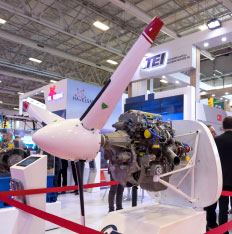
Developed to power Medium-Altitude Long-Endurance (MALE) Class Unmanned Aerial Vehicles (UAV), the TEI-PD170 diesel aviation engine is very light thanks to the cylinder block and cylinder head cover made of aluminum alloy. Following the acquisition of high-temperature strength and wear resistance aluminum alloy technology as part of the AYNA Project signed between the SSB and İTÜ-İTÜNOVA TTO, and VIG Metal, the domesticity rate of engines has reached very high levels. When we look at the cylinder head cover of the new generation DCI type engine with Common Rail technology and completely managed by a domestic and national Electronic Control Unit (ECU), we see that it has a double overhead camshaft (DOHC) mechanism. Since TEI-PD170 is planned to power the aircraft, a timing belt is preferred to drive the camshaft instead of gear, chain, or shaft to be lighter. I believe that the exhaust valves are made of standard steel alloy, while the intake valves are made of titanium for the engine to provide more torque and power. Titanium intake valve springs are 3-4 times harder than standard valve springs. In this way, the camshaft cams close much faster when the pressure on the intake valves is terminated, thus minimizing the leakages.
TEI-PD170-DT (Dual Turbo), which has very efficient fuel consumption, has 4 cylinders with a total volume of 2,100cc. Compared to the TEI-PD180-ST (Single Turbo) engine, which has one large-diameter turbocharger but is 10kg lighter and 10hp more powerful at sea level, the TEI-PD170-DT has 2 serial-connected turbochargers (two-stage turbocharging) to maintain the power it produces at high altitudes. The reason for choosing a serial turbocharging system is that the air compressed by the first turbocharger is then further compressed by the second turbocharger so that the engine is less affected by the low oxygen amount at high altitudes. If parallel turbocharger configuration were preferred, the "headers" (exhaust manifolds) shared by the 4 cylinders would be divided into two, and the exhaust gas pressure would be shared halfway between the two turbochargers. In this case, due to the small volume of the engine, the exhaust gas pressure would not be able to rotate the turbine blades at sufficient speed, and the engine would lose power. Smaller diameter turbochargers could be used to prevent this, but in this case, since the diameter of the snail fans would also get smaller, the compressor output would also decrease, and nothing would change. Therefore, only a serial turbocharging system can be used. All turbochargers used on the TEI-PD engine family also have a "wastegate" system. In short, this is a security system that regulates the maximum boost pressure in turbocharger systems to protect the engine and the turbocharger. The turbine blades, which operate at around 600°C and are under a great load due to centrifugal force, reduce their efficiency by changing their angle to allow excess exhaust pressure to bypass the turbine and limit their rotational speed. It is not difficult to estimate the load on turbine blades rotating at 200,000 RPM (revolutions per minute) due to centrifugal force. However, when turbochargers without a "wastegate" system are used, the engine's power output will be much higher. While the turbocharger on the 172hp TEI-PD170-DT engine has a typical boost pressure of 0.9 – 1.8 bar, the TEI-PD222 engine, which was increased to 2.0 – 3.0 bar, provides more power and torque, and the power-to-weight ratio has been improved further. There is also a model named TEI-PD222-ST that is 10kg lighter with a single turbocharger. From PD155 to PD222-ST, all engines in the expanding diesel engine family developed by TEI have in-line cylinder block arrangements. Compared to V or VR type engines, in-line engines stand out with their ease of production and lower cost advantage.
All members of the TEI-PD Aviation Engine Family use a 180-degree Flat Plane Crankshaft. Therefore, the ignition angles (crank angle) of the crankshaft are 180-360-540-720 degrees, respectively. In our 4-stroke engine, the piston completes four separate strokes (full travel of the piston along the cylinder) during the 720-degree rotation of the crankshaft. These are Intake, Compression, Combustion, and Exhaust, respectively. When we consider the ratio 360(2)/4=180-180=0 (our block angle is 0 degrees since it is an in-line engine) and the crankshaft angle is 180 degrees, we see that our engine has a very balanced structure. Although there is no balance problem in in-line engines since the block angle is 0 degrees, the straight crankshaft has chronic vibration problems at an acceptable level at certain rev ranges.
When we look at this type of crankshaft at a 180-degree (horizontal) angle, we see that when the arm bearings are at the top dead center or bottom dead center, they form a straight line named "Flat-Plane Crankshaft." Although engines with a 180-degree flat-plane crankshaft have both advantages and disadvantages compared to engines with a 270-degree cross-plane crankshaft, they have more disadvantages. When we look at the 270-degree cross-plane crankshaft from a 180-degree horizontal angle, the arm bearings form the "+" shape.
The flat-plane crankshafts may seem more efficient because of their advantages, but this is a relative concept.
They are lighter as there will be less counterweight. Therefore, since they will be exposed to less inertia and centrifugal force, they allow higher rotational speed and therefore produce more power.
If we look at the disadvantages of flat-plane crankshaft engines, they are very long due to the 180-degree angle difference between the sleeve bearings, and they produce less torque as their ignition gap is 50% more than the cross-plane crankshaft engines. The engine can reach its true potential at very high revs. However, considering that it is impossible and unreasonable to achieve high RPMs with diesel engines, it is also unnecessary for the TEI-PD series engine family. Additionally, since the engine needs a significant amount of oxygen for high RPM, we can see that its speed drops severely due to lower oxygen at high altitudes. Therefore, as the altitude of the aircraft increases, the advantages offered by the flat-plane crankshaft decrease.
If we look at the advantages of the cross-plane crankshaft, the angle difference between the sleeve bearings is only 90 degrees. In a 4-cylinder engine with a cross-plane crankshaft, one piston is fired for every 90-degree rotation of the crankshaft, while in a flat-plane crankshaft, it is 180 degrees. The cross-plane crankshafts produce higher torque because their firing interval is shorter. Therefore, they have a much better throttle response in the entire rev range. An example is the classic V8 American Muscle cars. Looking at the dyno test results, they have a smooth torque and power curve at lower and middle RPMs. Because they are much more balanced, they have lower vibration and a very pleasant-sounding acoustic signature.
The disadvantages are that the crankshaft is both larger and heavier, as more counterweights will be used. Because the crankshaft is heavier, it has more inertia, so it is reluctant to turn at high revs. Since even 1 kilogram is vital in an aviation engine, extra engineering work is required to lighten the engine.
If we use a cross-plane crankshaft in the TEI-PD170 engine, maybe it will produce 160hp instead of 172hp at full throttle, but it will be able to go up to 25,000ft - 30,000ft altitudes without loss of power. Moreover, with the development of material diversity in Turkey, the engine can be expected to become lighter. The weight and inertia of the cross-plane crankshaft can be reduced by using titanium with a relative density (specific gravity) of 4.51gr/cm3 instead of forged steel with 7.73-7.83gr/cm3 in the connecting rods. This will allow higher RPMs than before, although not as much as a flat-plane crankshaft