"The future of Unmanned Naval Systems and Türkiye`s Potential"
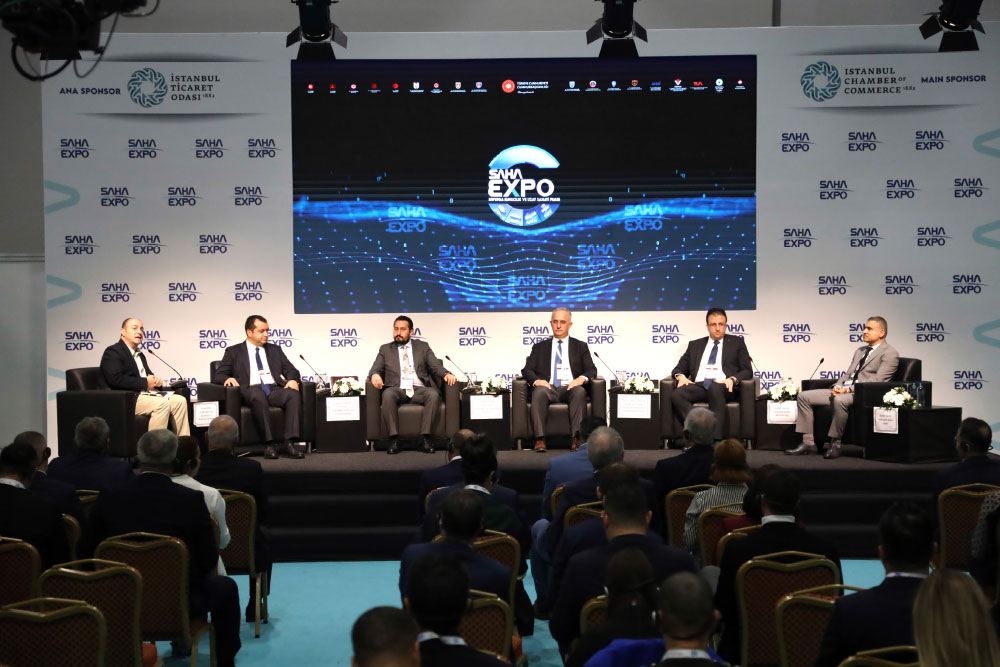
In the first part of the panel, Defense Industry Agency Head of Naval Platforms Department Cenk Cumhur KIYKIM spoke about the advantages of 4 different unmanned platforms, which are being developed by the leading Turkish defense industry companies under the Unmanned Surface Vehicles Program initiated by the Defense Industry Agency (SSB), and shared their expectations and goals of the project. Cenk Cumhur KIYKIM underlined that their expectation from the program, which is being carried out under 4 different contracts, is to create unmanned platforms that are operationally different from each other with their specialized payloads: "Reconnaissance, surveillance, and anti-surface warfare are standard requirements under each contract. We have assigned one platform for Electronic Warfare and another platform for Mine Countermeasure operations. Additionally, we have designated another platform for Anti-Submarine Warfare. The last task we set is the development of organic UAV capability for our unmanned surface vehicles. So each USV has different payloads. We can expect a lot from these platforms operationally. There is also competition between the parties in terms of autonomous capability."
Underlining that the work on anti-surface warfare is being developed very quickly, KIYKIM stated that all platforms can accurately engage moving targets or more than one target with long-range weapon systems and show these capabilities. "There are different requirements for USVs in the maritime environment, and it is not suitable to meet all these needs with a single platform design. So, we expect these platforms to take shape according to the operational environment. As I mentioned, the next step in our roadmap is to define how we can improve operational concepts or gain other capabilities. We will be considering these as well."
Moderator Tolga ÖZBEK addressed the panelists on the project's production and development side and asked how the process is managed in this new model, in which the Shipyard and System Integrators formed partnerships.
Speaking first, Samet BİLEN, Planning Manager of Yonca-Onuk Shipyard, stated that Yonca-Onuk Shipyard is a world-renowned company that manufactures 176 fast patrol/attack craft from advanced composite materials in 10 different countries. "As part of the business model put forward by the Defense Industry Agency (SSB), we have made certain updates in terms of autonomy with our business partner considering the requirements of the Turkish Navy. We are currently testing autonomy features. Although we seem to be competing in the autonomy part of the project, one of the most meaningful highlights of the project will be the modular payload capability with replaceable sensors and weapon systems. One of the most important principles was that the USV platforms could execute various missions and operations in different environments and maritime conditions. In this context, at Yonca-Onuk Shipyard, we designed our platform based on a proven product. You can consider our design in this project as a further iteration of a vessel we have previously delivered to the Turkish Navy."
Working with Yonca Onuk Shipyard on the development of the SANCAR AUSV platform, Murat MELÜL, Team Leader of HAVELSAN, stated that they have transferred the capabilities they have acquired in unmanned aerial (UAV) and ground vehicles (UGV) to this project and said: "As HAVELSAN, we employ our know-how and capabilities on command and control systems in this project. We are developing the ADVENT Combat Management System to form the mission system of the SANCAR AUSV. The SANCAR AUSV is designed for military operations such as intelligence, reconnaissance & surveillance, maritime patrol, anti-surface warfare, and mine countermeasure operations. We also consider that USVs can be used for harbor security, critical facility protection such as offshore gas and oil rigs, against asymmetric threats and piracy, and ensuring the security of critical areas and maritime security operations. Unmanned Surface Vehicles also can be used in harsh sea conditions and operations, which can be dangerous to ships with human crews and contaminated environments with chemical, biological, and nuclear waste. The SANCAR AUSV is ready to complete all these tasks."
Regarding the MARLIN and MIR USV systems, which are under development in partnership with ASELSAN-SEFINE Shipyard, Mustafa L. CİVELEK, Manager - Strategic & Unmanned Systems of SEFINE Shipyard, shared information about the ongoing process of the program: "Under the coordination of the SSB, we are developing the MARLIN AUSV with our business partner ASELSAN as a modular platform with anti-surface warfare capabilities as well as additional features. We are primarily focused on making the platform capable of operating at very long ranges in all phases of naval warfare and attach particular importance to its ability to operate in harsh sea conditions. We are concentrating on its capability to support naval operations not only in coastal waters but also in the open seas. We are also making serious efforts to localize the entire platform, including the propulsion systems. We pay special attention to taking our measures in advance by anticipating the interoperability of our systems and the interaction of the payloads with the platform. Last September, we gained valuable experience in a NATO exercise. We participated in 2 different exercises where nearly 100 surface and underwater USVs and UAVs worked together. These exercises allow us to mature the project development with experience in a real operational environment. We also plan to strengthen further the combat capability of our platform with new-generation fuel technologies and propulsion systems."
Vice President of ASELSAN Ahmet AKYOL underlined that ASELSAN started working on Unmanned Surface Vehicles 10 years ago and that they have developed the ALBATROS USV platform and shared information about the details of the MARLIN USV: "Together with our partner SEFINE Shipyard, we were assigned to build the USV platform with Electronic Warfare payload by the SSB. In this context, we have now integrated the concepts of our Turkish Armed Forces in Electronic Warfare into unmanned surface vehicles. This system we developed successfully demonstrated its capabilities in NATO exercises. In fact, it is currently participating in the Antalya EHDEN (Electronic Warfare Exercise) held by the Turkish Armed Forces. There is a critical need to detect, jam, and deceive enemy air defense or maritime surveillance radars in our geography surrounded by three seas. The MARLIN USV was designed to meet this need to a great extent. It also has reconnaissance & surveillance systems such as KIRLANGIÇ and MARTI that we have developed nationally and ASELSAN's product, the STAMP weapon system. We are also working on another USV called MIR with our partner SEFINE Shipyard. We've separated some of the functions. MARLIN is focused on Anti-Surface Warfare, while MIR is focused on Anti-Submarine Warfare. MIR will feature different sensors as well."
In the second part of the panel, the future of USV systems that can operate together in swarms was discussed, while the importance of having a network-centered structure for these platforms to operate together with other manned surface and underwater elements was also mentioned.
Emphasizing that these platforms will not operate alone in naval operations, Defense Industry Agency Head of Naval Platforms Department Cenk Cumhur KIYKIM said: "Interoperability is very important. In naval warfare, you are not dealing with just one threat. So, you need more than one capability to eliminate multiple threats. Therefore, we are first focusing on providing specific capabilities to these platforms. Then, we will deliver these platforms to the Turkish Naval Forces and wait for trials. Some of these are currently being tested in the EHDEN exercise. We are expecting new concepts and requirements with feedback from these tests. We aim to use platforms that will have network-centered communication capability with all systems from underwater to surface, from land to air, and even to space."
Are Swarm USVs & AUSVs the Future of Naval Warfare?
The panel also discussed whether USVs & AUSVs are the future of naval operations. Regarding the matter, Samet BİLEN from Yonca Onuk shipyard said: "In this project initiated by the SSB, we have to create an autonomous system as per the rules to prevent conflict at sea. Our contract with the SSB also determines autonomy levels. We need to deliver an autonomous vehicle that can navigate at sea and return to a previously selected waypoint when it loses communication. We are currently testing this. We are working on a software system with our partner HAVELSAN. This software should also include certain features, such as navigating at sea, operating in swarms, mission planning, and returning to set waypoints. We can consider this as a future release in the second-third phase."
SEFINE Shipyard Strategic & Unmanned Systems Manager, Mustafa L. CİVELEK, shared his remarks on this new concept, the advantages it will bring, and the uncertainties it will create in maritime operations: "The joint operations of all manned and unmanned aerial, surface, and underwater vehicles will constitute the whole swarm in naval warfare. The world is still far from this concept. I'm not talking about technical capabilities. We all know that combining these technical capabilities can answer this specific issue one day. In naval operations, since group commanders had known each other for a long time, they could predict how they would act and decide. But it won't be like that anymore. The commander of the swarm you have just met will make a decision about your task force, which will directly affect you. This is a very interesting problem. In fact, it also has sociological, educational, and practical dimensions. We are just adapting to this concept. However, significant results will emerge when handled in an integrated structure in a planned and organized way. We have classical concepts and doctrines at our disposal. The Turkish Naval Forces can conduct naval operations in line with NATO concepts. In order to solve this problem, an exercise was carried out with manned and unmanned ships taking part together for the first time in the world. The unmanned exercise was very straightforward, smooth, and very concrete. The only hindrance was the weather conditions in the ocean. The MARLIN AUSV endured it too. We even undertook a mission that our British counterparts could not. But in a manned part of the exercise, humans, communication, and the unconventional rules for interoperability became a paradox. As a country aware of this problem in the broader concept, we must act together with all relevant organizations. We have a concept that needs to be evaluated holistically, including maritime conflict laws, rules, and their regulations. I want express that it would be very valuable to intensify such panels and workshops to integrate studies on both academic and administrative regulations into this concept to raise awareness on this issue."
Vice President of ASELSAN Ahmet AKYOL: "We Aim To Demonstrate The Swarm Mission Capability with Eight Ships Soon"
Vice President of ASELSAN Ahmet AKYOL stated that ASELSAN had reached a certain level in swarm operations as the System Integrator. "We successfully demonstrated swarm capability with four unmanned platforms in the Mediterranean. We have another USV called ALBATROS-S. It can also operate in a swarm of four. We plan to demonstrate swarm capability with eight platforms in a few months. In this direction, we are proceeding with a roadmap for USVs to perform assigned tasks autonomously in swarms by increasing their artificial intelligence and autonomy capabilities. In fact, this concept will turn into a game-changing capability on the battlefield when it evolves to conduct swarm attacks with mission-specific weapon systems while your manned ships are defending themselves during a conflict. We have now accomplished the four-ship swarm capability and will hopefully demonstrate an eight-ship swarm soon."
Team Leader of HAVELSAN Murat MELÜL stated that interoperability is crucial at this stage and said: "A new version of ADVENT CMS, named ADVENT ROTA, will be used for the first time in an unmanned vehicle. So, when the SANCAR AUSV deploys on the field with the mission system, it will be able to perform tasks with the command and control ships through common network capability."
What is the Technological Readiness Level of USVs in the World?
SEFINE Shipyard Strategic & Unmanned Systems Manager Mustafa L. CİVELEK made important statements in the last part of the panel on the development of unmanned surface vehicles used in the world, which have completed their technological development. "We examined 25 important unmanned surface vehicles in the world participating in the exercise. Of course, there are more, but I am talking about the first 25, which can be used in naval warfare. Most of the 25 vehicles have actually completed their technological development and reached Technology Readiness Levels (TRL) of 5-6-7. These 25 vehicles do not have any technical-technological problems. When we look at the mission concepts of these 25 vehicles, we see that most of them are based on 10-15 meters platforms designed for payloads that can be used in naval warfare. A significant part of the USVs that joined this exercise were small vehicles. This was quite interesting. But those small vehicles had difficulties operating in the ocean. Only four or five countries have experience with larger platforms at 20, 27, and 40 meters; however, they were not among the participants in the exercise. Operational requirements define the speed of the vehicles. Some vehicles can reach 50 knots, while others have 12 knots, but they are all optimized for their missions. Another important parameter is "endurance." There is one research platform designed to stay at sea for 100 days. It is not operational yet, but it only focuses on whether it can remain at sea for 100 days. It works with new-generation fuel technologies. Another platform can stay at sea for 70-80 days. They are working to increase its endurance to 90 days. Apart from that, the vast majority of the platforms we observed have an endurance of 1-2 days; 2 days is very few, and most of them can operate at sea for less than 1 day. Autonomy is one of the most critical parameters of these systems. I divide autonomy into two; navigational and mission autonomy. There is a significant difference here. Since we mostly concentrate on navigational autonomy, there are no major problems in reaching TRL 2, 3, or even 5 in navigational autonomy. But Mission autonomy is still in its infancy. In terms of mission autonomy, similar platforms are still on TRL 1 or 2. At least, I have not heard of a mature system that has reached TRL 3 mission autonomy. I didn't see it in the NATO exercise either. When we examine them in terms of their payload-carrying capacity, the majority of these platforms are around 1-2 tons. There aren't many platforms that can carry 3 or 5 tons. There is one special platform designed to carry 16 tons. There is also the power generation issue. In other words, the energy required to operate the payloads is around 1-2 kW. Generally, we can talk about the installed power of about 5 kW. There is a platform that can supply 100 kW. An example that we should study well. It is necessary to evaluate why such a great power is needed. I don't think that every platform needs that much power. But when we look at the studies in our country, I believe that they are at or above the average of the foreign unmanned platforms I mentioned."
CİVELEK stated that they expect that unmanned systems will constitute up to 30% of the world's leading navies in the next 5 years. "Unmanned systems have a very interesting potential, not only for military uses but also for civil and dual-purpose uses. We receive serious requests from Norway, with which we have an export relationship, to build unmanned ferries for them. We conducted joint feasibility studies on this subject and reviewed our capabilities. We are investing twice as much in our infrastructure. We make serious efforts for our indoor shipbuilding sites. We do this to be able to work 24/7 in all seasons and present our work in a competent and paced manner. I also want to mention that platforms should no longer be viewed as projects but as products. Platforms should be reproducible, sustainable, cost-effective, and rapidly built within a product family. Because responding to a potential need 2 years later does not interest anyone right now. That's why we need to establish our infrastructure and production lines in a way that will respond quickly to market needs."
Vice President of ASELSAN Ahmet AKYOL emphasized that with the development of missile technologies, there is a shift towards expendable, cost-effective autonomous systems. The world is changing in the land, air, and sea domains. There is a transition towards more mobile, compact, and lighter solutions in ground vehicles. When you look at the future plans of the world's navies, there is a transition towards faster ships with lighter displacement to spread the risks. Of course, the basis of this is the advancements in missile technology. Precise strike capability has gained importance. As you know, a very large ship was sunk by two missiles in the Black Sea. The world is currently debating whether to put such assets on board a vessel. The development in missile technology is pushing people towards more mobile, compact, and autonomous systems. When we switch to unmanned systems, we don't need to protect them like manned systems. Today, investments and measures to protect a ship, aircraft, or tank cause severe cost increases. The transformation brought by unmanned systems leads us to more cost-effective, expendable, and autonomous systems as much as possible in all three domains. We are an electronics company that produces and develops payloads. All systems, including artificial intelligence and the sensors processing it, are in our core business. There is also a trend in shifting from payloads made for manned systems to special payloads made for unmanned systems. Because when we increase the number of platforms and make it cost-effective, the payloads are also expected to be cost-effective."
In the last part of the panel, moderator Tolga ÖZBEK asked the panelists about the payloads of the AUSV systems.
Head of Naval Platforms Department Cenk Cumhur KIYKIM stated that live fire tests were carried out with different munitions and added: "We fired missiles from our platforms in tests. We used CİRİT in the surface-to-surface role. We are also working on possible testing of KUZGUN and SUNGUR missiles in the future. We are conducting studies with our institutions, such as ROKETSAN and TÜBİTAK SAGE, to use different munitions on AUSV systems. These missiles are currently employed in a surface-to-surface role, but in our future vision, additional capabilities such as surface-to-air missiles or torpedoes will also be possible."
Vice President of ASELSAN Ahmet AKYOL emphasized that ASELSAN has both electro-optical camera systems needed to guide munitions and other cameras for reconnaissance and surveillance that do not require guidance. Ahmet AKYOL stated that they also focused on unmanned submarine concepts, which have an important place in their road maps. "Submarines are the most strategic, game changer, and deterrent capability in naval warfare. The unmanned submarine systems are also on ASELSAN's roadmap. Communication systems are the most critical element after navigation in underwater vehicles. For more than 20 years, we have provided navigation systems to the Turkish Armed Forces and have started a new project with the SSB. It is directly related to submarines. We are now working on a strategic navigation system under the leadership of the SSB with the participation of our universities. When we deliver this capability, it will be possible for submarines to navigate underwater both manned and unmanned for a long time"