The Science of Protection Dynamics of Ballistics Testing and Armor Standards

Throughout history, humans have always felt the need to protect themselves, which led to the development of weapons - from stones and clubs to the advanced technologies of today. As armament spread, people sought protection against the threat of weapons, resulting in the use of shields and armor. While fighting with hard objects, humans also used hard objects to protect themselves. Wars have played a significant role in shaping weapon and armor technology. In the 13th century, steel armor emerged as a shield against dangers, enveloping the entire body of a person fighting with swords or protecting themselves. With the invention of gunpowder and firearms, weapon technology evolved rapidly. As weapons became smaller and more effective, the need for high-performance, lightweight armor for vehicle and personnel protection became inevitable.
Metals have always played a crucial role in armor technology due to their favorable mechanical properties, such as toughness, strength, and hardness. However, the density of metals is higher compared to other engineering materials, making them heavier. It is quite challenging for an individual to carry heavy armor and move quickly with that weight. Similarly, high weight reduces the mobility of a vehicle. Therefore, technology has focused on the production of lightweight armor to address these issues.
The ballistic performance of engineering materials should be known when selecting the most suitable armor material to protect civilian or military systems with the lowest possible weight against various threats. Ballistics studies the movements of objects that are fired or propelled under the influence of gravity and atmospheric conditions, especially shrapnel (fragments), bullets, and rockets. It is generally divided into four parts. These are:
Internal Ballistics: Internal ballistics covers the time from the propellant's ignition until the projectile exits the gun barrel. The study of internal ballistics is important to designers and users of firearms of all types, from small-bore rifles and pistols to high-tech artillery. For rocket-propelled projectiles, internal ballistics covers the period during which a rocket motor is providing thrust.
Transitional Ballistics: Also known as intermediate ballistics, it is the study of a projectile's behavior from the time it leaves the muzzle until the pressure behind the projectile is equalized, so it lies between internal ballistics and external ballistics.
External Ballistics: External ballistics deals with the behavior of a projectile in flight. The projectile may be powered or un-powered, guided or unguided, spin or fin-stabilized, flying through an atmosphere or in the vacuum of space, but most certainly flying under the influence of a gravitational field.
Terminal Ballistics: Terminal ballistics studies how a projectile behaves when it hits its target and transfers its kinetic energy to the target. The bullet's design, as well as its impact velocity, plays a massive role in how the energy is transferred.
The most effective way to penetrate and damage a target is achieved with armor-piercing kinetic energy projectiles or shaped charges. Kinetic energy projectiles do not contain explosive material. The tip of the projectile is made from Tungsten (W) or Uranium (U) through sintering. The penetrating effect of these projectiles on the target depends on the caliber of the projectile, the energy of the projectile, the angle of impact, and the metallurgical structure of the projectile and armor material.
Ballistic protection deals with body armor and protection levels. The ballistic requirements for military and police armored vehicles are generally defined by international standards. The standards of the National Institute of Justice (NIJ) in the United States are the most commonly used in this field.
National Institute of Justice (NIJ) Standards
A number of different types of tests in this field are completed at a variety of ballistics testing facilities. Most tests are done in state-of-the-art indoor testing ranges that are equipped with NIJ- and CAST-approved equipment to measure and record the results of each test. The goal is to minimize the number of variables present during the test. Equipment intended for use in law enforcement or military applications must pass both NIJ- and CAST-certification testing. The National Institute of Justice (NIJ) is responsible for the development, testing, and certification of both ballistic-resistant and stab-resistant body armor in the United States. Similarly, the Centre for Applied Science and Technology (CAST) performs the same function for the United Kingdom. Any equipment used by law enforcement or military personnel must meet either NIJ or CAST standards, depending on where it is manufactured and used.
Since 1972, the National Institute of Justice (NIJ) has been establishing voluntary standards for body armor. The NIJ standard is the only accepted standard for the body armor worn by law enforcement and corrections officers in the United States. NIJ also administers a program to test commercially available armor for compliance with the standards to determine whether the vests meet NIJ's minimum performance standards. The NIJ ballistic resistance standard classifies body armor by levels of ballistic performance. Regardless of the performance level, NIJ's test protocol requires that the bullet should not penetrate the vest. Additionally, the vest must protect against blunt trauma.
According to the U.S. Department of Justice, "Ballistic Resistance of Body Armor NIJ Standard-0101.06", personal body armor covered by the NIJ standard is classified into five types (IIA, II, IIIA, III, IV) by the level of ballistic performance. In addition, a special test class is defined to allow armor to be validated against threats that may not be covered by the five standard classes. If an armor plate provides two or more levels of NIJ ballistic protection at different locations, it is classified based on the minimum ballistic protection provided at any location on the plate.
Level IIA: Tested to stop 9 mm and .40 S&W ammunition fired from short-barrel handguns. No rifle ammunition protection. Type IIA armor that is new and unworn is tested against 9 mm Full Metal Jacketed Round Nose (FMJ RN) bullets with a specified mass of 8.0 g (124 gr) and a velocity of 373 m/s ± 9.1 m/s (1225 ft/s ± 30 ft/s) and against .40 S&W Full Metal Jacketed (FMJ) bullets with a specified mass of 11.7 g (180 gr) and a velocity of 352 m/s ± 9.1 m/s (1155 ft/s ± 30 ft/s).
Level II: Tested to stop 9 mm and .357 Magnum ammunition fired from short-barrel handguns. No rifle ammunition protection. Type II armor that is new and unworn is tested against 9 mm FMJ RN bullets with a specified mass of 8.0 g (124 gr) and a velocity of 398 m/s ± 9.1 m/s (1305 ft/s ± 30 ft/s) and against .357 Magnum Jacketed Soft Point (JSP) bullets with a specified mass of 10.2 g (158 gr) and a velocity of 436 m/s ± 9.1 m/s (1430 ft/s ± 30 ft/s).
Level IIIA: Tested to stop .357 SIG and .44 Magnum ammunition fired from short-barrel handguns. No rifle ammunition protection. Type IIIA armor that is new and unworn is tested against .357 SIG FMJ Flat Nose (FN) bullets with a specified mass of 8.1 g (125 gr) and a velocity of 448 m/s ± 9.1 m/s (1470 ft/s ± 30 ft/s) and against .44 Magnum Semi Jacketed Hollow Point (SJHP) bullets with a specified mass of 15.6 g (240 gr) and a velocity of 436 m/s ± 9.1 m/s (1430 ft/s ± 30 ft/s).
Level III (Rifles): Tested to stop 7.62mm FMJ lead core rifle ammunition. Type III hard armor or plate inserts, as well as Type III flexible armor, is tested in both the "as new" state and the conditioned state against 7.62 mm FMJ, steel jacketed bullets (U.S. Military designation M80) with a specified mass of 9.6 g (147 gr) and a velocity of 847 m/s ± 9.1 m/s (2780 ft/s ± 30 ft/s). NIJ-approved hard armor and plate inserts must be clearly labeled as providing ballistic protection only when worn in conjunction with the NIJ-approved flexible armor system with which they were tested.
Level IV (Armor Piercing Rifle): Tested to stop .30cal steel core rifle ammunition. Type IV hard armor or plate inserts, as well as Type IV flexible armor, is tested in both the "as new" state and the conditioned state against .30 caliber armor piercing (AP) bullets (U.S. Military designation M2 AP) with a specified mass of 10.8 g (166 gr) and a velocity of 878 m/s ± 9.1 m/s (2880 ft/s ± 30 ft/s). NIJ-approved hard armor and plate inserts must be clearly labeled as providing ballistic protection only when worn in conjunction with the NIJ-approved flexible armor system with which they were tested.
Ballistics Testing
Ballistics testing is a standards-based process that involves testing products to determine if they meet safety, performance, and protection criteria. Most law enforcement and military applications, as well as commercial research and development programs, rely on ballistics testing. Ballistic testing can vary dramatically from one test to the next, depending on the needs of the individual requirement, such as low velocity and fragmentation, small and medium-caliber threats (up to 30mm), spiked and edged-weapon threats for stab-proof vests (UK CAST), non-lethal threats (blunt weapons, etc.), and blast testing (mines, IEDs, etc.)
While nearly any product can be tested for its resistance to ballistics, the most common applications for this form of testing are:
Personal protective equipment: Bulletproof vests and other equipment worn by law enforcement and military personnel.
Vehicle and structural armor: Bulletproof vehicles and glass both require sufficient ballistics testing.
Firearms and munitions: Both need to be tested before use to ensure that they are safe.
In order for ballistic steels to be used in military or civilian applications, it is crucial to determine their ballistic properties in advance. In determining ballistic properties, the use of armor terminology consisting of numerous different concepts, such as NATO angle (angular mil/milliradian), reference shot, V50 velocity, witness plate, and penetrator, is involved. There are generally two types of firing test methods for determining ballistic resistance:
Determining the ballistic limit, which is the maximum velocity (V) at which the projectile can be stopped, or
Determining the V50 value.
The V50 velocity is the speed at which the projectile is stopped with a 50% probability. The V50 velocity, an essential parameter for armor steels, is determined through Ballistic Tests conducted in accordance with NATO MIL-STD-662F Standard. According to NATO standards, this is defined by firing projectiles at speeds assumed to be the V50 velocity onto the test sample. To calculate the actual V50 value, the highest three speeds at which the armor stops projectiles and the lowest three speeds of shots passing through the armor are taken into account. Ballistics Tests must be conducted on every armor plate produced. There are many control mechanisms before and after the Ballistic Test. After the Ballistic Test, each plate is given a certificate based on the test results.
Typical ballistic test instrumentation utilizes a Mann barrel gun system that comes in a variety of calibers. A Mann barrel is a test barrel that has thick walls and is designed for accuracy. The interior of the barrel has helical grooves (rifling) that induce the spinning of the projectile, which stabilizes the flight by minimizing yaw through the consequent angular momentum. The barrel is mounted with concentric rings instead of a manually held stock. Recoil mechanisms that incorporate hydraulic dampening are used for projectiles that are larger than 12.7 mm (.50 BMG). The gun system is remotely fired through electrical initiation, using either percussion-primed cartridges initiated by a solenoid-driven striker (for smaller calibers) or electric primers (for projectiles larger than 12.7×99mm NATO). To determine V-50, the projectile velocity is systematically changed until the minimum value needed for complete penetration is obtained. The projectile velocity can be changed by varying the type (e.g., burn rate) and amount (charge weight) of gunpowder.
As outlined in the "Measuring the Blast and Ballistic Performance of Armor" report (Naval Research Laboratory, 2015), testing requires a minimum of two penetrations and two stoppages (partial penetration), with a velocity spread that does not exceed 2%. For bullets that have speeds close to the V-50, both complete and partial penetrations may occur for apparently identical conditions. To avoid artifacts due to edge effects or damage from prior shots, multiple shots on the same target make the selection of the impact points critical. During testing, the gun barrel is kept in a fixed position, with the target holder translated to alter the shot location.
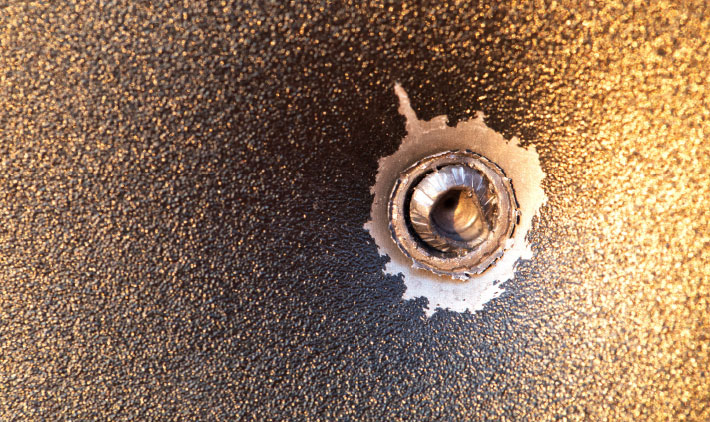
To determine V-50, it is necessary to evaluate how deep a projectile penetrates a target. Every projectile penetrates the target to some extent. When a projectile perforates a hole in the back side of the target that is big enough to let light pass through, it is called complete penetration. The hole can be caused by the projectile itself or by fragments of material that break off from the back of the target and scatter (i.e., spall). To measure complete penetration, a witness plate is placed around 15 cm behind the target along the line of the projectile's flight path. For most tests, a witness plate made of 0.5 mm thick 2024 T3 Al plate with a dimension of 30 cm x 30 cm is sufficient. However, to simulate the barrier for applications with a secondary barrier, the witness plate can be varied.
Armor design requires a careful balance between performance and weight. Therefore, both factors must be evaluated. Since most armor applications have specific performance requirements, any improvement in design often involves achieving the same performance with a lower weight and acceptable cost and the best design depends on the intended application