The world’s first Lightweight Airborne Surveillance Radar, Providing a 360-degree Field of View with no Moving Parts
A first look at the Osprey radar was given to members of the press at the product launch in London, England, on May 3rd, 2016, by Fabrizio Boggiani, Marketing & Sales Lead for the Leonardo Airborne & Space Systems Division and Brendan Nolan, Vice President Sales - Radar & Advanced Targeting for the Leonardo Airborne & Space Systems Division. Defence Turkey Magazine presented in the press event.
Leonardo, previously known as Finmeccanica, recently celebrated the launch of new radar from the Airborne & Space Systems division. The company made significant investments in the e-scan market approximately 10 years ago with the Seaspray - Active Electronically Scanned Array (AESA) products, which have resulted in a substantial step forward in technology that now provides radars with the ability to be more versatile. Sales have increased across the globe, from previously having been fitted on a few helicopters and a few fixed wings, to everything now from large and small aircrafts, aerostats and even unmanned platforms. The success of e-scan and the opportunities gained with electronically scanned radars are significant; resulting in not having pressurized wave guides, eliminating some of the technical challenges related to the installation of radars. These radars can be mounted much more easily. They are certainly a bit more expensive than m-scan, however the list of benefitting options and gained advantages are well worth it.
Superior Reliability And Operational Availability
At the core of the AESA radar design is the ability to tolerate individual element failure. Component failures within the array result in graceful performance degradation rather than complete system failure, delivering high operational availability when compared with conventional radar systems. Its high reliability and availability result in a reduced maintenance requirement and provides the option to reduce spares holding, resulting in significant cost benefits over the life of the system.
Multi-Mode Surveillance Radar
In order to meet the challenges of the 21st century, Osprey MM multi-mode surveillance radar provides second-generation Active Electronically Scanned Array (AESA) surveillance capability as the primary sensor on airborne assets. Osprey MM AESA radars are at a high technology readiness level (TRL) and are in production for fixed and rotary wing applications. Osprey MM’s forerunners, the mechanically scanned (M-Scan) and first generation AESA Seaspray radars have been delivering a high performance surveillance capability to armed forces and paramilitary users for more than 45 years. Osprey MM brings together wide azimuth and elevation electronically scanned (E-Scan) fixed antenna(s) with a compact, state-of-the-art Processor and multi-channel Receiver. Each array covers an azimuth sector of 120 degrees, with purely electronic scanning in azimuth and elevation. The handover from array to array is achieved via seamless automation. Modes are adapted to fully exploit e-scan capabilities, resulting in greater flexibility in scan rates and revisit times. There are increased interleaving options within modes, with additional interleaving now possible on a sector-to-sector basis.
Key Benefits
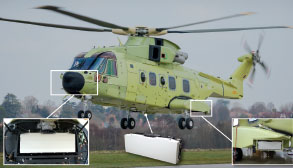
Class-leading maritime surveillance capability, AESA-enabled small target mode (STM), very high resolution, wide swath SAR Mapping, small radar cross section (RCS), low minimum detectable velocity (MDV), multi-channel moving target indication (MTI), Air-to-Air surveillance, track and intercept capability, instantaneous multiple mode interleaving, difficult target detection from high altitude, high reliability for persistent operations, flexible configuration, installation and integration. The system is reconfigurable to suit installation demands; the system can be configured to run with up to four arrays with the flexibility to install arrays at convenient points around the platform, providing maintained coverage with minimal platform impact. Benefits also include multiple fixed antennas, choice of antenna sizes, belly-free, obscuration-free 360° coverage, open standards interfaces, and compact, lightweight LRUs.
Key Features - Ideally Suited to Mixed Environment Operations
Osprey MM provides a genuine multi-domain capability, with high performance sea surveillance, notably against ‘difficult targets’, land surveillance with wide swath and very high resolution ground mapping and small and low speed ground target indication, high performance air-to-air surveillance, tracking and intercept. These capabilities, combined with the radar’s ability to rapidly interleave modes and provide scan-independent beam steering, make Osprey MM ideally suited to mixed environment operations, such as in the littoral. Osprey MM is a low size, weight and power (SWaP) radar system, offered with a range of antenna sizes that may include up to four fixed antennas, depending on the azimuth coverage requirement, and which leave the belly of the aircraft free for operation to and from unprepared surfaces; or for other antennas, sensors or weapon systems.
Osprey absolutely perfect for high-end maritime surveillance tasks
Looking for a periscope in a moving sea state has been described as a very difficult task, to say the least. On a manually scanned radar (m-scan) it tries discriminate the periscope from the clutter, by spinning very quickly to get as many hits as it can, in an attempt to eliminate the noise so that it gets a constant return. An m-scan radar operator will most certainly say that the scan needs to be done with a very high spin rate. The Seaspray brought in the ability, while spinning, to be able to electronically scan multiple times inside of that dwell period within that spin, while in the field of regard of the target. Now, with the Osprey the e-scan can occur all of the time.
Osprey Radar Evolutionary Design
Osprey is a product that compliments the Seaspray in the fact that it utilizes modes gained through years of investment and the subsequent acquired technology, understanding and experience. Of interest as well is the fact that some of the algorithms that were developed through the Vixen fire control range have been put into the Osprey as well. Modern processing technology, the increased processing power, along with the fixed plate array, has enabled the company to bring some air-to-air technology into a surveillance radar. In addition, modes have been taken from the PicoSAR, the overland battlefield surveillance radar, and placed into Osprey, making it a true multi-mode radar, able to prosecute the mission both overland and oversea with some basic air to air capabilities which gives end users a tremendous amount of flexibility when they are using a radar system.
The modes are fully exploited for e-scan. With one central processor, there is no need to have three separate radars. The 3 antennas which are feeding a separate processor, allows the aircraft an instantaneous view, the ability to look where ever it needs to look simultaneously. For example, synthetic aperture imaging can be conducted in one part of the field of view, while conducting air-to-air somewhere else and maritime surveillance in yet another field of view, that’s the true advantage of the Osprey.
Norwegian All Weather Search and Rescue Helicopter (NAWSRH) Program
The Norwegian requirement was an opportunity for Leonardo to shine, exceeding expectations. The environment that Norwegian helicopters operate in required a different design. Leonardo-Finmeccanica announced that the launch customer for the radar will be Norway, which has purchased Osprey as part of the country’s acquisition of 16 Leonardo- Finmeccanica Helicopters AW101s for the NAWSARH programme (Norway All Weather Search
And Rescue Helicopter). Leonardo Airborne & Space Systems Division was able to far exceed the requirements by offering the real value add of being able to take the radar off the under belly, to give them 360-degrees. One of their missions was to do Search and Rescue up in the narrow fjords, with the high cliff faces on either side; this radar with the AESA technology was able to offer processing capability much closer in to the aircraft itself, providing a useful radar picture within 10’s or 100’s of meters of the body of the aircraft. On a helicopter, such as the Norwegian Search and Rescue helicopter, which could be landing in snow and unpredictable terrain, the risk to damage or destroy underbelly radar was high. The design provides much more essential flexibility to the operators and the OEMs.
The Edinburgh Product Portfolio – Extensive History
The company has been at the forefront of the airborne radar market since the 1950s when the AI23 radar became the world’s first high power monopulse radar to enter squadron service. Maintaining their leading position in the market, they have been developing AESA technology since the early 1990s and now offer a world-leading range of AESA radar products that meet the requirements of the airborne radar market. Within their radar Centre of Excellence, they have designed, developed and supported radar systems for more than 65 years. Their software development capability meets the requirements of CMM Level 5. More than 3000 radar systems have been supplied for manned and unmanned fixed and rotary wing aircraft in surveillance, fire control and ground attack roles. They have extensive experience with surveillance radars and have produced more than 800 systems. Osprey MM is the latest addition to the portfolio of AESA surveillance radars, which includes Seaspray 5000E, Seaspray 7000E, and Seaspray 7500E, and PicoSAR.
The Seaspray family of m-scan radars has been successful on the AugustaWestland Lynx platform and more laterally the Blue Kestrel radar onto the Merlin. Significant partnerships have been established with many of the most important European programs, such as Typhoon for example – of which 60% of the avionics of the entire aircraft are provided by the Airborne & Space Systems division of Leonardo. Adding to Captor’s success on Typhoon, Captor-E is going on to the new Typhoon. Also Raven which is on Gripen, and Vixen which is smaller, have some customers in the US and around the world as well.
Airborne & Space Systems division - a significant player converting manned aircraft into an unmanned solution.
The Airborne & Space Systems division of Leonardo division is 55% based in the UK and 45% in Italy. In addition to Fixed and Rotary Wing platforms, the avionics (cockpit, computing, communication, navigation and identification) Sensors and Radars, they also are significantly involved in EW and Intelligence. The two main areas are related to the protection of platforms through specialized equipment and intelligence, typically onboard ISR platform both manned and unmanned. They also have an integrated missions system for ISR ISTAR missions. The division carries out significant activities in UAVs, unmanned solutions. They have their own platform, the UAV family called Falco, that consists of two different versions, one for one for shorter missions and one for longer persistent missions, which typically requires more than 18 hours of endurance. These platforms are significantly equipped with their own sensors and their own avionics. The division is the partner of Piaggio Aerospace for the P.1HH HammerHead for the conversion of the former P.180 from a manned aircraft into an unmanned solution. The division is responsible for sensors and mission systems on board and on the ground, including all of the avionics. In addition, target drones have been sold in 40 countries around the world.
This division works actively for the Italian space agency and the European space agency. There has been significant press attention regarding what they have accomplished for the Rosetta program, and also with what they have accomplished with ExoMars for the drillers, lunar drillers. They are very specialized in payload both for power supply onboard satellites and special robotic missions onboard satellites. Airborne & Space Systems works in cross-pollination with the other divisions of Leonardo. However, their division is also working independently in the market, serving and partnering with many platforms, manufacturers and system integration onboard airborne. Their identity and strategy is to be ‘platform agnostic’ in providing their solutions in avionic equipment and specialized mission sensors.
Future Prospects - Scalable product
The vision to achieve a fully populated flat pan array by utilizing existing technologies from Seaspray, combined with technologies from fire control radars was met with great success. The result is a concept that can be applied across a number of different areas. The company indicated that it would be relatively easy to scale up this product, however they are not currently investing in this at the moment. It is most definitely a feasible option for a customer to approach them with a specific requirement for a bigger antenna. These elements are being discussed at the moment, but it is not a product that they will have in their brochures, however company experts stated that it’s clearly something that’s easy to do.
Prior to product launch, 3 sales have been made behind the scenes – More on the horizon
At the product launch event, Leonardo Airborne & Space Systems Division shared that they have already sold this product to 3 customers. The one sale that is in the public domain is through the Leonardo helicopters division for the NAWSARH program. The other 2 customers for fixed wing products are in the US; further details were not disclosed during the product launch Q & A session due to non-disclosure agreements, however the company stated that they will be able to make an announcement soon. In addition, there is a bid for a 2 panel version in the US, awaiting a decision for Rotary Wing in the next 4 – 6 weeks. With company investments and the internal zeal to advance design and technology, the company estimates to be at last 5 years ahead of any of their competitors. They took the initiative and did not wait for government contracts. As a company they clearly recognize and appreciate that this type of technology is hugely important both to end users, who want the operation advantages of e-scan, and also aircraft manufacturers who want a simple, clean installation, with no moving parts, no wave guide, and that is electronically controlled. The Osprey excellently compliments the existing portfolio of radars.