Three Major Strategic Facility Investments by TÜBİTAK-Sage and Uzay – Charging Forward in the Race to Create High Value Added Products for the World
TÜBİTAK Uzay Optical Systems Research and Implementation Laboratory’s (OPMER) ground-breaking ceremony and opening ceremonies for TÜBİTAK Sage Advanced Integration Technologies, Mobile Flight Infrastructure (MFI) and Remote Test Monitoring Infrastructure were held with the participation of the Minister of Science, Industry and Technology, Mr. Fikri Işık, the Minister of National Defense İsmet Yılmaz, TÜBİTAK President Prof. A. Arif Ergin and numerous invitees.
In his speech at the ceremony, the Minister of Science, Industry and Technology, Mr. Fikri Işık noted that within the scope of the advanced integration technologies established at the TÜBİTAK Sage campus; critical activities such as laminated production, perforation, tempering, 3 dimensional laser cut, laser welding, coating and brazing would be conducted and added that the rapid, high-quality and indigenous production of high pressure tanks and missiles’ fuel tanks would be accomplished while missile trunks and high – strength steels could also be welded at once and in high quality.
Işık drew attention to the fact that two main functions could be executed with the help of the Mobile Flight Test Infrastructure and said, “Firstly, through telemetry system, real time data will be collected from flying ammunition and these data will be used for improving the design of that ammunition. The second function of this infrastructure -the flight termination system- will be terminating the flight of ammunition launched from orbit without giving harm to the environment. With the investments we will make throughout this Project, all the tests - from the initial flight stage to the end product - of all the national ammunition fulfilling the requirement of ‘Long Range Missile’ and ‘Multiple Target Tracing’ will be executed in Turkey through domestic resources”.
“We no longer leave our destiny in the hands of other countries”
Extending information on the soon to be established TÜBİTAK Uzay Optical Systems Center, Işık stated that the optical systems are a high value added area, such as is the case with energy, defense, space and medicine. Işık pointed out that Turkey was limited in infrastructure and qualified human resources aspects in this area and expressed that almost all the lenses, prisms and mirrors used in the imaging systems currently being developed in the country were being imported. Işık also stated that certain difficulties arose in the procurement of these products from time to time and continued, “A few days ago, the missiles of Roketsan installed into our unmanned air vehicle Bayraktar fired to the target which was 8 kilometers away with hundred percent precision. In the past, let alone the ones with destructive power, they did not even agree to sell the UAVs for observation purposes to Turkey. So what did we do? Firstly, we developed our unmanned air vehicles and now we have gained capability to fire missiles from these UAVs. We are no longer leaving our destiny in the hands of other countries. With the Optical Systems Center, we are aiming to accumulate know-how on the optical components, and nationalize the infrastructure and workforce. In this way, we will be able to develop the optical products we utilized in the indigenous projects through domestic facilities, and we will support Turkish industry’s leap in the optical products with high added value”.
Fikri Işık emphasized that they attach great importance to areas such as optics, space, aviation, biotechnology, medicine, advance material and nanotechnology, expressing that they will be conducting activities based on products that will advance the country forward, gaining high technology products in such areas while they would focus on the sector’s acquisition of R&D and production skills in these critical technologies.
“Our defense industry transformed into a national structure”
Minister Işık drew the attention of the audience to the changes Turkey has undergone in the last 14 years, stating that great change and developments were accomplished in all areas. Işık informed that in 2002, a defense industry with 80 percent foreign dependence in the monopoly of international weapon companies existed, today 60 percent of the defense requirements were being fulfilled through indigenous production. Işık mentioned the advantages of the studies and activities conducted in defense industry and noted that the level of imports was reduced with the fulfillment of army’s and security forces’ demands through indigenous production. Işık stressed that the burden caused by importation was gradually reduced with the help of the domestic projects and stated that the utilization of national technologies increased the deterrent force of the army.
Minister Işık pointed out that two Turkish Companies existed among the list of the World’s 100 greatest defense companies and continued, “With the participation of more than a thousand companies, SMEs, research institutes and universities, today our defense industry has a national structure. If the period between 2002 – 2015 is taken into consideration, the number of projects conducted increased from 66 to 416, the total amount of the managed projects increased from $ 5 billion to $ 31 billion, the defense industry sector’s turnover increased from 1 billion US$ to 5 billion US$, and finally the defense and aerospace exports increased to $1.6 billion from $ 250 million. Currently our defense industry is spending $ 1 billion annually for R&D expenses, and this falls to 15 percent of our total R&D expenditure”. Işık also mentioned the Internet of things and pointed out the need to increase the talks between the institutions. Işık stated that they have been conducting very serious studies regarding security technologies and emphasized the need of shortening project durations.
İsmet Yılmaz: “We will not leave space alone”
Regarding the studies and activities on the defense industry, Minister of National Defence İsmet Yılmaz said, “Within the scope of national mobilization we will exist on the land, on the seas and in the sky, and also we will not leave space empty”.
In his remark at the groundbreaking ceremony of TÜBİTAK- Uzay Optical Systems Research and Implementation Laboratory (OPMER) and opening ceremonies of the TÜBİTAK- Sage- Advanced Integration Technologies, Mobile Flight Infrastructure, Minister Yılmaz stated that they were satisfied with the achievements and endeavors of TÜBİTAK- Sage and underlined that the production of the SOM missile was alone a good reason for this satisfaction.
Yılmaz emphasized that the most important public service was security and continued, “If you cannot establish security, you cannot provide healthcare services, you cannot furnish the right for education, you cannot bestow the right of freedom of speech, nor grant freedom of religion. Security services are the essential precursor to all public services. We need security in order to fully exercise all of our rights”.
Yılmaz mentioned that TÜBİTAK was working night and day in order to maximize the security services and added, “As part of the national mobilization, we will leave our mark on the land, on the seas and in the sky and we will not leave space empty. We launched the Göktürk-2 Satellite. Göktürk-1’s tests are being conducted at TAI. From now on, both TÜBİTAK- Uzay and TAI will be used for satellites to be utilized either for communication or for intelligence purposes. Two of them will cooperate hand in hand. We trust our institutions, our companies and Turkey’s future because we trust our citizens”.
Yılmaz underlined the decrease in Turkey’s foreign dependency and made the following assessment:
“If we follow this path, we have a target of rendering Turkey one of the ten greatest economies in the world. For this, we need to reach our export target of 500 billion US$. It is not easy at all, but we can achieve it if we believe in it. If we could produce high value added products based on know-how, for example, if we export the “Atak” Helicopter, a product valued at $1.5 per kilogram, instead we would gain thousands of US$ per kilogram if we build a satellite similar to Göktürk-2 satellite, then we will gain 200 thousand US$ per kilogram, if we produce and export gallium nitrate based chip then it will be 10 thousand US$ per kilogram. If we produce and export such products with high added value, without a doubt we will reach the export target of $ 500 billion and then we will become one of the ten greatest economies of the world. Turkey is now manufacturing its own helicopters, training aircrafts and unmanned air vehicles. We can build whatever Turkey requires. What do they ask for? They ask for a certain amount of time. Because regardless of how hard you work, in the defense industry it is not possible to produce a product within a few days. A certain amount of time is essential, say 3 years, 5 years or 10 years. Some of these durations may seem too late for us, but they will be quite early for our children. Therefore, there is no time to stop and wait, we will work, and we will work harder. We will work to compensate the times we have lost in the past”.
Studies to be conducted in the laboratories
Scientific And Technological Research Council of Turkey (TÜBİTAK) President Arif Ergin stated that as the institution, they were happy to realize the projects for the development of the platforms and systems which will gain the country technologic superiority.
Ergin underlined that in order to reach its targets, Turkey has to attain the technology base required in nanotechnology areas and social sciences, material, aviation and space, information and communication, defense technologies including biotechnology while gaining a systematic dimension to the technology acquisition studies. Ergin stated that the adoption of a product based technology management understanding and conducting studies to this end are also required for reaching the targets.
Ergin mentioned that within the body of TÜBİTAK-Uzay, activities for the passage into domestic production will be accomplished and an Optical Systems Research and Implementation Laboratory sufficiently qualified to contribute to the sector will be established. Ergin also said that activities such as the structural forming of large scaled optical components required by satellites, astronomy and critical systems, optical features, adding optical features, surface treatment, functional coating, integration of tests, analysis and systems will be conducted at the laboratory.
Ergin expressed that upon the completion of the TÜBİTAK-Uzay Optical Systems Research and Implementation Laboratory, important achievements planned will be reached, such as projects regarding the development of high resolution satellite cameras, domestic astronomic telescopic systems, high powered laser optics and airspace warning system optics.
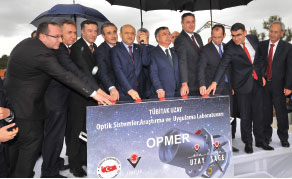
Following the speeches, Minister Işık and Minister of National Defense İsmet Yılmaz and Undersecretary for Defense Industries İsmail Demir pushed the button and laid the foundation of the laboratory. Later, Minister of Science, Industry and Technology Fikri Işık, Minister of National Defense İsmet Yılmaz, TÜBİTAK President Prof. A. Arif Ergin and the accompanying delegation realized the opening of the TÜBİTAK-Sage Advanced Integration Technologies, Mobile Flight Test Infrastructure and Remote Test Monitoring Infrastructure.
Defense Industries Research and Development Institute (Sage) is an affiliate of The Scientific and Technical Research Council of Turkey (TUBITAK). The main function of TUBITAK-Sage (Defense Industries Research and Development Institute) is to perform research and development activities for defense systems including engineering and prototype production, starting with their fundamental research and conceptual design. Most of the projects are performed in coordination with related defense institutions.