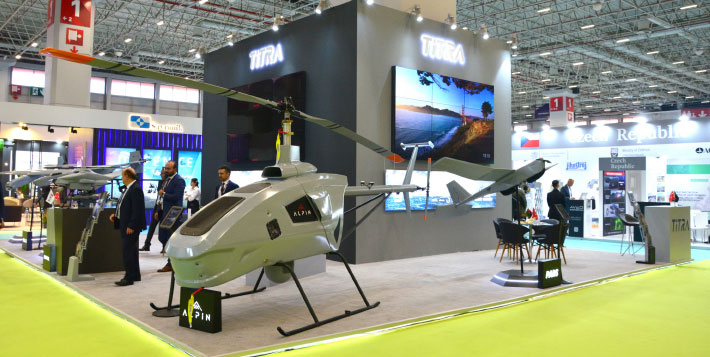
TİTRA TECHNOLOGY Showcases 4 New Products at SAHA EXPO 2024

During the fair, TİTRA also signed a series of strategic cooperation agreements with METEKSAN DEFENCE, NARDAN Power Conversion Systems, REPKON Defence Systems, and ROKETSAN.
The strategic cooperation agreement signed with REPKON Defence Systems involves the integration of REPKON's RDS40-MGL 40mm Rotary Grenade Launcher onto TİTRA's electric-powered DUMRUL Rotary-Wing Mini UCAV. Similarly, the agreement with ROKETSAN focuses on integrating the METE Laser-Guided Mini Missile System into the DUMRUL platform. These integrations are expected to enhance DUMRUL's operational effectiveness in military operations, thereby providing military units with stronger offensive and defensive capabilities. The cooperation agreement signed with NARDAN Power Conversion Systems encompasses using locally manufactured electric motors developed by NARDAN in TİTRA's DELİ Loitering UAV platform. Utilizing these domestic engines aims to maximize the performance of the DELİ UAV, further increasing its effectiveness in reconnaissance, surveillance, and offensive operations. Additionally, under the agreement signed on October 22, 2024, with METEKSAN DEFENCE, the ALPİN Unmanned Helicopter will be equipped with METEKSAN's MİLSAR SAR/MTI Radar. The MİLSAR radar system, capable of wide-area scanning and delivering high-resolution imagery under all weather conditions, will enable the detection of moving targets and provide critical intelligence for cross-border operations.
Türkiye’s first unmanned helicopter, ALPİN, has been delivered to the Turkish Land Forces and has proven itself in combat operations conducted in northern Iraq. To equip ALPİN with autonomous takeoff and landing capabilities on naval platforms, TİTRA signed a cooperation protocol with Airbus during the SEDEC Fair held in May 2024. This development will enable ALPİN to serve not only the Turkish Land Forces and Special Forces Command but also the Turkish Naval Forces. Based on feedback from the field, TİTRA has implemented a series of improvements to ALPİN and developed the ALPİN-II version. Contract negotiations between the Secretariat of Defence Industries (SSB) and TİTRA for the procurement of ALPİN-II Unmanned Helicopters commenced in October 2024. With new hardware and software integrations, ALPİN-II will be capable of operating from various platforms, including naval assets, and will serve both the Turkish Armed Forces and security units.
The DELİ-2 Tactical Loitering Munition System, designed for use against beyond-line-of-sight (BLOS) targets from mobile or fixed positions, is available in two versions: Inertial Guidance (IG, INS/GNSS) and Electro-Optical (EO). The DELİ-2EO can perform critical tasks such as target detection and destruction, as well as collecting photos, videos, and location data of targets. One key advantage of the DELİ-2EO is its ability to integrate warheads available to the user. Its high-security electromechanical fuse system, designed to accommodate various warhead types, also allows the system to be safely returned if the mission is canceled. The DELİ-1 Kamikaze UAV, with a maximum takeoff weight of 13 kg, features a 3.45 kg warhead, offering an operational range of 85 km and an endurance of 75 minutes. On the other hand, the DELİ-2EO, weighing 15 kg and equipped with an EO camera in its nose-mounted gimbal, carries a 3.8 kg warhead with an operational range of 50 km and a flight endurance of 45 minutes.
The DELİ Mini Tactical Kamikaze UAV System, known for its capability to operate in GNSS-denied environments, offers significant advantages in the field with its advanced autonomous and semi-autonomous mission capabilities. The DELİ Mini features a flight endurance of 30 minutes, an operational range of 35 kilometers, and a control range of 20 kilometers. Its cruising speed is stated at 22 m/s, with a maximum speed of 45 m/s.
Developed in about a year using entirely domestic resources, the MERKÜT Tactical FPV Attack Drone System is an FPV (First Person View) drone system manually operated by a pilot who visually tracks the target. The MERKÜT system can perform effectively even in electronic warfare environments, neutralizing ground targets by tracking the enemy. Equipped with low-light imaging capability, it enables UAV operators to carry out missions safely from secure locations without exposing themselves to danger.
The DUMRUL Rotary-Wing Mini Armed UAV (Mini UCAV), powered by an electric motor, is a silent helicopter with a takeoff weight of 17–18 kg and a flight endurance of up to 30 minutes. Designed for close-range tracking, DUMRUL can neutralize enemies using its weapon systems and integrated imaging capabilities. It supports a payload of up to 8 kg, can be controlled over a range of 60 kilometers, and remains airborne for 30+ minutes. The weapon systems integrated into DUMRUL include two MKE MOD 132 81mm UAV mortar munitions, a 40mm grenade launcher, or two METE Missiles, making it highly versatile for combat scenarios.
During our visit to the TİTRA stand at SAHA EXPO 2024, we received firsthand information about the showcased products and conducted a brief interview:
Defence Turkey: Could you provide an update on the status of the DELİ Kamikaze UAV System Project, for which a cooperation agreement was signed between TÜBİTAK SAGE and TİTRA at SAHA EXPO '22?
TİTRA: We have introduced the second version, which we call DELİ-2. The initial product, known as DELİ-1, had an 85 km range. Now, we have equipped it with a warhead. One of the most significant developments is its anti-GNSS capability, allowing it to operate in GNSS-denied environments. A pilot camera and proximity sensor were integrated at the front. Tests were conducted this summer, including firing tests at Karapınar.
Defence Turkey: Is the proximity sensor optical?
TİTRA: No, it's a laser sensor. Our optical sensor-equipped version is the DELİ-2EO. As I mentioned, tests for this version were also conducted at Karapınar this summer. A swarm operation test was performed. Two DELİ-2 units were launched simultaneously. One waited in the air while the other proceeded. They then engaged the target simultaneously from different angles.
Defence Turkey: Why was one unit kept waiting in the air?
TİTRA: That was part of the operational concept demonstrated. One UAV would take off and wait at a designated point. Once the second UAV was launched, they proceeded to the target location together.
Defence Turkey: You mentioned that the DELİ-2 Tactical Loitering Munition System's capability to operate in GNSS-denied environments has been enhanced. Could you elaborate? For instance, does it feature an ASELSAN KARETTA or a similar Anti-Jam GNSS System?
TİTRA: If desired, an Anti-Jam GNSS System like ASELSAN KARETTA can be integrated. However, even without it, if GPS is lost, DELİ-2 can still continue its mission. How? If there is a telemetry connection, a small camera at the front, which can move on a single axis, allows us to see the UAV's path from the Ground Control Station (GCS). The UAV maintains its stability and altitude while heading to the desired location, holding specific headings. If the target's heading is known—for instance, you direct it to the target at a specific heading—the pilot can then take control for the final dive. If telemetry is also lost under such conditions, meaning both GPS and telemetry are unavailable…
Defence Turkey: Is the telemetry connection encrypted?
TİTRA: It is encrypted. If telemetry is also lost, the UAV autonomously returns either to the Ground Control Station or to a predefined safe location.
Defence Turkey: When the system returns, can it deploy a parachute and land, or does it self-destruct?
TİTRA: Upon return, if you want it to land, it has an autonomous landing capability. The DELİ-2 can land on its body. However, if a 'safe area' is not designated, meaning you don't want the UAV to return, it also has the option for self-destruction in the air. DELİ-2 can self-destruct mid-flight. The version we are discussing here is the electro-optical version, referred to as DELİ-2EO. One of the most significant features we've developed is visual navigation, which allows the UAV to navigate using visual references. Thanks to the integrated camera with this capability, DELİ-2EO can continue its navigation and mission even if GNSS is lost by referencing terrain visually. For instance, if the target location is unknown but a specific area needs to be scanned, the UAV scans the region, identifies the target, and the Ground Control Station (GCS) designates it. Afterward, DELİ-2EO can autonomously dive toward the target.
Defence Turkey: Could you share details about DELİ-2's range and flight endurance?
TİTRA: The range of the DELİ-2 versions is currently 50 km, with a flight endurance of 45 minutes. Additionally, DELİ-2s are launched using a catapult. Their maximum takeoff weight is 15 kg. We have also introduced the DELİ Mini Tactical Kamikaze UAV System, which is being showcased for the first time at SAHA EXPO. The DELİ Mini requires an operator and can be hand-launched. The UAV is thrown by hand and carries a 2 kg warhead, which was tested this year at the Karapınar Test Range in Konya. If you know the coordinates, it can fly to the target. Alternatively, it has a three-axis gimbal camera integrated at the front, allowing the pilot to take control and dive toward the target. The UAV can also be controlled using FPV goggles, enabling the pilot to visually navigate and engage the target. The DELİ Mini shares the same characteristics as the IG version of DELİ-2, rather than the electro-optical version. It has an operational range of 35 km and a flight endurance of 30 minutes. Its total takeoff weight is 8 kg.
Defence Turkey: Does the flight endurance include the loitering time?
TİTRA: You have 30 minutes of total flight time. Within 30 minutes, you can loiter, patrol the target area, or track a moving target. You can also use it for imagery and reconnaissance.
Defence Turkey: Why is the warhead designed this way?
TİTRA: The fuse is positioned at the front, and the warhead’s configuration is cylindrical. The fragments, or pellets, are distributed across the surface. Upon detonation, it explodes in a spherical pattern, not directed forward. This design gives the user the option to define an approach or impact angle up to 85 degrees. At an 85-degree impact angle, the warhead achieves maximum fragmentation efficiency, covering a spherical area with a 15-meter radius for the DELİ-2 Mini. The DELİ-2 version, however, has an effective radius of 30 meters.
Defence Turkey: How many fragments are there in the warheads?
TİTRA: The DELİ-2 version contains 3,500 fragments, while the DELİ Mini version has 1,600 fragments.
Defence Turkey: You mentioned that tests have been conducted for DELİ-2 and DELİ Mini. When will they be fully operational?
TİTRA: We are in discussions with several military commands, particularly regarding the DELİ-2 IG version. The DELİ-2EO version will be finalized by the end of this year, as it is still an ongoing project. The DELİ Mini version, which is a newly introduced product this year, will also be ready by year’s end. The DELİ-2 IG is already a finished product. We are in discussions with military commands of several countries, including Azerbaijan, Kazakhstan, and Pakistan.
Defence Turkey: If explosives are not attached to these UAVs, could they be used for long-term aerial reconnaissance, such as surveying a forested area, using the EO camera in the nose?
TİTRA: Absolutely. For such cases, we can configure the EO version without a warhead and integrate an additional battery instead. With two batteries, the flight endurance extends to 1.5 hours and can even reach up to 2 hours. The camera also features a 30x zoom capability. At an altitude of 1,000 meters, or even 150 meters, the UAV operates silently, with no detectable sound. Both the DELİ-2EO, DELİ-2IG, and DELİ Mini versions are inaudible above 150 meters. This configuration allows for extended aerial reconnaissance missions.
Defence Turkey: What is the local content rate of your products, and are there any export restrictions?
TİTRA: The local content rate is very high. All aircraft are manufactured at our facilities in Kazan/Ankara. We source a few foreign components, but those are minimal. We produce all structural parts, wings, fuselage, hardware boards, and avionics. We display all the avionics and hardware boards for the UAVs at the fair; you can see our avionics booth. These same modules are used across our platforms, from the large ALPİN helicopter to the smaller DUMRUL helicopter and throughout the DELİ family. We have also signed a localization agreement for the engines, which are now domestically produced in Istanbul. Additionally, our antennas are manufactured locally by a firm in Ankara. Therefore, our local content rate is exceptionally high.
Defence Turkey: Thank you for your time and insights. We wish you a successful fair