“Together for Peace” AMAN-23 Multinational Maritime Exercise

Throughout history, the sea has been an important medium for economic prosperity. The waterways have been used as a medium of trade and have provided the impetus for growth of maritime enterprise. Over the years, dependence on the sea as an economical and efficient means of transport has grown and resulted in greater concern for the safety of the sea lines of communication (SLOCs). A SLOC is a route taken by a ship to transit from point A to B. In maritime terms, it should be short, economical and safe for transporting cargo. The SLOCs serve as umbilical cords of a state's economy. Therefore, any act that is inimical to the safety of the SLOCs, almost by definition, challenges security.
The oceans produce up to 70% of the oxygen we breathe, cover about 71% of the earth’s surface and about 97% of the earth’s water can be found in the oceans. According to some estimations around 40% of the world’s population is living within 100km of coastal areas.
Bordered by 30 states, including Pakistan, the Indian Ocean today is arguably one of the busiest maritime zones and the most important water space on the globe. Over 60% of the world’s oil supplies and more than 80% of global seaborne trade transits through the Indian Ocean. Being known for the center of economic, political, and strategic activities that have significant impact on the geopolitics and maritime security of the region, the Indian Ocean Region (IOR) is home to important SLOCs and maritime choke points. The Indian Ocean is also Europe’s primary gateway to the Asia-Pacific markets; more than 35% of all European exports go to Asia and four of its top 10 trading partners are in the region.
Therefore, even Europe is highly dependent on ‘Sea Lines of Communication’ (SLOC) through the Indian Ocean. Sharing maritime boundaries with Iran, Oman, and India, Pakistan is an important littoral state of the Western Indian Ocean and occupies a strategic position at the crown of the Indian Ocean. 95% of Pakistan’s trade by volume and 100% of its oil imports are routed through the North Arabian Sea. Pakistan is a maritime state. With more than 1,000km of coastline along the Arabian Sea, 240,000 sq. km. of Exclusive Economic Zone (EEZ) and 50,000 sq. km. of Continental Shelf provides Pakistan significantly large maritime avenues for exploration. Pakistan’s coastal belt and the extended maritime zone are filled with living and non-living oceanic resources such as hydrocarbons, minerals, renewable energy, and biotechnology options. However, despite a tremendously rich coast and a huge mass of water at its disposal, Pakistan has not been able to develop into a true maritime nation. As pointed out above, a significant portion of the world’s population is concentrated around the coasts, however, in case of Pakistan, most of the coastline is scarcely inhabited.
Regarded as the sustainable use of ocean resources or ‘Blue Resources’ for socio-economic development, improved livelihoods and creating jobs while preserving the health of marine ecosystem, the Blue Economy is considered as the future of sustainable growth for Pakistan. The Blue Economy has been gaining traction globally as a new paradigm for inclusive and sustainable development, especially for coastal and island countries like Pakistan, which is strategically located in the Indian Ocean at the crossroads of major commercial trade routes. South Asian states such as India and Bangladesh are earing billions of dollars from the Blue Economy. Given the geographical and territorial advantage,
Pakistan’s potential in Bule Economy is immense. The actual potential of Pakistan’s Blue Economy Sector is estimated to value more than US$100 billion, however the annual revenue generated nowadays is only at the US$450 million level. Pakistan had declared the year 2020 as the Blue Economy Year and has also included Blue Economy in the 2025 Vision Goal of the State.
The fortune of any nation to explore and exploit the benefits of ocean resources is hinged on the secured environment.
Given its strategic importance, ensuring the security of the Indian Ocean is crucial for regional stability and global peace. The Indian Ocean Region (IOR) faces a number of maritime security challenges, including piracy, terrorism, illegal fishing, human trafficking, and drug smuggling, which threaten the stability and security of the region and have a direct impact on the global economy. For example, piracy off the coast of Somalia had resulted in increased insurance coasts, rerouting of shipping lanes, and a decline in trade and investment.
Since it has not produced an indigenous maritime power in the modern history the Indian Ocean remains unique in the sense that it has depended significantly on extra-regional forces for ensuring maritime security. The contemporary global maritime environment remains replete with traditional and non-traditional challenges which require a collaborative response by friendly navies. It is widely accepted that no regional country can single-handedly tackle the diverse threats that exist in the IOR.
Due to its geo-strategic location in the Indian Ocean and complete dependency on SLOCs, Pakistan is an important stakeholder in the Indian Ocean security framework and the Pakistan Navy (PN) has been contributing significantly, both in terms of men and material, to maritime security and counter piracy efforts in the IOR for the last 20 years. In order to strengthen interoperability and global efforts of maritime forces, the Pakistan Nay initiated the Multinational Maritime Exercise ‘AMAN’ in the North Arabian Sea in 2007. Marked as a blue diplomacy move by the Pakistan Navy, Exercise AMAN is a humble effort toward enhancing cooperation between Navies against prevalent and emerging transnational security threats. In Pakistan’s national language Urdu, AMAN means ‘PEACE’ and the slogan/motto of the AMAN Exercise is ‘Together for Peace’. The concept of the Exercise was designed to provide a common forum for information sharing, mutual understanding and identifying areas of common interest. Organized by the Pakistan Navy biennially since 2007 in the waters of the Indian Ocean Region, the AMAN Exercise aims to promote regional peace and stability by fostering a common understanding and approach to maritime security issues. Considered as an important initiative aimed at enhancing maritime security in the region the AMAN Exercises are believed to be able to reduce the dependence on extra-regional forces/powers in addressing security challenges in the Indian Ocean. The AMAN Exercises provide a platform for regional littorals to work together and develop a common understanding and approach to maritime security issues.
The AMAN series of exercises play pivotal role against regional threats for not just the participating countries but for the extra-regional countries as well. The AMAN series of exercises are considered to be the most significant initiative of the PN in the field of maritime diplomacy, aimed at reinforcing regional maritime security and cooperation between partnering nations.
Exercise AMAN
The Pakistan Navy (PN) has been hosting the Multinational Maritime Exercise AMAN biennially since March 2007. Exercise AMAN brings together Ships, Aircraft, SOF/EOD Teams and Observers from the Navies of East and West under one umbrella for collaborative peace and security in the maritime domain. With Exercise AMAN, the PN seeks to enhance interoperability between regional and extra regional navies as a means of promoting peace and stability in the region and beyond. Besides its function as an opportunity to gather the international maritime community to one platform to promote peace and stability, Exercise AMAN also provides a unique training opportunity to develop and practice tactics which help participants foster and sustain the mutual relationships that are conductive for ensuring safe and secured sea lanes on the world’s oceans.
The AMAN Exercises are structured to create Responses, Tactics, Techniques and Procedures (RTTPs) against nontraditional threats through tactical warfare planning followed by high-end warfare serials at sea such as Naval Gunfire, Visit, Board, Search & Seizure (VBSS), Anti-piracy, Operations, Combine Anti-Submarine Exercise, Communications, Boarding and Air Defense.
The AMAN Exercises are planned with focused objectives, which are as follows:
Develop coalition building and multi-layered security cooperation to promote a safe & sustainable maritime environment.
Enhance tactical interoperability between regional and extra regional navies thereby acting as a bridge between the regions.
Validating RTTPs to counter non-traditional threats in the maritime domain.
Project a positive image of Pakistan as a country contributing towards regional peace and stability.
Consolidate the PN's position in the regional maritime arena.
Display of united resolve against terrorism and crimes in the maritime domain.
Intermingling of multinationals with depiction of their respective cultures.
Since 2007 a total of 9 AMAN Exercises have been planned, but since in 2015, AMAN-15 was not held due to some operational commitment of the PN, only eight of them have been executed including Exercise AMAN-23. The participation details of AMAN-07, 09, 11, 13, 15, 17, 19 and 21 are as follows:
1st Exercise AMAN-07: It was held in March 2007 with great success. During AMAN-07 a total of 28 countries participated with ships/aircraft or observers. 14 ships from Bangladesh, China, France, Italy, Malaysia, UK and the US Navies joined the exercise. In addition, SOF/EOD Teams from Türkiye and Bangladesh also participated in SOF Exercises. 21 countries attended the Exercise as Observers.
2nd Exercise AMAN-09: The second Exercise of the AMAN series was held in March 2009. A total of 24 countries participated in the Exercise with ships/aircraft or observers. During AMAN-09, 23 ships, 14 of them from Australia, Bangladesh, China, France, Malaysia, UK and the US along with 13 aircraft (including 2 P-3C Orion MPAs from Japan) and 9 SOF Teams from China, the US, Türkiye, Nigeria and Bangladesh participated. Observers from 27 countries also attended Exercise AMAN-09.
3rd Exercise AMAN-11: It was conducted from 8-12 March 2011. During this Exercise, 28 countries participated with ships/aircraft or observers. A total of 11 ships from Australia, China, France, Indonesia, Italy, Malaysia, Saudi Arabia and the US participated. 3 aircraft from Australia & Japan and 3 x SOF/EOD/Marines Teams from China, Türkiye and the US also participated during Exercise AMAN-11. 43 observers from 26 countries attended the Exercise.
4th Exercise AMAN-13: It was conducted from 4-8 March 2013. Navies of 29 countries participated in the Exercise with ships/aircraft or observers. A total 12 ships from 10 different countries, 2 aircraft, 9 SOF/EOD Teams from 6 countries and 36 observers from 21 countries took part in AMAN-13.
5th Exercise AMAN-15: It was scheduled to be held in February 2015. 13 ships, 2 aircraft, 14 SOF/EOD/Marines Teams and more than 60 observers from 34 countries had confirmed their participation in the Exercise. However, due to some operational commitments of the PN, the AMAN-15 Exercise was not conducted. Only the International Maritime Conference was held.
6th Exercise AMAN-17: It was the 5th exercise conducted within the AMAN series and was held from 10-14 February 2017. Navies of 35 countries participated in the Exercise with 12 ships from Australia, China, Indonesia, Russia, Sri Lanka, Türkiye and the UK. 2 P-3C Aircraft from Japan, 10 EOD/SOF Teams from China, Indonesia, Malaysia, Maldives, Russia, Sri Lanka, Türkiye and the UK also participated during Exercise AMAN-17. 67 Observers including 7 Senior Officers from participating countries attended the Exercise.
7th Exercise AMAN-19: The 6th edition (it was the 6th exercise conducted) of the AMAN series, AMAN 2019 (AMAN-19) was conducted during 8-12 February in Karachi and North Arabian Sea. Navies of 83 countries were invited to participate and 45 Navies (46 with Pakistan) participated through Ships (a total of 21 ships from 10 Navies including the PN and the Pakistan Maritime Security Agency/PMSA), Aircraft (11 fixed wing and 13 rotary wing aircraft took part in the Fly Past), Special Operation Forces (SOF, including 6 SOF Teams, 5 Explosives Ordnance Disposal [EOD] Teams and 4 Marines Teams from 11 countries), Observers and Speakers.
8th Exercise AMAN-21: Amidst the geopolitical flux accentuated by the global pandemic of COVID-19, the Pakistan Navy hosted the 7th edition (it was the 7th exercise conducted) of the AMAN series of multinational exercises from February 11-16, 2021, in the North Arabian Sea. Navies of 45 countries (46 with Pakistan) including Türkiye (with 2 MPAs 1 SAS Team and 1 SAT Team), the US, the UK, China, Indonesia, Philippines, Japan, Malaysia, the Russian Federation and Sri Lanka participated in the Exercise with Ships, Aircraft, Special Operation Forces (SOF, including Explosives Ordnance Disposal [EOD] Teams and Marines Teams), Observers and Speakers. It is a rare occasion where men in arms from the US, China, Russia, Iran, Türkiye, and the Kingdom of Saudi Arabia (KSA) are gathered in an environment of harmony and friendship. It is also noteworthy that during AMAN-2021, for the first time since 2011 (during Exercise Bold Monarch off the coast of Spain), the Russian Navy took part in joint exercises alongside NATO countries’ naval forces.
Exercise AMAN is a clear manifestation of Pakistan’s profound commitment to promoting peace and stability in the region through harmony and collaborative efforts between navies of the world. The participation of such a large number of Eastern and Western Navies in Exercise AMAN is truly a testament that the international community appreciates Pakistan’s sincere efforts for peace and maritime security and that it is willing to join hands with Pakistan for creating greater harmony and cooperation in the IOR.
Exercise
AMAN-23
The 8th edition of the AMAN series of exercises, AMAN 2023 (AMAN-23) was conducted during 10-14 February in Karachi and the North Arabian Sea. Navies of 110 countries were invited to participate and 50 Navies (51 with Pakistan) participated through Ships (a total of 20 ships from 8 Navies including the PN and the Pakistan Maritime Security Agency/PMSA), Aircraft (12 fixed wing and 7 rotary wing aircraft took part at Fly Past), Special Operation Forces (SOF, including 4 SOF Teams, 6 Explosives Ordnance Disposal [EOD] Teams and 5 Marines Teams), Observers (123 Observers from 50 countries), Ambassadors (from 5 countries), Deputy High Commissions (from 6 countries), Defense Attachés (from 35 countries) and Speakers. A total of 9 warships from 7 guest countries participated in the exercise, namely the US (1x), China (3x), Indonesia (1x), Italy (1x), Japan (1x), Malaysia (1x), and Sri Lanka (1x). A total of 20 warships from 8 Navies including the PN and the Pakistan Maritime Security Agency/PMSA took part at the International Fleet Review (IFR) including; PLA Navy’s Type 052DL Destroyer NANNING (162, an upgraded variation of the Type 052D destroyer and recently received an upgraded propulsion system among many other modifications), Indonesian Navy Frigate KRI Raden Eddy Martadinata (331), Italian Navy Frigate ITS Carlo Bergamini (F 590), Malaysian Navy’s Lekiu Class Frigate KD Lekiu (FFG 30), Sri Lanka Navy Offshore Patrol Vessel SLNS Samudura (P 261), the Japanese Navy’s Akizuki Class Destroyer JS Suzutsuki (DD 117) and the US Navy’s Arleigh Burke Class Destroyer USS Truxton (DDG 103), Pakistan Navy warships PNS Tughril (261), PNS Taimur (262), PNS Yarmook (271), PNS Tabuk (272), PNS Saif (253), PNS Zulfiquar (251), PNS Tariq (181), PNS Himmat (1027), PNS Moawin (39) and PNS Nasr (47). 2 Kashmir Class Patrol Ships PMSA Kahmir (143) and PMSA Kolachi (144) from Pakistan Maritime Patrol Agency (PMSA) were also took part in AMAN 2023. Türkiye was supposed to participate in the AMAN-23 Multinational Maritime Exercise with 1 Maritime Patrol Aircraft (MPA) along with 1 SAT Team and 1 SAS Team. However, this was abandoned after the M7.8 and M7.5 earthquakes that occurred 9 hours apart on different fault lines in the southern region of Türkiye and Northern Syria and claimed the lives of 50,096 people (as of March 20, 2023) only just in Türkiye alone.
Like all previous AMAN Exercises, Exercise AMAN-23 was also conducted in two phases: The Harbor Phase and the Sea Phase. The Harbor Phase comprises the Arrival of Participating Units, the Opening Ceremony at the PN Dockyard, the Maritime Counter Terrorism Demo by SSG(N)/Pakistan Marines, Cross Ship Visits, Calls On, international get together and presail planning of evolutions at sea. Whereas the Sea Phase included tactical maneuvers, exercises related to maritime security such as anti-piracy and counter terrorism, search and rescue, gunnery firing and air defense exercises during the Harbor Phase and International Fleet Review (IFR).
In order to share Türkiye’s pain due to the devastating earthquakes and in a show of solidarity with earthquake victims in Türkiye, the Pakistan Navy cancelled some of the planned activities within the scope of the AMAN-23 Exercise schedule including the International Band Display and International Food Gala & Cultural Show. The participating naval vessels carried out drills on various subjects including RAS, Anti-Piracy, Main-Gun Firing, Formation Movement and VBSS operations. Exercise AMAN-23, with compact schedules and rich activities, strengthened mutual understanding and trust between the Pakistan Navy and the participating navies. The Exercise also enhanced the capability of participating naval sailors to deal with various security threats and demonstrated the determination and confidence of Pakistan and other participating countries in jointly addressing risks and challenges and safeguarding peace, prosperity and stability in the IOR.
Opening Ceremony at PN Dockyard
The 8th edition of the AMAN series of multinational maritime exercises (AMAN-23), which is held every two years, kicked off with a remarkable Flag Hoisting Ceremony at the Pakistan Navy Dockyard (PN Dockyard) in Karachi in the morning on February 10, 2023. The ceremony was held in front of the PNS Taimur (262) and PNS Tughril (261), Type 054 A/P guided missile frigates constructed in China, and which substantially enhanced the PN’s anti-surface and anti-air warfare capabilities. The ceremony was attended by a large number of senior military officials from 51 participating navies (including the Pakistan Navy/PN), observers, foreign diplomats and a large number of Pakistan Navy personnel. The start of the exercise was marked by the simultaneous hoisting of the flags of all AMAN-23 participants. At the ceremony Türkiye was represented by Consul General in Karachi Cemal SANGU and Naval Attaché of the Turkish Navy Captain (Navy) Göksel ORTAMEVZİ. Commander of the Pakistan Fleet (COMPAK), Vice Admiral Ovais Ahmed BILGRAMI graced the occasion as Chief Guest whereas Commander of the Tanzanian Navy Rear Admiral Ramson Godwin MWAISAKA, Chief of the Djiboutian Navy Colonel Abdourahman Aden CHER, Commander of Djiboutian Coast Guard Colonel Wais Omar BOGOREH and Commander of the Lebanese Naval Forces Senior Captain Haissam DANNAOUI attended the ceremony as Guests of Honor.
The program commenced with a recitation from the holy Koran. After that, Commander of 9th Auxiliary & Mine Warfare Squadron (COMAUXMIN-9) Commodore Sohail Ahmad AZMI read out the Welcome Message of Chief of the Naval Staff (CNS), Admiral Muhammad Amjad Khan NIAZI. Thereafter, flag parties formed up for the hoisting of the flags of all participating countries. Senior representatives of all countries took their position in front of their respective flags, the guard then presented a gun salute followed by the national anthem. Afterwards, Commander of the Pakistan Fleet (COMPAK), Vice Admiral Ovais Ahmed BILGRAMI delivered his inaugural speech. After the speech, all country representatives formed up in the Media Enclosure for the Cake Cutting, Group Photograph and Media Interaction.
As the ceremony began, the flag squad of the Pakistan Navy (PN) presented a march-past on the tune for the national song ‘Iss Parcham Ke Saye Talay Hum Aik Hain (Unity Song)’ with every officer holding a neatly folded flag of each of the 51 participating countries in the AMAN-23 Exercise. Soon the representatives of each of the countries - Australia, Azerbaijan, Bahrain, Bangladesh, Belgium, Cameroon, China, Cote d’lvoire, Djibouti, Egypt, France, Germany, Hungary, Indonesia, Iran, Iraq, Italy, Japan, Jordan, Kazakhstan, Kenya, Kuwait, Lebanon, Libya, Malaysia, Maldives, Morocco, Nepal, Netherlands, Nigeria, Oman, Pakistan, Palestine, Philippines, Qatar, Romania, Saudi Arabia, Seychelles, South Korea, Spain, Sri Lanka, Sudan, Tajikistan, Tanzania, Thailand, Tunisia, Türkiye, UAE, UK, US and Zimbabwe took their positions in front of their respective flagpoles. Following a three-volley gun salute, the flags of all participating countries were hoisted with the playing of Pakistan’s national anthem as all personnel in uniform saluted and the guests stood up in respect.
During the ceremony, the Message of Chief of the Naval Staff (CNS), Admiral Muhammad Amjad Khan NIAZI was read out by Commander of the 9th Auxiliary & Mine Warfare Squadron (COMAUXMIN-9) Commodore Sohail Ahmad AZMI. In his message, the CNS Adm. NIAZI warmly welcomed the participants of the AMAN-23 exercise. The Admiral stressed that the AMAN Exercise is a regular feature involving regional and extra-regional Navies to create a safe and conducive maritime environment for smooth and unhindered maritime activities in the region. He further underlined that the Pakistan Navy has been a pioneer in its efforts to promote joint maritime security in the region besides creating camaraderie as highlighted under the motto of the Exercise ‘Together for Peace’. Adm. NIAZI emphasized that this bond will continue to grow and bring them even closer to the popular goals of realizing regional peace and shared prosperity. Admiral NIAZI also underlined that the gradual increase of the number of countries participating in Exercise AMAN is a testimony that this exercise also has training values for all the participants. “There are is lot that could be learned, and to be learned together from the activities that have been organized during this Exercise, the harbor and sea phase, along with the International Maritime Conference. The uniqueness of this exercise is its model, Together for Peace,” Adm. NIAZI stated in his message.
Speaking on the occasion, Commander Pakistan Fleet, Vice Admiral Ovais Ahmed BILGRAMI extended a warm welcome to all the participants and thanked them for their wholehearted participation in the exercise. At the beginning of his speech Vice Admiral BILGRAMI also paid his deepest condolence to the people of Türkiye and Syria for the huge devastation and loss of precious lives during the recent earthquakes. “Our thoughts and prayers are with the bereaved families. We stand with them in these testing times and pray that their pain and suffering are over soon,” Vice Admiral BILGRAMI said. He emphasized that as a maritime nation Pakistan has substantial stakes in keeping the surrounding seas safe and secure. “Our interests are based on 3 imperatives. Firstly, our extraordinary dependence the seas for trade. Secondly operationalization of Gwadar Port and the upcoming China-Pakistan Economic Corridor (CPEC)
Project and thirdly our strategic location astride the global energy highway,” Vice Admiral BILGRAMI added.
In his address Vice Admiral BILGRAMI delivered following speech:
“Cumulatively, these imperatives make maritime stability an important national security interest for Pakistan. We realize the importance of maritime security not only for us but for all other countries whose prosperity and progress are tied to the seas. While we talk of security and stability at sea, let us be mindful of the threats and challenges that we face in the maritime domain, ranging from piracy, terrorism, narco-arms trafficking, to climate change. However, the vastness of the seas makes it extremely difficult for any one nation to deal with these diverse challenges alone. This calls for collective effort to make sure that the seas remain safe and secure for all to use and benefit from. The Pakistan Navy is therefore a firm believer in the concept of collaborative maritime security and has been actively participating in maritime security and counter piracy operations along with other partner navies since 2004. Furthermore, since 2018 the Pakistan Navy has been undertaking regional maritime security patrols through which our ships maintain presence in vital sea areas in the Indian ocean region to contribute towards maintaining good order at sea in accordance with our international obligations. Exercise AMAN thus underscores the significance of combating maritime threats collectively through cooperation and mutual support and provides enormous opportunities to the participants for shipping and rehearsing the contours of such a collective response.
Ladies and gentlemen, the AMAN Exercises are also about building ships. Friendships, relationships and partnerships. Occasions like these help us understand each other a bit better in a way which otherwise may not be possible. Coming together for AMAN also increases our awareness as to how we can achieve synergy through collaboration against common threats and challenges. I am hopeful that the exercise this year will provide a forum for greater information sharing, enhancing mutual understanding and finding innovative solutions for the benefit of all the participating navies. I am confident that our interaction over the next few days will manifest the true spirit of exercise AMAN as reflected so aptly in its motto ‘Together for Peace.’ As Commander of the Pakistan Fleet, I expect AMAN-23 to be mutually rewarding and professionally beneficial for all the participants. I also pledge our esteemed guests the best of our traditional hospitality. I hope that you will take back with you not only fond memories of the exercise and your stay in Pakistan, but also the spirit of cooperation and collaboration that have brought us all together. I thank you all.”
Following the completion of the flag hoisting ceremony, we created an opportunity to have a short interview with the Commander of 9th Auxiliary & Mine Warfare Squadron (COMAUXMIN-9) Commodore Sohail Ahmad AZMI on AMAN-23. Before commenting on AMAN-23 Commodore AZMI underlined that he is extremely sorry about the earthquake devastation. “We are also praying, and we are standing with you and understand that it is not your pain it’s our pain also” he added. Answering our question on the importance of AMAN-23 Commodore AZMI underlined that it’s a four-day exercise and there’s more than 50 countries participating in this exercise. “By the number of participants, you could say that it is one of the major or biggest Maritime exercises, not just in this region, but in the world. The exercise is 4 days, 2 days are for the harbor phase and 2 are for the sea phase. In the harbor phase it is about discussion, it’s about understanding what kind of threats we are facing. And of course, what mechanics can we adopt to fight those threats. At sea we are going to demonstrate how it is possible to operate alongside other navies because once the navies come, we need some procedures, so that we can, you know, make use of it and then operate together. So, this is what we are going to do at sea, like counter piracy, counter terrorism, and fighting exercises and of course international fleet review (IFR).” Regarding our question about commenting on Exercise AMAN from the PN point of view, Commodore AZMI said, “As pointed out by the CNS Adm. NIAZI in his message, much we depend on the seas for our trade and our food security and economic security. And this is why we think that once we operate at sea, the seas need to be secure; and our argument is that you alone cannot make the seas secure. So, you need people, willing people to come together to make the seas secure. So, this is one of the is one of the messages that we are trying to give. I’m not saying that it will transform everything from this year onward, it is a gradual and steady effort that we need to continue doing and hopefully there will be further solid realization of the fact that the navies must operate together to make sure that Maritime stability is in place.”
1st Pakistan International Maritime Expo & Conference (PIMEC-23) and IMC-2023
Alongside AMAN-23, the Pakistan Navy has also hosted its first ever ‘Pakistan International Maritime Expo & Conference (PIMEC) under the patronage of the Ministry of Maritime Affairs, February 10-12, 2023 at the Karachi Expo Center. The vision behind the PIMEC is to create a marketplace for presenting innovative ideas and showcasing the untapped potential of Pakistan’s Maritime Sector. The PIMEC also afforded participants and stakeholders, both international and national, the first-hand opportunity for scoping, networking, and hand shaking for B2G and B2B interactions to explore avenues for optimum exploitation of ocean resources under the ambit of the Blue Economy. In view of Pakistan’s overwhelming reliance on sea-based trade, the maritime industry is guarantor of Pakistan’s sustainable growth and prosperity. PIMEC-23 was intended to provide a foundation to bring together international and national stakeholders from diverse maritime industries to synergize businesses and forge economic cooperation. PIMEC-23 was also organized to highlight the opportunities available in multiple maritime domains including Shipping, Port Infrastructure, Coastal Tourism, Fisheries and Hydrocarbon Resources. The conduct of PIMEC-23 alongside Exercise AMAN-23 is a conscious effort to promote the development of Pakistan’s Maritime Sector. PIMEC-23 showed tremendous interest with the participation of 133 exhibitors including 21 foreign and 112 local companies. About 37 international delegations from 17 countries including Bahrain, KSA, Qatar, Oman, Türkiye, UK, Italy, Germany, Portugal, US, Colombia, Sri Lanka, Malaysia, Gambia, Guinea Bissau, Mauritius, Madagascar, Seychelles and Kazakhstan attended the event.
6 companies including ASFAT, ASELSAN, MED MARINE, MİLSOFT, STM and UZMAR from Türkiye opened stands at PIMEC-23. HAVELSAN on the other hand participated at PIMEC-23 without opening a stand.
Pakistan Foreign Affairs Minister Bilawal Bhutto ZARDARI graced the inauguration ceremony of PIMEC held on February 10, 2023, and the Chief of Naval Staff Admiral Muhammad Amjad Khan NIAZI was also present. In addition, a large number of civil military, foreign and local delegates attended the event. The CNS Adm. NIAZI in his message to PIMEC emphasized that the Pakistan Navy, being a major stakeholder in shaping the maritime mindset of the country, is proactively playing its role in creating the necessary maritime awareness to harness the untapped potential of the Blue Economy. He further emphasized that this milestone event will bring together international and national stakeholders and create a marketplace for the presentation of innovative ideas while showcasing maritime potential and opportunities in this dynamic area. Admiral NIAZI further emphasized that PIMEC is a platform to reaffirm Pakistan’s commitment to the conservation and sustainable use of oceans and marine resources, the exploitation of natural resources and to stimulate growth for collective and shared prosperity.
In the backdrop of PIMEC, the International Maritime Conference (IMC-2023) was also organized at the Karachi Expo
Center from 10 to 12 February 2023 by the National Institute of Maritime Affairs (NIMA) under the auspices of the Pakistan Navy and with a theme of “Adapting the challenges and opportunities of the blue economy for developing countries”.
Having been conducted since 2007, the IMC provides a platform to maritime stakeholders, academicians and policy makers to discuss ideas/issues with internationally renowned scholars, practitioners and experts in the maritime domain. During IMC, eminent speakers, experts and representatives from Pakistan and abroad, both from public and private sectors, have shared their views on contemporary maritime issues and suggested viable options for developing countries, like Pakistan, to spur the Blue Economy.
Subject-matter experts from China, Germany, Malaysia, Sri Lanka, Türkiye, UK and the US participated in the three-day conference and shared their thoughts on the dynamic theme. Additionally, a majority of international scholars also joined the conference online. The conference was thematically distributed under four sessions and covered 27 papers by reputable national and international speakers. At IMC-23, Captain (Retired) Saner SARI, Country Head of ASFAT delivered a speech titled ‘Geo-strategic Effects and Importance of Maritime Security on the Blue Economy’ and Engr. Captain (Retired) İbrahim AKSU, MİLSOFT Director, Proposal Management delivered a speech titled ‘Combat Management System (CMS) Approach for Naval Platforms’.
A troupe of 7 journalists from international media outlets and defense and aerospace sector magazines including Defence Turkey , courtesy of the Naval Directorate of Public Relations, were invited from China (2x), Malaysia (1x), Sri Lanka (2x) and Türkiye (2x) and hosted in Karachi to follow AMAN-23. The exercise was also followed by around 40 local journalists based in Karachi and Islamabad.
Maritime Counter Terrorism Demo by SSG(N)/Pakistan Marines at PNS QASIM Manora
As a part of the AMAN-23 Multinational Maritime Exercise, on February 12 at PNS QASIM Manora (Marines Base located on Manora Island just south of the Port of Karachi), Special Operations Forces (SOF) of the Pakistan Navy (Special Services Group Navy/SSG[N] & Marines), presented an impressive Maritime Counter Terrorism Demonstration on the coast of Manora Island. At PNS Qasim, where I had the opportunity to visit during the AMAN 2019 Exercise, the new buildings and facility construction activities of the Pakistan Navy caught my attention. Old buildings have been demolished and larger and modern buildings were built in their place. Governor Sindh Muhammad Kamran Khan TESSORI graced the Maritime Counter Terrorism Demo as Chief Guest.
Pakistan CNS Admiral Muhammad Amjad Khan NIAZI, Commander of the Pakistan Fleet Vice Admiral Ovais Ahmed BILGRAMI, Commander Karachi of the Pakistan Navy Rear Admiral Zakir Ullah JAN and high-level distinguished observers, Ambassadors and Attachés from foreign countries participating in the exercise were also present on the occasion. The SSG(N) is a multi-dimensional force with the capability to undertake assignments on land, air, sea and subsea. The Maritime Counter Terrorism Demonstration was carried out in the following phases; Rescuing an Injured (by hostile forces) SEAL by Harbin Z-9 SAR Helicopter, Demonstration of Advanced Fire Arms Techniques, Disposal of a Planted Improvised Explosive Device (IED) by EOD Robot, Dolphin Maneuvers at a speed of 45 knots by 4 Maritime Tactical Patrol Boats and 2 MRTP15 VBSS boats, Fast Boat Recovery covering fast extraction of a five-man SSG(N) Team, initially dropped by a PN Sea King helicopter about 200m from the beach from hostile water with a Special Forces Boat, Static Line Para Jumps by SSG(N)s/Commandos from PN ATR 72/500 aircraft (a total of 6 SSG(N) paratroopers were dropped from 800 feet into the sea, these jumpers then formed part of the Beach Reconnaissance Team for the Counter Terrorism Demonstration), the Counter Terrorist Demonstration (Maritime Counter Terrorism Team commonly known as CTT demonstrated a coordinated beach assault operation to neutralize terrorists’ stronghold and safe house by making air (and by sea approach and using different techniques of infiltration [insertion of Air Assault Teams by Sea King Helicopters from the air and insertion of SOF Teams & Marines Platoon by the hovercrafts from the sea], fire arm techniques and quick recovery and extraction of hostages) and Demonstration of Bomb Burst Aerial (executed by 3 Sea King Helicopters from the Pakistan Naval Aviation at 60 knots to present a special salute to honor the Chief Guest). Then paratroopers from the Pakistan Navy Sea Eagle Team (established in 1991) demonstrated High Altitude HALO (High-Altitude-Low Opening) Jumps from an ATR 72/500 aircraft. 9 HALO Jumpers performing free fall descending and carrying the national flags of nations of the SOF/EOD Teams that participated in Exercise AMAN-23 (including Azerbaijan, Japan, Kuwait, Malaysia, Oman, Saudi Arabia, Sri Lanka, Türkiye, the US and Pakistan) jumped from a height of 10,000 feet and landed at target located on the coast with precise accuracy. According to shared information their parachutes had a 8:1 glide ratio and a 77km/h glide speed in ‘0’ wind conditions.
Following the successful landing of 9 HALO Jumpers, the PN Sea Eagle Team Commander presented the Pakistan flag to the Chief Guest. Normally, an SAS and SAT Team from the Turkish Naval Forces Command were scheduled to participate in AMAN-23 and in the Maritime Counter Terrorism Demonstration. However, due to the February 6 catastrophic earthquakes in Türkiye, the Turkish Naval Forces had to cancel their participation in the AMAN-23 Multinational Maritime Exercise at the last minute. Although there was no participation from the Turkish Navy, the Pakistan Navy did not forget the earthquake disaster in Türkiye, and in order to show its solidarity with those affected by the earthquakes on February 6, a paratrooper from the Sea Eagle Team made a jump with the national flag of Türkiye. More than 100 Pakistan Navy personnel were involved or deployed for the Maritime Counter Terrorism Demonstration.
At the end of the Maritime Counter Terrorism Demonstration, we had a short conversation with Commander of the Special Services Group of the Pakistan Navy SSG(N) Commodore Jawad Haider KHAWAJA. Commodore KHAWAJA said, “Thank you very much to all of you for joining Pakistan in this event. We are very thankful to all of you. Today’s event was basically to demonstrate the Maritime Counter Terrorism Demonstration, which the skills that we have acquired, along with aviation and the special operators of the Pakistan Navy SSG. And we demonstrated many events today, like free fall para jumps, static line para jumps and helo casting and recovery of the jumpers through jumper search and rescue and the frogmen, repelling. So, there were many events today. The Pakistan Armed Forces has curbed many events of terrorism, and this is what we wanted to demonstrate here, that in the Maritime domain and in the Land domain, we will not afford any naughtiness by any type of miscreant or the terrorists. So, this was what we demonstrated to all the Exercise AMAN participants and the observers who participated today. Thank you very much.”
Regarding our question about the training system that has been used by the SSG and is there any plan to buy new technology for training for the SSG(N), Commodore KHAWAJA underlined that the Special Service Group Navy has a volunteer system and the officers and the special operators they are trained through the Navy SEAL Course. “We have four Battalions and a Naval Operations Training Center and we also train the law enforcement agencies, we also import training to our friendly countries, all those who require the different training skills. So, there are many foreigners who join the Pakistan Navy in our training center to take these courses” Commodore KHAWAJA said. In response to our question whether it can be said that the SSG(N) training system is focused on physical training rather than simulation training Commodore KHAWAJA underlined that the special operations training is like 80% mental fitness, and 20% physical fitness. “And that physical fitness, although it is very robust, it is very hard, but those skills can only be achieved when a person who is mentally fit, that he should have a passion to undertake that training” he said.
Sea Phase of AMAN-23: IFR
On February 14, 2023, the 8th Multinational Maritime Exercise AMAN-23, the largest multinational exercise ever hosted by the Pakistan Navy (PN), reached its conclusion with the execution of the International Fleet Review (IFR) at 40nm off the Port of Karachi in the north Arabian Sea in the Pakistan EEZ.
A total of 20 naval vessels from 8 countries in various displacement and types participated in the Sea Phase of AMAN-23 including; PLA Navy’s Type 052DL Destroyer NANNING (162), Indonesian Navy Frigate KRI Raden Eddy Martadinata (331), Italian Navy Frigate ITS Carlo Bergamini (F 590), Malaysian Navy’s Lekiu Class Frigate KD Lekiu (FFG 30), Sri Lanka Navy Offshore Patrol Vessel SLNS Samudura (P 261), Japanese Navy Akizuki Class Destroyer JS Suzutsuki (DD 117) and US Navy’s Arleigh Burke Class Destroyer USS Truxton (DDG 103), Pakistan Navy warships PNS Tughril (261), PNS Taimur (262), PNS Yarmook (271), PNS Tabuk (272), PNS Saif (253), PNS Zulfiquar (251), PNS Tariq (181), PNS Himmat (1027), PNS Moawin (39) and PNS Nasr (47). 2 Kashmir Class Patrol Ships; PMSA Kahmir (143) and PMSA Kolachi (144) from the Pakistan Maritime Patrol Agency (PMSA) also took part in AMAN 2023.
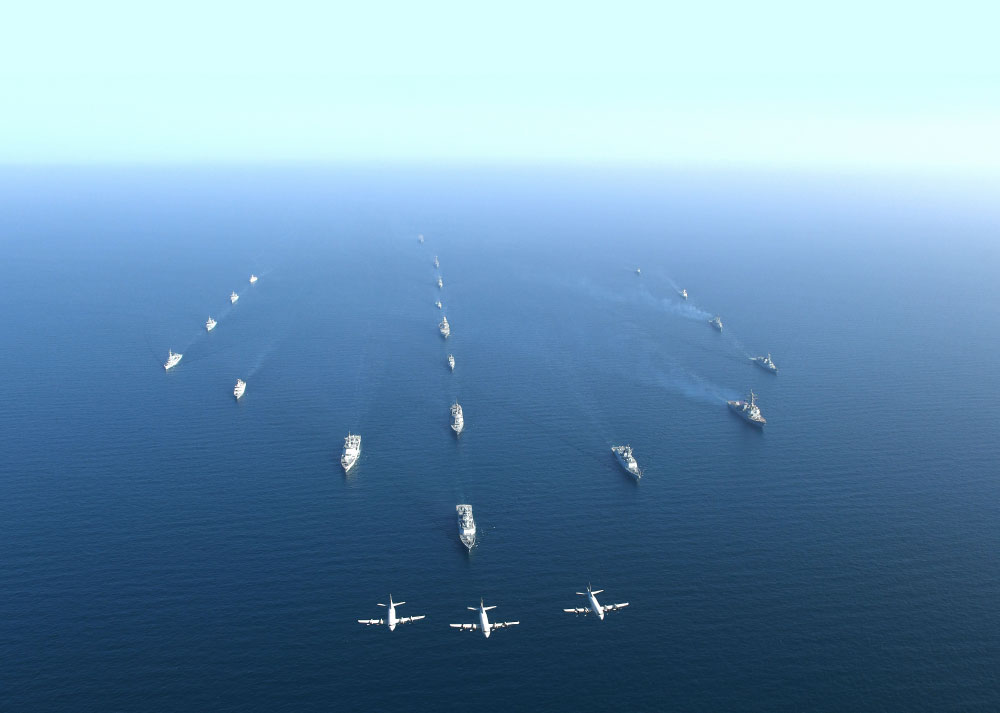
The IFR also featured an impressive Fly Past by participating aircraft and helicopters including 3 x P-3C Orion Long Range Maritime Patrol Aircraft (LRMPA, known as ‘Flying Destroyers’), 3 x ATR72/500 LRMPA, 2 x WS-61 Sea King Mk 45 Helicopters, 3 x Z-9EC ASW/ASuW Helicopters (known as Stingray and designed to hunt enemy submarines), 1 x Z-9 Helicopter from China, 1 x NH-90 from Italy, 4 x JF-17A Thunder and 2 x Mirage III Aircraft from Pakistan Air Force (PAF).
During the IFR PNS Moawin (AOE-39), the Pakistan Navy’s largest Fleet Replenishment & Combat Support Ship constructed at KSEW (Karachi Shipyard and Engineering Works) Shipyard, took center stage as it hosted dignitaries, including Prime Minister of Pakistan Muhammad Shehbaz SHARIF, Governor Sindh Muhammad Kamran Khan TESSORI, Chairman Joint Chiefs of Staff Committee General Sahir Shamshad MIRZA, Chief of Army Staff General Syed Asim MUNIR, Chief of the Naval Staff (CNS) Admiral Muhammad Amjad Khan NIAZI, Chief of Air Staff Air Chief Marshall Zaheer Ahmad BABER, Commander of the Pakistan Fleet (COMPAK) Vice Admiral Ovais Ahmed BILGRAMI, as well as Ambassadors, Defense and Naval Attachés and number of other guests.
Upon arrival on board Pakistan Navy Ship (PNS) Moawin (AOE-39) Fleet Replenishment & Combat Support Ship by a Harbin Z-9 Naval Helicopter, Prime Minister SHARIF was welcomed by CNS Admiral NIAZI and Senior Naval officers. During IFR, the Chief Guest and other high-ranking officials on board PNS Moawin witnessed various operational activities including, Replenishment at Sea (RAS), a Joint Counter Piracy Demo, Anti-Submarine Rocket Depth Charge (RDC) Firing, Simultaneous fan-out Maneuver by YARMOOK Class OPVs PNS Yarmook (271) and PNS Tabuk (272), Surface Practice Firing on Killer Tomato, Fly Past by Air Units (PN, PAF and foreign participating Aircraft) and Man and Cheer Ship in Honor of the Chief Guest.
At the beginning of the drill PNS Moawin refueled a pair of TUGHRIL Class Type 054 A/P Frigates while underway. This is the first time TUGHRIL Class Frigates participated in Exercise AMAN, these vessels have been recently inducted into Pakistan Navy (PN) service and now form part of 25th Destroyer Squadron of the PN Fleet. The PNS Tughril (261) was inducted into the PN in December 2021 and the PNS Taimur (262) was inducted in June 2022. The remaining two ships are on track to join the Pakistan Navy Fleet in 2023. According to CNS Admiral NIAZI, “Acquisition of the Type 054A/P Frigates is a symbol of enduring friendship and historical affinity between China and Pakistan.” The Type 054A/P is one of the latest multi-role frigates of Chinese origin equipped with state-of-the-art weapons and sensors that include CM-302 SSM and LY-80 SAMs as well as the advanced anti-submarine warfare suite and combat management system. These ships are equipped to operate under multi-threat scenarios.
Within the scope of replenishment at sea (RAS) demo, PNS Tughril (261, on the right side) and PNS Taimur (262, on the left side) took a position on either side of the PNS Moawin. The two receiving ships had hoses sent their way from PNS Moawin through which fuel was supposed to be transferred to them. Underway refueling and replenishment at sea is considered to be one of the most dangerous activities carried out at sea and extreme care was taken by PN personnel during the drill. It was also pointed out that PNS Moawin, built with the cooperation of Türkiye, is the Pakistan Navy’s largest indigenously built ship that was commissioned in October 2018. Under the contracts signed in 2017 and on June 1, 2018. Pakistan is procuring a total of four Type 054 A/P Frigates (classified as TUGHRIL Class) from China and the lead ship named PNS TUGHRIL (F-261) was commissioned into PN service at a ceremony held at Hudong-Zhonghua Shipyard in Shanghai, China on November 8, 2021. Equipped with state-of-the-art combat management and an electronic warfare system along with modern self-defense capabilities, the Type 054 A/P Frigates are the largest and most advanced warships China has ever exported.
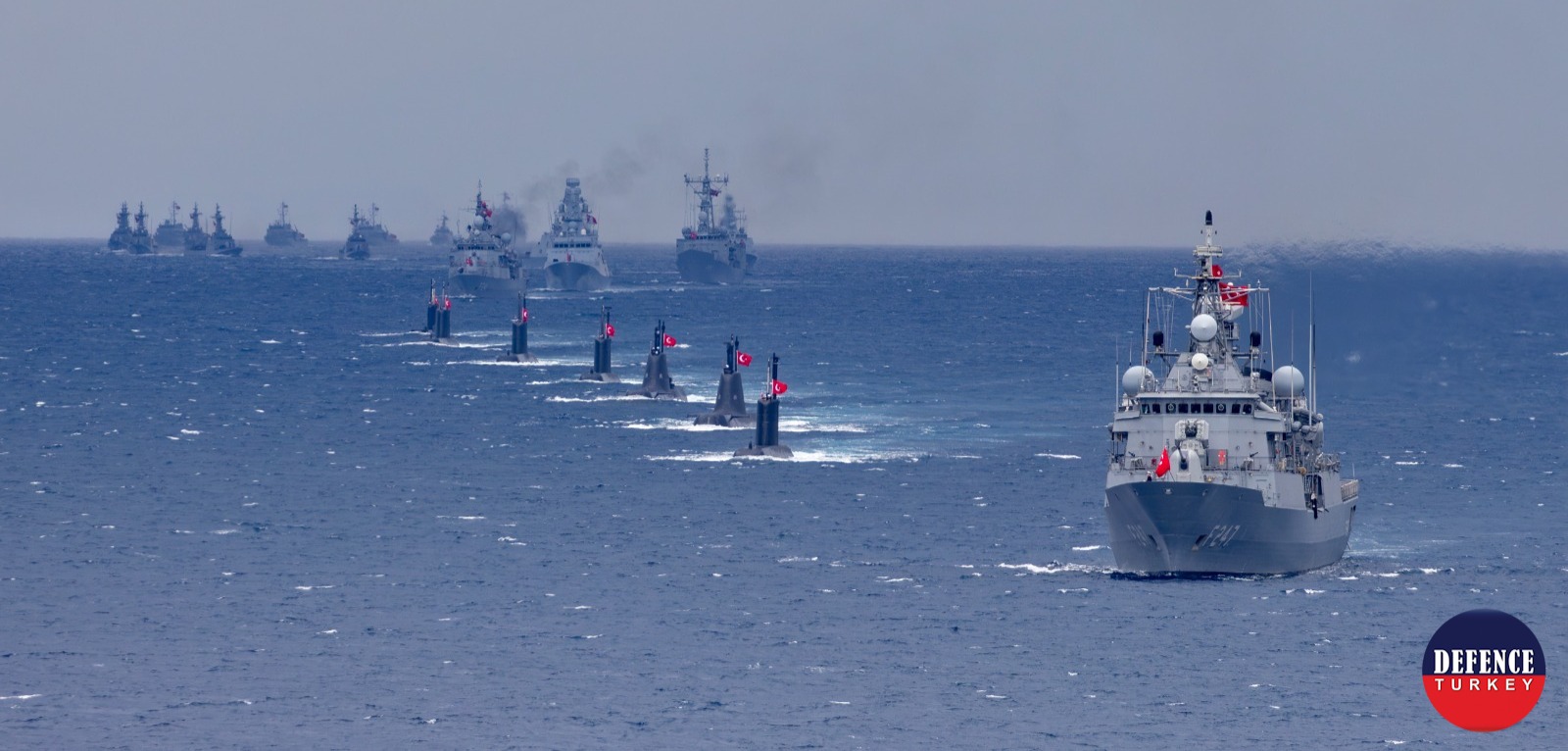
The RAS demonstration was followed by the Joint Counter Piracy Demo (with the participation of PNS Tughril, PNS Taimur, PN SeaKing Helicopter and boats) by Special Operation Forces (SOF) of Pakistan and friendly countries (Azerbaijan & Malaysian) and Simultaneous Rocket Depth Charge (RDC) Firing from both PNS Tughril and PNS Taimur Frigates at simulated submarine targets. The RDC is a short-range weapon used against all types of submarines. The main purpose of RDC firing is to herald the enemy submarine and gain valuable time to launch a more lethal and accurate attack with shipborne torpedoes. Both frigates then maneuvered themselves to align behind each other to look like they were just one ship from behind. Main gun firing on a floating surface target called Killer Tomato (equipped with radar reflectors) was carried out by PN frigates PNS Tughril and PNS Taimur, PLA Navy’s Type 052DL Destroyer NANNING (162) and Indonesian Navy Frigate KRI Raden Eddy Martadinata (331). While the ships that would take place in Surface Practice Firing on Killer Tomato at given pre-deployed floating surface targets were taking their positions ahead of PNS Moawin for the firing run, the PNS Yarmook (271) and PNS Tabuk (272) approached the beam of warships at high speed simultaneously and then performed a fan-out maneuver to the starboard and portside respectively at high speed. Then a Fly Past was presented by the PN, PAF and aircraft from participating friendly countries, which was followed by Men and Cheership by the participating ships in honor of the Chief Guest. Thereafter, the participating ships formed up in traditional “AMAN Formation” to signify unity and harmony to ensure PEACE in maritime domain.
The AMAN-23 Multinational Maritime Exercise served to improve the ability of participating countries to jointly respond to maritime security threats and demonstrated the determination of all participants to jointly safeguard maritime security.
Prime Minister SHARIF congratulated the PN for hosting the mega event and reaffirmed Pakistan’s resolve for peace and security in the region. He also appreciated the participation of the large number of like-minded Nations and emphasized that AMAN-23 will pave the way to make the region more peaceful and secure with combined efforts by all stakeholders. He reiterated the need for strategic cooperation to counter transnational maritime threats and encourage safety, security and stability in the region.
PNS Moawin (AOE-39) Fleet Replenishment & Combat Support Ship
Designed by Delta Marine under a project carried out by STM as the Main Contractor, the Fleet Replenishment & Combat Support Ship PNS Moawin (AOE-39) with an overall length of 158m and a displacement of 16,400 tons was constructed at KSEW (Karachi Shipyard and Engineering Works) Shipyard adjacent to the PN Dockyard in Karachi Port and commissioned by the Pakistan Navy on 16 October 2018. The vessel served as the flagship during the IFR phase of Exercise AMAN-23. Outfitted with an indigenous radio communication system and data link system (Link Green), the vessel can carry ship and aircraft fuel over 8,000 tons, fresh water, and ammunition. According to the PNS Moawin’s ship designer Delta Marine, the 15,600-ton vessel (16,400 full-load) can carry up to 8,650 tons of F-76 fuel, 210 tons of JP-5 fuel, 1,050 tons of fresh water and dry cargo of up to 650 tons. It has a ferry range of 10,000 nautical miles at a speed of 15 knots.
Equipped with MilSOFT’s Pakistan Navy Information Exchange System (NIXS), the PNS Moawin, if required, can also serve as a Command Ship thanks to her advanced Combat Management System (CMS) capability. PNS Moawin can support two maritime helicopters (one WS-61 Sea King Mk45 and one Z-9EC) and can equip them with guided anti-ship missiles (2 x AM39 Exocet) and light torpedoes (4 x Mk46) for both Anti-Submarine Warfare (ASW) and Anti-Surface Warfare (ASUW) missions. The vessel can reach a maximum speed of 20 knots with two controllable pitch propellers (CPP) powered by two diesel engines. The cruising speed of the ship is 15 knots. But, during the RAS demo at AMAN-23 in the Sea Phase, the ship speed was announced as 9-12 knots. The speed was reduced to 5 knots during the shipboard helicopter operation to increase the stability of the vessel for smoother landing and take-off of the Sea King and Z-9EC Helicopters, which were used to transport VVIP guests from Karachi to the ship.
PNS Moawin has 8 decks and can accommodate 250 to 300 personnel depending on the type of mission to be performed. Serving under the Pakistan Navy Fleet's 9th Auxiliary & Mine Warfare Squadron, the ship will support the Pakistan Navy's combat/auxiliary elements by transferring critical equipment such as fuel/water and ammunition at sea during operations with her Replenishment/Fueling-at-sea Systems (RAS/FAS), thus increasing their operational capability. Equipped with a 20mm Mk15 Blok 1B Phalanx CIWS and two ASELSAN 12.7mm STAMP Systems for self-defense needs, PNS Moawin is also outfitted with the DR-3000 ESM (Electronic Support Measure) System. The PNS Moawin is able to refuel and replenish ships at distances of 52m and 36m with her Replenishment/Fueling at Sea (RAS/FAS) systems at the same time. PNS Moawin can perform refueling operations in a much more efficient and easier way compared to the old supply ships. Thanks to PNS Moawin the replenishment time is reduced by one-third according to the PN.
Pakistan Sent Earthquakes Relief Supplies to Türkiye Onboard PNS Nasr and PNS Moawin
In addition to air (via air-corridor 50,000 tents and tons of items have been delivered) and land routes, within the scope of a Humanitarian Assistance & Disaster Relief (HADR) Mission, Pakistan sent its earthquake relief supplies to Türkiye by sea on board the PNS Nasr (A-47) Replenishment Tanker and PNS Moawin (AOE-39) Fleet Replenishment & Combat Support Ship in March 2023. The PNS Nasr, carrying earthquake relief assistance goods mainly tents (3,500 winterized tents) and blankets arrived at Mersin Port on March 20th morning. PNS Nasr set sail from Karachi Port to Türkiye (Mersin Port) on March 1, 2023.
The second PN ship deployed on a HADR Mission, the PNS Moawin, carrying 550 tons (367 tons [2,635 tents and 38,370 blankets] to Türkiye and 179 tons [22,000 blankets and 144 tons donations] to Syria) of relief supplies departed from Karachi Port to Mersin Port on March 11 and reached Mersin Port on March 23rd. Consul General of Türkiye in Karachi Cemal SANGU also attended the send-off ceremonies organized for the PNS Nasr and PNS Moawin. The ship was warmly welcomed by Turkish Naval officials and Pakistan diplomatic staff. To mark solidarity with Türkiye-Pakistan brotherhood, a simple and graceful ceremony was organized onboard PNS MOAWIN to commemorate Pakistan Day. The ceremony was attended by Turkish Government and Military officials including Governor of Mersin and Chief of Staff of the Turkish Naval Forces along with the Ambassador of Pakistan to Türkiye. At the ceremony, PN Mission Commander expressed condolences on behalf of Chief of the Naval Staff Admiral Muhammad Amjad Khan NIAZI and the people of Pakistan for the tragic loss of lives and property and reaffirmed the PN’s resolve to stand with brotherly countries at the time of need. Turkish government officials highly appreciated the support provided by the Government of Pakistan.
Pakistan Navy’s Modernization Efforts; YARMOUK Class OPVs & HANGOR Class Submarines
Its geo-strategic position and geopolitical situation obliges Pakistan to be a maritime state and dictates to have and sustain a powerful naval force. The Pakistan Navy (PN) has not hidden its desire to become a major Blue Water-power (one capable of sustained operations across open oceans) in the Indian Ocean Region (IOR). With geopolitics undergoing a major realignment phase, the PN has become a major tool to project force, create goodwill throughout the region and increase Pakistan’s influence in the IOR. Following the construction of Gwadar Deep Water Port and the China-Pakistan Economic Corridor (CPEC) the PN has ascended to paramount importance.
In order to adapted itself to changing security environments and establish a deterrent force power against its arch-rival India, the PN has been continuously transforming itself, restructuring its organizational structure and carries out new tasks against the challenges of the new security environment, while maintaining and enhancing conventional naval capabilities.
Having spoken to media representatives who followed the IFR, Pakistan CNS Admiral NIAZI confirmed that the modernization plans for the Pakistan Navy will be continuously carried out with the purchase of more equipment and systems for service. “The modernization and upgradation of our systems and equipment to beef up the capabilities of our fleet is a continuous process. We will continue to add more and more platforms in our fleet, including surface, subsurface, as well as air assets… As part of this program, we are looking at adding more aircraft to our fleet, including a jet-propelled type, which can/will be converted into long-range maritime patrol aircraft” Admiral NIAZI told.
YARMOOK Class OPVs
During the International Fleet Review (IFR), held on February 14 as part of the AMAN 2023 Multinational Maritime
Exercise, I had the chance to closely observe and examine the first two YARMOOK Class Offshore Patrol Vessels (OPVs) built by DAMEN Shipyard at Galati facilities in Romania as per PN design/requirements under the agreement signed on June 30, 2017.
The first of the YARMOOK Class OPVs, PNS Yarmook (271), which was named after the Battle of Yarmouk between the Islamic Forces under the command of Khalid ibn al-Walid and the Byzantine Empire in 636 A.D. in Yarmouk, and was launched on May 17, 2019, and commissioned on February 13, 2020. The second ship of the YARMOOK Class PNS Tabuk (272) was commissioned on November 12, 2020. After the delivery, some of the weapons and sensor systems of the ships were installed at the Karachi Shipyard in Pakistan. In this context, YARMOOK Class OPVs were equipped with ASELSAN's MUHAFIZ 30mm Remote Controlled Stabilized Naval Gun System and the ARES-2NCL Extended Integrated Radar and Communication Electronic Support Measures (R-ED/C-ED) System. The ALPER LPI Navigation Radar is also available on the PNS Tabuk. I believe that the vessels are also equipped with the Naval Information Exchange System (NIXS) developed by MİLSOFT for the Pakistan Navy and the indigenous data link system "Link Green".
Built on DAMEN Shipyard's OPV2200/2300 design (there is only the OPV 2200 brochure available on the website, but it is referred to as OPV 2300 in the DAMEN Shipyard’s press release), the YARMOOK Class vessel is 91.25m long and 14m wide with a draught of 4.52m and a displacement of 2,261 tons. Equipped with CODAD (Combined Diesel and Diesel) type main propulsion system, the YARMOOK Class can reach a maximum speed of 22.5 knots thanks to four Caterpillar 3516E diesel engines (each with a capacity of 2,525bkW) and two shafts with controllable pitch propellers (CPP). With a cruise range of 3,500nm, the vessels can remain at sea for a month. The vessels also have a helipad suitable for day and night landing and take-off of a 5.5-ton helicopter, and a hangar.
The YARMOOK Class, which is defined as a medium tonnage and size multi-purpose platform, is equipped to perform various missions such as Combat Search and Rescue (CSAR/MAK), Surveillance and Intelligence Gathering, Military Operations Other Than War (MOOTW), Surface Warfare, and Maritime Security Operations. In this context, the vessels are outfitted with 20mm Phalanx Mk-15 Block 1B CIWS for close-in air defense purposes and are equipped with HARBAH Anti-Ship Cruise Missiles (2x4, 8 in total) that can be used against both surface and land targets for Surface Warfare (SUW/ASUW) missions. The HARBAH Anti-Ship Cruise Missile, which has an advanced guidance system consisting of INS/GPS/GLONASS, DSMAC Camera, Radar Altimeter, Imaging Infrared Camera, and Radar Seeker can reach a maximum speed of 0.8 Mach and an operational range of 280km+ (maximum range 750km). HARBAH is 50cm in diameter, 6.8m long, and weighs 1,350kg. The turbojet engine employed in the missile is powered by JP-8 aviation fuel (range can be increased if JP-10 is used). GIDS (Global Industrial and Defense Solutions), a state-owned company, first displayed the scale model of the HARBAH Anti-Ship Cruise Missile abroad at DIMDEX 2022 and then at ADEX 2022. The HARBAH NG Missile, the new generation version of HARBAH, was first exhibited at IDEAS 2022. I believe that the YARMOOK Class vessel will be able to launch the HARBAH Anti-Ship Cruise Missile, which has a CEP value of ≥10m, using only the target's bearing measurement (detected by the R-ED System) when required, thanks to the ASELSAN ARES-2NCL Extended R-ED/C-ED System.
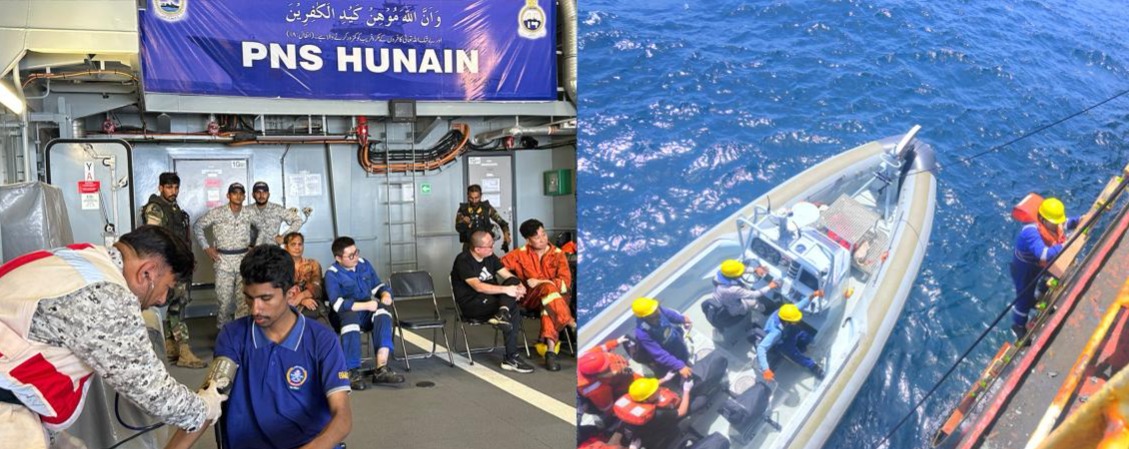
Upon the YARMOOK Class’s high acclaim, the Pakistan Navy ordered two additional vessels in 2020 and the construction activities of the first of the OPVs (PNS HUNAIN), also known as YARMOOK Batch II, started on July 15, 2022, at DAMEN Shipyard's Galati facilities in Romania.
Admiral Muhammad Amjad Khan NIAZI, Chief of Naval Staff of Pakistan, stated in our interview that took place in Istanbul on November 25, 2022, “Two YARMOOK Class OPVs have already been commissioned, and two larger and more capable OPVs are being built in Romania.”
The first ship's keel laying ceremony and the second ship’s first steel cutting ceremony were held on October 12, 2022, with the participation of Admiral Muhammad Amjad Khan NIAZI, Chief of Naval Staff of Pakistan. Unlike the first two vessels, the YARMOOK Batch II OPVs, which will be delivered to the Pakistan Navy in February and August in 2024, are based on the OPV 2600 design. YARMOOK Batch II OPVs, which will be 98m long, 14.4m wide, and weigh approximately 2,600 tons, will be able to reach a speed of 24 knots and have a cruise range of 6,000nm with a speed of 12 knots. They can be operated by a crew of 60 and will also have space for an additional 36 crew members. As in the first batch of two vessels, Turkish Defense Industry companies are anticipated to undertake roles in the YARMOOK Batch II OPVs with their products.
HANGOR Class Submarines
Since 1964, the Pakistan Navy has had a submarine fleet which currently consists of five conventional submarines that include three Agosta 90B (KHALID Class, 200kW MESMA AIP capable) Submarines and two Agosta 70B (HASHMAT Class) Submarines. KHALID Class Agosta 90Bs have been installed with an AIP system and are being upgraded in cooperation with Türkiye (STM Main Contractor). The Pakistan Navy will modernize its submarine fleet with eight HANGOR Class hunter-killer submarines (Type 039B Yuan Class with a Stirling engine-based AIP System) ordered from China under the agreement signed on July 23, 2015. The first submarine of the Class, PNS Hangor, is named after the PNS Hangor, a French-made Daphne Class submarine, which torpedoed and sank INS Khurkri during the 1971 India-Pakistan War. Four of the HANGOR Class Submarines are being constructed at the Wuchang Shipbuilding Industry Group (WSIG) in Wuhan, China, and four are being constructed at Karachi Shipyard & Engineering, Works (KSEW) Shipyard under a Transfer of Technology (ToT) Agreement. The submarines are under various stages of assemblage in Pakistan and China. These conventional-type modern submarines are equipped with the latest weapons and sensors. The induction of HANGOR Class Submarines with an air independent propulsion (AIP) system onboard will significantly enhance their submerged endurance capabilities. The project is continuing as per the timeline despite certain delays due to COVID-19 and technical intricacies.
HANGOR Class Submarines will be equipped with the latest weapons and sensors, mostly of the Chinese origin. Pakistan is already operating an AIP onboard the existing AGOSTA-90B (KHALID) Class Submarines and induction of HANGOR Class Submarines with AIP onboard will further enhance the PN’s subsurface capability.
HANGOR Class Submarine is capable to undertake variety of missions as per operational dictates. The Submarine has advanced stealth features and is fitted with state-of-the-art weapons and sensors to operate under multi-threat environments and can engage targets at stand-off ranges.
The construction of the 5th submarine (PNS Tasnim) started on December 9, 2021, at KSEW Shipyard. The Keel Laying
Ceremony of the PNS Tasnim Submarine and Steel Cutting of the sixth (SM-6, the second of the locally constructed submarines) HANGOR Class Submarine was carried out at KSEW in December 2022. Pakistan CNS Admiral NIAZI graced the occasion as the Chief Guest.
Built by a 16-year loan from China, the first of the HANGOR Class submarines is anticipated to be delivered to the Pakistan Navy by the end of 2023, followed by the eighth submarine in 2028. As the Pakistan Navy Submarine Fleet is intended to comprise eight submarines, initially the Agosta 70Bs and eventually Agosta 90Bs will be decommissioned as per the specified plan with the start of the induction of HANGOR Class Submarines into the PN fleet.
The 76-meter-long, 8.4-meter-diameter, 2,800-ton, diesel/electric-propelled HANGOR Class Submarines, which can remain at sea for 65 days and are anticipated to weigh 3,600-ton when submerged with 60 crew members. The HANGOR Class Submarines' Stirling-Powered Air Independent Propulsion (AIP) System is anticipated to be equipped with three or four Stirling engines. According to available information, HANGOR Class Submarines will be able to operate underwater for 20 days without snorkeling, and their cruise range will be 260nm+ with the diesel/electric propulsion system and 760nm+ with the Stirling AIP System.
It is claimed that China has further developed the 75kW Kockums V4-275R Stirling engine (closed cycle diesel engine) technology, which it acquired in the late 1980s, through reverse engineering and developed its own indigenous AIP System based on Stirling technology. According to open sources, Yuan Class Type 039A/039B Submarines have both
75kW (4 units) and 100kW (2 units) Stirling engines developed by the 711th Research Institute of China Ship Scientific Research Center (CSSC). It is also claimed that three Stirling engines, each with a 140kW with a capacity, are used in the Type 039C Class.
China revealed its first full-scale AIP system prototype (for tech demo) based on Stirling technology in 2002, and the system was ready for operational use after 20,000 hours of testing since 2004 as part of the Type 039A Yuan Class
Submarine Project (the first AIP-powered submarine class of the Chinese Navy). The first Type 039A Yuan Class Submarine outfitted with the Stirling AIP System entered service in 2007, and when the submarine completed its 10-year service life in June 2017, the Chinese Ministry of Defense announced on June 14, 2017, that the submarine had successfully accomplished more than 50 critical missions and safely covered hundreds of thousands of miles. In the tests conducted in mid-2018, one of the Type 039A Yuan Class Submarines outperformed several benchmarks set by the Chinese Navy, such as the longest cruising range, maximum diving depth, and the ability to sink the target ship at a specific temperature thanks to its AIP technology. China completed the performance tests with the 320kW capacity Stirling engine prototype developed with domestic resources in December 2021. The new 320kW capacity Stirling engine is expected to be employed in the Type 039C Class. The Japanese Navy’s Sōryū-class submarines, which are 84m long and weigh 2,950 tons on the surface and 4,200 tons submerged, are equipped with four Kawasaki Kockums V4-275R Stirling engines (4x75kw, 300kW thrust).
The PN is also interested in acquiring Second Strike Capability. In this context Naval Strategic Forces Command has been established and the BABUR-III nuclear-capable Submarine Launched Cruise Missile (SLCM) System, with a reported range of 450km, has been tested several times. Pakistan successfully conducted live firing test of BABUR-III SLCMs from an underwater, mobile platform on January 9, 2017. Pakistan’s indigenous BABUR-III SLCM is widely expected to be carried on the PN’s KHALID Class Agosta 90B Submarines. In March 2018 following the completion of second firing test of the BABUR-III SLCM Pakistan claimed to have attained credible second-strike Capability. The BABUR-III SLCM is capable of delivering various types of payloads, including nuclear warhead. Through a media release, Pakistan’s InterServices Public Relations (ISPR) announced that with a range of 450km BABUR-III missile was test-fired from “an underwater dynamic platform, which successfully engaged its target with precise accuracy, meeting all the flight parameters”. The missile was tested from a submerged platform off Pakistan’s coast in the Arabian Sea and flew to strike a target at an undisclosed location. Babur-III SLCM’s first test was carried out in January 2017 and it is a naval variant of BABUR-II Ground Launched Cruise Missile (GLCM), which was successfully tested in December 2016. The second-strike capability is normally placed on a nuclear submarine, but since Pakistan does not have one it is believed that the missile would be deployed on both Agosta 90B/KHALID Class and HANGOR Class (Chinese Type 039B Class) AIP submarines. Development of credible second-strike capability would enable Pakistan to protect and promote its interest in the IOR where Indian naval vessels patrol throughout the year