TRNAV: Türkiye’s GPS Independent Positioning and Timing System
Navigation is the ability to determine position, orientation and velocity relative to a known reference point. Humankind’s desire to travel from point A to point B has been the driving force behind developing systems/tools to navigate accurately and safely. In addition to position, time information is also crucial in many applications ranging from location-based services to autonomous platforms. Since the deployment of Global Positioning System (GPS) satellites by the US in 1970s, GPS has been the most employed and ubiquitous source for position and time information. However, the weak satellite signals and well-known signal structure renders the GPS vulnerable to intentional or unintentional interference. In recent years, as unmanned systems have become widespread and are increasingly included in military operational concepts, electronic attacks on satellite navigation signals have increased. Hence, all global satellite navigation signals, especially GPS, are under the increasing threat of intense jamming. Hence, supporting resilient operation of GNSS against such threats, e.g., anti-jam systems, and GPS/GNSS independent navigation technologies have become more important.
TUALCOM has been developing state-of-the-art, high-performance and competitive RF-Microwave and Communications solutions since 2013. TUALCOM’s product range spans over various domains in the fields of RF Microwave Communications technology with more than 100 different field/battle proven solutions for GPS/GNSS Anti-jam CRPA, Data Link, Telemetry, Data Acquisition and Data Recording, Flight Termination, Electronic Warfare and 5G Communication Systems that have been deployed on thousands of platforms to meet a wide range of challenging requirements. Amongst these solutions, TUALCOM’s 2, 4 and 8 element CRPA based Anti-Jam Systems have been at the forefront of battle against jamming and spoofing providing resilient PNT to hundreds of different manned/unmanned land, air and maritime platforms.
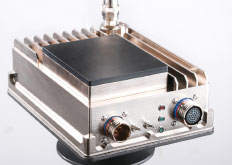
In an effort to move from resilient PNT to assured PNT TUALCOM recently has developed another added-value system to address the problem of GPS/GNSS unavailability. TDMA based data link units have been combined together as a PNT system employing a smart algorithm that is capable of determining position accurately and providing time precisely. TUALCOM’s integrated communications and navigation solution TRNAV comprises a constellation of land based portable or fixed terminals to support GNSS when available or continue providing navigation capability when it is denied while maintaining wide band communication. Reconfigured, and re-designed, from what was originally utilized as data link terminals, ground stations and position finders are capable of self-organizing and self-synchronizing for point-to-multipoint communications in mesh network structure. Once the network of ground station terminals is powered, transceivers synchronize and form a constellation through Time Division Multiple Access (TDMA) signals. Then the receiver, called the position finder, is immediately able to determine its position in 3D by just using the RF signals from the stations and employing time-of-arrival based multilateration. Moreover, since the position finder, that can be deployed on any land, air and maritime platform, also acts as station, assured PNT coverage is pushed beyond the borders of the operation area. Time of flight information for the TDMA signals is also used to precisely calibrate the relative time information within the network, where this relative time converts to absolute time if absolute time is available at any of the terminals, at any time during the operation. In addition to providing precise time and position information, mesh communication and Ad Hoc networking properties allow TUALCOM’s TRNAV to act as a data link allowing data share as well as image and video stream between the terminals. Moreover, TRNAV’s wide band communication capability and superior computation rate enable it to provide more efficient navigation capability for high-speed platforms when compared to GPS/GNSS systems. TRNAV’s software defined radio (SDR) infrastructure allows changing the operating frequency within a wide frequency interval which in turn enables forming separate networks of regional communication and navigation, operating side by side without interfering each other.
TUALCOM’s proprietary data link systems with high power, wide-band, frequency hopping capabilities constitute the backbone of TRNAV, enabling jam and spoof free TRNAV operation. SDR architecture provides a flexible and configurable system and allows rapid development of additional features ensuring safe operation under electronic warfare measures. With received signal power more than 50dB higher than the GPS, TRNAV is more resilient against powerful broadcasters of RF signals close to the receiver and employes several ECCM techniques, such as FHSS and DSSS, that render the system robust against EW measures.
TRNAV constellation is currently operational in parts of Türkiye with tens of portable and fixed terminals currently in place, whereas plans to extend the coverage by deploying more terminals is already underway. Moreover, as a member of NATO SET Research Task Group RTG-309 “NATO PNT Open System Architecture & Standards to Ensure PNT in NAVWAR Environments” TUALCOM will demonstrate TRNAV capabilities during an exercise planned to take place in 2024.
Extensive field tests have revealed that the positioning performance of TRNAV is comparable to that of GPS's. Moreover, time accuracy is calculated as 5 ns RMS during the tests. As expected, field tests also confirmed that;
TRNAV complements GPS/GNSS and ensures accurate navigation in GPS/GNSS denied/degraded/jammed regions.
Time information across the terminals are highly stable and accurate.
If any of the terminals have access to absolute time, such as atomic clock or high integrity GPS, then the network time could be updated.
Position finder’s ability to feed its position back to the terminals allow precise tracking of the platform when needed. This feature also allows checking operational and health status of ground terminals.
TRNAV position output could be made available as a position fix for INS when the integrity of the GPS is compromised.
Additionally, easy and quick deployment and no need for calibration features render TRNAV as a perfect solution for reliable communication and PNT needs of first responders following a disaster as well. Coupled with precise position and time output, TRNAV is the correct technology for positioning and timing solution for critical infrastructures, location-based services and emergency location determination.
The combination of resilient PNT through TUALCOM’s GPS/GNSS Anti-Jamming Systems and assured PNT through TRNAV will provide the next generation of unbeatable position and timing solution.