TurAF to Replace KC-135R Stratotankers with A330 MRTT Aircraft
According to the information I have received, concrete progress has been made in the negotiations that started with Airbus Defense & Space in 2020, and it is said that the green light for the project may be given in the summer of 2021 (July/August).
Within the scope of the project, which will be carried out under the coordination of ASFAT (Military Factory and Shipyard Management Inc.) within the Turkish Ministry of National Defense (MoND), a total of 7 A330 MRTT Aircraft are expected to be delivered to the Turkish Air Force, to replace the 7 KC-135R Stratotankers in the inventory on a one-to-one basis. According to my sources, there is a plan to procure the planes in 2+5 as part of Turkey’s higher business package demand. Although the A330 MRTT Aircraft has a higher fuel and personnel/cargo carrying capacity compared to the veteran KC-135R Stratotanker Aircraft (it is estimated that missions performed with 7 KC-135Rs today can be performed with 4 or 5 A330 MRTTs) the A330 MRTT can be sufficient, I assess that the two important factors in determining the number of A330 MRTTs as 7 are the increasing workload of the TurAF due to Turkey’s military presence (base/units) in 15 countries around the world, including Syria, Libya, Qatar, Somalia, Iraq, Azerbaijan, and Sudan to ensure its own national security and international missions under the NATO or UN umbrella, and the potential for the emergence of different unforeseen missions and configurations for the A330 MRTT Fleet. The A330 MRTT has sufficient spare capacity to take advantage of new digital technologies and can be fitted with a wide range of sensors to enhance its features beyond air-to-air refuelling and strategic air transport.
According to the current plan, in the first phase, ASFAT will select 7 aircraft with the lowest engine flight hours among the A330-200 widebody passenger airliner in the Turkish Airlines (THY) Fleet on behalf of the MSB (there are 14 A330-200 aircraft with GE CF6-80E1 engines in the THY fleet). Then, the first plane will be ready for the MRTT conversion with preliminary work expected to take 6 months (for example, the paint on it will be wiped, and the seats in the cabin will be removed). With the help of technical support and related documents from Airbus, structural transformation work on the aircraft is expected to be carried out at the 2nd Air Maintenance Factory Directorate (2nd AMFD, former 2nd Air Supply Maintenance Center [ASMC], the name of facilities was changed to the 2nd Air Maintenance Factory Directorate in March 2017).
The first A330-200 aircraft, which will be transformed into a "green aircraft" within the 6-month preparatory work, will then be sent to Airbus Defense & Space's facilities in Getafe located 20km south of Madrid, the capital of Spain, for the MRTT structural transformation (conversion) work that is expected to take 12 months. A certain number of Turkish personnel will also participate in the structural transformation work on the first aircraft at the Getafe facilities and receive on-the-job training. Although not certain at this stage, it is stated that in case of demand, the MRTT structural transformation work on the second A330-200 can also be carried out at the Getafe facilities, but there is a definite plan for the structural transformation work on the other 5 aircraft to be carried out in Turkey.
During the MRTT conversion process of each the A330-200 aircraft, some 16,000 types of new components will be installed and approximately 450 new electrical harnesses (for a total cabling length of more than 50 km), as well as 6,000 brackets and 1,700 connectors. TurAF A330 MRTTs are believed to have the ability to refuel both probe and receptacle-equipped aircraft and to be able to receive fuel as well.
It is said that the company Turkish Technic, which provides maintenance and repair services to A330-200 aircraft, including their avionic systems, may also take part in the structural transformation studies. The company Airbus Defense & Space will provide the necessary technical and know-how support for the preliminary preparation and structural transformation work to be carried out on the aircraft. The subsystems to be integrated into the plane under the MRTT transformation work will also be procured from ADS. If the project is implemented, the MRTT conversion work of A330-200 aircraft will be carried out in Turkey for the first time after the UK. As may be remembered, the transformation process of the first 2 FSTA Voyager Tanker/Transport Aircraft under the Royal Air Force (RAF) Future Strategic Tanker Aircraft (FSTA) Program (14 aircraft in total) was carried out in Getafe, Spain, in 2009 and 2010; while the 3rd and 4th planes were converted at Cobham Aviation Services' facilities in Bournemouth, England. However, due to the delay in the process and the RAF's decommissioning of the venerable VC-10 and Tristar tanker aircraft in 2013, it was decided to also transform the other 10 A330-200 aircraft in Getafe.
TurAF’s 10th A400M Aircraft Planned for Delivery in January 2022
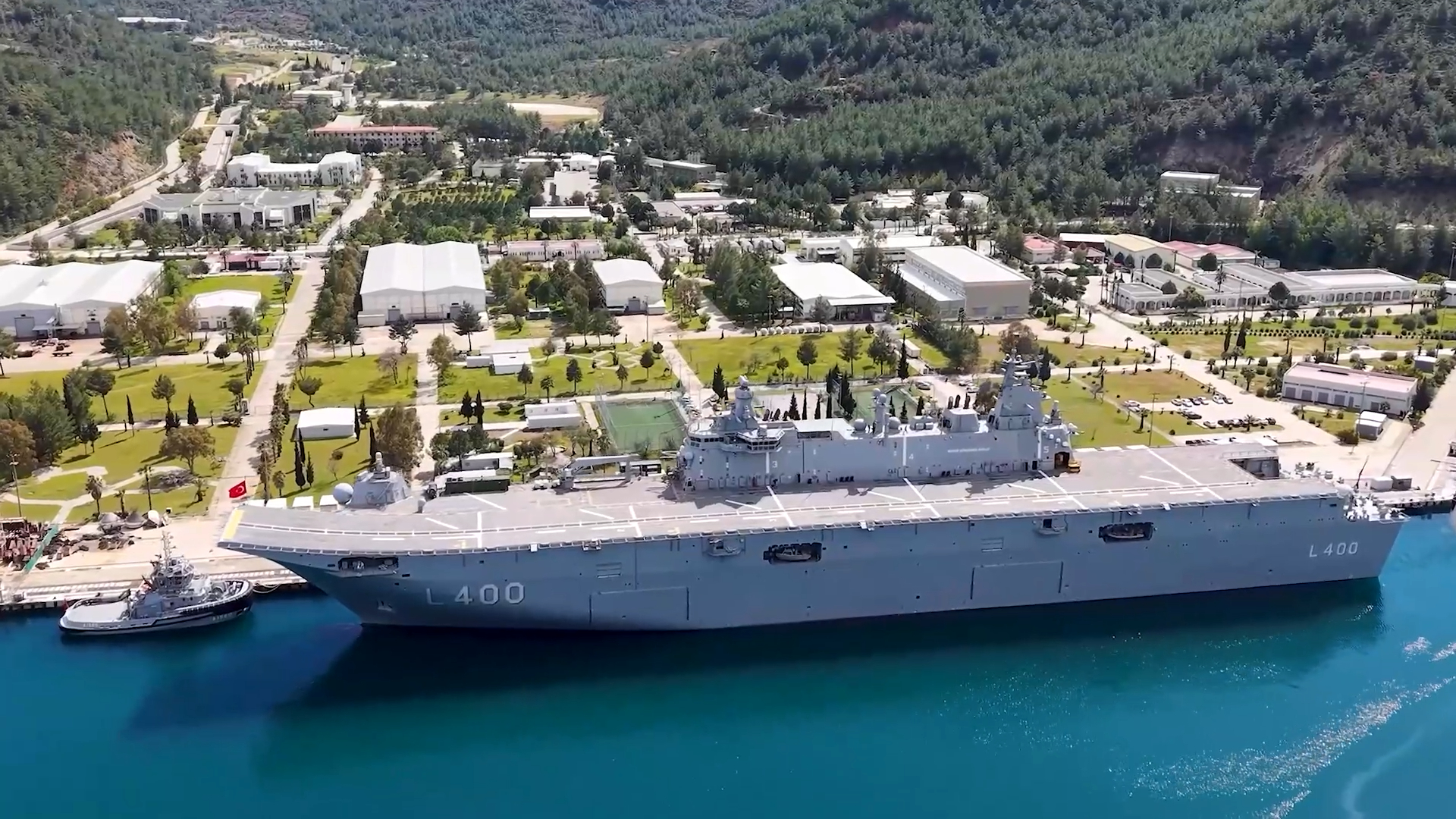
As may be remembered, under the A400M Aircraft Retrofit Contract signed between Airbus Defense & Space and ASFAT on October 3, 2019, the retrofit work of the first A400M Aircraft (MSN-009/13-0009) was started in December 2020 at the 2nd AMFD, which is the authorized maintenance center for the A400M aircraft. The retrofit work, which includes software and hardware upgrades, is expected to be completed in July 2021, and the preliminary work for the second aircraft (MSN-013/14-0013) is expected to begin. Following the retrofit process, the 9 A400M Aircraft in the TurAF inventory is planned to reach Full Operational Level (FOL) by 2023/2024. It is stated that the TurAF A400M Fleet has an overall mission capable rate of 85%. Since the 10th A400M aircraft to be delivered in January 2022 will already be in the latest software and hardware configuration, it will not undergo the retrofit process. Retrofit work is being carried out in the newly built private aircraft hangar with a construction area of 10,000 m2 and a height of 24 m equipped with high-tech protection equipment, and the second hangar is expected to be completed soon. According to the information I have received, the preliminary preparation and structural transformation of the A330 MRTTs will be carried out in this hangar.
The Airbus A330 Multi Role Tanker Transport (MRTT)
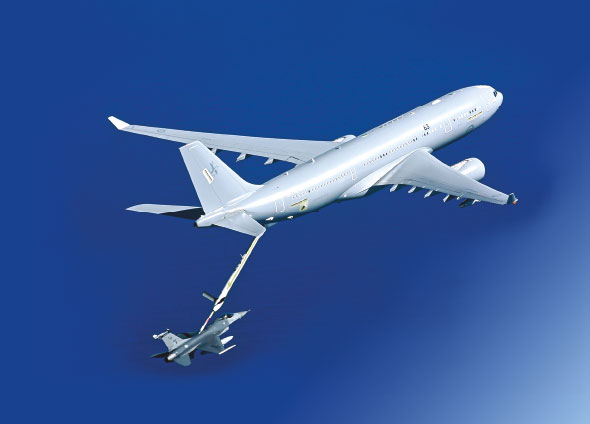
Based on the Airbus’ popular A330-200 widebody passenger airliner, the A330 Multi Role Tanker Transport (MRTT) Aircraft can carry 111 tons (245,000lb) of fuel on its wide wings and tail. Thanks to this feature, no modification is required in the fuselage to load the fuel tanks onto the aircraft. As all fuel is carried on the wings and tail, the A330 MRTT can carry up to 45 tons (99,000lb) of additional cargo in the cabin. Being the only new generation tanker that can carry 111 tons of fuel without auxiliary fuel tanks, the A330 MRTT is capable of performing three different tasks in one mission with zero turnaround time (Air-to-Air Refueling [AAR], Passenger/Military Personnel/VIP Transport and Aeromedical Evacuation [AME]). Promoted as the only new generation tanker aircraft solution in the market that offers true multi-role capabilities in this respect, the A330 MRTT can refuel 82.2 tons at a range of 500nm (926km). With 64,000kg (140,800lb) of fuel, the A330 MRTT can perform an AAR mission at 500nm for 5 hours, or for 4 hours and 30 minutes at 1,000nm (1,852km) with 55,000kg (121,000lb) of fuel. The A330 MRTT can provide fuel to 4 fighter/bomber aircraft without an external weapon load up to a range of 3,600nm (6,700km, with a 25 tons cargo load, this distance is 2,800nm [5,200km]). Additionally, it can transport 266 passengers or 130 NATO standard stretchers in a two-class configuration or 300 passengers with their personal belongings in a single-class layout to intercontinental distances at a high speed, comfortably. As part of the Strategic Transport Mission, the A330 MRTT can ferry 40 tons (88,000lb) of cargo and 300 troops with military equipment to a distance of 8,400km (4,500nm), 30 tons (66,000lb) of cargo, and 200 rescue personnel with their equipment to a distance of 10,200km (5,500nm) and, from the danger zone, it can transport 250 evacuees with 20 tons (44,000lb) of cargo to a distance of 12,000km (6,500nm).
The A330 SMART MRTT, the new version of the A330 MRTT with Automatic Air-to-Air Refueling (A3R) capability, can also be used as a communication node and command & control aircraft apart from air-to-air refueling and transport missions with its Link 16 Tactical Data Link and Broadband SATCOM capability.
As of June 2021, a total of 61 A330 MRTT have been ordered, 47 of which have been delivered. The A330MRT Fleet has over 250,000 flight hours in service. The A330 MRTT Aircraft currently in service with the Royal Australian Air Force (RAAF, 7 aircraft), the Royal Saudi Air Force (RSAF, 6 aircraft), the UAE Air Force (3 aircraft), the Royal Air Force (RAF, 14 aircraft), the Republic of Singapore Air Force (RSAF, 6 aircraft), the French Air Force (12 aircraft) and the Republic of Korea Air Force (ROKAF, 4 aircraft), as well as the NATO/NSPA Multinational MRTT Squadron (NATO Support and Procurement Agency, 9 aircraft, Royal Netherlands Air Force, Luxembourg Armed Forces, German Air Force, Royal Norwegian Air Force, Belgian Air Force and Czech Air Force).
With a total length of 58.80m, a height of 17.40m, and a wingspan of 60.3m, the A330 MRTT Aircraft has a Maximum Take-Off Weight (MTOW) of 233 tons and a Maximum Landing Weight (MLW) of 182 tons. With a maximum payload/cargo capacity of 45 tons (99,000lb), the aircraft is powered by General Electric (GE) CF6-80E1A3 (320kN) or Rolls-Royce Trant 772B (316kN) engines. In addition, the A330 MRTT can be equipped with three different refueling systems, which allow aircraft with different probes to be refueled in the air: two underwing refueling pods (Cobham 905E, for aircraft with probe-and-drogue capability such as F-35 and F/A-18, 1,800kg/min fuel transfer rate), the Fuselage Refuelling Unit (FRU, Cobham 805E, for large aircraft with hose-and-drogue capability such as A400M, 1,300kg/min fuel transfer rate), and the Aerial Refueling Boom System (ARBS, for aircraft with refueling port/receptacle such as F-16). Defined as the "21st-century benchmark for new generation tanker/transport aircraft," the A330 MRTT can transfer 100 liters of fuel per second and 3,600kg (1,200 gallons/min) of fuel per minute with the Aerial Refueling Boom System (ARBS) with a fly-by-wire system.
The Aerial Refueling Console, where fuel transfer is controlled, is located just behind the cockpit (also in the same position on KC-46A), unlike other tanker aircraft in service. The operator manages the refueling process remotely, thanks to cameras with day and night vision capabilities. With the ARBS, two engines backing up each other are used to increase the safety of refueling, and even if one of the engines fails, the system can complete its task with a single engine (although the fuel transfer rate is slightly reduced). Furthermore, thanks to the Universal Aerial Refueling Receptacle Slipway Installation (UARRSI), the A330 MRTT can also refuel from another MRTT/tanker aircraft to increase its flight range.
Boeing KC-135 Stratotanker
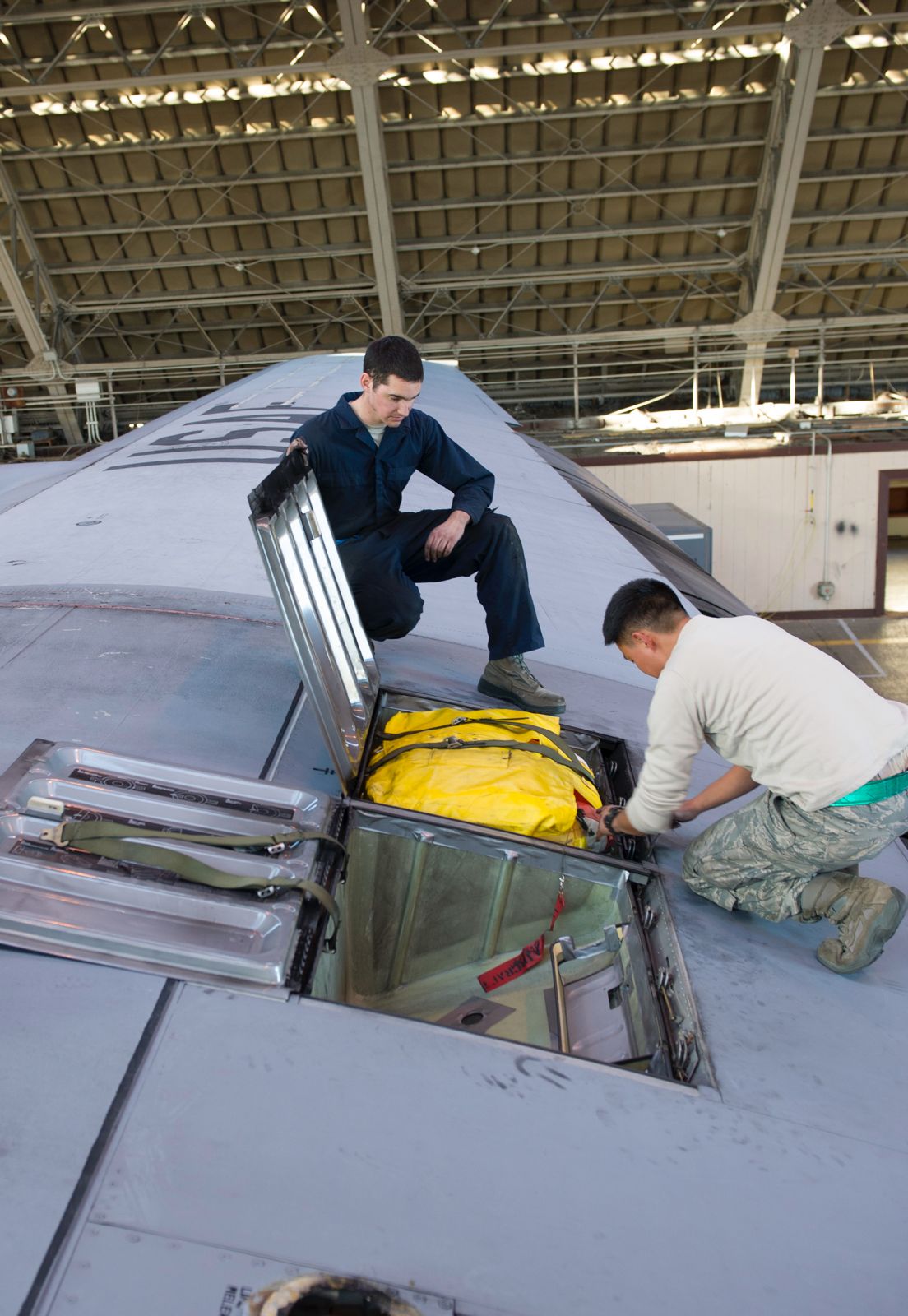
7 KC-135R Stratotanker Tanker Aircraft, which provide the Turkish Air Force with the opportunity to become a global force and significantly increase the operational efficiency by giving the combat units the ability to respond to threats around our country without changing their locations, operate within the 101st Tanker Squadron (Call Name: Asena) stationed at the 10th Tanker Base Command in İncirlik, Adana. The planes were delivered to the US Air Force in 1959-1963 in the KC-135 configuration. They were decommissioned in 1993 and started to be stored at the 309th Aerospace Maintenance and Regeneration Group (AMARG), and later modernized and delivered to the Turkish Air Force between December 1997 and July 1998.
The TurAF first gained air refueling capability in July 1995 with the leased KC-135R Aircraft and later in December 1997 with the second-hand KC-135R Aircraft, taken out of storage from AMARG in 1996 and modernized with new engines and avionics. With a fuel capacity of 92 tons, the KC-135R can transfer 52 tons of fuel to other aircraft during air-to-air refueling. The KC-135R Stratotanker, which can stay in the air for 8 hours during aerial refueling missions, has a range of 2,419km (up to 17,766km for ferry missions). KC-135R Airplanes are equipped with an aerial refueling boom in the tail to refuel aircraft with embedded refueling ports/receptacles. However, a "boom-drogue adapter" can be attached to the boom for aerial refueling of aircraft with refueling probes (the tanker retains its articulated boom but has a special shuttlecock-shaped hose/drogue, sometimes called a basket, at the end of it instead of the standard nozzle). The 101st Tanker Squadron has a limited number of this refueling adapter in its inventory and is generally used during aerial refueling missions in multinational exercises.
Metal fatigue now occurs in the KC-135R Aircraft in the inventory of the 101st Tanker Squadron, the youngest of which is 58 years old, and the maintenance, repair, and operating costs of the aircraft are gradually increasing. KC-135R Aircraft were modernized with Global Air Traffic Management (GATM) System avionics in the early 2010s. In this context, the first upgraded KC-135R aircraft was delivered in April 2011. Additionally, the US Air Force provided training to Turkish Air Force personnel for the GATM System under a two-week course held at Mildenhall Air Base of the Royal Air Force in England. The course consisted of two phases, Classroom Training and On-board Training. KC-135R Aircraft had previously undergone Pacer-CRAG (Compass Radar and Global Positioning System) modernization