Turkey-China Partnership Emerges out of T-LORAMIDS Tender
Defence Industry Executive Committee (SSIK) held on September 26th, under Prime Minister Recep Tayyip Erdoğan’s presidency. Turkish Chief of General Staff General Necdet Özel, Minister of National Defence İsmet Yılmaz, Defence Industry Undersecretary Murad Bayar and military and defence officials attended the meeting that lasted for three hours. Turkish Long Range Air and Missile System (T-LORAMIDS) was at the top of the agenda. In the statement made after the meeting, it was announced that starting the talks for the contract related to the joint production of Air Defence Systems and missile systems with the China Precision Machinery Import and Export Corporation (CPMIEC) in Turkey was decided.
At the previous SSIK meeting of January 2013, it was concluded that American Raytheon-Lockheedmartin consortium, Italian-French Partnership Eurosam, Russian Rosobronexport and Chinese CPMIEC should give offers one more time and that these offers should be reevaluated. Additionally, at that meeting Turkish Defence officials mentioned that joint production model and the condition of 50% domestic participation were discussed. It was stated that following this stage, Chinese company gave the best offer and that accordingly CPMIEC lowered its offer under 4 billion USD and met the demands of Turkey regarding joint production and technology transfer.
Following the SSIK meeting, Murad Bayar disclosed that the Chinese company offered 3.44 billion US$ which was below other company’s offers. Bayar also stated that the offers were evaluated at Defence Industry Executive Committee Meeting and it was decided to initiate contract negotiations with the Chinese company and if for any reason the contract is not made with the successful bidder, then negotiations will be initiated with Eurosam (2nd successful bidder) and if the contract is not made with the 2nd successful bidder, then negotiations will be initiated with the 3rd successful bidder (US company. Bayar also stated that the Russian company’s offer was disqualified from the tender. “Following the contract award as per the tender specification and advance payment, the Chinese company shall complete all deliveries of missile system within 4 years. The Contract is expected to be signed within 6 months,” said Bayar. He also stated that they will make technology transfer for the system production and added “When we start to make our own system in Turkey, we will have our own infrastructure and capability to use. Almost all of the missiles will be manufactured in Turkey.”
Turkey shall embrace a new era with the completion of T-LORAMIDS Project and with this surprising result the reaction of the Western and ally countries is an issue of concern. As the proposed system’s integration with the NATO is not strategically and technically appropriate, Turkey will have to endure several problems. Defence officials express that allies would not be willing to integrate their air defence components with the Chinese system. On the other hand with the selection of this system, Turkey’s plans for the future began to come into surface. “We will not encounter any problems regarding the system’s integration with NATO. Turkey has air defence network and command control network. These networks are connected to NATO in an upper level and are able to exchange information. All our defence systems can be integrated with NATO systems when necessary. This system can be integrated with our air defence network and this will also be in compliance with all NATO standards,” said Undersecretary for Defence Industries Murad Bayar regarding these drawbacks. Bayar also stated that many eastern bloc countries have become NATO member countries in recent years and all of these countries have been using eastern bloc air defence systems and no problems are recorded. He also added that the general approach as “NATO member countries use NATO member countries’ products” is generally acceptable and this does not mean the use of other systems is not appropriate.
As a result, it seems the reactions created in the world as per this decision will continue for a long time. NATO and allied countries will undoubtedly take part at the center of the discussions. The efficiency of strategic cooperation of Turkey with China, the technological acquisitions and Turkey’s reaction against challenges that would emerge both in political and technical issues shall determine who the successful competitor will be in the tender. The successful bidder is already announced but Turkey clearly has many issues and parameters to review in the future.
Hürkuş in Serial Production
One of the most important decisions in the meeting besides the T-LORAMIDS tender was the resolution on the serial production of the Primary and Basic Trainer Aircraft “Hürkuş”. According to this, at the first stage TAI shall manufacture 15 “Hürkuş” aircrafts of which the development and flight tests continue. TAI’s Vice President of the Aircraft Group Mr. Özcan Ertem mentioned that the decision regarding the serial production of “Hürkuş” was highly important for Turkish aerial industry.
Ertem noted that if the contract could be signed before the end of 2013, first Hürkuş aircraft would be delivered to the Air Forces Command in 2017 and the remaining 14 would be delivered in 2018 and added that aircraft’s cost has not been determined yet. Ertem said “Depending on the electronic devices they are equipped with, these types of aircrafts are between the range of 10-12 million USD in the world. We are trying to remain in that range in order to be competitive”.
Ertem expressed that the foreign countries were also interested in Hürkuş and that they were preparing to bid in 2 countries and added “We have 4 major competitors and these are aircrafts from Switzerland, USA, Brazil and Korea. With Hürkuş we shall be one of their major competitors in every tender”. Turkey’s first basic trainer aircraft Hürkuş started its flight tests on August 29, 2013. Hürkuş accomplished her first four flights successfully; the aircraft shall be tested in the next two years and shall be receiving a type certificate from Turkish General Directorate of Civil Aviation (SHGM) and European Aviation Safety Agency (EASA) when it shows that it complies with the conditions. The trainer aircrafts, which shall be purchased for covering the needs of the Air Forces Command, are intended to be used together with the KT-1Ts in the inventory of the Air Forces Command.
Ability to Fly at Low Speed
Hürkuş weighs 3.2 tons and is 11 meters long and 3,70 cm high. The aircraft works with 1,600 hp PT6A-68T Pratt & Whitney Canada turboprop engine. With its powerful engine supported with five bladed propellers, Hürkuş could reach up to 310 knots of maximum cruise speed. The aircraft could climb up to 35000 feet and could cover 800 sea miles ground with full reservoir. Owing to its acrobatic capabilities Hürkuş could carry weights of +7 g /-3.5 g and with its powerful engine it could take-off at such a short distance like 500 meters. One of the distinctive features of Hürkuş is its “fowler” type flaps. While expanding the wing area this flap also enables the aircraft to remain in the air in low levels of speed. The cockpit of the aircraft designed by TAI engineers and tutors of the Air Forces offers 5 degrees down-view angle of visibility to the tutor pilot over the student’s helmet while offering perfect visibility to the pilots during landing. The firing mechanism of the F-35 is used in Hürkuş. In extraordinary cases where the explosives do not function the seat’s spades break the glass and within 0.8 seconds both the tutor and the student pilot may be able to leave the aircraft.
MILGEM-S Tender Starting All Over Again
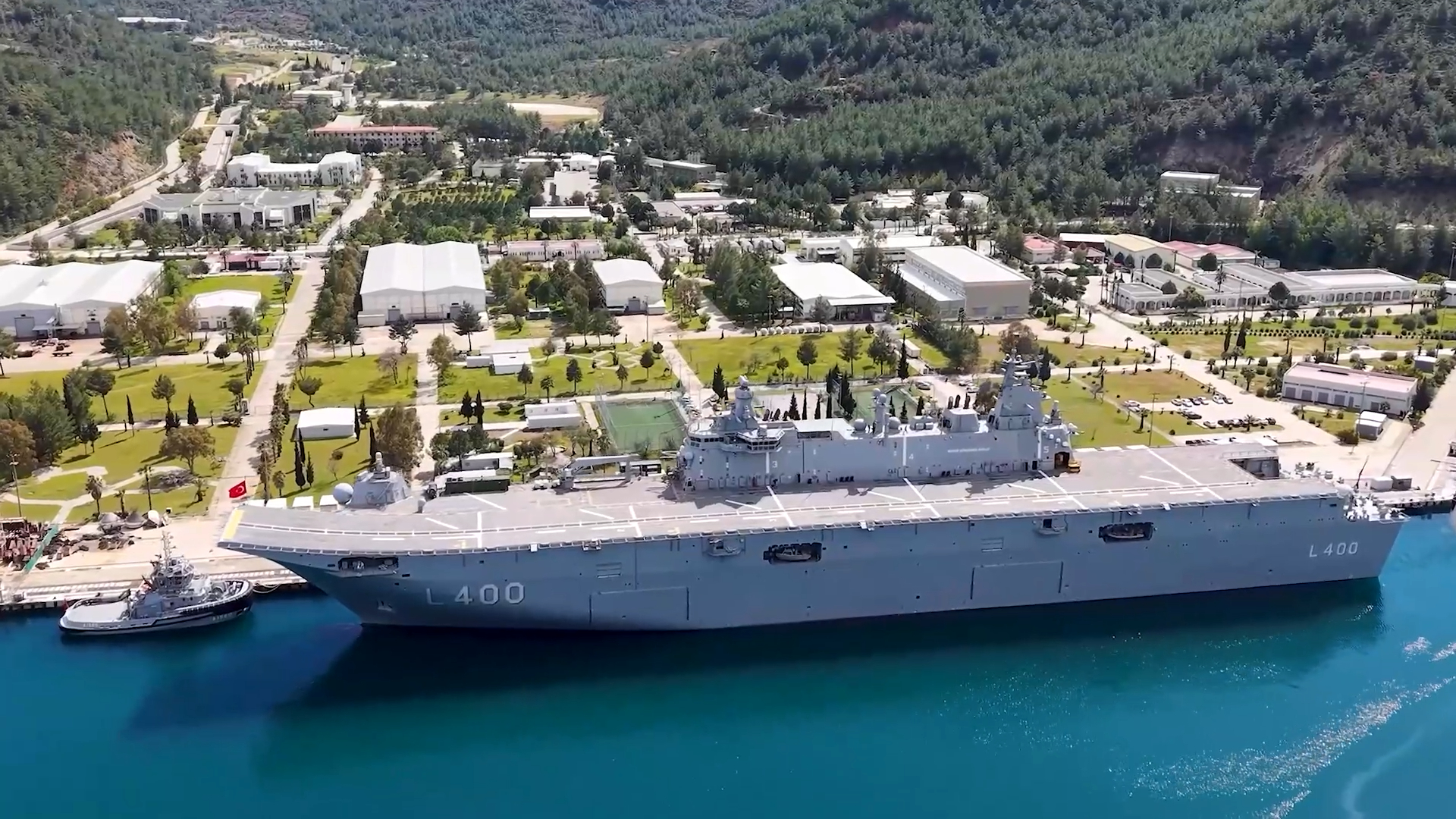
One of the major decisions of the SSIK meeting under Prime Minister Erdoğan’s presidency was the cancellation of the MILGEM-S Tender. The contract regarding the building of 6 MILGEM corvettes with a total value of 1,5 billion USD at RMK Marine Shipyard was cancelled with a resolution made at the last meeting. While no official statement was made, due to experts this decision was as a result of the report of the Prime Ministry Inspection Board that stated “no public welfare provided” which was given due to the objection of the companies that were not invited to the tender that was made in last May. With this decision, the tendering procedure is now back to square one but the manufacturing of the ship platforms and system integrations shall continue uninterruptedly. According to this, the manufacturing of the platforms and system integrations of the 3rd and 4th ships shall be conducted by the İstanbul Pendik shipyard affiliated with the Naval Forces Command, similarly the way it was done for the first two ships. For the remaining 4 corvettes a tender will be made again and 7 shipyards shall be invited.