Turkey Outlines UAV Plans
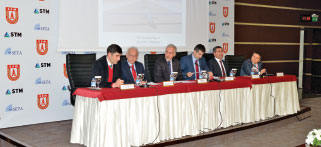
A Panel on “Turkey’s UAV Roadmap in Relation to Technological Developments” organized by the Foundation for Political, Economic and Social Research (SETA), Undersecretariat for Defense Industries (SSM) and Savunma Teknolojileri Mühendislik ve Ticaret A.Ş. (STM) was held at the premises of the SSM. The Panel was moderated by the SETA Security Research Director Asst. Prof. Murat Yeşiltaş and the opening speeches were given by the Undersecretariat for Defense Industries Prof. İsmail Demir and Head of SSM Unmanned and Smart Systems Department Mr. Yakup Taşdelen. Head of TOBB-ETU Mechanical Engineering Department Prof. Ünver Kaynak, STM Consultant Mr. Cengiz Karaağaç, Vestel Defense Deputy Director General Mr. Süha Özgür Dinçer, TAI Engineering Director Mr. Remzi Barlas and Baykar General Manager Mr. Haluk Bayraktar participated in the panel as speakers.
Turkey’s transition period to UAV production through its domestic resources and indigenous design, the developments in UAV technology and the direction of the technological evolution, UAV utilization’s integration to the civil aviation field, current studies and targets, requirements and issues of the private sector were examined throughout the panel.
In his opening remarks, Undersecretary for Defense Industries Prof. İsmail Demir underlined that within the scope of the development of UAVs, they concentrated on the naturalization of the companies assigned as well as their support and stated that the requirement for UAV systems in military and civil areas will be increasing in the future. “As the Undersecretariat, we focus on the indigenousness of the unmanned air systems. We aim to develop platforms in which all the components from each hardware unit to software, from all the command systems to communication systems are indigenous or could be procured infinitely. This is more important regarding the unmanned systems in which we technologically reached to a certain point. Because from our past unpleasant experiences, we are fully aware of the potential obstacles that may emerge due to the impression we had around the world as a result of the level we arrived. We must adopt the required measures in advance. We would like to state that we support and continue to support all our companies conducting activities within this scope in their indigenousness and independency efforts. Not only the platform and system producers, but also the component and system producers should concentrate in full steam on Research and Development for developing all critical technologies that may arise as obstacles”, added Prof. Demir.
SSM Unmanned and Smart Systems Department Head Mr.Yakup Taşdelen informed the participants on Turkey’s UAV systems adventure from 1989 to date and on sector’s vision for the future. Taşdelen stated that they had numerous indigenous UAV systems with completed development studies, under serial production or delivered to the requesting authorities. “The most widely used system - the Bayraktar mini UAV system - was taken into operation by our Land Forces, Gendarmerie Task Force and National Police. We delivered the ‘Malazgirt’ system to which we refer as the Rotary Wing Mini UAV to Land Forces Command. In Tactical Class, Bayraktar TB2 Unmanned Air Vehicle is being utilized by our Land Forces Command. Moreover, recently, we launched the studies for the procurement of the same system for our National Police. We will be initiating the procurement activities regarding the Tactical Class for our Gendarmerie General Command in the upcoming period. The development studies of the Anka program are underway. The final configuration of Anka-S program, the Anka Block-B will be supplied to our Air Forces Command. Besides, in accordance with the demand of our National Police, the activities regarding the procurement of Anka Unmanned Air Vehicle have been launched” added Taşdelen. Taşdelen also expressed that they left an important milestone within the scope of Anka-S program and added, “We successfully accomplished the first flight of the Anka Block-B configuration’s merely structurally transformed version. Only structural modifications were made in this platform. There are no critical systems over the aircraft presently, TAI is conducting certain tests in order to learn the flight dynamics and gain time until the qualification tests”. Stating that all the Bayraktar TB2 systems have been included into Land Forces’ inventory, Taşdelen added, “The activities for the armament of this platform are underway. We conducted a firing test from this platform for the first time and hit the target with 100% precision. We attach great importance to this systems’ execution of various tasks besides the reconnaissance and surveillance”.
Vestel “Karayel” Tactical UAV on Theater
Taşdelen presented information regarding the “Karayel” system - another platform in Tactical Class and developed by Vestel Defense Industry and said, “The tests executed within the company are almost complete. I hope that soon we will be able to initiate the acceptance tests. System is currently hired to provide reconnaissance and surveillance services in the operation field. The performance of both our Tactical Class Platforms’ are beyond the performance criteria stipulated by the contract.
Taşdelen mentioned that during the development stage of these indigenous platforms, they attached great importance to the indigenous development of the sub-systems as well and noted that if they procure these sub-systems from foreign countries then they would be facing export license restrictions in the future when they wished to arm these platforms. Taşdelen expressed that they launched quite significant programs to this end. “We focus on the domestic production of the task computer and sub-systems of the operative UAV platform. During Anka-S Project, we achieved to naturalize many smart boxes directly procured from foreign countries as part of the Anka Block-A development program. The flight control and task computer was developed and produced by Aselsan. Again, the camera systems to be installed over the platform were also produced by Aselsan. All electronic systems equipped to the platform as hardware are being developed by Aselsan. We severely increased the domestic participation rate in this program” continued Taşdelen. Adding that they made a strategic modification for the procurement of a Strategic Attack UAV, Taşdelen said, “We will proceed through indigenous development instead of importation or a consortium. We are preparing the request for proposal presently”.
Mr. Yakup Taşdelen: “We will organize a UAV Symposium in May 2016”
Telling that the UAV Road Map they published in 2011 needed an update; Taşdelen added “In May, we will hold a symposium for increasing the awareness for the UAVs. Right after this symposium, a draft document will be prepared by the sub working groups and we plan to publish the updated version of this document in the first quarter of 2017”.
Turkey’s UAV Strategies Discussed in the Panel
The panel started following the opening speeches. It was moderated by the SETA Security Research Director Asst. Prof. Murat Yeşiltaş and the Head of TOBB-ETU Mechanical Engineering Department Prof. Ünver Kaynak, STM Consultant Mr. Cengiz Karaağaç, Vestel Defense Deputy Director General Mr. Süha Özgür Dinçer, TAI Engineering Director Mr. Remzi Barlas and Baykar General Manager Mr. Haluk Bayraktar participated in the panel as speakers.
The first speaker of the Panel, Head of TOBB-ETU Mechanical Engineering Department Prof. Ünver Kaynak extended detailed information on the worldwide developed UAV systems, the UAV systems under development and on the projects developed in Turkey. Prof. Kaynak informed the participants on the UAV systems developed by Turkey with alternative energy, namely the Kuzgun, Tan 100 and Tepegöz projects and mentioned that the utilization of alternative energy in unmanned systems was becoming more popular each day.
Underlining that sharing of the roles in vertical and horizontal platforms was of high importance in Turkish aerospace industry Prof. Kaynak continued, “In my opinion, the technology flow is quite critical in aerospace. The technology flow between the layers should be more flexible. The technology developed at the lowest segment will access the market through the top segment companies capable of competing worldwide. We should encourage this transitive structure from the bottom to top”.
6th Generation Unmanned Combat Air Systems to Serve beyond 2035
STM Consultant Mr. Cengiz Karaağaç stated that UAV production in the world reached gigantic numbers in the last ten years, adding that according to the data of 2015, 600 companies from over 60 countries conducted only UAV production. Karaağaç mentioned that in line with the demands of the civilian and commercial markets, a growth of yearly 20% was expected in the UAV market and regarding the military area, they anticipated a steady yearly growth of 5 percent each year.
Karaağaç stated that the military UAV systems were mostly designed for the operation environments focused on terrorism and underlined that unfortunately these systems remained unprotected against the air defense threats. Karaağaç said, “The UAV systems are unprotected within the conventional operation environments. In 2011, Iran seized America’s most developed UAV during the Electronic War attacks. In 2013, two Global Hawks crashed at the air space of China at 60 thousand feet, similarly the deactivation of the UAVs in East Ukraine indicates that the UAV systems are insufficient in conventional operation environments. In this respect, features such as maneuver, invisibility, autonomy will start to stand out in the systems to be developed in the following years. And in the 2020s, I believe that many air operation tasks would be accomplished through the systems with relatively lower maneuver capabilities but capable of engaging to the remote targets. In 2030s, large hulled Unmanned Air Vehicles will be able to conduct cargo transportation, in-flight refueling tasks. After 2035, Unmanned Combat Air Systems will be included into the inventory of the Air Forces. These systems will not be the unmanned configurations of F-35 aircrafts. Sixth generation Unmanned Combat Air Systems will be able to execute tasks alone in certain levels with the help of artificial intelligence and autonomy”.
Pointing out that nowadays the communication systems used in UAV systems and GPS based navigation systems could be easily jammed through Electronic Warfare, Karaağaç said, “New alternatives need to be developed for the secure execution of the UAV flights. Besides, the data derived through UAVs reached a gigantic size; their processing, valuation and dissemination are getting harder. Development of the systems conducting such operations automatically will be required in the future”.
Cargo Transportation to increase in the UAV Systems
Karaağaç emphasized the need to work on laws and directives regulating UAV production and utilization in Turkey. Stating that the ill-intentioned and unconscious usage of the systems and UAV utilization for terrorist attacks should be prevented in Turkey, Karaağaç continued, “There are no frequency ranges to be assigned to the UAV systems. In the future, for controlling the UAV systems, these frequency bands will have to be allocated. Another important point is interoperability; technologies enabling the correspondence with the Manned Air Vehicles and with the sensors on the ground or at the sea, interoperable technologies are required”.
Karaağaç noted that from the year 2020 on, the flights of the unmanned air systems meeting the required criteria will be released at the civilian air space and said, “Companies such as Google and Amazon made substantial investments on these systems. Starting from 2017, we can observe the first implementations of this cargo transportation with relatively less load capacity. On the other hand, for the transportation of the cargos with more carrying capacity, the platforms composed of the representatives of universities and companies have been conducting substantial studies. It is predicted that the systems which will deploy the Robotic Military Units to operation field and take them back when their tasks are completed would be developed in the ultimate stage. DARPA in USA has a project in this regard. Meanwhile, within the context of global internet, the UAV systems expanding the scope of the internet will become prevalent. Google and Facebook invested over 100 million US Dollars. Google has been flying its balloons since 2013 at the stratosphere. Similarly, it developed Aquila 1 UAV. Google conducted the introduction of this system and it will soon launch the test flights. They aim to remain in the air for three months with this system”.
Tactical UAV of Vestel Defense “Karayel” in Operational Tasks
Vestel Defense Deputy General Manager Mr. Süha Özgür Dinçer made a presentation on the requirements and problems of the private sector and extended comprehensive information on Vestel Defense’s UAV adventure the “Karayel” and the Tactical Class Unmanned Air Vehicle. Dinçer said that Vestel Defense has joined the UAV development process in 2003 and continued “We started our adventure with the mini demo ‘Arı’ UAV in 2005. Then we designed the hand launched ‘Efe’ system with lower take-off weight and longer endurance, weighing 5 kg. In this period, we initiated the preparations for the ‘Karayel’ Tactical Class Unmanned Air Vehicle. In 2009, upon the request of our Undersecretariat for Defense Industries, we designed a demo with 8 hour long endurance capability in 250 kg take-off weight, with 150 km of maximum range and capable of carrying 35 kg of payload. In 2011, we won the tender for the tactical class launched by our Undersecretariat for Defense Industries. The contract is composed of 6 air vehicles, 3 ground control stations, 5 ground data terminals, 4 remote vision terminals and 4 payloads. We signed the contract in 2011. We indigenously developed the night and day reconnaissance and surveillance, target acquisition point, artillery fire for adjustment, damage assessment systems. This system is capable of conducting the autonomous take-off and landing tasks. One of the features of the system that stands out is its development in compliance with the NATO’s STANAG 46/71 (Unmanned Aerial Vehicle Systems Airworthiness Requirements) certification, this was not compulsory according to the contract but we volunteered for it as Vestel Defense. We accomplished almost 600 technical meetings with total six sub-working committees under the leadership of STM. We endured many difficulties but we succeeded.
The payload unit has a capacity of 70kg in Karayel. Endurance of the platform is 20 hours with a payload of L3 MX-15 (Multi-Spectral Imaging System) of 51 kg of the Wescam Company. The air vehicle is capable of conducting flights to 150 km and beyond through the data link at 18-22 thousand feet. In Sivrihisar (operational test field near Ankara), we reached 202 km of range through the data link. However, in the operational region in East Anatolia, it is not possible to reach this range because of the altitude and mountainous geography. Through the antenna transfer defined in the contract, and ground data transfer we are able to reach 300 kilometers. In the operational region, at Turkey’s coldest regions we conducted flight at ice accretion conditions for three months. The technical specification stipulates the execution of flights at 40 knots wind and -30 +50 heat temperatures. In order to test the limits of the system and assume the acceptable risks, we conducted successful task flights at 61 knots of wind and in -35 degrees, at 18.500 feet altitude. Moreover, in December 2015, our two air vehicles with X3 and X2 tail numbers conducted tasks simultaneously at the forward base area”.
Telling that the air vehicles were capable of advanced base transfer through the ground data terminal at the region they conducted their tasks, Dinçer added “In the operational region, we have forward bases at two different locations. Three more advanced bases will be established soon in the region and through this, our coverage area will extend from East Anatolia region to Black Sea”.
Armed UAV “Karayel” to Debut in June 2016
Declaring that they accomplished the user trainings of the “Karayel” Tactical Class Unmanned Air Vehicle, Dinçer continued, “We provided training to a total of 50 trainees composed of pilots, payload operators, task commanders, system administrators, maintenance administrators, electricians and mechanic technicians. Turkey’s second UAV battalion was established in this region. We conducted 103 sorties in this region. 246 hours out of 496 hours of flight is composed of task flights”.
Dinçer noted that they would be focusing on the ammunition integration and SAR integration topics in the upcoming period and claimed that they would be making two products with completed ammunition integration and documentation processes which are to be delivered in May or June.
Taking the floor after Vestel Defense Deputy General Manager Mr.Süha Özgür Dinçer, TAI Engineering Director Mr.Remzi Barlas told the audience that TAI started working on projects regarding the development of Unmanned Systems for the first time in 1990 and added that they had over 20 years of experience and competent staff in this area. Barlas said, “As TAI, we have 212 personnel in our Unmanned Air Vehicles department and 150 of them are engineers. More than half of these engineers are graduates of electric-electronic and computer engineering faculties and the other half are composed of the graduates of aerospace, space, aircraft engineering and mechanical engineering departments”.
SATCOM Equipped “Anka” to Conduct its Maiden Flight within 2016
Barlas mentioned that in 1996 TAI started the development of the “Turna” and “Keklik” target drone systems which were included in the Turkish Armed Forces’ inventory in 2001 and continued, “In 2007, we put forth the “Gözcü” system derived from the “Turna” system. In 2010, we successfully accomplished the maiden flight of the “Anka” MALE – Class UAV. And in 2013 we completed the acceptance tests of the “Anka Block-A” development program and signed a mass production contract with the Turkish Air Forces Command within the framework of the “Anka-S” program. The flight tests of the “Anka Block-B” configuration under indigenous radar integration studies are ongoing. The Satellite Communication (SATCOM) capable configuration which will be included into our Air Forces Command’ inventory is still under serial production. We accomplished the first flight of the pilot vehicle with the “Anka-S” structure. Within 2016, we will be conducting the first flight of the final configuration by integrating the SATCOM equipment in the system. And at the beginning of 2017, we wish to accomplish the delivery of the first aircraft within the scope of the “Anka-S” program”.
Barlas told that through the Indigenous Development Project, they aimed to develop a platform with 24 hours of endurance at 30 thousand feet altitude at the first stage, adding that this would not be possible within a single phase he continued, “At this stage, we developed our product over two separate blocks namely the Block-A and Block-B by revising the Project with our Undersecretariat for Defense Industries. Within the scope of Block-A, we introduced our product with a humble performance such as 18 hours of endurance capability at 23 thousand feet equipped with the Aselflir-300 T indigenous camera and two prototypes of these aircrafts are still conducting their performance flights. Then, for reaching the performance of 24 hours endurance at 30 thousand feet altitude, we made lightening in the structural form and aerodynamic improvements in Block-B. We exerted substantial efforts. The integration of the “SARPER” SAR/GMTI-ISAR Radar produced by Aselsan to the Block-B configuration continues. Our activities are being conducted in full steam for acquiring our Turkish Armed Forces a platform we name as “Anka-S”, with a HD CATS camera installed so that it could transfer images in night and day conditions, be controlled from the satellite, conduct data transfer over the satellite and at the same time execute tasks of PLS or combat research and rescue tasks via a radio relay”.
Barlas stated that as TAI, they created a Road Map for UAVs and added, “Our road map consists of the development of the radar invisible UAV systems in addition to the development of the systems named as drones or target drones. In the upcoming period, with the development of Combat UAV Systems, we aim to direct our resources step by step towards the Unmanned Combat Air Systems. On the other hand, in line with the demands of the Naval Forces Command, we conducted technology development studies for unmanning a manned helicopter of 1.5-2 tons class”.
“TB2” Operates 22 Hours a Day at the Operation Zone
Last speaker of the Panel, Baykar Makine General Manager Mr. Haluk Bayraktar shared the development, production and the delivery processes of Baykar Makine’s “Bayraktar TB2” Tactical and “Mini Bayraktar” UAV systems with the participants. Telling that they delivered the Mini Unmanned Air Vehicles to the Land Forces Command in 2007, Barlas added that in the meantime the tactical class UAV procurement Project was launched to tender by the Undersecretariat and that they simultaneously started working on the development of this program as well. Stating that they attended the demonstration with the prototype they developed in 2009, Bayraktar added that after the demonstration flights it was decided to procure 12 Unmanned Aerial Vehicles from their company. Bayraktar mentioned that following the contract negotiations lasted for two years, the contract was signed in 2012 and added that after the completion of the development and production processes which lasted for 2.5 years, they started the deliveries to the Turkish Armed Forces as from the first half of the 2015. “The domestic participation rate in the development of this platform was identified as 93 %. Achieving this high rate of added value is of vital importance for our country”, said Bayraktar. He mentioned that the “Bayraktar TB2” Tactical Class Unmanned Air Vehicle completed 1200 hours of flight by the end of 2015 and 620 hours of this has been task flights. Bayraktar added, “Our air vehicles at the operation zone are conducting their tasks uninterruptedly in compliance with the minimum 22 hours endurance. As a result of a year-long study, we completed the integration of the ‘MAM’ smart munitions, which are derivatives of the UMTAS missile developed by Roketsan as an Anti-Tank Missile, to our platform and after all these studies, we fired the targets with 100% precision by conducting our very first test recently.”
Following the presentations of the panelists, Q&A session started and various questions were addressed to the panelists.