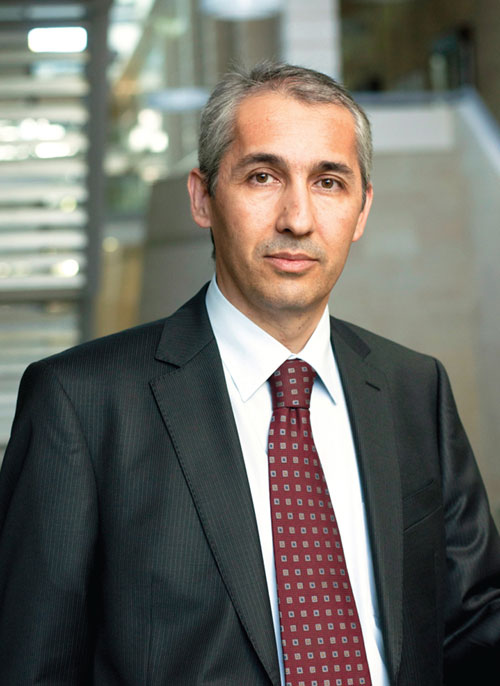
Turkey Strengthens its Land Systems Capabilities
Defence Turkey: Mr Şenel, first of all we would like to thank you for taking your time for this interview. As known, Turkey has taken significant steps during the last decade in land vehicle platforms thanks to SSM’s leadership as well as Turkish defence companies’ devoted studies. Also, Turkey has become one of the most important countries in the world that makes platform design and integration as well as transfers technology to third countries. Could you please make an evaluation for us on where we stand now and our capabilities achieved so far?
Only a decade ago, Turkish Land Platforms Industry was only capable of producing limited variants and limited number of vehicles under license, such as AFVs, 4x4 Land Rovers etc. Therefore we strictly depended on foreign suppliers, especially on the complex land systems.
Today, however, I can proudly say that almost all of the projects carried out by SSM Land Platforms Department are local development projects. Main contractors are Turkish companies; platforms and systems are designed and qualified by Turkish engineers; domestic capabilities and infrastructure are utilized for design, qualification and production. Tactical Wheeled Armoured Vehicles, Amphibious Armor Combat Earthmover, Amphibious Assault Bridge, Armoured Mine Resistant Ambush Protected Vehicles (Kirpi) are perfect examples for the local development projects conducted by SSM. On top of all these projects, I have to underline the most important one, National Main Battle Tank Altay Project.
Main Battle Tanks (MBT) are considered as the most sophisticated land vehicles. Modern MBTs are equipped with various types of electronic sub-systems as well as advanced mechanical and hydraulic sub-systems. In addition, all those major sub- systems are mounted together and work in a harmony on a unique high armoured platform after an advanced engineering optimization. Altay Program – I would like to name it as a program because it includes many high scale sub projects such as fire control system, main gun and amour development – is such an indigenous development program that shows the level where the Turkish Land Platforms Industry has reached. The main contractor Otokar has already started testing the first prototype of Altay. Once we start the serial production and delivery of Altay MBT to Turkish Army, I will proudly state that Turkey is one the few countries in the world who develop and produce her own MBT. This will be demonstrating and proving the maturity level of Turkish Land Platforms Industry.
Today, Turkish companies dealing with land platforms are capable to design, develop and produce various types of vehicles with no major technical support from foreign sources. They are initiating these activities without waiting any order from SSM or Turkish Land Forces (TLF) and marketing their systems internationally. For example, FNSS succeeded the largest ever defence export last year in a single project achieved to date by a Turkish defence industry. I would like to underline that FNSS will not only export their Pars vehicles but also provide technical support and assistance to Malaysian engineers.
Otokar designs and manufactures various types of armoured vehicles like Arma, Kaya, Cobra, etc. and exports them to tens of countries and users in the world. This example is so important that foreign users feel confidence on these systems even though some of those have not been delivered to Turkish Army yet. Otokar is currently scheduling to provide Cobra vehicles to Kazakhstan within the scope of an agreement.
On the other hand, Aselsan successfully modified and qualified a foreign MBT –Leopard 2 A4– equipping it with the sub-systems which were developed and designed by Aselsan engineers. At this point, I would like to remind that Aselsan was invited to Finnish Leopard Modernization Project Tender last year and was very close the win the competition against the strongest companies of the world.
To sum up, our industry is capable of developing, designing, qualifying and serially producing their own wheeled and tracked land platforms and the variants. In parallel, they compete against well-known foreign companies all over the world to export both their products and know-how technologies.
Defence Turkey: Are the Turkish National Main Battle Tank (TNMBT) preliminary prototypes of Altay Project, which is amongst the most important projects of Turkey to be produced within the specified schedule? Is there any delay anticipated? Could you please brief us on the current status of the Program?
In July 2008, we signed Altay Project Phase I Contract with Otokar, which covers the design, development, production, test and qualification of the Turkish National Main Battle Tank (TNMBT) Prototypes.
According to Project Implementation Schedule, Phase I of the Project lasts for 78 months and consists of the following 3 stages:
Stage I: Conceptual Design
Stage II: Detailed Design
Stage III: Prototype Development, Qualification and Acceptance
In principle, the successful completion of Phase I will be followed by Phase II which is the Serial Production of TNMBT.
The Project includes local design and development of many critical subsystems, which will enable the Turkish Defence Industry to acquire new technologies and capabilities, and reduce foreign dependency of Turkey in this field significantly.
Main subcontractors of Otokar during this project are as follows:
Aselsan, shall design and develop subsystems such as Fire Control System and Command Control Communication Information System.MKE, shall produce 120mm L55 Main Gun System. Roketsan, shall design, develop and produce Modular Armour Package. MTU/RENK, shall develop and produce 1500hp Euro-Power-Pack. Additionally, Hyundai-Rotem of Republic of Korea shall provide technical support and assistance in required areas.
Conceptual Design Stage of the Project was successfully completed and System/Subsystem detail design activities have been on-going in accordance with the Project Implementation Schedule. Production of preliminary prototypes and infrastructure investment studies are also being carried out in parallel to the detail design and production activities.
In the Altay Project, two preliminary test prototypes, Mobility Test Rig and Firing Test Rig will be developed and tested. According to the test results of these Test Prototypes, the design of Altay tank will be upgraded and Detailed Design Stage will be completed.
Yet already, Mobility Test Rig is developed and test activities are being conducted. Furthermore, Firing Test Rig production is on-going properly in accordance with the Contractual Schedule. At the end of this year, we are planning to commence the firing tests.
In substance, I can proudly claim that our national main battle tank, Altay, is on the way to become the best battle tank in the world.
Defence Turkey: In July 2012, BMC, HEMA Endüstri and Tümosan submitted their proposals for the tender regarding the indigenous design of power-packs planned to be used firstly at Altay Main Battle Tank and then at other land, aerial and marine platforms; development of various types of diesel engine and transmission mechanisms; prototype production as well as test and qualification studies. The evaluation phase is still on-going. What are your primary expectations on such indigenous development project? What are the studies being conducted to minimize possible risks?
The studies, aimed for the national development of a power-pack for military vehicles have been ignited with the "Land Vehicles Industry Day" dated June 2008. Until then, we have carried out several activities in order to identify the capabilities and infrastructure of the industry. Our efforts have been accelerated with the decision of Defence Industry Executive Committee to initiate the "National Power-Pack Development Project" in 15 December 2010. Today, our efforts reached to the official tender and our evaluation team has been working hard to finalize the evaluation process.
Our primary aim of and expectation from the Project is to develop an indigenous power-pack for Altay tank. In the near future, with the capabilities gained through this project, it is also targeted to develop various types of power-packs for the needs of other land/marine vehicles and civil applications.
We are all aware that this program will be one of the most challenging projects that SSM has ever had. It bears lots of foreseen and unforeseen risks. In order to reduce the risk level that potential contractors of the project may face, we encouraged them to take technical assistance from an experienced third party. So, some foreign engineering companies showed interest to this project model and started to work with the local main contractor candidates. However, this does not mean that the local companies can obtain an already developed power-pack from those engineering companies. We have strongly drawn the red lines and stated in the Request for Proposal (RFP) document that all the design activities should have been handled in Turkey, with the assistance of foreign engineers where necessary.
Defence Turkey: Turkish Land Forces’ evaluation phase of requirements within the scope of Special Purpose Tactical Wheeled Armoured Vehicle Project is still in progress. Could you please inform us on the current status of the Project?
An operational study is being carried out by TLF to analyse whether a common platform can be used together for the special purpose tactical wheeled armoured vehicle and weapon carrier vehicle projects. After the study is over, the requirements will be conveyed to SSM.
Defence Turkey: Could you please brief us on the latest status of Weapon Carrier Vehicle Project and Mine Clearing System Project?
Three years ago, we had received the bidders’ proposals and were very close to finalize the assessment for the Weapon Carrier Vehicle Project. This project was defined by TLF separately than the Special Purpose Tactical Wheeled Armoured Vehicle at that time. Later, TLF wished to work on this project to redefine the requirements and the evaluation process was stopped.
Mine Clearing System Project is being reviewed by TLF from operational point of view. The revised requirements have not been passed to SSM yet. Under the present circumstances, Altay tank appears to be the best solution taking into consideration the positive progress recently experienced in the project and the successful production of Altay first prototype, so called Mobility Test Rig (MTR). MTR has already gone through more than 2000 km field testing.
Defence Turkey: Could you please inform us on the current status of the other projects being carried out by Vehicle and Special Projects group as well as Tank and Tracked vehicles group?
Most of the projects commenced by my Department are the first of its kind in Turkish Armed Forces inventory. Among these, I can talk about Amphibious Assault Bridge, Mobile Surgical Hospital, Wheeled Tactical Vehicles and Mine Resistant Ambush Protected Vehicles Projects.
Amphibious Assault Bridge is a special project which is produced by few countries in the world. This vehicle is designed, verified and produced by FNSS Company based on a 8x8 Pars vehicle chassis in a considerably short time, using domestic sources. Serial production phase is on-going and deliveries started already. Deliveries of all the bridge systems to TLF are planned to be completed by the mid-2013. The project is composed of 4 bridge systems; each system consists of 12 vehicles that makes 150m long bridge, plus 4 vehicles for training purposes. In sum, we shall deliver 52 vehicles to TLF in total.
The Amphibious Armoured Combat Earthmover is also a national development project in accordance with the contract with FNSS. These engineering vehicles are planned to be operated together with Amphibious Assault Bridge systems to prepare the coast of the rivers for easier operation. The qualification of prototype vehicle was successfully completed in June 2012 after conducting some tough tests such as amphibious operation to cross a running river, excavating, levelling, shovelling up, endurance, mobility and system level EMI/EMC tests. Currently, vehicle acceptance tests are being conducted in FNSS facilities and we are expecting to finalize the delivery of all 12 vehicles in the early 2013.
Mobile Surgical Hospital was especially difficult project for us, considering the importance of required medical expertise which did not exist in SSM. Thanks to the medical doctors and specialists from Health Command and STM giving support to the project team and also thanks to the performance of main contractor Gama that allowed us to complete the project successfully and deliver the mobile hospital to the Health Command in time. Delivery and warranty period is completed. This hospital can be transported anywhere, be made ready to use in a few hours for all kind of medical operations not only for military purposes but also for natural disasters when and where necessary.
Mine Resistant Ambush Protected Vehicle is the outcome of a successful national development project. The vehicle is named Kirpi and produced by BMC. Kirpi is a combat proven vehicle. The first delivery was in March 2011 and 273 vehicles have been delivered to TLF until now. Deliveries are expected to be completed in early 2013.
Other tactical wheeled vehicles that we procure from BMC are 2,5 ton; 5 ton and 10 ton troop & cargo transport vehicles. We also procured 3/4 ton command & control,personnel transport vehicles from Otokar in parallel. Only some 2,5 ton vehicles are left to be delivered in the coming months. All of the other vehicles are already in the service of TLF.
We have been procuring the NBC Mobile Field Laboratory from Indra, Spain. Because we would procure only one laboratory system, we invited also foreign contenders for the tender. This system has passed the qualification and certification tests successfully and is prepared for acceptance tests. We expect to deliver the laboratory to TLF shortly.
We have also been carrying out a demonstration activity of a modified Leopard 2 A4 tank through an additional agreement between SSM and Aselsan. A Leopard 2 A4 tank has been equipped with the electronic systems that will be used on Altay Tank such as tank firing control system, electrical gun and turret system, remote control weapon system, etc. and currently this modification is being tested by Aselsan on the field including the firing tests. And I can undoubtedly say in advance that the recent impressions are pretty satisfactory.
Defence Turkey: We have realized that a special emphasis is made at SSM’s 2012-2016 Strategic Plan on the test infrastructure requirement to achieve indigenous product development. What would you like to say about the on-going studies and planned incorporations for the establishment of an Automotive and Mine Testing Facility to meet also the civil and international automotive industry test requirements?
In order to meet the Altay project test requirements, we planned some investments regarding the armour development activities through our contract with Roketsan. Small calibre ballistic tests can be conducted in Roketsan Elmadağ facilities while armour tests with high calibre ammunition are to be conducted within allocated part of Şereflikoçhisar Military Test Range, to be maintained and managed by Roketsan. This test range includes also mine testing facility. Some other important infrastructures for tests exist in the main contractor facilities, especially in Otokar, FNSS, BMC, Aselsan companies. Some of them were invested by means of SSM contracts, while some others were gained by those companies within their own budgets. I should express that TÜBİTAK, The Scientific and Technological Research Council of Turkey, is another important source regarding test facilities.
Since I was appointed as the Land Platforms Department Head, I have been following very closely the studies for establishing a test range to meet the civil automotive industry test requirements. These studies were carried out by Automotive Manufacturers Association until 2011, then Ministry of Industry took a decision these studies to be coordinated by TSE, Turkish Standards Institution. This project requires a serious investment including a very large test field to be provided by the government. We shall contribute to this test centre project with the military land vehicles test requirements. When it becomes operational, I believe this test centre will meet the most of the test requirements of civil automotive industry and some of the military land vehicles industry, as well as serving for international demands. That will provide a big cost saving for Turkish companies not being obliged to pay for foreign test centres.
Defence Turkey: The performance of depot/factory level maintenance and modernization of procured systems by local companies who are the producers of such systems is a critical issue for the sustainability of the sector. In the near future, an infrastructure to deliver cost-efficient logistical solutions is planned to be developed. Making some pilot implementations for the activation of life-cycle management and performance based logistics through contracts is taken part in the Strategic Plan. Within this context, what are the studies being carried out by your Department? Is logistic contract standard going to be included as an addition in the existing standard contracts of your Department in the near future? What are your studies as per this issue?
In "SSM 2012-2016 Strategic Plan", some objectives have been assigned to SSM Land Platforms Department regarding the logistic support for the systems developed and delivered by Turkish industry. In accordance with the mentioned objectives, SSM organization has been restructured and the pilot projects have been defined for logistic support.Currently, logistic standards and guidelines are being prepared by the relevant unit named "Logistic Planning and Coordination Division" in SSM.
Altay and Kirpi Projects were defined as two of those pilot implementations. We, Department of Land Platforms, are preparing to sign logistic contracts with the main contractors of Altay and Kirpi Projects based on performance based support if possible.
Defence Turkey: We see that Turkey’s primary market targets on the basis of platforms are Middle East, Far East, African Countries and Turkic Republics. Could you please share with us 2012 market status and achieved export figures? Are there any other regions that we plan to increase our presence and efficiency in 2013 except for current markets?
This question actually enters into the expertise and responsibility area of our International Cooperation Department. To the best of my knowledge, military and aviation export reaches up to USD 960 Million, according to Turkish Exporters’ Assembly. New export opportunities in Middle-Eastern and North African countries have arisen in 2012 as a result of "Arab Spring". Furthermore, some activities in order to find new markets in Mid-Asia Turkic Republics and Far-East have been conducted and serious gains have been achieved. In this respect, some studies for export aiming Gulf Countries, Kazakhstan, Turkmenistan, Malaysia, Indonesia, Philippines, Libya and Egypt have been carried out. Our activities intended for those areas will also be increasingly continued in 2013. In addition, it is foreseen that our efficiency in Sub-Saharan African countries will increase in 2013.
Defence Turkey: What are the collaborations made with platform producers for the export version studies of the land vehicle platforms’ components from the beginning of the development phase? Do you have any determined roadmap related on this issue?
In land platform projects, this is one of the most crucial points on which we cogitate. Systems and some critical sub-systems, which are especially designed to meet the Turkish Land Forces Command requirements, sometimes are expensive and not very appropriate for the export purposes. Therefore we encourage the main contractors from the beginning that an export version of the system is to be studied and developed. Turkish industry currently has lots of variants in wheeled platforms. We have been planning to generate alternative designs for Altay Main Battle Tank and other special platforms in the future. We are also willing to export our modernization skills which we gained through the modernization projects of M60, Leopard I and Leopard II Tanks. For instance Turkish Fire Control System Leopard II Tanks attracts users of Leopard around globe and is a part of our road map for exporting our indigenous defence systems.
To sum up, considering the alternative design for export is the reality of today’s conditions and we fully encourage Turkish defence industry in this manner.
Defence Turkey: We have already known that one of the priorities given by SSM is to ensure specialization in the sector. What are the studies being performed for the establishment of long-term strategic alliances between platform producing main contractors and qualified sub-contractors having design capabilities, small enterprises, research institutions and universities?
Coordinating the research institutions and universities including SMEs (small and medium enterprises), is a common strategy of SSM Project Departments as stated in the SSM’s official project management guidelines.
Today, specialization is an essential element of defence sector and small firms are willing to participate in national defence programs which grant them a long lasting work-share in specific areas and a good reputation in the eyes of defence industry actors. On the other hand, universities and research institutions are encouraged to participate in defence programs since they have already been working on areas which we desire to improve. So, utilizing the scientific outcomes of the studies conducted will be supporting the sector in terms of acquiring the needed technology in the fastest way possible. This also grants economic opportunities to universities which make them be able to increase their R&D budgets and this sequence becomes a cycle between defence industry and universities enabling us to sustain a well-organized partnership.
Today universities take part in Altay Program mainly on armour development studies. We have also tried to draw on the past studies of ITU, Istanbul Technical University, in the areas of power pack development. ITU also helped us in design and development phases of amphibious platforms such as Amphibious Armour Combat Earthmover Project and Amphibious Assault Bridge by providing data from the studies conducted in their labs.
Defence Turkey: Would you like to give any further messages to Defence Turkey readers?
Turkish defence industry has been improving very rapidly in the recent years. I can proudly state that especially the platform manufacturers have almost reached the maturity level in comparison to the world’s most advanced industries. However, complex and critical sub-systems will still be demanding serious attention for local development in the coming years and this will be more difficult than developing a platform because it will require a higher technology level. I hope that future will witness the times when the inventory of Turkish Land Forces Command will be a composition of mostly local products. Especially, I would like to stress on Altay project which I believe it to be one of the most striking Turkish defence projects of all times. Hopefully the next interview, we find opportunity to talk about the serial production, TLF operation and export activities of Altay MBT. Future is promising for Turkey.





