Turkish Air Force Shaping Its Future with ‘Made in Türkiye’ Air Platform Projects!
In the constantly evolving and expanding operational environment, the Turkish Air Force aligns its current capabilities with the needs of the future with the modernization projects it has implemented to fulfill the duties assigned to it by law, to adapt to ever-changing conditions, and to prevent possible threats. The TurAF, which has added modern platforms and weapon systems tailored for today's security and crisis environment to its inventory with modernization projects, a significant part of which is carried out with national resources, can thus fulfill its main mission and function of 'eliminating hostile targets' continuously and precisely. The Turkish Defense & Aerospace Sector has developed with remarkable progress in many areas during the last decade and today can compete in the international arena and can meet the majority of both the TurAF as well as its international customers’ requirements.
Major Made-In-Türkiye Next Generation Manned & Unmanned Jet Powered Air Platforms
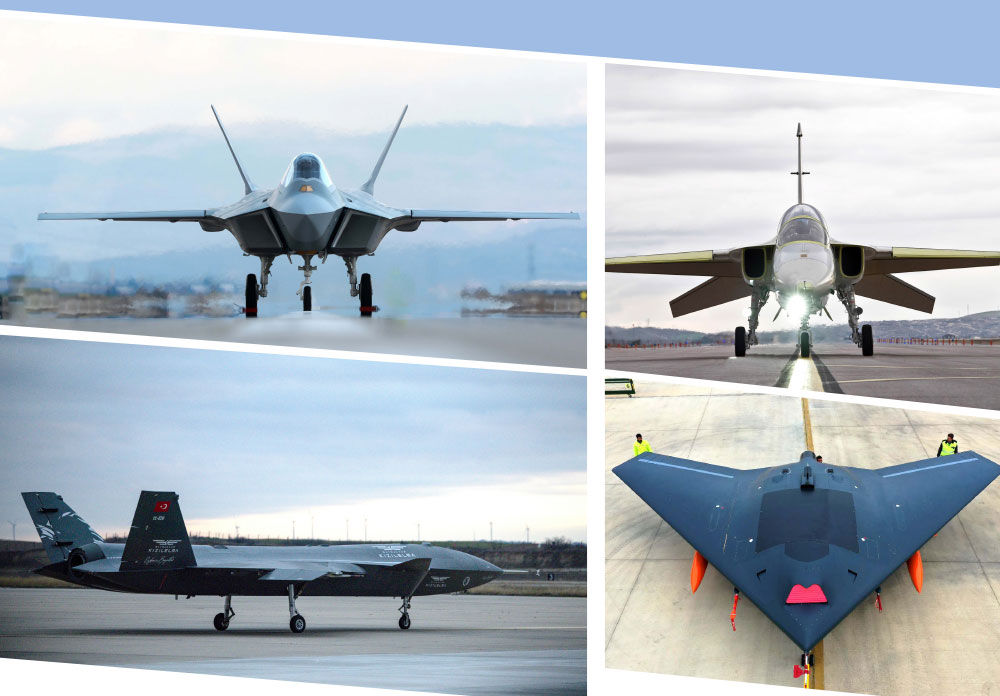
Although the Turkish Defense & Aerospace Sector’s current strength has yet to rank among the first echelon, Türkiye is still insisting on developing more advanced next generation domestic manned and unmanned fighters. In this context, the indigenously developed 5th Generation fighter jet MMU/TF-X’s first prototype GTU/P0 and twin-seat, single-engine supersonic new generation Advanced Jet Trainer (AJT) HÜRJET’s first production prototype, dubbed P1, performed their first engine runs on February 21 and January 30, 2023, respectively and started their slow taxi tests on March 16 and March 18 respectively. HÜRJET P1 is expected to conduct its maiden flight in late April or early May 2023 and the MMU/TF-X is planned to perform its maiden flight by the end of 2023 (however, contrary to TUSAŞ CEO KOTİL, the SSB’s DEMİR believed that the first flight would take in late 2024 or in 2025).
MMU/TF-X: National Combat Aircraft
In order to meet Turkish Air Force (TurAF) requirements beyond 2030s, the TF-X National Combat Aircraft (abbreviated as Milli Muharip Uçak/MMU in Turkish) Development Program was launched in accordance with Decision No 545 adopted at the Defense Industry Executive Committee (DIEC, the highest decision-making body on defense procurement in Türkiye) dated December 15, 2010. Featuring Low Observability and Super-cruise capabilities and to be equipped with domestically developed systems and sensors, the MMU/TF-X will be a 5th Generation indigenous air superiority fighter with secondary ground attack capability. Designed to meet the operational requirements of the TurAF between 2030 and 2070, the TF-X, is a proposed single-seat, twin-engine all-weather multi-role fighter being developed by Prime Contractor Turkish Aerospace (TUSAŞ) with technological assistance from BAE Systems. The MMU/TF-X will replace the F-4E 2020 Phantom IIs and F-16C/D Fighting Falcon combat aircraft currently in the service of the Turkish Air Force (TurAF) during the first quarter of the 2030s.
Türkiye is likely to procure some 150 to 200 TF-Xs (Main Contractor TUSAŞ’ production goal is 400) in the long term to replace F-4E 2020s and F-16s. The MMU/TF-X Program has become even more important for Türkiye since the F-16C/D combat aircraft, which forms the backbone of TurAF’s airpower, will be deactivated from service starting from 2030 (Block 30TM and Block 40M versions) and deliveries of F-35As to the TurAF were halted (procurement of up to 110 aircraft were planned) by the US Government in July 2019.
The MMU/TF-X will have new generation features including Low Observability, High Maneuverability (to be better than F-16C), Internal Weapon Bays (has both cheek and ventral internal weapons bays, each cheek weapons bay, can hold a launcher for short-range (WVR) air-to-air missile. The centerline/ventral weapon bays are in tandem configuration, External Weapon Carriage (for NATO and Indigenous weapons), Increased Situational Awareness, Interoperability with AEW&C aircraft, UCAVs and AARs, Super Cruise, Advanced Avionics for Sensor Fusion (5th Generation avionics suit) and Independent Operation Capability (no need for other A/C). The aircraft will be equipped with an indigenously developed gallium-nitride (GaN) Active Electronically Scanned Array (AESA) Radar, Integrated Processing Computer (Mission Computer), KARAT Infrared Search and Track (IRST) System (on top of the nose in front of the cockpit), Integrated EW Suit, as well as an TOYGUN Integrated Electro-Optical Targeting System (below the forward fuselage, which is abbreviated as BEOS in Turkish and will have a similar function as the Electro-Optical Targeting System [EOTS] on the F-35), Helmet Mounted Sight System (HMDS, there is no HUD at the cockpit) and an Integrated Cockpit Display System (panoramic cockpit display) like that on the F-35 Lightning II aircraft. ASELSAN has been contracted to develop the indigenous AESA Radar, BEOS, IRST System, HMDS and EW Suit. Within the scope of the MMU/TF-X Program, ASELSAN also is developing the
Integrated RF System (abbreviated as BÜRFİS in Turkish) for the MMU/TF-X. TÜBİTAK, on the other hand, has been contracted for the development of the Integrated Processing Unit (IPU, a mission computer and abbreviated as BÜİT in Turkish). TÜBİTAK BİLGEM delivered the Integrated Processor Unit Prototype developed for the MMU/TF-X at the end of August 2022 as part of the Integrated Processor Unit Project. The Integrated Processor Unit (IPU) and Avionic Interface Unit (DCU) prototypes delivered to TUSAŞ will perform the Aircraft Management System and Mission Management System functions of the MMU/TF-X Development and Test Aircraft (GTU/P0), which is planned to perform its maiden flight by the end of 2023. 1 x IPU and 4 x DCUs will be used on the GTU/P0 prototype. This computer system, which will manage the aircraft systems by taking the pilot’s commands, provides information to the pilots via the Integrated Cockpit Display System and allows giving commands on the touchscreen. Several new technologies, such as the new multi-core version of the National Real-Time Operating System, Deterministic Network Technology, Avionic Digital Video Bus, and High-Speed Multi-Core (128x) Processors, are used on this prototype chassis. The IPU is a very important national technology for MMU/TF-X, and TÜBİTAK BİLGEM will deliver more advanced versions in the future. The MMU/TF-X will also feature the ASELSAN-YILDIRIM DIRCM System.
Within the course of the MMU/TF-X Program, new capabilities and equipment will be added to the aircraft under a “Block Development Approach”, and in each Block, the level of local content ratio will increase. The Block 0, Block 10 (2029) and Block 20 (2032) aircraft will be powered by General Electric’s F110-GE-129E engines and starting from Block 30 (2035) the MMU/TF-X will gain true 5th Generation capabilities with indigenous 35,000lb class turbofan engines featuring stealthy exhaust nozzles for low-observability. With plans to perform its maiden flight in 2033 and to be inducted into TurAF service starting from 2035, the Block 30, 5th Generation multi-role model will have the capability to perform a full air-to-air and air-to-ground combat missions and to feature increased local content share thanks to indigenously developed turbofan engines, sub-systems and avionics. According to our sources the MMU/TF-X will gain Full Operational Capability (FOC) by 2040. The Block 0 aircraft (GTU/P0 prototype) is expected to be in 4th++ Generation configuration and the Block 10 prototypes, that are expected to feature 4.5th Generation Fighter performance and sensor fusion capability, will be in air superiority configuration. Even if everything goes as planned, it is not possible for the TurAF to declare an Initial Operational Capability (IOC) by mid 2030s with the first TF-X/MMU Squadron.
By 2030, 8 MMU/TF-X prototypes will be manufactured. According to TUSAŞ President & CEO Temel KOTİL the first 7 MMU/TF-X aircraft will be powered by GE’s F110-GE-129E Turbofan Engines and starting from the 8th aircraft the 35,000lb class indigenous turbofan engine will be used. TUSAŞ applied to the US Government for 5 engines in 2019 and 5 engines in 2021 to procure a total of 10 engines in two separate batches for the TF-X aircraft. Meanwhile in June 2022, the SSB issued a Request for Proposal (RFP) for a new tender to select the Main Contractor Company for the MMU/TF-X Engine Development Project Phase-II, which constitutes the second phase in the development process of the new generation national turbofan engine that will power the National Combat Aircraft (TF-X). In addition to TRMotor Güç Sistemleri (TR-M) and TEI, which carried out Phase-I activities, TAEC Uçak Motor Sanayi A.Ş., a Kale-Rolls-Royce Joint Venture also submitted its bid for the MMU/TF-X Engine Development Project Phase-II tender.
Prototypes and first batches series production MMU/TF-Xs are to be powered by a pair of F110-GE-129E engines, each generating 29,500lb of thrust. The F110-GE-129E engines are expected to be used in GTU/P0, Block 10 aircraft (2028/2029) and Block 20 (2032) aircraft and then switch to the indigenous 35,000lb turbofan engine from Block 30 onwards (2035). While the first batch of 10 engines procured directly from GE, engines for the series production aircraft are expected to be assembled at TEI facilities in Eskisehir, Türkiye with a local content share of over 50% if an agreement can be reached with GE and the US Government. As we go to press, it has not yet been publicized whether this contract also covers an option for the local final assembly and parts manufacturing at TEI facilities in Eskisehir. According to our sources TUSAŞ has awarded a new contract during the second half of 2022 to GE to build an undisclosed number of F110-GE-129E engines for the first and second batches (two squadron, 40 aircraft) of TF-X aircraft to be inducted into to the TurAF service in the 2030s.
TEI Chairman and CEO Mahmut AKŞİT pointed out that the studies are continuing for the production of F110-GE-129E engines in Türkiye, which are planned to be used until the domestic engine with a capacity of 35,000lb is ready. “We are working on locally producing F110-GE-120 engines at our Eskişehir facilities by TEI. In this context, we are focusing on a business model with the platform manufacturer TUSAŞ and the main engine manufacturer GE that will keep domestic production at the maximum level.” I believe that around 100 F110-GE-129 engines with spares can be procured for the first 40 aircraft, which are expected to be in Block 10 and Block 20 configuration. Within the scope of the F110-GE-100 Turbofan Engine Production Project, which started with manufacturing only 12 parts under General Electric (GE) license, TEI carried out the final assembly and tests of 176 F110-GE-100 Engines in total and delivered them under the Peace Onyx-I (PO-I) Project. Within the scope of Peace Onyx-II Project (FMS/Foreign Military Sales Program), TEI carried out the final assembly and test activities of 95 F110-GE-129 IPE Engines for a total of 80 F-16C/D Block 50 Aircraft ordered in two separate batches (40+40) in March 1992 and delivered the 95th F110-GE-129 IPE Engine in April 1998. Thus, as part of the PO-I and PO-II Programs, TEI carried out the final assembly and tests of 271 engines in total (F110-GE-100 and F110-GE-129 IPE). Under the PO-IV, TEI carried out the assembly and tests of further 42 F110-GE-129B engines and completed the deliveries in December 2010. Therefore, TEI carried out manufacturing, final assembly, and test activities of 313 F110-GE-100, F110-GE-129 IPE, and F110-GE-129B Turbofan Engines in total between 1987 and 2010.
TUSAŞ has previously announced that the deliveries of the first batch of 20 MMU/TF-X will be completed in 2034. In time TUSAŞ will gain the capability to manufacture two TF-X aircraft per month and a total of 24 aircraft per year.
TUSAŞ performs the production and final assembly of MMU/TF-X prototypes at the MMU Assembly and Test Building Block A (MMU Hangar), the construction of which were completed in March 2022. It was stated that two MMU/TF-X Aircraft can be produced at the same time in Block A. TUSAŞ started the assembly of the first prototype of the MMU/TF-X at the MMU Hangar on April 30, 2022, and the Development Test Aircraft (abbreviated as GTU in Turkish and also called Prototype 0) was moved to the Final Assembly Line on November 21, 2022. TUSAŞ held a Defense Industry Press Conference at the Kahramankazan Campus on January 11, 2023 and unveiled the GTU/P0 prototype at the MMU Hangar to the defense and aerospace media representatives. MMU/TF-X GTU/P0 will be used in different tests throughout the program as an internal prototype produced with TUSAŞ resources. Until 2030, TUSAŞ will produce 7 more prototypes, which will be improved gradually and have additional equipment and capabilities apart from the GTU/P0 prototype. The Serial Production of MMU/TF-X, which is expected to start in 2029, will be carried out at a new facility, which is announced to be built right next to the MMU Assembly and Test Building, and where final assembly and production of 10 aircraft can be carried out at the same time.
Apart from the GTU/P0 prototype, TUSAŞ also producing the MMU/TF-X Full Length Structural Test Aircraft, which will be used in comprehensive static tests. Martin Baker product ejection seats will be used in the MMU/TF-X and HÜRJET Programs. Both the MMU/TF-X and HÜRJET cockpit/canopy frames were shipped to the Martin Baker facilities in 2022 for testing. Developing indigenous ejection seats was abandoned due to costs and lengthy testing processes. The MMU/TF-X’s canopy is supplied by VOLO Composite, the main and nose landing gear, landing gear control system, wheels and brakes and test systems by TAAC, Wide Area Display (touchscreen) by STG, the Mission Computer known as Integrated Processing Unit (IPU) and the Avionic Interface Unit (DCU) by TÜBİTAK BİLGEM, Tires by Petlas, Power Distribution System by İŞBİR, Batteries by ASPİLSAN, 122kW APU (Auxiliary Power Unit) and ATSS (Air Turbine Start System) by TRMotor. VOLO Composites also delivers structural composite parts, and TAAC provides flight control systems (actuators) for the MMU/TF-X.
The MMU/TF-X consists of over 20,000 parts. The materials used in the under structure of the MMU/TF-X Aircraft, which consists of 4 main components excluding the control surfaces, are as follows:
Forward Fuselage: 7050 T7451 (aluminum alloy commonly used in aviation).
Forward Center Fuselage: 7050 T7451. It is 5m wide, 4.2m long and 2.2m high, with a structural weight of 1.470kg.
Wing Module: Titanium. The Forward Center Fuselage of the MMU/TF-X Aircraft is manufactured vertically in one piece with wings and it weighs 2,125kg.
Aft Fuselage: Titanium. Its total weight is 3,945kg.
Uni-Directional (UD) epoxy resin-impregnated Carbon Prepreg composite material is used as the coating of the MMU/TF-X. The monolithic Air Intakes of the aircraft with S-Duct geometry are made of composite material by hand-laying. It starts from the forward fuselage and extends to the rear engine section. The S shape inlet will help reduce Infrared signature from frontal aspect since it can block the view of the engine fan stage.
The Horizontal Stabilizers of the plane, which is as big as the wing of an F-16, are 2.9m wide, 4.1m long, 0.4m high, and weigh 235kg. The titanium bulkhead of the aircraft has a width of 5.3m and height of 1.6m.
As pointed out above according to TUSAŞ data the MMU/TF-X is 21m long, 6m high, has a wingspan of 14m, a service ceiling of 55,000ft, a top speed of Mach 1.8, and can pull +9/-3.5G. According to the posters in the MMU Hangar, the maximum speed of the aircraft is Mach 2, the maximum ceiling is 60,000ft, the service ceiling is 55,000ft, the maximum payload capacity is 20,000lb, the G limit is +9/-3G, and turn rate is 9G at Mach 0.9 and 15,000ft and 4G at Mach 0.9 and 30,000ft.
The Critical Design Review (CDR) Phase of the MMU/TF-X Development Test Aircraft (abbreviated as GTU in Turkish and also called Prototype 0), which is expected to perform its maiden flight by the end of this year, is scheduled to be completed in September 2023. The Preliminary Design Review (PDR) Phase of the GTU/P0 prototype was completed in 2022. The PDR Phase of the first Block 10 (also known as Block 1) MMU/TF-X Aircraft, which was normally planned to be delivered to the TurAF in 2030, but announced by KOTİL to be delivered in 2028, was expected to be completed by the end of January 2023. According to the information we received, the MMU/TF-X Block 10 PDR, submitted for approval in December 2022, was successfully completed during the second week of March. However, according to our sources the PDR Phase will be completed in stages and a series of revisions will be made in this process. In this context, another PDR meeting was held on April 1st. The CDR Phase of the first Block 10 type delivery aircraft, which is expected to make its first flight in 2025, is planned to be completed in October 2024. However, it is also said that this date can be brought forward to August 2024. With the completion of the PDR Phase of the First Delivery Aircraft (Block 10), the Preliminary Design Phase of the MMU/TF-X Program, with a budget of US$1.3 billion, the Implementation Schedule (To) of which started in September 2018, has also been officially completed.
Following the completion of the CDR process of the First Block 10 aircraft, the contracts for the Detailed Design and Qualification Phase (Phase-I Stage-II), which is planned to be completed by the last quarter of 2028, are expected to be signed during the DSEi 2023 Exhibition to be held in England in September between the SSB and TUSAŞ and between TUSAŞ and BAE Systems. During the DSEi 2023 a contract for the turbofan engine to be used on the MMU/TF-X is also expected to be signed between the SSB and TAEC Uçak Motor Sanayi A.Ş., a Kale-Rolls-Royce Joint Venture. It is estimated that the Detailed Design and Qualification Phase (Phase-I Stage-II) and IOC/FOC will cost approximately US$7.3 billion, while an additional US$14 billion will be required for the Serial Production of the 5th generation MMU/TF-X. Unit cost for a prototype aircraft is estimated at US$120 million, while Serial Production TF-X Aircraft is estimated to cost US$80 million.
Currently, work on the MMU/TF-X Program is focused on the first flight to be performed this year and the development of the flight control system that will serve on the GTU/P0 prototype during the maiden flight. However, it cannot be said that every team is focused on the first flight, for example, the work on the Block 10 configuration, which will be the first delivery aircraft, continues in parallel. The MMU/TF-X GTU/P0 prototype, which is prepared for the first flight to be made this year with the accelerated aircraft flying process, is expected to be used mainly in the ground tests to be carried out during the MMU/TF-X Program, as an internal prototype produced with TUSAŞ’ own resources after the first flight.
Recent Developments Under MMU/TF-X
In 2022, significant developments took place in the MMU/TF-X Program. In this context, the Preliminary Design Phase of the project was completed by detailing the system requirements and functions for the final configuration to be delivered to the TurAF. High speed air inlet, low speed ground effect, high speed force and moment, and high-speed stall and spin tests were conducted. First flight and air-to-air firing scenarios were demonstrated on the TF-X Engineering Development Simulator. The Preliminary Design of the systems was completed together with domestic and foreign subcontractors. Final assembly line activities started in November 2022. Beginning in December 2022, functional ground tests were carried out for the engine, aircraft mounted accessory gearbox, engine start system, electrical systems, landing gear, hydraulic power systems, flight control systems, fuel system, and cockpit avionics. Subsequently, the first electrification and first engine run were successfully completed.
According to the original plan the first MMU/TF-X prototype dubbed ‘Development Test Aircraft’ (abbreviated as GTU/P0 in Turkish) would be unveiled to the Turkish public at the ceremony to be held on March 18, 2023, when the 108th anniversary of the Çanakkale Naval Victory is celebrated. However, according to TUSAŞ the ceremony was postponed due to the devastating earthquakes that occurred on February 6. According to the current plan an impressive ceremony will take place in late April 2023 at TUSAŞ facilities for the MMU/TF-X GTU/P0 prototype, HÜRJET P1 prototype, T929 ATAK II Helicopter and ANKA-III TİSU/MİUS.
Painted with a two-tone gray color the GTU/P0 prototype performed its first engine run-up test at with F110-GE-129E Turbofan Engines on February 21, 2023 at the Outdoor Engine Test Field, next to the MMU/TF-X Assembly & Test Building. With this test ground trials have been launched.
The GTU/P0, whose additional systems are still being assembled, was taken out of the hangar and completed a series of slow taxi tests on March 16. During the tests the aircraft moved under its own power, marking a successful integration of its General Electric F110 engines. With the start of slow taxi tests the MMU/TF-X Program has reached another milestone.
On March 17, Türkiye's state-run Defense Industry Agency, or Savunma Sanayii Başkanlığı (SSB), released a set of photos of the GTU/P0 prototype that were taken on the runway at the TUSAŞ facilities in Ankara.
The GTU/P0 prototype appears to be equipped with an IRST sensor housed on top of the nose in front of the cockpit and BEOS sensor mounted underneath the aircraft’s nose in a position reminiscent of the F-35’s Electro-Optical Targeting System (EOTS).
MMU/TF-X Program and TUSAŞ Pakistan Office
There were several posts on social media that Pakistan was interested in the National Combat Aircraft (MMU/TF-X) Program and even wanted to be a partner. TUSAŞ is currently working with approximately 50 engineers as part of the MMU/TF-X Program at the Pakistan Office established in a university campus in Pakistan.
These Pakistani engineers, who are TUSAŞ employees, are led by a highly experienced engineer of Pakistani origin who previously worked at Lockheed Martin. The number of engineers working at TUSAŞ Pakistan Office is expected to reach 100 this year. TUSAŞ is also planning to open an office in the technopark established on the old airport campus in the capital city of Islamabad. According to the information I received, the engineering team in Pakistan will complete the production of the scale model of the MMU/TF-X this year and will conduct a series of flight tests…
HÜRJET New Generation AJT & LCA Development Project
The HÜRJET is a twin-seat, single-engine supersonic new generation Advanced Jet Trainer (AJT) and Light Combat Aircraft (LCA). It is being developed by TUSAŞ under a Protocol signed between TUSAŞ, the SSB and the TurAF on July 2, 2018. The initial studies for the “Advanced Jet Trainer & Light Attack Aircraft (HÜRJET) Project” were started in July 2017 and the Project was officially launched on August 14, 2017, as a company funded project (which was funded from TUSAŞ’ own resources) after receiving a green light to go ahead from the TUSAŞ Board.
The HÜRJET Project is aimed at the development of an indigenous new generation Advanced Jet Trainer (AJT), able to perform supersonic flight to replace the T-38M AJTs in the service of the TurAF in 2030s, and a Light Combat Aircraft (LCA) able to perform a Close Air Support (CAS) role to assist and release the load off the TurAF’s F-16C/Ds shoulders. The indigenous jet trainer HÜRJET will be utilized to train and prepare pilots for the next generation MMU/TF-X aircraft in the 2030s, replacing the aging T-38M jet trainers in service with the TurAF. Currently the TurAF operates 68 T-38M Advanced Jet Trainers in Advanced Jet Training and Combat Readiness Transition Training at Çiğli Air Base (2nd Main Jet Base Command) in İzmir.
Parts production started in January 2021 within the scope of the HÜRJET Jet Trainer Development Project, which successfully completed the Conceptual Design Phase in April 2018, Preliminary Design in July 2019, and Critical Design in February 2021. At the end of 2020, the engine subcontract was signed with General Electric for the delivery of F404-GE-102 Turbofan Engines with a thrust capacity of 17,000lb. The necessary engine integration activities were expedited following the contract award. In 2022, detailed design and analysis activities were carried out and the engine-aircraft interfaces were made ready for engine integration and testing. On January 12, 2022, at the Defense Industry Executive Committee Meeting, a decision was taken for Serial Production for HÜRJET, and in the first phase, orders were placed for the first batch of 4 aircraft (+12 options) for the Air Forces Command. As of August 2021, component-level assembly activities started in the HÜRJET Project, and the first forward fuselage of the aircraft (consisting of 350 parts) was rolled out of the production line to the final assembly line on June 11, 2022. Within the scope of HÜRJET New Generation AJT & LCA Development Project, TUSAŞ completed the production and final assembly of first flight prototype, dubbed P1, in 2022.
On December 26, 2022, the first F404-GE-102 Turbofan Engine to be installed on HÜRJET P1 successfully passed the first electrification test and was delivered in January 2023 (the first engine arrived during the second half of January and was installed on the P1). The engine delivery was supposed to start in November 2022; however, the delivery date was postponed to January 2023 due to a technical problem in the production of a critical subsystem (the APU). The engine’s assembly, integration, and testing activities were completed in five days.
Following the necessary controls, the first production prototype of the HÜRJET New Generation AJT & LCA, P1, has begun the ground testing phase in January 2023 ahead of a first flight, which was supposed to take place on March 18, 2023, the 108th anniversary of the Battle of Çanakkale (Gallipoli). HÜRJET P1 performed its first engine run-up test successfully on January 30, 2023. Powered by a General Electric F404-GE-102 turbofan engine the P1 prototype is equipped with a 20”x8” high resolution large-area cockpit display (VSCF-LAD 208) delivered by STG.
In the following process, the engine start system, and control and warning systems will be tested until the maiden flight. The final stage will then be reached for the engine’s ground tests. HÜRJET will begin counting down the days until its first flight after the conclusion of these tests, which are required to verify the engine integration prior to the maiden flight.
On March 18, 2023 President of Defense Industry Agency (SSB) İsmail DEMİR announced the start of slow taxi tests of the HÜRJET, uploading a video of the HÜRJET P1 prototype taxiing. TUSAŞ CEO KOTİL also uploaded a video showing the P1 prototype being towed out of its hangar, with the video showing the taxiing test from inside the prototype’s cockpit. In his statement to NTV on March 28, 2023, the SSB’s DEMİR disclosed that HÜRJET will be in the skies soon and added, “There will be several test flights. If the sound of jet planes is heard from here in the next 1 month, it is HÜRJET.” So, the maiden flight with HÜRJET P1 is expected to take place in late April or early May 2023. DEMİR also stated that they have a plan to produce 40 HÜRJETS in the first place. “We expect a large number of orders” DEMİR said.
Within the scope of the project, as of March 2023 three HÜRJETs and two mock-ups were produced, including the Static Test Aircraft being used in strength tests (the aircraft was rolled out of the hangar on December 24, 2022, with a towing vehicle), the P1 prototype that will make the first flight, and the Fatigue Test Aircraft to be used in the Iron Bird Test System. In addition, an HÜRJET cockpit fuselage was shipped to the ejection seat manufacturer Martin Baker for canopy tests. According to the information we have obtained, the single-engine and tandem seat HÜRJET Advanced Jet Trainer (AJT) consists of approximately 10,000 parts. HÜRJET is anticipated to enter the national inventory in 2025, and it is aimed to produce two HÜRJETs per month during the serial production phase.
The HÜRJET AJT, the first of which is expected to be delivered to the Air Forces Command in 2025, will be capable of performing tasks such as Combat Readiness Training, Air Patrol (Armed and Unarmed), and Aerobatic Demonstration. With a speed of Mach 1.4 and +8/-3G limits, HÜRJET will be able to operate at an altitude of up to 45,000ft and carry a payload of nearly 3 tons. With its advanced human-machine interface (HMI), digitally controlled flight system, and internal tactical and virtual training systems, HÜRJET will offer a new-generation aircraft flight experience.
The HÜRJET P1 is a prototype manufactured by TUSAŞ using its own resources. TUSAŞ has planned to produce four prototypes (P1, P2, P3 and P4) for flight tests under the HÜRJET New Generation AJT & LCA Development Project, a Static Test Aircraft (Full Size Structural Test Aircraft), and a HÜRJET fuselage for the Iron Bird Test System. In addition, an Engineering Development Simulator called “HÜRJET 270,” which has a 270-degree field-of-view visual system, has been produced to be utilized for tests in a virtual environment. The HÜRJET 270 Simulator contributes to improve the ergonomics of the HÜRJET design with the feedback received from test pilots, while also enabling data collection for the HÜRJET Training Simulator to be developed in the future. As of January 2023, it was not yet clear whether the P1 prototype would be one of the four aircraft ordered for the Air Forces Command. Following the production of four flight prototypes for the Trainer version, TUSAŞ plans to produce a new prototype for the Light Combat Aircraft (LCA) version. The final decision will be made after discussions with the Air Forces Command and the SSB. HÜRJET was first offered by TUSAŞ in the international tender held by the Malaysian Air Force in 2022 for its 18-aircraft Light Attack Aircraft requirement.
The HÜRJET Static Test Aircraft, which has the same configuration as the P1 prototype, is currently undergoing static strength tests on a specially constructed Full-Size Static Load Test Rig before the first flight. All types of aerodynamic loads that the aircraft may be exposed to during flight are being applied to the fuselage on the ground. In this way, the accuracy of the calculations made by TUSAŞ engineers will be verified before the flight. It is anticipated that the planned test campaign for HÜRJET will last three years.
The Iron Bird Test System (HÜRJET Iron Bird System Integration Test Rig), the most sophisticated aviation test system ever developed in Türkiye, was developed by the engineers of TAAC for the HÜRJET Jet Trainer and Light Attack Aircraft. TAAC, a TUSAŞ and ALTINAY Technology Group Joint Venture Company, is also producing an Iron Bird Test System for testing of the Flight Control System of the Turkish Fighter. The Turkish Fighter Iron Bird Test System is expected to be completed shortly. The Iron Bird Test System, HÜRJET 270 Simulator, Full-Size Static Load Test Rig, and Static Test Aircraft are being utilized to speed up the HÜRJET Project’s progress and the aircraft is rapidly getting ready for its first flight. While the avionics system tests of the aircraft can be performed on the HÜRJET 270 Simulator, all actuator, landing gear, and hydraulics tests of the aircraft are carried out on the Iron Bird Test System, and the static strength tests of the fuselage are carried out on the Full-Size Static Load Test Rig before the first flight.
In addition to the Full-Scale Static Testing, which tests the strength of critical points such as the connection points of the landing gear, the places where the wings are connected to the fuselage, and the connections of the engine, the HÜRJET Static Test Aircraft also undergoes nearly 50 different tests, ranging from bird strike tests to wing tests and rudder tests. The indigenously designed and manufactured HÜRJET Full Size Static Load Test Rig is currently the largest test rig in Türkiye in terms of piston capacity and size. The aircraft's systems (electrical, avionics, hydraulic, propulsion, fuel, flight control system, air conditioning, and landing gear) will all go through ground testing prior to takeoff in addition to the structural and ground vibration tests that must be completed as part of the first flight permit.
ÖZGÜR Program
Under the F-16 Block 30 Avionics Modernization (ÖZGÜR Program) Development and Prototype Phase, which was initiated with the Defense Industry Executive Committee’s (DIEC/SSİK) decision dated December 15, 2010, within the framework of the requirements of the Turkish Air Force, it was aimed to equip and certify one of the 37 Block 30 F-16C/D Aircraft (F-16C with tail number 87-0019), which had previously not been subjected to avionics modernization, with an indigenous mission computer with national Operational Flight Program (OFP) and an indigenous avionics suite solution.
The number of aircraft fell to 35 due to accidents/incidents over time.
The contract worth US$46 million was signed between the SSB and TUSAŞ on March 6, 2012 and became effective on May 24, 2012. The project schedule was initially planned for 52 months, then was revised to 80 months. It was planned that the mission computer (central computer) to be used within the scope of the modernization would be developed by ASELSAN, the OFP software would be developed by TUSAŞ, the HUD system to be used in the national avionics suite to be developed based on the mission computer would be purchased (off-the-shelf) from abroad, and the color MFDs would be developed again by ASELSAN with domestic capabilities. Thanks to the national mission computer, the Turkish Air Force would have a thorough control over the OFP and there would no longer be any reliance on the United States for the integration of national weapon systems on aircraft. The 4th phase of the ÖZGÜR Project, which was planned to be executed under 4 phases, includes the Digital Moving Map, Data Link, and Air-to-Air/Air-to-Ground Weapon Integration activities.
Within the scope of the ÖZGÜR Project, serial production phase started in 2022. The TurAF F-16C/D Block 30TM Aircraft are being equipped with the National Mission Computer, System Interface Unit, Cockpit Up Front Integrated Control Panel, Fuel Hydraulic Display, Engine Instrument Display, Emergency Prime Indicator, Secure Voice Device (for HF/VHF/UHF Radios), National Identification Friend or Foe (IFF) System, Multi-Mode Receiver, Inertial Navigation System, Interface Blanking Unit, AVCI-II Helmet Mounted Display/Targeting System (fighter version of AVCI HMDS currently in use on board T129 ATAK Helicopters), Center Cockpit Display, and Color Multifunction Displays.
The TurAF F-16 Blok 30TM Aircraft receiving ÖZGÜR Avionics Modernization will be also equipped with ASELSAN’s MURAD AESA Nose Radar. According to the ASELSAN 2018 Almanac document, the F-16 AESA Nose Radar Development Project Phase-I Protocol was signed between the SSB and ASELSAN on December 4, 2018. The Defense Industry Agency announced the signing of the Phase-1 Protocol on March 24, 2019, on its official social media account. ASELSAN is also developing the AESA Nose Radar for the National Combat Aircraft (MMU/TF-X). The signed Protocol covered the development of the AESA Radar, prototype production, factory tests and verification, and the preliminary studies necessary for its integration into the F-16 Block 30TM Aircraft. In the second phase of the project, it is aimed to integrate the prototype radar into the F-16 Aircraft, to demonstrate its performance on the aircraft, and to start serial production if the results are successful. GaN-based T/R modules are used in the ASELSAN AESA Nose Radar antenna array. According to the information I received at the IDEF '21 Fair, the GaN chips used in the radar were produced abroad since chips of this size could not be produced at the ASELSAN BİLKENT Micro Nano (AB-MikroNano) Factory. ASELSAN designed Chips are produced in factories in East Asia; however, they are planned to be produced locally in Türkiye in the near future.
With over 1,000 GaN-based Transmit/Receive (T/R) modules (each with 20w capacity and peak power of 30w) the X-Band MURAD AESA fighter radar is claimed to have equivalent or even better capabilities than the AN/APG-83 SABR GaAs AESA radar on F-16V Blok 70/72 Viper aircraft. According to open sources, the GaAs-based AN/APG-83 SABR AESA Radar has a maximum range of 296.3km (370.4km in another source). The SABR radar can detect a warplane from 120km, lock it from 84km, and track more than 20 targets at the same time (it can detect a target with a 1m2 RCS at a distance of 47nm, the APG-68(V)9 radar can detect a target with same RCS from 38nm). The MURAD AESA Nose Radar is already integrated on the AKINCI UCAV, and a series of test flights have been performed during the first months of 2023. According to reports a series of improvement and modification studies are being carried out on the radar in the light of the information obtained and the feedback provided during the flights conducted onboard the AKINCI UCAV. Flight tests with the AKINCI UCAV is continuing as of March 2023.
The new systems and equipment such as the MURAD AESA Nose Radar and the AVCI Helmet, as well as new national munitions, will be integrated into the F-16 Block 30TM Aircraft within the scope of the ÖZGÜR Project when the related development activities are finalized.
In his statement to CNN Türk on March 25, 2023, President of the Defense Industry Agency (SSB) İsmail DEMİR stated that under the ÖZGÜR Program two Block 30 prototypes have been completed successfully so far and following the Block 30TM Aircraft, the Block 40TM and Block 50TM Aircraft in the TurAF inventory will also receive the ÖZGÜR Avionics Modernization packet.
ANKA-III Next Generation Stealth UCAV
On March 18, 2023, the image of the first ANKA-III, a jet powered next generation stealth UCAV, which developed by TUSAŞ and adopts a truncated diamond-shaped ‘flying wing’ planform that is equipped with sweptback outer wings with control surfaces let into the trailing edges of the air vehicle’s fuselage, and trailing edges and upper surfaces of its wing sections, was revealed on the Internet. Thanks to its triangular large-aspect-ratio swept wing design the ANKA-III will have strong stealth performance. According to the image that was shared with the public for the first time, the construction of the aircraft has been basically completed, and it will be rolled off the assembly line soon. TUSAŞ is building the ANKA-III low-visibility, tailless Unmanned Combat Aerial Vehicle (UCAV) on the know-how and technological infrastructure gained from the MMU/TF-X and HÜRJET Projects. The jet powered ANKA-III Stealth UCAV strives to achieve its first flight in late April or early May 2023.
Although the image of the ANKA-III’s first full-scale technology demonstrator was shared with the public for the first time by TUSAŞ on March 18, the Turkish Unmanned Combat Aircraft/Combat Unmanned Aerial System (abbreviated as TİSU/MİUS in Turkish, which is today known as ANKA-III) was first mentioned by TUSAŞ at the Panel titled “Türkiye's UAV Roadmap in Relation to Technological Developments” jointly organized by SETA, the SSB, and STM on Thursday, December 24, 2015.
It was seen in the slides that TİSU/MİUS, which was designed for an air-to-ground attack role (deep strike aircraft) and will be able to function in swarms, has a flying wing design (tailless fixed-wing aircraft) and is powered by a single turbofan engine. The ANKA-III picture (shown while being towed to the Outdoor Engine Test Field by a tug) shared by TUSAŞ on March 18, was very similar to the TİSU/MİUS design shown on December 24, 2015. It was also shared that TİSU/MİUS will also have a version for the airspace defense (air-to-air, Loyal Wingman) role and that scale models of both air-to-ground and air-to-air versions would be produced first, then both platforms would gain swarm mission capability.
Afterward, no information or visuals were shared about the project for a long time until 2020. That year, I received the first information that the flying wing design TUSAŞ TİSU/MİUS Project was continuing. At that time, 6-8 months was mentioned for the first flight. However, the flight was later made in 2021 with a scale model. I was informed that SEL tests were started with the MİUS prototype at the beginning of 2021 and that the SEL tests were completed in July 2021. In 2022, the production and final assembly activities of the ANKA-III’s first full-scale technology demonstrator started.
TUSAŞ President & CEO Temel KOTİL, who made a speech titled “Aviation and Space Industry” on the last day of the “Summit Kartal: Entrepreneurship and Innovation Summit” organized by the Kartal Association in October 2022, announced for the first time that they have developed an unmanned aircraft. In December 2022, Vice President Fuat OKTAY said in his 2023 budget speech, "Our new type of unmanned jet fighter aircraft is coming from TUSAŞ. The ANKA-III will open a new page in the field of UAVs with its jet engine and speed, high payload capacity, and tailless design that is almost invisible on the radar." With his statement, he announced to the public for the first time that TİSU/MİUS was given the name ANKA-III. A few days later, computer-generated images of the ANKA-III appeared in the media.
TUSAŞ President & CEO KOTİL announced that they produced and flew a small-scale model of the ANKA-III on January 9, 2023, and added, “We are also making the bigger one, and it will be revealed in the coming months. The ANKA-III will be able to jointly operate with MİUS, MMU/TF-X, HÜRJET, and ATAK…” In his speech during the 4th Military Radar and Border Security Summit on March 21, 2023, KOTİL announced that the ground tests of the first prototype of the ANKA-III had started earlier than the planned schedule and shared a slide containing the technical features of the ANKA-III with the audience. The final assembly of the first ANKA-III prototype was completed in January 2023, and then ground tests began. President of the Defense Industry Agency (SSB) İsmail DEMİR also announced in March 2023 that the ANKA-III will fly with HÜRJET and pointed to late April or early May. Therefore, it seemed certain that both HÜRJET and ANKA-III would fly during the ceremony to be held at TUSAŞ facilities in late April.
ANKA-III TİSU/MİUS exceeded my expectations with its appearance, design, and production quality. Therefore, I consider the ANKA-III to be a good example of demonstrating the production quality and engineering capability that TUSAŞ acquired from the F-35 JSF and MMU/TF-X 5th-generation aircraft programs. In terms of external design and concept, ANKA-III TİSU/MİUS reminded me of the NEURON Unmanned Combat Aerial Vehicle (UCAV) Program, which Türkiye was interested in the early 2000s. Türkiye planned to participate in the Neuron UCAV Program carried out under the leadership of France and made an official application to join this program in 2005. However, with the pressure of Greece, which is a member of the Program, France replied to Türkiye that the industrial team was formed, the work was shared between the industrial partners, and a new partner could only join the program after the first flight test of Neuron UCAV (it was aimed for 2011 at that time but conducted on December 1, 2012). Consequently, Türkiye searched for a new partner and cooperated with EADS. In fact, a Memorandum of Understanding (MoU) was signed between TUSAŞ and EADS in May 2011 for cooperation in the Talarion Program. Therefore, thanks to our bad neighbor, we have ANKA-III TİSU/MİUS today. The ANKA-III has a similar size and weight characteristics to the NEURON UCAV. According to open sources, NEURON has a total length of 9.5m, a wingspan of 12.5m, an empty weight of 4.9 tons, and a maximum take-off weight (MTOW) of 7 tons. The Neuron UCAV is powered by a FADEC-controlled Adour Mk 951 Turbofan Engine with a thrust capacity of 6,500lbf (29,000N). Based on the Adour Mk 106 Turbofan Engine (6,000lb thrust), which was developed in 1968, the Adour Mk 951 was certified in 2005.
With the ANKA-III, the Turkish Aviation Industry has designed a flying wing aircraft for the first time since 1948 and has brought it to the flight test stage. The THK-13 flying wing glider prototype designed by Senior Engineer Yavuz KANSU was produced at the Turkish Aeronautical Association Aircraft Factory, and the first flight test was carried out on August 24, 1948. Since they have no vertical surfaces and are extremely flat, the flying wing designs have a low radar cross-section. That’s why strategic stealth bombers like the B-2 Spirit and B-21 Raider have a flying wing design. However, since it requires thick wings, the flying wing design is more suitable for subsonic aircraft.
However, flying wing designs have inherent disadvantages, such as an unstable and difficult-to-control flight profile, as they lack traditional stabilizers and associated control surfaces. The THK-13 was unsuccessful for these reasons, and the project was canceled after two test flights, resulting in a slightly damaged forced landing and a crash. However, thanks to today's digital 'fly-by-wire' computer-aided flight control systems, most of the inherent aerodynamic disadvantages of flying wing design are minimized, and long-range bomber aircraft can be produced efficiently and effectively. TUSAŞ must have transferred the digital 'fly-by-wire' technology used in both HÜRJET and MMU/TF-X to the ANKA-III, ensuring that the design works flawlessly.
It seems that the ANKA-III Stealth UCAV will serve as a deep-strike aircraft, where the advantages of the flying wing design can be used most efficiently. In this context, TUSAŞ can use the ANKA-III as the long-range iron fist of the MMU/TF-X by developing an artificial intelligence system and establishing a manned-unmanned teaming system between MMU/TF-X and ANKA-III. Suppose that we can successfully bring the 5th Generation manned MMU/TF-X and the new generation unmanned ANKA-III TİSU/MİUS pair to the skies. In that case, we will have a significant force multiplier for the Turkish Air Force (TurAF) in the 2030s by developing it with national resources. Since the ANKA-III TİSU/MİUS is also expected to take off and land on ships, it will be able to serve not only at air bases but also on surface combatants such as aircraft carriers/LHDs.
According to the ANKA-III data released by TUSAŞ CEO KOTİL during the 4th Military Radar and Border Security Summit held on March 21, 2023, this stealth UCAV has a maximum take-off weight of 6.5 tons, cruise speed of 250 knots (0.42 Mach at 30,000ft), top speed of 425 knots (0.7 Mach at 30,000ft altitude), can stay in the air for 10 hours (max endurance at 35,000ft), and carry 1,200kg payload. The ANKA-III airframe is believed to consist of Uni-Directional (UD) epoxy resin-impregnated Carbon Prepreg composite material over an aluminum (7050 T7451, also used on the MMU/TF-X) substructure. The cost of building and testing the ANKA-III full-scale demonstrator has not been shared by TUSAŞ yet.
The ANKA-III has an estimated wingspan of approximately 12m, an overall length of 9m, and a body width of 4m. The stealthy, tailless ANKA-III full-scale demonstrator also features a low-observability W shaped engine intake located above the forward fuselage for its turbofan engine without afterburner. However, its nozzle has not been designed in stealth yet. Shielded engine exhaust design is expected to be used with an indigenous turbofan engine. I believe that AI-25TL (1,720kgf - 1,850kgf) or AI-322 (2,500kgf - 3,000kgf) series turbofan engines are used in the single-engine ANKA-III. In the Serial Production Phase, the TF-6000 Turbofan Engine, which TEI is still developing, will be used in ANKA-III TİSU/MİUS. TEI aims to start the assembly of the first TF-6000 (2,721kgf/6,000lbf) prototype in April 2023 and to carry out the first test before the end of 2023.
Due to the flying wing layout with a very high lift-to-drag ratio, the aircraft is expected to have maximum range of more than 3,000 kilometers. In addition, due to the high stealth of this drone, it mainly undertakes the high-risk precision strike mission of breaking through the enemy’s air defense system. Within the scope of AKA-III Program TUSAŞ is also expected to develop a manned-unmanned teaming system in which one manned aircraft (MMU/TF-X) and three to four ANKA-III stealth UCAVs can carry out missions simultaneously. In addition to supporting MMU/TF-X, the ANKA-III will be also able to perform missions on their own, such as surveillance, reconnaissance, electronic warfare and kinetic attacks.
To increase its 'stealth' features, I believe the ANKA-III will have an advanced Electro-Optical Targeting System (EOTS/IR/LD/LRF), Anti-Jam GPS/GNSS Antenna, Signal Processing Unit, and Satellite Communication (SatCom) system. The ANKA-III Next Generation Stealth UCAV will be able to carry a wide range of air-to-ground and air-to-air national munitions under its wings and internal weapon bays, thanks to its 1,200kg payload capacity. Smart air-to-ground/surface munitions such as KUZGUN TJ/SS, ÇAKIR, GÖKÇE, GÖZDE, TOLUN Small Diameter Bomb, LGK-81/82, LAÇİN, TEBER-81/82, HGK-82/83/84 and IIR guided BOZDOĞAN air-to-air missile will be among these.
KIZILELMA Unmanned Fighter Aircraft
The first flight test of the turbofan-engine powered BAYRAKTAR KIZILELMA Unmanned Fighter Aircraft, the development of which was initiated by BAYKAR in 2020 using the company`s own resources, was successfully conducted on December 14, 2022, at Çorlu Airfield Command. BAYKAR Technologies took KIZILELMA to the skies using the technical infrastructure and know-how gained from the turboprop engine powered AKINCI HALE UCAV.
According to the statement made by BAYKAR Technologies, BAYRAKTAR KIZILELMA, which took off at 14:59 following the completion of the necessary pre-flight tests at the Akıncı Flight Training and Test Center located at Tekirdağ Çorlu Airfield Command, successfully completed its maiden flight and landed at 15:17. Türkiye’s first domestically designed and built jet-powered Unmanned Fighter Aircraft, BAYRAKTAR KIZILELMA, ushered in a new era in Turkish aviation history with this historic first flight test lasting 18 minutes. BAYRAKTAR KIZILELMA (tail number TC-ÖZB), the second production prototype powered by the Ivchenko Progress AI-25TLT turbofan engine, rolled out of the production line at Özdemir Bayraktar National UAV R&D and Production Campus on November 14, 2022, and was then brought to the Akıncı Flight Training and Test Center in Çorlu. As part of the ground tests conducted, the first automatic taxi and ground driving tests of BAYRAKTAR KIZILELMA were successfully performed on November 20, 2022, and BAYRAKTAR KIZILELMA performed its maiden flight on December 3, 2022. The first Engine Integration Test of KIZILELMA with the Ivchenko Progress AI-25TLT turbofan engine was conducted on September 17, 2022, at the test field in Özdemir BAYRAKTAR National Technology Center, on the first prototype aircraft produced for ground tests of critical systems. The second production prototype of BAYRAKTAR KIZILELMA performed its 2nd flight test on January 23, 2023 and the 3rd flight test on March 30, 2023 the Akıncı Flight Training and Test Center in Çorlu. During the test BAYRAKTAR KIZILELMA (tail number TC-ÖZB) climbed to the altitude of 20,000ft and it also successfully completed Medium Altitude System Identification Test. After the test BAYKAR Technologies CTO Selçuk BAYRAKTAR disclosed that they are planning to start the series production of BAYRAKTAR KIZILELMA in early 2024.
Critical Milestones of BAYKAR's KIZILELMA Unmanned Fighter Aircraft Project
BAYKAR shared its initial concept designs for the Unmanned Fighter Aircraft with the public on December 24, 2015, with a presentation by CEO Haluk BAYRAKTAR at a panel discussion titled “Türkiye's UAV Roadmap in Relation to Technological Developments,” organized jointly by SETA, Presidency of the Defense Industry Agency (SSB), and STM.
Due to time constraints, Haluk BAYRAKTAR was unable to use several of the presentation's slides. These included concept designs of stealth Unmanned Fighter Aircraft (two distinct concept designs were shared) and MALE Class Armed/UCAV solutions, as well as technical specifications of the aircraft. A 36-month program schedule was set for the development of the turbofan engine-powered Unmanned Fighter Aircraft (0.8 Mach cruise speed), which is expected to have an operational altitude of 40,000ft, 4-5 hours endurance, maximum take-off weight of approximately 3.5 tons, a payload capacity of 1 ton, and a SatCom datalink.
The concept design of the turbofan-engine BAYRAKTAR KIZILELMA, the development of which began in 2020, was completed in May 2021, and on July 20, 2021, the first concept design images of the Unmanned Fighter Aircraft and the first details about the aircraft's features were shared with the public. On that date, it was also announced for the first time that BAYRAKTAR KIZILELMA would be able to land and takeoff from surface platforms with short runways. Meanwhile, the AI-322F Turbofan Engine Supply Contract and the AI-25TLT Turbofan Engine Integration Contract were signed between BAYKAR Technologies and Ivchenko Progress on November 11, 2021, during the SAHA EXPO 2021 Exhibition for the supply and integration processes of the turbofan engines to be utilized in the KIZILELMA configurations.
The production line image of Unmanned Fighter Aircraft was first published on March 12, 2022, and the fuselage production of the “Prototype Production Development Model,” which is a full-scale mock-up of Unmanned Fighter Aircraft, launched on this date at Özdemir Bayraktar National UAV R&D and Production Campus. On March 12, 2022, the official name of the project, "KIZILELMA," was first released to the public. On March 27, 2022, the Unmanned Fighter Aircraft’s fuselage image with wings mounted was first shared by BAYKAR on its official social media account.
With the help of the experience gained from the "Prototype Production Development Model," BAYKAR also began making the second production prototype with the tail number TC-ÖZB, which was used for KIZILELMA’s ground and flight tests.
BAYKAR Technologies CTO Selçuk BAYRAKTAR shared the first photo of the painted KIZILELMA Prototype Production Development Model on his Twitter account on June 11, 2022. It was noteworthy that the aircraft had the Turkish flag on its tail, and the no "01" on its tail and nose, as it was the first production model. In the images of the production line posted by Selçuk BAYRAKTAR on June 19, 2022, the Prototype Production Development Model of KIZILELMA and the second production model/prototype, which was still in production at that time and called PT-2, were both next to each other. Images of the second production model/prototype of KIZILELMA getting ready for flight with the tail number TC-ÖZB were shared by Baykar Technologies CTO Selçuk BAYRAKTAR on his social media account on August 26, 2022. The model/prototype was first on display at TEKNOFEST BLACK SEA in Samsun from August 30 to September 4 of that same year. The aircraft bore the signature of Özdemir BAYRAKTAR, the founder of BAYKAR, who passed away on October 18, 2021.
BAYRAKTAR KIZILELMA’s Design and Technical Features
A jet-powered and delta-wing unmanned fighter aircraft BAYRAKTAR KIZILELMA has two vertical tails on its front fuselage, on the air vents, with two horizontal control surfaces (dihedral canard, thus expected to have aggressive maneuverability in air-to-air combat). BAYRAKTAR KIZILELMA is a jet-powered unmanned fighter aircraft with a delta type wing structure and two vertical tails on the front of its fuselage, on the air vents, with two horizontal control surfaces (dihedral canard, thus expected to have strong maneuverability in air-to-air combat).
According to an open-source review, KIZILELMA, whose X-Band RCS is measured as 0.24, has a body shaped in certain angles and forms to reduce the radar cross-section for stealth capability, and an internal weapon bay to carry precision-guided air-to-air and air-to-ground munitions.
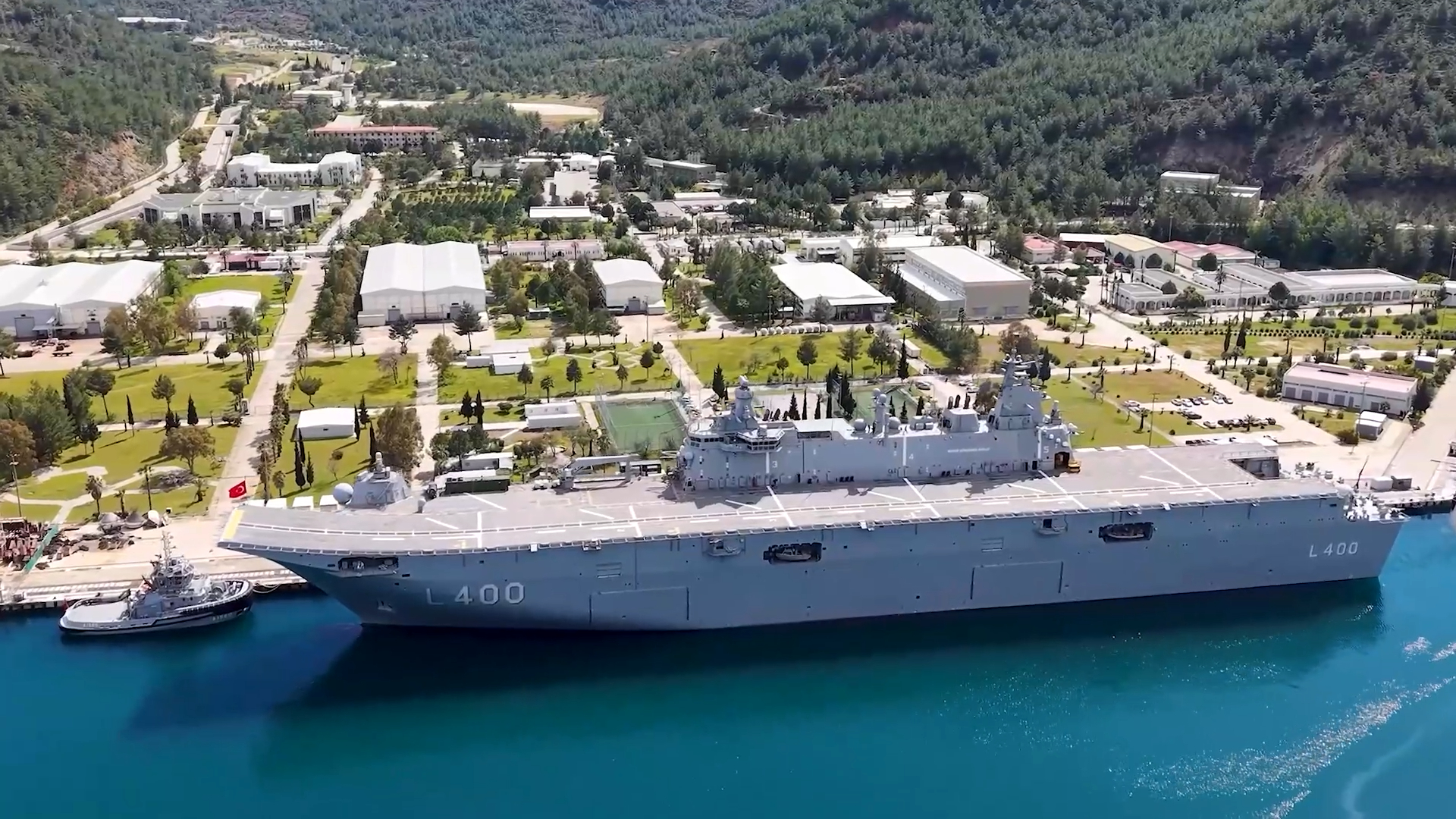
In addition, the coverings on the fuselage are also manufactured in a serrated structure in order to reduce the radar cross-section. In the final version, the fuselage is anticipated to be coated with special materials and paint that absorb radar signals. BAYRAKTAR KIZILELMA, which is announced to be capable of landing and taking off on short-runway ships such as the TCG Anadolu LHD, is expected to be able to land on short-runway ships with the assistance of arresting gear (wire ropes and hooks). Additionally, it was revealed that KIZILELMA will have the ability to fight as a swarm UAV thanks to its smart UAV autonomy.
As previously mentioned, the AI-322F turbofan engines, which have a maximum thrust of 9,260lb with afterburner and a maximum thrust of 5,500lb without afterburner, have been selected for KIZILELMA, which will have a variety of engine options. The TF-6000 (6,000lb thrust) and its afterburner version TF-10000 (10,000lb thrust) turbofan engines, which are currently developed by TEI, will also be used in KIZILELMA models.
According to information released to the public, BAYRAKTAR KIZILELMA will be produced in three different models. The first model is called KIZILELMA-A, and it will be able to fly at nearly supersonic speeds (Mach 0.6 - Mach 0.9, transonic) thanks to an Ivchenko Progress AI-25TLT TF engine with a thrust capacity of 3,800lb that was also utilized in the first flight test. The second model, KIZILELMA-B, will be powered by an AI-322F turbofan engine, will have more ammo carrying capacity, and will be able to reach supersonic speeds (Mach 1.35, supersonic). The third model is the KIZILELMA-C, which will be capable of operating at supersonic speeds (Mach 1.35, supersonic) with two AI-322F TF engines, which will have more in-fuselage weapon bay capacity and higher ammo carrying capacity.
The KIZILELMA-A version has a fuselage length of 14.7m, a height of 3.3m and a wingspan of 10m. With a maximum take-off weight of 6 tons and a maximum speed of Mach 0.6, KIZILELELMA-A will have an endurance of 5+ hours, a mission/combat radius of 500nm and climb to an altitude of 35,000ft (45,000ft for B and C models). KIZILELELMA-A, which has autonomous take-off and landing capability, will have payloads such as Electro-Optical Targeting System (EOTS/IR/LD/LRF) and Multi-Purpose ASELSAN MURAD AESA Radar, and can be controlled and commanded both in line of sight (LoS) and beyond line of sight (BLoS) thanks to its SatCom communication capability. KIZILELMA-A, which has a total payload capacity of 1,500kg, including three bays under each wing (a total of six external load bays) and in-fuselage weapon bay, will be able to carry a wide range of indigenous air-to-air and air-to-ground munitions. These include SOM-J, KUZGUN TJ/SS, ÇAKIR, GÖKÇE, GÖZDE, Miniature Bomb, LGK, LAÇİN, TEBER-81/82, LHGK-84, HGK-82/83/84, and IIR guided BOZDOĞAN and RF guided GÖKDOĞAN air-to-air missiles