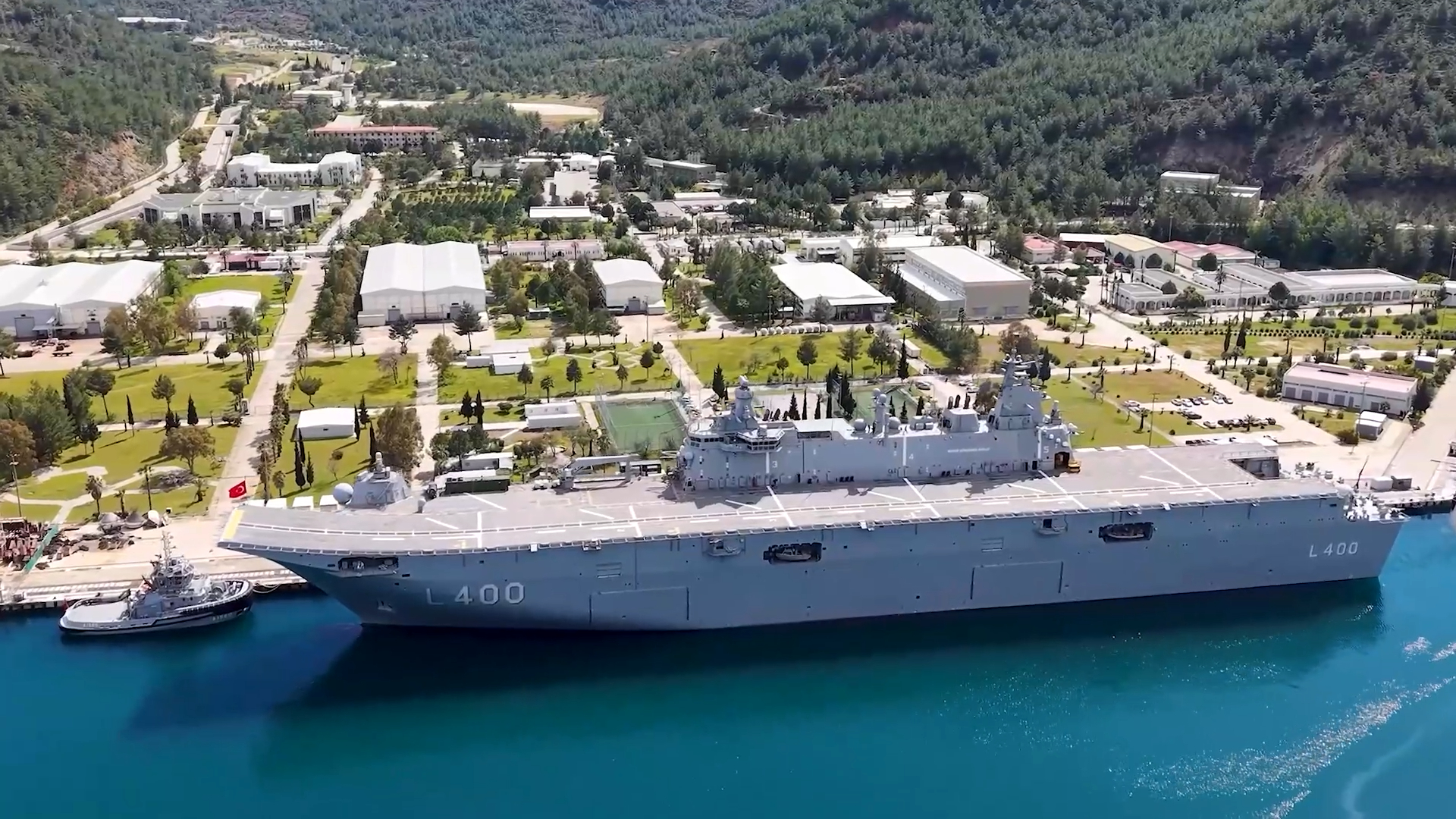
Turkish Defense Industry, a Formidable Player in the Mid-Tier Market, Ready to Enter Larger Global Markets
On 27th April 2016 a presentation was made to SaSaD Ordinary General Assembly Meeting at Sheraton Hotel by Mr. Brad Curran, Aerospace & Defense Industry Analyst with Frost & Sullivan, in Ankara, Turkey. With his vast experience, 26 years of service in the US Marine Corps and close to 10 years with Frost & Sullivan, Mr. Curran specializes in the tracking of global defense spending and C4ISR technologies. At this event he shared insight on global markets and how Frost & Sullivan assesses the future of the defense industry in an environment where major countries are reducing defense spending, in the midst of growing threats and changing technologies. Key topics addressed included the evolving relationships in the defense world, budgets and priorities for this year, industry competition, collaboration and consolidation. In addition, technology priorities, the surging technologies of the future and the defense industry outlook 10 years from now.
Evolving Relationships in the Defense World
Many nations continue to increase their defense technology levels and encourage exports, resulting in increased defense industry competition and margin pressure. Large global defense firms seek to diversify sales away from mature home markets. For example, global firms like Lockheed Martin or Finmeccanica, have saturated markets coupled with shrinking budgets at home. Simultaneously, mid-tier defense industry participants seek to enhance local capability and enter the larger global markets. These local and regional defense firms often have government support to increase exports while also improving technical operational capability. They are seeking out opportunities to diversify and find new markets in Turkey, South Korea, Egypt and other places around the world. In order to access mid-tier and emerging nations, these firms are pursing joint ventures, partnerships, and technology transfer opportunities. Concurrently, these mid-tier nations would like access to the larger markets such as the United States, France or Great Britain, with the intent to also gain technology transfer to improve their own capabilities and enhance their own ability to export. Examples of this are demonstrated by partnerships with companies such as Finmeccanica working with Turkish Aerospace Industries or Lockheed Martin working with Korean Aerospace Industries on aircraft projects. In Turkey, this is also exemplified with shipyards, such as Gölcük Marine Shipyard working with ThyssenKrupp on potential submarines, and in India with TATA working in partnership with Honeywell for C4ISR systems. Large global firms are seeking diversification away from mature home markets. Local and regional defense firms with government support desire to increase exports for technology and economic improvement. For example, the South Korean government is aggressively supporting their defense industry for defense exports. In addition, Brazil, India, Turkey, Ukraine, Taiwan, South Africa, Israel, and most importantly now Japan will pursue new business. Japan, a nation of great industrial and technological power is at the cusp of entering into this market. In an era of shrinking and saturated markets, the environment has become very difficult, also with increased competition. The global defense market is crowded, competition is intense, and margins are tight. Countries such as Turkey and South Korea are in a very good position. Nations such as Saudi Arabia and Indonesia are seeking to limit their dependence on traditional technology suppliers such as the US and Russia, while also building an indigenous capability to manufacture basic defense products. It has become a dilemma for nations to be completely dependent on the US, Russia and in some cases China, because of inevitable political changes, and dynamic technology changes. Nations traditionally aligned economically and militarily with large nations such as the United States or Russia seek to limit their dependence on these technology suppliers. By reaching out to new sources, countries can often gain price and services advantages while also building an indigenous capability to manufacture defense products. Therefore, they aim to diversify their sources of industry, and build their indigenous capability as well.
Defense Budgets and Priorities in 2016 - Key Market Drivers and Restraints
Perceived threats from renewed “cold war” era-like aircraft and ship deployments, aggressive territorial claims, the introduction of advanced weapons systems, refugee movement, and terrorist attacks are driving nations in all regions of the world to respond with expansion and upgrades of border security and military capability. For example, perceived threats from North Korea, China, Russia, Iran, and ISIS. A variety of areas are causing concern across the world and are driving markets forward. For example, the increased Russian patrols of submarines, ships and aircraft. The Increase of blue water Naval capability and the occupation The Senkaku Islands by the Chinese. Also the activity with Iranian missiles and North Korean missiles. The on-going problems with Iraq, Syria, refugees from North Africa, and the Mexican border in North America. The NATO countries that border Russia, including the Black Sea, bordering China, North Korea and Syria and parts of Libya, are causing concern with border control and C4ISR capabilities.
Another driver for the market is the fact that platform service life, especially for western nations, is nearing the end, making deferred maintenance and some new builds a priority for a variety of ships, aircraft, and ground vehicles. Incremental upgrades to proven designs and technologies are desired. Proven designs and technologies are desired. Many nations around the world, including the largest nations, must address the issue of wear and tear of ships, aircraft, ground vehicles, tanks, and combat vehicles. These fleets are worn out, maintenance has been deferred and they need to be replaced. However, when they are replaced, it will be in fewer numbers, as a result of increased C4ISR technology capabilities, enabling the capacity to mass fires instead of massing troops and platforms.
Economic uncertainty among western nations and oil and natural gas producers restrains military procurement. Weapons sharing plans among regional security partners in Northern Europe and the Middle East along with reduced troop levels overall lower the number of platforms required. Defense industry overcapacity will result in some consolidation and lower margins both for domestic and exporting firms. For example, China is increasing their defense spending, however they are achieving this by drastically reducing the size of their army. They are going to have fewer platforms and fewer troops and use their financial resources to upgrade their capabilities. The trend of weapons-sharing plans, among regional security partners, reduces the number of expensive platforms required overall. Countries like Sweden, Norway and other NORDEFCO countries (Nordic Defence Cooperation) are pooling resources. Another example is the sharing of aircraft carriers between France and Great Britain. The UAE and Saudi Arabia and possibly others are sharing assets in the Middle East. Japan, the US and Australia as well could follow this approach.
Defense Procurement Forecasts by Region
Total global defense procurement for 2016 is expected to be about $ 668 billion. North America has the highest market value, but will have low growth. The most attractive regions for global exporters through 2020 are Asia Pacific, Middle East North Africa, and Northern and Eastern Europe. North American defense procurement, led by the US is about $ 275 billion in 2016. The market is stable, but growth is expected to be flat through 2020. The Asia Pacific region, led by China, Japan, and South Korea, will grow at about 5% a year, with anticipated procurement spending of $ 174 billion in 2020. The Middle East North Africa region will also have good growth, $ 70 billion is 2016, growing at 4% a year to reach $ 80 billion in 2020. Saudi Arabia, UAE, Israel, and Egypt are actively increasing their defense capability. The best mix of market growth and market value is Asia Pacific and Middle East North Africa, and Turkey is located in this region…an advantageous position for the Turkish Defense Industry.
Defense Industry Competition and Global Leaders
The top 3 global defense firms are Lockheed Martin, Boeing, and BAE Systems. Lockheed Martin continues to be the largest defense company in the world. Typically, BAE has ranked #2, however last year Boeing caught up and secured the #2 ranking because of large aircraft sales, Chinook helicopters, Apache Attack helicopters, MMA aircraft with India and others. These companies produce a variety of advanced defense products and services for US, UK, and global customers. Other prominent industry leaders include Raytheon, Northrop Grumman, General Dynamics, Airbus, United Technologies, Leonardo-Finmeccanica, and Thales. All of these aerospace, defense, and security firms seek to leverage their “dual-use” products and services and increase exposure to the more general non-defense markets, while integrating mature commercially developed technologies, products, and services. There are a variety of examples of companies that are already partnering and have expressed continued interested in Turkish Defense companies. The ongoing theme continues, major companies are very interested in what is transpiring in Turkey, South Korea, Egypt, and India. Though market data is difficult to obtain, Russian and Chinese defense firms, most owned or heavily influenced by the state, remain very important global defense industry participants and competitors. Defense exporters of both nations have adequate and cost effective military equipment, with long experience and broad exposure to a variety of key market segments and customers. Regional defense firms are also important suppliers of platforms, systems, and key technologies for local defense needs and export. Aselsan, Havelsan, FNSS, Embraer, IAI, Denel, Tata, Samsung, and Mitsubishi are a few examples of successful regional firms that provide vital defense products and services for both domestic and international customers. The market in Africa is not a good one, but of note, Denel is doing something interesting with the building of an ammunition factory in Saudi Arabia, producing everything from 9MM, 155 artillery rounds, which can be described as a soup-to-nuts turnkey operation. In South America, Embraer is most certainly a company of interest that has been described as a potential partner for Turkish Industry; they have built successful relationships with many Israeli companies and are getting technology transfers. The influence and market share of these regional firms will continue to increase as commercial and defense industries converge, technology levels increase, and partnerships become essential.
Changes have started now in the Middle East. Particularly with Saudi Arabia and UAE it is observed that they are seeking to diversify their economy away from just an oil economy; and also the US is disengaging from the Persian Gulf, expecting them to take on more of their own defense responsibility. They are seeking better capability to both produce basic defense products and to learn more tactics, techniques and procedures. This poses a significant opportunity for Turkey, to help these nations.
Procurement Spending Share by Nation – South Korea is Turkey’s future Defense Industry competitor
The US has approximately 40% of the expected procurement spending, followed by China and Russia. It is not often realized that Japan has robust defense spending, very capable and advanced defenses, and like Turkey and other NATO members, Japan trains regularly with the US on techniques and procedures. The spending ratios for France, Germany and the UK are stable. Data indicates that India’s spending is growing. An interesting surprise to note is that South Korea reached the top 10 this year. They are certainly anticipated to be the main competition for Turkey; in the next 10 years South Korea intends to be the leading mid to upper tier supplier for defense technology.
Defense Technology Priorities by Segment
Command and Control, Communications, Computers, Intelligence, Surveillance & Reconnaissance (C4ISR) technologies has the largest market share of about $110 billion in 2016, or about 16% with expected growth of 2% a year through 2020. Border security, counter-terrorism, collaboration, and improved weapons sensors drive improvements in this segment. It has been observed, for example, that with the Russian activity in Ukraine, Ukrainians were overwhelmed by Russian electronic warfare and cyber-attacks. Operationally, this is a point of weakness within NATO that definitely needs to be addressed. The Turkish defense industry has an opportunity to look at this high interest area to try to solve some of these problems, dealing with the rising barrage of massive electronic warfare attacks and cyber security attacks.
Military unmanned systems will have the fastest growth rate, 4% a year, reaching about $13 billion by 2020 as more nations build and deploy unmanned aerial, ground, and sea vehicles to improve situational awareness and operational decision-making. This area has come a long way in the last 10 years. Many nations, including Turkey, will increase their airborne assets. This area is expected to grow in the next 10 years much as unmanned aerial grew in the previous 10 years. The challenge ahead is for sensors to get smaller, missiles need to get smaller, the assets need to cross-queue each other and collaborate similar to a flock of birds. In order to operate alongside manned aircraft, safety issues and autonomous navigation must be addressed. These are technology gaps that the large companies have not solved and are most certainly opportunity areas to be exploited.
Other well-funded technology areas with good growth rates include rotary wing aircraft, combat service and support equipment/services, and ships. Fixed wing aircraft, missiles & rockets, and ground vehicles are well funded, as nations seek to replace and upgrade older platforms. Looking farther out, advanced nations with strong research & development programs have begun work on next generation technologies and operational concepts that may change warfare. Railguns, laser weapons, systems to counter unmanned aerial vehicles, missiles, and artillery, hypersonic missiles, holographic training & simulation, anti-satellite missiles and electronic warfare, cyber-attack, and nano and graphene technologies are all being researched for future military applications.
Industry Convergence: A Cross-Pollination of OT, IT and Telecommunication
Times have changed. In the past there was a distinction between the defense industry and the commercial industry. The current landscape of the defense industry is one that is vitally dependent upon the innovative and agile commercial industry for wireless technologies, cloud computing, big data, cyber security, computing, technology, and satellites. For example, 70% of US traffic goes over commercial satellite transponders, and even more than that overseas. Defense companies, defense industries and even governments themselves are pursuing avenues to save money. There is an ardent effort underway to increase the technology refresh and to increase competition. If there are mature commercial technologies available, especially for communications and surveillance and reconnaissance, they are going to be in demand. Technologies of the future, that are being developed in the fast-paced commercial world, will be applied to ever evolving defense problems. It is essential for defense companies to keep an eye on commercial developments and to partner with these commercial companies as well, leveraging these cutting-edge technologies.
The Global Defense Industry in 2026
Large global firms will continue to have the dominant share of defense industry spending in 2026. Current mid-tier regional and local firms will provide more platforms and technology, leaving only the most advanced concepts to the few nations with large military and industrial facilities. Basic research & development with military applications that is currently done by governments, defense companies, universities, and private firms will shift more to private information technology and materials firms. By 2026, commercial research will take the lead for new technologies. Procurement programs awarded to large systems integrators with established supply chains will give way to multiple short term awards to encourage competition and enable faster technology refresh. Mid and lower tier nations will skip technology generations and field a variety of advanced C4ISR technologies and state-of-the-art weapons.
Services such as maintenance, repair, overhaul, training, engineering, integration, and logistics currently done by platform manufacturers is increasingly taken on by local service firms. 10 years from now more of these activities will be routine services completed by countries like Turkey, South Korea and others, performing maintenance for countries across the board from small to large. These companies gain additional expertise from joint ventures and carry out routine work and basic upgrades. Only the most advanced sensors and IT systems, that may still have some proprietary components, will require on-site services by the manufacturer.
Market share for basic defense technology platforms outfitted with some very advanced systems will grow for nations such as Turkey, Brazil, India, Israel, Japan, and South Korea; at the expense of current high-tech defense product manufacturers from countries like Germany, Italy, Spain, and Sweden. The US, UK, and France will retain a technical and operational leadership role, while Russia and China will continue to provide capable defense platforms and systems to nations with political or financial restrictions.
Mature and proven systems that are moderately priced will gain market share. Turkey, for example has a wide variety of mature and proven systems, and companies will seek to utilize these systems. The Turkish Armed Forces are among the most professional and best equipped in the world, an excellent spotlight and selling point for the Turkish Defense Industries. Global Defense industry participants will continue to face overcapacity with limited and selective procurements. Expect mergers and local partnerships with firms producing dual use technologies. Turkey is positioned to be a formidable competitor in the race to close technology gaps in the global market.