Turkish Naval Forces & The SH-70 (S-70B SeaHawk) ASW/ASUW Helicopters
Within the scope of the project, which was launched in the 1990s to meet the requirement of the Turkish Naval Forces for a new generation helicopter with Anti-Submarine Warfare (ASW), Anti-Surface Unit Warfare (ASUW) and over-the-horizon detection/identification capabilities, a contract worth US$117 Million was signed between the Presidency of Defense Industries (SSB) and the American aircraft manufacturer Sikorsky in February 1997 to procure four S-70B-28 SeaHawk Helicopters.
Then, the number of helicopters was increased to eight with some changes in the configuration. The First Batch (Lot-I) SeaHawk Procurement Project Contract for the purchase of eight S-70B-28 SeaHawk Helicopters was signed on June 19, 1998, and the helicopters were delivered between April 2002 and November 2002. However, one of the helicopters crashed into Sapanca Lake during a training flight on December 3, 2002, and two pilots died in the crash.
Following the deliveries of the first batch of eight helicopters (24 helicopters planned in total), negotiations then started for the purchase of an additional eight more S-70B-28 SeaHawk ASW/ASUW Helicopters from the same company. Then, upon the request of the Turkish Naval Forces (TNF) a decision was made to add an additional SeaHawk to the purchase to replace the crashed helicopter, and the number of platforms was increased to nine. To both lower the unit cost in contract negotiations with the company and to use the remaining part of the EximBank loan previously provided for another project with the company's initiatives, the number of platforms was increased to 12, and the remaining five platforms were added as an option to reach 24. Meanwhile, an S-70B simulator, Electronic Warfare (EW) Laboratory, and retrofit of existing systems were also included in the project. However, during the contract negotiations that started in December 2003, the SSB and Sikorsky Aircraft could not agree on unit costs for a long time.
Although the Second Batch (Lot-II) SeaHawk Procurement Project contract was finally signed between the SSB and Sikorsky Aircraft on June 24, 2005 (the cost of the project at that time was US$390 Million), it became effective on November 1, 2006, after a year of negotiations. The approximately US$557.3 Million Lot-II contract covered the procurement of a total of 17 ship-borne S-70B-28D SeaHawk ASW/ASUW Helicopters, along with a two-year support package. Although the final acceptance of the first six helicopters should have started in 2009 as per the agreement in the project, the process could not be started until September 2010 and was completed in early 2011 after the completion of the preliminary acceptance process in the United States in November 2010. The deliveries of all 17 helicopters were completed in early July 2012.
The production of critical mission and navigation equipment of the Lot-II S-70B SeaHawk Helicopter was carried out by Aselsan under a US$45.6 Million agreement signed in December 2006. In this context, Aselsan delivered 1 AN/AAS-44 FLIR, 2 LN-100G INS/GPS, 4 MFD (MFD-268C5s, which are also an Aselsan product but using new Ethernet-based technology, were delivered instead of MFD-268E3), 2 CDU-900, and MFX-484 VHF/UHF Have Quick radio sets for each helicopter.
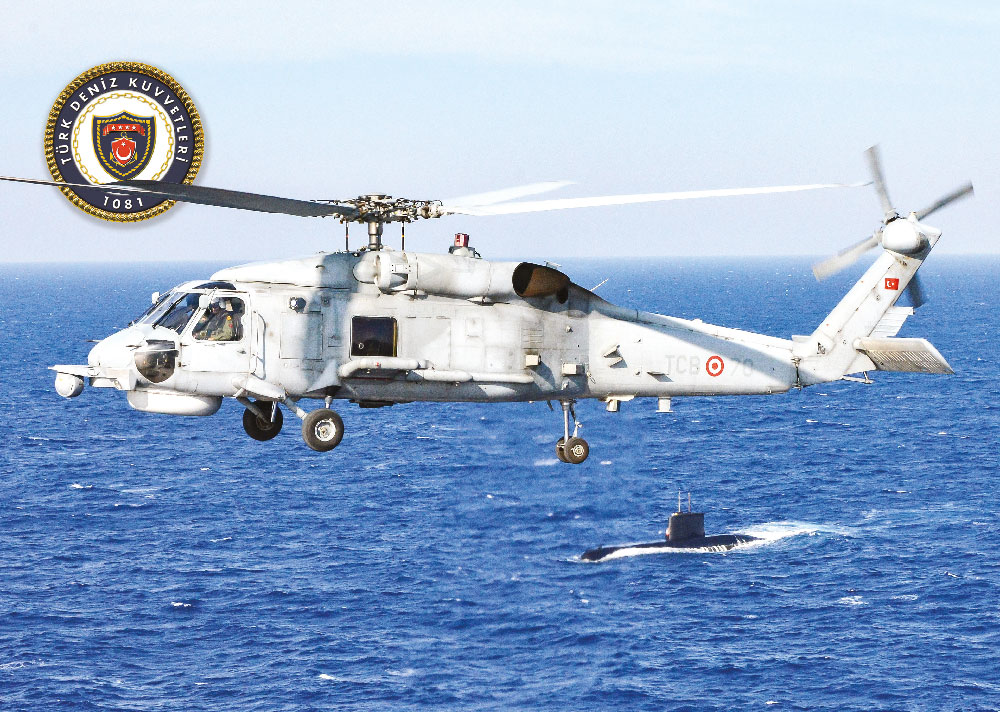
The tail section and the rotor blades of the S-70B SeaHawk Helicopters that powered by a pair of T700-GE-401C turboshaft engines, can be folded to reduce their footprint aboard ships. SeaHawk Helicopters are operated by the 351st Naval Helicopter Squadron stationed at the Naval Aviation Group Command, Cengiz Topel Naval Air Station. Naval Aviation Group Command also operates two AB-212 utility (TCB 29 and TCB 30) and nine AB-212 ASW/ASUW (TCB 37, TCB 38, TCB 39, TCB 41, TCB 42, TCB 44, TCB 45, TCB 46 and TCB 47) helicopters.
One of the 17 S-70B-28 SeaHawk Helicopters, delivered under the Second Package (Lot-II) SeaHawk Procurement Project, took off from Cengiz Topel Naval Air Station with four crewmembers at noon on October 12, 2014, to participate in a training activity planned in Konya. However, the helicopter disappeared from radar screen after it lost connection with its base at 12:25, and the wreckage of the chopper was located in the Kartepe district (Balaban Village) of Kocaeli province. In this tragic accident, helicopter pilot Major Deniz AKDENİZ, co-pilot Lieutenant Çağrı CEYHAN, sensor operator Chief Petty Officer Mehmet KARAKAŞOĞLU, and the anti-submarine warfare systems operator Petty Officer First Class Ömer Burak ÖĞÜT lost their lives.
The tail number of the helicopter that crashed in the said accident appears as TCB 66 when compared with the tail numbers of S-70B-28 SeaHawk helicopters (dubbed SH-70 by the Turkish Naval Forces Command) listed on the official website of Turkish Naval Forces Command (TCB 50, TCB 52, TCB 53, TCB 54, TCB 55, TCB 56, TCB 57, TCB 58, TCB 59, TCB 60, TCB 61, TCB 62, TCB 63, TCB 64, TCB 65, TCB 67, TCB 68, TCB 69, TCB 70, TCB 71, TCB 72, TCB 73, TCB 74 and TCB 75). The SH-70 Helicopter with TCB 66 tail number was used as a test platform as part of the Laser UMTAS Project carried out by the main contractor Roketsan. In line with the decisions and directives of the Turkish Naval Forces, the integration work of the Laser UMTAS Missile, which is considered as an indigenous alternative to the AGM-114M HellFire II Missile (84 missiles have been procured), into the SH-70 Helicopter began in the first quarter of 2014. The first live missile firing from TCB 66 was successfully executed on September 16, 2014, about a month before the tragic accident. During the live-fire demonstration, a surface target at 4 km (towed by TCG Ödev at low speed) was successfully engaged with a missile launched at 200m above sea level. The Laser UMTAS Missile with an effective range of 500m to 8000m has two different launch modes: Lock-on Before Launch (LOBL) and Lock-on After Launch (LOAL). The Laser UMTAS System, which has been modified according to the requirements of the Turkish Naval Forces Command, were to be commissioned under the TEMREN Project to complement HellFire II Missiles and replace them in the future. According to the Aselsan 2018 Annual Report, the integration studies of the TEMREN Guided Munitions into the Turkish Naval Forces SH-70 (S-70B SeaHawk) Helicopters were continuing, and the first launch test was planned to be conducted in 2019. On the other hand, the Aselsan 2019 Annual Report only stated that the integration studies were continuing and did not share any information about the launch test.
Within the scope of the Second Batch (Lot-II) SH-70 Procurement Project, one SeaHawk Helicopter was delivered free of charge by Sikorsky Aircraft in return for the delay penalty. With the 18th helicopter (TCB 075) delivered in the first half of 2015, the number of SH-70 Helicopters in the Naval Aviation Group Command fleet reached 24 (a total of 26 S-70Bs were produced, two of which crashed). Meanwhile, the 7 SH-70 Helicopters delivered under the First Batch (Lot-I) SeaHawk Procurement Project were upgraded to the same configuration as Lot-II Helicopters under a 47-month retrofit program launched in October 2012.
The SH-70 Helicopters, which are among the most effective ASW/ASUW Helicopters in the world, are the export version of the SH-60B SeaHawk Helicopter and have a digital cockpit design consisting of four MFD-268C5 full-color active-matrix liquid crystal displays and CDU-900 flight management system. The helicopters can be equipped with a 272 kg (600 lb) capacity rescue hoist, LN-100G INS/GPS, APX-100/APX-119 IFF, Link-11, AN/AAS-44 FLIR, LR-100 ESM, AN/APS-143(V)3 Maritime Surveillance Radar, AN/AQS-18A or HELRAS Dipping Sonar, EW AN/ALE-47 CMDS Airborne Countermeasures Dispenser System, AN/AAR-60 MWS-TU Missile Warning System, and AN/ALQ-144 IRCM Infrared Countermeasures Set. The SH-70 of the Turkish Naval Forces can be armed with Penguin Mk2 Mod7 Anti-Ship Guided Munition (ASM) with 32km range and AGM-114M HellFire II or TEMREN/Laser UMTAS Guided Munitions with an 8km range against surface targets, and Mk46 Mod5 or Mk54 Lightweight Torpedoes (LWTs) against underwater targets. As far as we know, 10 of the Lot-II SH-70 Helicopters are equipped with DS-100 Low-Frequency Dipping Sonars (HELRAS) operating at a frequency of 1.38kHz and other helicopters are fitted with AN/AQS-18A Dipping Sonars that removed from AB-212 ASW/ASUW Helicopters. Thanks to these high-value platforms, the Navy's anti-submarine, surface detection, and strike power have increased significantly, creating a force multiplier effect.
According to open sources, the standard combat load of the S-70B SeaHawk Helicopter consists of 2 Mk46 Mod5 or Mk54 Lightweight Torpedoes. The helicopter can also carry two self-sealing fuel tanks on either side of the lower fuselage (inner pylons) as part of the SeaHawk Crashworthy External Fuel System (SEACEFS). Additionally, depending on the mission, the helicopter can carry one Penguin Mk2 Mod7 ASM (however, according to Sikorsky Aircraft’s S-70B International SeaHawk Technical Information document, in ASUW Mission armed with two Penguin Missiles SeaHawk Helicopter will have a radius of 350km, with a 4 total time on station hours at ISA conditions) or 4 HellFire II/Laser UMTAS Guided Munitions on an extended pylon (Missile Launcher Assembly/MLA) on the port side of the fuselage, an external fuel tank on the inner port-side pylon, and a lightweight torpedo on the inner starboard-side pylon. A Turkish Navy SH-70 crew member that I had the opportunity to meet at TEKNOFEST 2019 noted that the SH-70 cannot carry two torpedoes, 2 Penguin, or 8 HellFire II/Laser UMTAS simultaneously but only able to carry 4 HellFire II/Lazer UMTAS or 1 Penguin ASM on the port side and one lightweight torpedo on the starboard side. However, in the SH-60R SeaHawk 'Romeo' model, two light torpedoes or 8 HellFire II Guided Munitions can be carried simultaneously with Missile Launcher Assembly (MLA) on either side of the fuselage.
The pilots that will fly SH-70 (S-70B-28 SeaHawk) Helicopters, as well as the Acoustic (DS-100 HELRAS and AN/AQS-18A) and Tactical (AN/AAS-44 and AN/APS-143(V)3) Sensor Operators, are trained with the Havelsan’s 'Full Mission Simulator (Level D qualified), Mission Simulator and Sensor Operator Trainer procured under HELSIM Project and delivered to the Naval Aviation Group Command in 2010. Since Lot-I SH-70 Helicopters have been upgraded to the lot-II configuration with a retrofit program, the simulator systems have been also upgraded to the Lot-II configuration in hardware and software wise under a HELSIM Project Lot-II Modification Project launched by the SSB in 2015. Within the scope of HELSIM Project Lot-II Modification Project all simulator systems located at SeaHawk Simulator Center established at Naval Aviation Group Command have received following upgrades:
Hardware replacements (New MFDs, consoles and panels)
Ethernet-Hub cabling between MFDs.
Radar system modifications
Sonar system modifications
ESM system modifications
LINK 11 system modifications
S-70B Naval Utility Helicopters
The Turkish Naval Forces decided to purchase six S-70B-28D SeaHawk Helicopters, which can also be used in search and rescue missions, to meet its naval utility helicopter requirement. Selecting S-70B fuselage as the basis for its naval utility helicopter requirement have allowed the Turkish Navy to utilize most of the its existing maintenance/repair, support, and pilotage training infrastructure capability. To also meet the Turkish Coast Guard Command's requirement for six utility helicopters, the Presidency of Defense Industries (SSB) initiated the TNFC Third Batch (Lot-III) SeaHawk and TCGC Utility Helicopter Procurement Project via a direct procurement model and requested a proposal from Sikorsky Aircraft on December 12, 2016. The Proposal Evaluation Report was completed on January 18, 2017, and the proposal submitted by Sikorsky was not accepted during the evaluation process. However, both TNFC's and TCGC's requirements for a naval utility helicopter that can operate in marine conditions with a corrosion-resistant fuselage still on the agenda.
The S-70B SeaHawk Naval Utility Helicopters were intended to have the same airframe/fuselage as the S-70B-28D SeaHawk ASW/ASUW Helicopters but without the Sonar, FLIR and ESM Systems. Naval Utility Helicopters were planned to have either AN/APS-143(V)3 Radar, which is still used by SeaHawk Helicopters, or another less capable surface radar (cost-effective) to prevent sea and airspace violations, especially during missions on the Aegean Sea. The S-70B SeaHawk Helicopters, which can carry 10 passengers, was also expected to include a rescue hoist and the Aircraft Ship Integrated Secure and Traverse (ASIST) System.
FLIR System Replacement
A decision was made to replace the AN/AAS-44 Forward Looking Infrared (FLIR) System on the SH-70 (S-70B-28 SeaHawk) Anti-Submarine Warfare/Anti-Surface Unit Warfare (ASW/ASUW) Helicopters with a new generation device, and in this context, tests were carried out in the first half of 2018 with the FLIR System’ Star SAFIRE 380-HLD FLIR payload. The Aselsan product CATS FLIR System was also reported to be tested; however, there have not been any announcements about the order so far.
ASIST System and SH-70 Helicopter
The GABYA and BARBAROS Class Frigates and the ADA Class Corvettes of the Turkish Naval Forces Combat Fleet Command are equipped with Curtis-Wright's Indal Technologies product Aircraft Ship Integrated Secure and Traverse (ASIST) System. Thus, the SH-70 ASW/ASUW Helicopters can land and take off from these ships' flight decks.
Thanks to ASIST, a lightweight and fully integrated 'wireless' system, pilots can land the helicopter without any outside help during a quiescent period in ship motion. During the descent, ASIST's precise Helicopter Position Sensing Equipment (HPSE) system continuously tracks and monitors the exact position of the helicopter, relative to the designated landing area and displays it to the pilot through a series of visual landing cues. Guidance data is simultaneously relayed to a computer-controlled Rapid Securing Device (RSD), which automatically moves fore and aft along the flight deck track to maintain its position directly beneath a probe on the underside of the helicopter. Immediately upon touchdown, the probe is secured by the RSD, and the aircraft is ready to be aligned and traversed into the hangar.
While on deck, the helicopter can be easily rotated and transported by a single operator without the need to connect any ancillary equipment or guide cables to the aircraft. The unique design of the Indal ASIST RSD makes it possible for the single operator to rotate a 14-ton helicopter through 360 degrees within the confines of the flight deck, all while maintaining complete security in extreme sea states. The ASIST System allows helicopter operations in up to sea state-6 conditions depending on the platform and helicopter type. For example, the ADA Class Corvettes, which can fully operate in sea state-5, can conduct unrestricted helicopter operations in up to sea state-4 (including 4) with the ASIST System.
The SH-70 (S-70B-28 SeaHawk) ASW/ASUW Helicopters have a total of 4 downward-looking laser beacons on the right and left side of the fuselage (located on the tail boom section) and four visual signs/lights in the cockpit as part of the ASIST System. According to the information I received, as the helicopter approaches the deck for landing, the laser sensors on the back of the fuselage continuously tracks and monitors the exact position of the aircraft relative to the designated landing area by measuring the distance/height with lasers in coordination with ASIST's HPSE system. As soon as the helicopter descents to 1.5m and is in the same position as the RSD, the system informs the pilots with four green lights and automatically lands the aircraft.
DS-100 HELRAS and National HELOSON Dipping Sonar Project
The first 7 of the 24 S-70B SeaHawk ASW/ASUW Helicopters (Lot-I) operated by the 351st Naval Helicopter Squadron of the Naval Aviation Group Command, are fitted with the DS-100 Helicopter Long-Range Active Sonars (HELRAS), operating at 1.38kHz frequency. In comparison, the 17 of the remaining 18 helicopters purchased under Lot-II can use both HELRAS sonars and AN/AQS-18A mid-frequency dipping sonars removed from the AB-212 ASW/ASUW Helicopters. There is an 80% subcomponent similarity between the 326 kg HELRAS sonar and the 264 kg AN/AQS-18A Dipping Sonars, both of which are L-3 Ocean Systems products.
The HELRAS sonar operates in 1.31-1.45kHz frequency bands and has selectable detection ranges of 1, 1.5, 2.5, 4, 6, 10, 16, 25, 40, 60nm (nautical miles) and is designed to be used in open seas and oceans due to its operation in the low-frequency band. In shallow waters, on the other hand, AN/AQS-18A (264kg total weight, 88.9kg Wet End weight) and similar mid-frequency (9.23kHz - 10.520kHz) dipping sonars with a 20nm range are more preferred. The Turkish Naval Forces prefer AN/AQS-18A for the Aegean Sea, which is considered shallow, whereas it prefers the HELRAS for missions in the Mediterranean and the Black Sea, which are deeper than the Aegean Sea and use these systems effectively. The main reason why HELRAS is not preferred in the Aegean is because of its low frequency, it causes reverberation under the sea, and thus, its eco selectivity decreases. Therefore, the higher frequency AQS-18A (operates in mid-frequencies) is preferred.
The first two low-frequency, long-range HELRAS active dipping sonars developed by L3 Ocean Systems were accepted at the company premises between July 23 and 27, 2001, and delivered to Sikorsky on August 14, 2001, to be integrated into Turkish Navy SH-70 Helicopters. The first SH-70 equipped with HELRAS was delivered to the Turkish Navy in April 2002. While the unit cost of the HELRAS Sonar System was about US$1 Million at that time, today this figure can exceed US$3 Million.
A senior Naval Officer, whom I had the opportunity to meet during my visit to the Naval Aviation Group Command in 2015, pointed out that there were some technical problems with the low-frequency, long-range HELRAS Active Dipping Sonar in the early years but these were solved later, and the sonars had been functioning almost flawlessly for the last two years (2013-2015). According to the information I have obtained, the manufacturer L3 has replaced the problematic Kevlar cables that are used for the dipping (Up to 500m) of the 155 kg and 2.58m wide HELRAS Sonar Wet End and also updated its software. Previously the wet end of the sonar experienced some problems when opening and closing or when pulled back into the helicopter. Sometimes the system gives a low-battery warning even though the battery is full. For example, during the White Storm 2012 Naval Exercise, on May 10, 2012 the SH-70 Helicopter, which in accordance with the Exercise scenario immersed its HELRAS Sonar Antenna Unit to detect the position of the hostile submarine, had to lose/drop the Sonar Antenna Unit (Wet End) into the water as a result of the technical failure. A similar situation was also experienced by the Greek Navy Lot-II Aegean Hawk Helicopters. For example, as a result of a technical problem experienced during the submarine detection training conducted in the Gulf of Karystos in the first half of March 2011, the crew saved the helicopter by cutting the cable of the HELRAS Sonar Wet End at the last moment. The Greek Navy later located the sonar wet end at a depth of 140m and recovered the system. According to Greek sources, the cost of the HELRAS Sonar at that time was US$2.5 Million.
The HELRAS Sonar transmits in 360 degrees with a single ping and allows the operator to detect and follow the contacts on a calibrated display, both audibly and visually. The HELRAS Sonar also provides passive search, contact identification, and underwater communication capabilities, and has been used as the sharp ears of SH-70 Helicopters in ASW missions with its advanced technology and 120,000-yard (109.7km) detection range.
During the TEKNOFEST Istanbul Aviation, Space, and Technology Festival held at Istanbul Ataturk Airport between September 17-22, 2019, the Lot-II SH-70 Helicopter with tail number TCB 57 (18th helicopter delivered under Lot-II contract) was exhibited, during the previous edition of the event that took place in 2018 another Lot-II SH-70 Helicopter with tail number TCB 75 (24th helicopter) was exhibited. The TCB 57 crew member, whom we had the opportunity to meet during the event, noted that both HELRAS and the AN/AQS-18A sonar could be used in the helicopter (it was fitted with HELRAS, while exhibited). According to the information I have obtained, the SH-70 crew, who has found some solutions for themselves in the light of past experiences, does not currently experience any serious problems with HELRAS. Although the cable used for dipping and retracting the sonar wet end (Sonar Antenna Unit) is made of Kevlar, it can lose its strength and break (because it cannot carry the 155kg sonar wet end) if there is a small tear on it. To prevent cable-related problems, the TNFC has established a Cable Test Station. On the other hand, because of their experience, the SH-70 crew has found a way to save the high-cost HELRAS Sonar Wet End in case of a cable break. The cable breaks when the Wet End must be retracted while its eight hydraulically driven arms are still underwater in the extended configuration. Since the extended arms put excessive load on the Kevlar cable, the Wet End starts to spin when it is retracted from the sea. Since this situation damages and breaks the sonar's cable, the crew lowers the helicopter's hoist cable (rescue rope) to the bottom part of the Wet End, called the 'funnel,' just before it starts to spin. Then, by cutting a part of the Wet End produced from the mica (a very fragile material) and attaching a hook to it, the Crew prevents the Wet End from falling into the sea even if the cable breaks during an emergency.
Additionally, the software of the system is updated regularly. According to the information I have received, as of September 2019, 15 different software versions have been developed and delivered with the contribution of the feedback provided by the Turkish Naval Forces, one of the most active users of HELRAS.
On the other hand, studies have been initiated to develop a national Helicopter Dipping Sonar System (HELOSON) similar to the DS-100 Helicopter Long-Range Active Sonar (HELRAS), which has been operated by the Turkish Naval Forces since 2002 and has caused the several SH-70 Helicopters to almost crash (helicopters were saved by cutting the HELRAS sonar wet end cable) several times in the past. In this context, a call was issued by TÜBİTAK SAVTAG (Research Support Group on Defense and Security Technologies) under the 1007 Program with the code "1007-SAVTAG-SSB-2019-02" on July 1, 2019, to improve the Anti-Submarine Warfare (ASW) capabilities with domestic and national facilities.
The scope of the call aims to develop the ASW capabilities described below with local and national facilities under a program called HELOSON. The main framework and scope of this program aim to realize multiple R&D intensive work packages with a technology readiness level of 4-6 and verify them in a real environment to develop the capabilities listed below.
The capabilities expected to be developed by the specified call are:
1. An active/passive dipping sonar system will be developed for a helicopter (SeaHawk) to be selected from the Turkish Naval Forces inventory.
2. Various “SONOBUOY” systems, subsystems and software will be developed to meet various ASW needs. In this part of the project, a specific and limited number of:
a) Active and directional passive "SONOBUOY" prototypes that can be deployed from surface and air platforms (including SeaHawk),
b) “SONOBUOY” Signal Processing System (with radio receiver),
c) "SONOBUOY" Deployment Pattern Optimization (SOPO) and Planning Software and mobile "SONOBUOY" Simulator will be developed.
Under the Project in which Aselsan is also expected to participate, an active/passive dipping sonar with similar features to the DS-100 HELRAS will be developed domestically. According to the Aselsan Sonar and Submarine Systems Road Map, HELOSON will be ready in 2025. Additionally, as a separate study, a Technology Acquisition Obligation Project for Helicopter Sonars was also launched by the SSB Naval Systems Department.
Meanwhile, Armelsan has recently introduced the ORKUN-2053, a mid- frequency band dipping sonar developed for the Anti-Submarine Warfare, to the public opinion by sharing its images and a product information bulletin at their official webpage. As Turkey’s firs indigenous helicopter dipping sonar the ORKUN-2053 Sonar is able to operate up to a depth of 350m and can transmit in 3 different frequencies between 8kHz-11kHz in a 360-degree coverage area. It is claimed that ORKUN-2053 Indigenous Mid-Frequency Helicopter Dipping Sonar that weighs around 270kg, can detect targets from long range thanks to its high source level. The company had shared first-hand information on ORKUN-2053 sonar during IDEF ‘19 Fair."
Greek Navy and Aegean Hawk ASW/ASUW Helicopter
The Greek Navy also equipped some of the eight S-70B-6 Aegean Hawk and 7 AB212 ASW/ASUW Helicopters in its inventory with the AN/AAQ-22 Star SAFIRE II FLIR System. The Greek Navy chose the SeaHawk Helicopter in December 1991 and, on August 17, 1992, ordered the first batch (Lot-I) of 5 S-70B-6 Aegean Hawk (Greek Navy designation) Helicopters with analogue cockpit architecture. Three optional helicopters in the first order were later added to the final order, and on June 12, 2000, a new agreement was signed for the additional helicopters. The second Batch (Lot-II) 3 Aegean Hawk Helicopter featured digital cockpit architecture. The first eight analogue cockpit fitted Aegean Hawk Helicopters, which can only fire Penguin Mk2 ASM, were equipped with AN/AQS-18(V)3 Dipping Sonar, AN/APS-143(V)3 Maritime Surveillance Radar, AN/APX-100 IFF and AN/ALR-606(V)2 ESM Systems. The eight S-70B-6 Aegean Hawk Helicopters, which were supplied under the first agreement without a FLIR system, were later upgraded and equipped with the AN/AAQ-22 StarSAFIRE II FLIR System. The additional three glass cockpit S-70B Aegean Hawk Helicopters delivered under the second agreement were capable of firing AGM-114M HellFire II Missiles and fitted with HELRAS Dipping Sonar, LR-100 ESM System, AN/APX-119 IFF System, LN-100G INS/GPS System, AN/APS-143(V)3 Maritime Surveillance Radar, and Raytheon product AN/AAS-44 FLIR system with Laser Designator (LD). According to Greek sources Aegean Hawk Helicopters can be equipped with up to 3 Mk46 Mod1/2/5 Lightweight Torpedoes, 1 Penguin ASM, and 4 AGM-114M HellFire II (second batch helicopters only) air-to-surface missiles.
In addition to the 11 S-70B Aegean Hawk Helicopters operated by the 2nd Navy Helicopter Squadron, the Greek Navy has also publicised its plan to purchase seven more MH-60R ASW/ASUW Helicopters from the USA under a FMS approach. In this context, the U.S. Defense Security Cooperation Agency (DSCA, part of the U.S. Department of Defense/DoD, i.e., the Pentagon) officially notified the U.S. Congress on July 12, 2019, regarding the sale of seven MH-60R Helicopters (est. US$600 Million) to Greece through the Foreign Military Sales (FMS) channel and received Congressional approval for the potential sale. In case of a firm order, the helicopters, which will be powered by T700-GE-401C turboshaft engines, will be equipped with the AN/APX-123 IFF System, AN/APS-153(V) maritime Surveillance Radar, AN/AQS-22 Airborne Low-Frequency (ALFS) Dipping Sonar System, AN/AA-44C(V) Multi-Spectral Targeting System (MSTS), Embedded INS/GPS System (with Anti-GPS Spoofing Module), AN/SSQ-36/53/62 Sonobuoy launchers, and next-generation radio sets. The MH-60R Helicopters are expected to replace the seven veteran AB212 ASW/ASUW Helicopters operating together with the Aegean Hawks at the 1st Navy Helicopter Squadron stationed at the Kotroni Naval Helicopter Base near the town of Marathon, which is still the heart of Greek Naval Aviation.
Within the framework of the decision approved by the Greek Parliament in May 2020, 4 MH-60R ASW/ASUW Helicopters will be procured for the Greek Navy in the first stage with the cost of €260 Million (it is claimed that 4 helicopters are supplied at the price of 3 helicopters in Greek sources). Greece has also launched a maintenance/logistics support project to extend the operational service life of 11 S-70B6 Aegean Hawk Helicopters in the Navy inventory until the 2030s. In the coming days, the Government Council for Foreign Affairs and Defence, usually known by its acronym KYSEA (is the supreme decision-making body on issues of foreign policy and national defence of Greece) is expected to approve a US$83 Million contract that covers the provision of spare parts and technical support for the next four years.
Within the scope of the MH-60R ASW/ASUW Helicopter Program on October 26th 2020 Lockheed Martin gets two contracts from the Pentagon to produce and deliver four MH-60Rs (US$180 Million) to Greece and to procure and integrate 3 AN/AQS-22 Airborne Low Frequency Sonar (ALFS) Systems (US$13.980,348 Million) on these helicopters. Deliveries are expected to be completed in February 2025.