Türkiye Deploys Fighter Jets to Romania for NATO Air Policing Mission
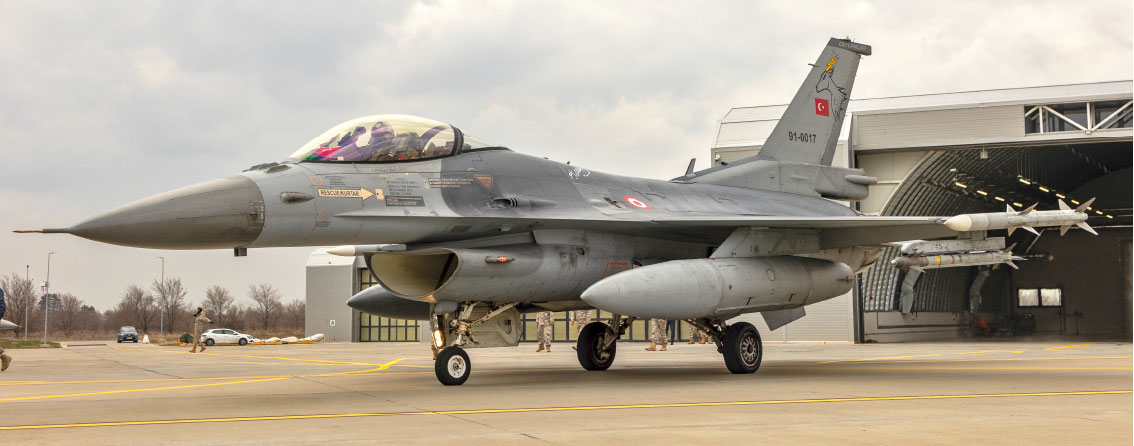
On November 30, belongs to the 152nd Squadron of the Turkish Air Force Command four Turkish F-16 fighter jets arrived in 86th Borcea Air Base, in Romania to participate in NATO’s enhanced Air Policing mission in the south for the first time. Turkish Air Force Command F-16 jets have deployed to Feteşti Air Base for the execution of Enhanced Air Policing mission from 01 December 2023 to 31 March 2024 in order to protect and safeguard NATO airspace effectively.
The North Atlantic Treaty Organization (NATO), as a defensive alliance providing the safety and security of member nations, takes the responsibility of securing the NATO airspace. Air Policing is the key component of this responsibility and serves as a continuous mission performed by various Allied Air Forces from several different locations to provide the integrity of NATO airspace. Air Policing is an important mission which strengthens the vulnerabilities that can occur. Authority of national air defence assets provided by Allies to support Air Policing mission is transferred to NATO and air policing mission is conducted under operational control (OPCON) of Allied Air Command.
The Turkish detachment augments Romanian air force jets and surface-based air defences. Following Russia’s full-fledged invasion of Ukraine, NATO has reinforced its presence in the eastern part of the Alliance, including with more fighter jets and surveillance flights.
Turkish F-16 Detachment Commander Colonel Sedat KUÇASLAN from the 152nd Squadron said “I convey my warmest appreciation and gratitude to both air forces from Romania and Türkiye for this high level of commitment that will allow this enhanced Air Policing mission to happen from here during the next four months,”
As of December 31, 2024, the 152nd Squadron transferred its duties to the 113th Squadron. 113th Squadron of Turkish Air Force conducts enhanced Air Policing mission with 4xF-16 jets and approximately 73 personnel on a 24/7 basis against any threats with high readiness in a “15-minute standby mode”. This air policing mission in Romania is the third employment of Turkish Air Force after the first two missions executed in Lithuania in 2006 and Poland in 2021.
On March 6, the Romanian Air Force deployed one of their C-27 transport aircraft for combined training missions with F-16 fighter jets from Romania and Türkiye, based at Fetesti Air Base.
In the morning of the training day, Romanian and Turkish F-16s conducted interception training with the transport aircraft that took off from Otopeni Air Base; the activity’s goal was to enhance skills of both the jet and transport aircraft pilots. In the afternoon, at Fetesti Air Base, the Turkish F-16s conducted training scrambles simulating the alarm chain from fighter preparation to take-off for an intercept. After taking off, they were joined by Romanian F-16s for a session of air-to-air combat drills over the Romanian Black Sea coast near Constanța.
About 50 international media had the opportunity to observe the demonstration – some of them flew to Fetesti onboard the C-27 aircraft and witnessed first-hand how NATO interception procedures are executed.
“Since 2014, Romania has hosted NATO enhanced Air Policing of fighter detachments from eight Allies and – now – Türkiye at its air bases near the Black Sea Coast. This has been a major contribution to NATO’s collective effort to show its commitment to collective deterrence and defence and the close cohesion among Allies,” said Captain Cornel Pavel, Romanian Navy, deputy head of the Information and Public Relation Directorate of the Romanian Ministry of Defence.
Until the end of March, a Turkish Air Force detachment is deployed at the base with four F-16 jets for NATO’s enhanced Air Policing; the jets fly sorties alongside their Romanian colleagues to safeguard NATO airspace on the eastern flank.
Major who is “Dizel” call sign from the Turkish Air Force said the following about their mission, Turkish Armed Forces and Turkish Air Force routinely conducts air defence missions and flights at home as well to protect NATO airspace. Therefore, as the Turkish pilots, we are all well trained, highly capable and extremely familiar with alarm reaction missions. We stand ready to fulfil this critical capability need in the most effective way. I would like to add that during our Air policing mission over Romania, we have the same feelings and the same responsibility level as we are protecting our own airspace.
Mutual trainings between allied nations` assets are imperative to enhance interoperability. With that being said, mission execution in a harmony with units in a high combat readiness level has a very positive impact on succession of air policing mission objectives. Alarm reactions are time critical missions to engage the possible threats and to prevent any intrusion to NATO airspace within the area of responsibility. Rather than conducting only alarm reaction during our deployment, we execute training missions as much as possible with different NATO assets and platforms such as air to air refueling, air defense missions with ground-based air defense units and interception training between Allied aircrafts.
As I finish my words, We present our gratitude and respect to the host nation and its people for their hospitality. We are NATO and we are Stronger Together.
The French Rafale detachment deployed to Fetesti for a five-day Agile Combat Employment (ACE) during which jets participate in combined training with regional air and ground forces supporting NATO’s force posture on the Black Sea shores in Romania. Several NATO Allies conduct ACE deployments across Europe to practice expeditionary capabilities projecting a force package at short notice with minimum own support relying on services provided by the receiving airfield. The ACE concept is a force multiplier for NATO’s Air Forces as it increases agility, interoperability, readiness, survivability and continuity of air operations.
Fetesti Air Base – Romania’s 86th Air Base – is home to a squadron of F-16s and also hosts the European F-16 Training Center (EFTC) for Romanian, other NATO pilots and Ukrainian pilots. The training location is intended to train Romanian and Ukrainian pilots to become F-16 pilots. The Netherlands took the initiative to establish the EFTC and made its own F-16s available for this purpose. The fighter aircraft remain the property of the Nethzerlands. The first 5 F16s are now in Romania.
Lockheed Martin and its subcontractors Daedalus Aviation Group, Draken International, GFD - a subsidiary of Airbus Defense and Space, and ILIAS Solutions will team up to provide F-16 operational training at the new center. This is the result of a special collaboration between the Ministry of National Defense of Romania, the Romanian Air Force and the Royal Netherlands Air Force, in partnership with Lockheed Martin. As part of this agreement, the team will be responsible for the organization, programming, operation and maintenance of F-16 fighter aircraft provided by the Royal Netherlands Air Force (RNLAF) in support of F-16 operational training. Specifically, GFD and Draken will provide experienced F-16 instructor pilots with recent front-line combat experience who have flown the F-16 within the US Air Force and other air forces throughout Europe