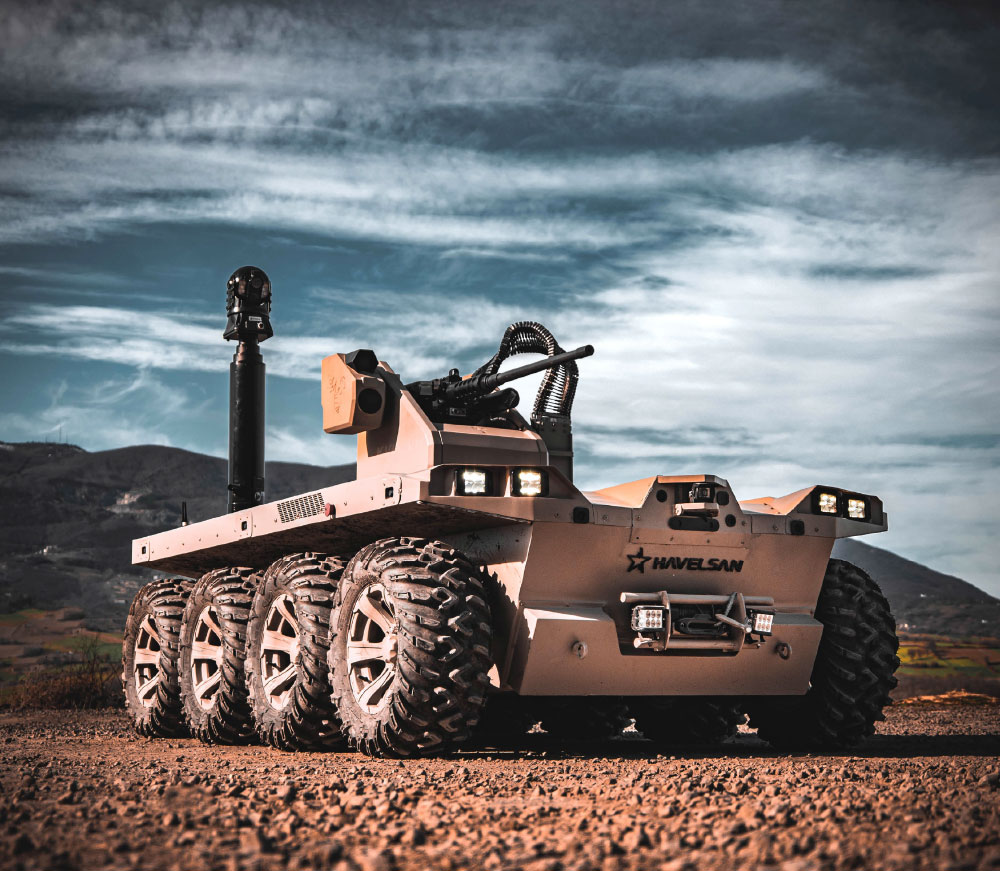
Türkiye`s New Breakthrough on the Field: Unmanned Ground Vehicles

Thanks to developments in artificial intelligence (AI), sensors, and communication systems, there has been rapid development in Unmanned Ground Vehicles (UGVs) in the last ten years, with a range of uses in both civilian and military sectors. These machines offer new capabilities and free up resources and personnel for other tasks, making them particularly interesting to militaries worldwide. Generally, Unmanned Ground Vehicles (UGVs) are robots that operate on land without a human operator. UGVs are the land-based counterpart to Unmanned Aerial Vehicles (UAV) and Unmanned Surface Vehicles (USV). They can be either autonomous, meaning they are capable of navigating and performing tasks without human intervention, or they can be remotely controlled by a human operator at a different location. UGVs come in various shapes and sizes, ranging from small, handheld devices that can be carried by a single person to large, tracked vehicles that are capable of carrying heavy payloads.
Militaries around the world see a lot of potential in these machines, especially after the drones have proved themselves in combat and other military operations. One of the main advantages of UGVs is that they can be used for a variety of applications that are too difficult or dangerous to have human operators present, such as bomb disposal, reconnaissance, search and rescue, or hazardous material handling. UGVs can also be equipped with a variety of sensors and communication systems, which allow them to navigate and perceive their environment, including cameras and lidar, radar or ultrasonic sensors for obstacle detection and avoidance, GPS, wireless radios, or satellite links, as well as manipulators or other tools for handling objects.
The history of UGVs can be traced back to World War I. During the war, the French developed the "Torpille Terrestre" (Land Torpedo), a breeching UGV loaded with a 40 kg (88 lb) explosive charge and saw limited combat use in 1916. However, it performed poorly and was eclipsed by the first tanks. In the 1930s, the USSR developed Teletanks that were remotely controlled by radio from another tank. Armed with DT machine guns, flamethrowers, or smoke canisters, Teletanks were first used by the Soviet Red Army in the Winter War (1939–1940) against Finland and at the start of the Eastern Front after Germany invaded the USSR in 1941. From 1942, the Germans used the Goliath tracked mines (Leichter Ladungsträger Goliath/Goliath Light Charge Carrier, also known as Beetle Tanks by the Allies) that were directed through a control cable as disposable demolition vehicles during World War II. The electrically powered Sd.Kfz. 302 and the petrol-engine powered Sd.Kfz. 303, carrying 60 kg (130 lb), or 100 kg (220 lb) of high explosive charge, depending on the model. They were used for multiple purposes, such as destroying tanks, disrupting dense infantry formations, and the demolition of buildings or bridges. Goliaths were single-use vehicles that were destroyed by the detonation of their warheads.
The first major mobile robot development effort was SHAKEY, developed in the late 1960s as a research study for the Defense Advanced Research Projects Agency (DARPA). SHAKEY was a wheeled platform featuring a set of drive wheels controlled by stepping motors. Among its component technologies were a steerable TV camera, ultrasonic range finder, sensors, and an RF link that was connected to its mainframe computer to help guide its navigational tasks. DARPA subsequently developed a series of autonomous and semi-autonomous ground robots, often in conjunction with the U.S. Army. The SHAKEY program reemerged in the early 1980s as the DARPA Autonomous Land Vehicle (ALV) as part of DARPA's Strategic Computing (SC) Initiative. The Autonomous Land Vehicle was an eight-wheel hydrostatically driven all-terrain vehicle capable of up to 72 kilometers per hour (45 mph) on the road and up to 29 km/h (18 mph) on rough terrain. The ALV was powered by a 12-kW diesel power unit and was equipped with a sensor suite consisting of a color video camera and a laser scanner.
Unmanned Ground Vehicle Studies and Development Projects in Türkiye
The roadmap of the Unmanned Ground Vehicles project was laid by the Defence Industry Agency (SSB) as part of the Presidential 100-day action plan in 2018. Although Turkish Defense Industry companies worked on UGVs before, this was the first nationwide initiative on a comprehensive development program. In this context, the SSB carried out concept determination studies to evaluate the needs by ensuring coordination with the Turkish Armed Forces and aimed to develop unmanned ground vehicle prototypes in three main categories: Light, Medium, and Heavy Class. In the following stages, these categories were detailed, and concepts for use in each category were determined separately.
The Light Class UGVs were later subcategorized into three different levels. The 1st Level Light Class Throwable Unmanned Ground Vehicles can operate in different environments such as dirt roads, caverns, caves, and indoors for day or night reconnaissance & surveillance purposes. The remote-controlled vehicles weigh less than 1 kilogram and can operate silently in closed areas with an operational duration of up to 2 hours. The 2nd Level Throwable Unmanned Ground Vehicles can carry out pre-operational reconnaissance & surveillance, trap detection, and security operations on dirt roads, caverns, caves, tunnels, residential areas/indoors, and multi-story buildings. The throwable vehicles weigh less than 3 kilograms, can climb stairs (17 cm vertical obstacle climbing, 60% gradient/30% side slope), has adjustable speed control, and can be equipped with reconnaissance & surveillance modules with optical and digital magnification capability. If necessary, the 2nd Level vehicles can be remotely controlled or operate in fully autonomous and semi-autonomous modes. On the other hand, the 3rd Level Unmanned Ground Vehicles can map large areas and buildings/rooms in residential areas to provide decision support before an operation. Weighing less than 6 kilograms, these vehicles can climb stairs and be equipped with reconnaissance & surveillance, extended surveillance, terrain mapping, and CBRN modules. The vehicles can operate semi-autonomous or can be remote-controlled.
The Medium Class is divided into 2 different subcategories, 1st Level and 2nd Level UGVs, with weights between 500 kg and 2.5 tons. The 1st Level Medium Class UGVs are projected to have reconnaissance and surveillance capabilities with a maximum weight of 500 kg and high mobility. The vehicles are electrically powered and can reach a maximum speed of 7 km/h with an operational duration of up to 4 hours. The 1st Level Medium Class UGVs feature wireless digital network-based communication systems and will carry a variety of payloads, including a surveillance system, robotic manipulator arm, and speaker, or can be armed with a 7.62mm remote turret. The 2nd Level Medium Class UGVs weigh around 2.5 tons and will be equipped with heavier payloads such as Satellite Communications antennas, STANAG Level II Ballistic Shields, or 12.7 mm Remote-Controlled Weapon Stations (RCWS). These vehicles are capable of operating on rough terrain, different weather, and visibility conditions for reconnaissance and surveillance purposes. The 2nd Level UGVs will also be capable of transporting personnel if necessary.
The Heavy Class Unmanned Ground Vehicles are planned to be used in logistics, reconnaissance, and transportation in risky areas. The vehicles can also be employed to engage and neutralize hostile threats, when necessary, with their high firepower and mobility capabilities. As part of the project, the vehicles are intended to maintain their mobility even after the UGV kit integration. The vehicles, which can also be used as manned platforms when needed (optionally manned), can operate in semi-autonomous mode or can be controlled remotely. The vehicles will also have the ability to record images from at least two driving cameras and transfer them to the Remote-Control Computer or share them with other platforms. Additionally, it will also be possible to control the systems and critical subsystems on the vehicles through the Remote-Control Computer.
The studies on Light Class on UGVs started in 2018 with technology acquisition and R&D projects, and prototypes were subsequently produced. Following the signing of the serial production contracts in 2020, more than 50 UGVs were delivered in the same year and tested in the field by the Turkish Armed Forces through 2021. Over 100 more Light Class UGVs were also delivered in 2022. Concept studies and technical requirements for Medium Class UGVs began in 2019, and project contracts were signed in 2020. The prototype vehicle production and the competition processes were completed in 2022. The SSB's studies on Heavy Class UGVs are focused on unmanned M113 armored vehicles. In this context, 5 different concept vehicles are planned to be developed: Command Vehicle, Fire Support Vehicle, Tactical Decoy Vehicle, Engineering Reconnaissance Vehicle, and Logistics Support Vehicle. In this context, the Turkish Defence Industry Agency signed an agreement with FNSS on November 9, 2021, during the 'Unmanned Ground Vehicles and Military Robotic Technologies Ceremony' held in Ankara. The serial production of Heavy Class SHADOW RIDER UGVs, developed by FNSS, are expected to begin following the trials with these vehicles. The SSB also signed agreements with ASELSAN, BEST Group, ELEKTROLAND, and HAVELSAN companies for the Serial Production of Medium Class Unmanned Ground Vehicles, while the Light Class Unmanned Ground Vehicles serial production agreements were signed with ALTINAY, AROX, ELEKTROLAND, ESETRON, and HOYTEK companies. The SSB also focuses on the importance of the integration of UGVs with border security systems and interoperability with other manned systems.
Light Class Unmanned Ground Vehicles
ABRA and NAGA are Light Class Unmanned Ground vehicles developed by Turkish defense company HOYTEK. Both systems are designed as handheld throwable UGVs and can be used in tactical operations in urban/suburban areas or on the field (only NAGA). The 1st Level ABRA weighs 1.5 kg with 30x30x13 cm dimensions. The IP67-certified UGV features a front color camera with IR illumination. ABRA has 2 hours battery life and can be remotely controlled from 180 meters (LOS) and 70 m (NLOS). NAGA is the 2nd Level heavier tracked UGV that weighs 4.5 kg with 31x31x13 cm dimensions. The IP65-certified NAGA features front and rear, and rear color cameras with IR illumination. NAGA has a 3 hours battery life and can be remotely controlled from 250 meters (LOS) and 70 m (NLOS). Unlike ABRA, NAGA can be fitted with mission-specific modules such as grabbers or PTZ cameras.
GEKO Light Class Unmanned Ground Vehicle is developed by Turkish defense industry company ESETRON. GEKO is the smallest member of the ESETRON family. It is a two-wheeler that can be used for indoor and outdoor reconnaissance and surveillance missions and can be operated remotely via a Remote-Control Unit. GEKO can correct its orientation in case of an overturn and maintain its direction autonomously as well. Besides showing its direction to the Remote-Control Unit, thanks to the onboard sensors, GEKO provides easy direction for the operator with its ability to head toward any saved direction. Weighing approximately 1.5 kg, GEKO can be thrown to 20 m horizontally and 6 m vertically. In addition to the LOS 150 m NLOS 50 m communication range, GEKO can also perform its task with a 50 m cable. It can traverse on 60% vertical and 30% side slopes and reach a max speed of 5 km/h. GEKO can cross 5 cm obstacles and 10 cm deep water.
EJDER is a wheeled and tracked Light Class UGV that can be used both indoors and outdoors and even on wide terrain. Weighing 6 kg, EJDER can be operated via a Remote-Control Unit from distances up to 600 m LOS and 150 m NLOS range. It can also be operated with a 100 m cable. It can activate the return-to-home mode in both uses. Achieving a maximum speed of 7 km/h, The EJDER can climb obstacles of 17 cm and 25 cm in depth. It can traverse on 60% steep and 30% side slopes and correct itself if it turns upside down. It can also cross 10 cm deep water. EJDER can work continuously for 3 hours. EJDER Light UGV can carry lightweight payloads and has a 110-degree horizontal and 90-degree vertical camera in addition to the LED and IR İllumination systems. The operator can also use the onboard microphone for ambient listening.
Weighing 4 kg, KOMODO is an unmanned ground vehicle that offers a wide variety of uses depending on the different payloads. The vehicle can be thrown to a height of 15 m horizontally and 6 m vertically. Developed from the EJDER Light UGV, KOMODO can traverse on 60% steep and 30% side slopes. It can be remotely controlled up to 400 m LOS and 150 m NLOS range or a 100 m cable.
ACROB is a mini unmanned throwable robot developed by ELEKTROLAND DEFENCE. ACROB is a highly innovative small tactical remotely operated vehicle to provide a range of missions such as video and audio surveillance & reconnaissance, remote negotiation, suspect identification/inspection, and forward scouting. Thanks to its maintenance-free robust frame, the handheld robot can be thrown by soldiers through openings in buildings and confined spaces. AKROB weighs 4.9 kg with dimensions of 48Lx32Wx15H cm. ACROB is designed to operate in rough outdoor terrain and indoors with the ability to climb stairs and obstacles quickly. AKROB features a 2-way audio system allowing remote negotiation, three 1920x1080 cameras with a 60° viewing angle for video surveillance, IR illumination for day/night operation, and wireless communication up to 350 m (LOS). AKROB is powered by rechargeable Li/Ion batteries that allow 2 hours of continuous operation. AKROB has a maximum speed of 3.6 km/h. It can climb stairs/vertical obstacles of 20 cm and traverse slopes up to 35° (friction dependent). Having 3 cm ground clearance, AKROB can pass up to 10 cm deep water.
Medium Class Unmanned Ground Vehicles
ASELSAN's ASLAN is a Medium Class 1st Level Unmanned Ground Vehicle that can operate autonomously or be controlled remotely. ASLAN is 165 cm long, 135 cm wide, and weighs around 700 kg. It can reach a maximum speed of 10 km/h and has 4 hours of battery life, depending on the mission type. ASLAN uses electric motors for its drive system, which can operate at temperatures between -20°C to +49°C. The vehicle can be armed with a 7.62 mm SARP-L weapon system, as well as a 360° rotating 2-axis stabilized gimbal with Day TV and Thermal Camera (30x Optical Zoom). ASLAN can perform reconnaissance, surveillance, and assault missions under harsh environmental conditions with high mobility and using mission-specific payloads. ASLAN can be remotely controlled with the vehicle control console (Digital Wireless). The portable operator control unit features both Wired/Wireless controls and allows automatized mission planning/execution and live image monitoring and recording. The highly mobile ASLAN can cross gaps of 60 cm, obstacles of 20 cm (60% steep slope/60% side slope) and climb stairs (30% gradient) autonomously. Thanks to its Dynamic Path Planning capability, it can also perform border patrol on a defined route. ASLAN has several accessories, including front and rear LED illumination, front IR illumination, front and rear drive camera, 360° surround view camera, two-way microphone and speaker, and an integrated GNSS system as standard.
BEST Group developed FEDAİ Unmanned Ground Vehicle based on the company's experience in remote-controlled vehicles. FEDAİ is the first outcome of their work in this field and one of the four vehicles selected under the UGV project initiated by the Turkish Defence Industry Agency. The current configuration features a KORALP RCWS with a 7.62 mm machine gun. In addition, different payloads can be easily integrated into the vehicle, given its flexible architecture. FEDAİ was developed for reconnaissance/surveillance and, when necessary, can eliminate any threats it encounters, especially in operations carried out in urban areas. The company states that FEDAİ has been successfully used by different Turkish security forces in active combat. With its tracked structure, it can easily traverse trenches up to 50 cm in width and any obstacles it encounters. FEDAİ's simple architecture allows each pallet to be driven by a separate servo motor. FEDAİ can also haul and rescue injured personnel or light vehicles in hard-to-reach areas with its 400 kg towing capacity. FEDAİ UGV weighs 400 kg and can reach a maximum speed of 10 km/h. FEDAİ also has a MIL-STD-810G shock resistance and durability rating.
HANÇER UGV, developed by ELEKTROLAND DEFENCE, adapts to all terrain conditions with its adjustable ground clearance and independent track suspension. The design with 4 flippers/tracks provides unique movement capabilities. Also, the wheeled version is optionally compatible to use if required. Its 700-meter wireless control range plays a significant role as a leading infantry in conflict zones and dangerous operations. With LTE usage support, it can be managed instantly over long distances by the command-and-control center. Thanks to the optional tether usage feature, HANÇER UGV can follow the operator easily (follow-me mode) and even go in front of the operator without needing a control unit. HANÇER UGV weighs 650 kg with dimensions 111x134x140 (flippers closed) and 111x215x150 (flippers opened). It is powered by 2 DC motors and has a continuous battery life of 3 hours. HANÇER can reach a maximum speed of 15 km/h and operate at temperatures between -20 °C/+49 °C. HAANÇER has a 50 cm ground clearance allowing it to pass 60 cm wide ditches and climb 55 cm obstacles. It can traverse on 60% vertical and 30% side slopes and has water fording capability up to 50 cm. HANÇER features 1280x720 front and rear Day/IR Night cameras as well as a 640P uncooled thermal drive camera at the front. It can also be equipped with a 360° mast mounted PTZ 30x optical zoom camera. HANÇER is armed with a 5.56 mm or 7.62 mm SARP-L Stabilized Remote Weapon Station for combat. It can optionally be fitted with a 6-axis robotic manipulator arm for EOD missions.
HAVELSAN designed and produced HAVELSAN BARKAN (Medium Class 1st Level) in response to the needs of the modern combat field. The BARKAN assists field personnel in many areas, especially in increasing the operation's success, preventing losses, and reducing operational costs. The BARKAN can be used in multi-purpose missions thanks to its autonomous features and modular design in which different payloads can be integrated. It has been developed for tasks such as carrying or towing cargo, providing close protection, and armed reconnaissance. BARKAN is 140 cm long, 90 cm wide, and weighs around 500 kg. It uses a fully electric drive system and can reach a maximum speed of 12 km/h. BARKAN has an operating duration of 8 hours. BARKAN can be fitted with a 7.62 mm SARP-L RCWS, 40 mm Grenade Launcher, Robotic Arm (Bomb Disposal Mission), Peripheral Surveillance System, CBRN Mission System, Load Carrying/Towing System, and 3D Mapping System. BARKAN also conducted tests with the METE 40 mm Laser-guided Miniature Missile developed by ROKETSAN in January 2022 and became the first UGV in Türkiye that launched a missile system. The vehicle can perform GPS-independent patrol missions and return to base when the link is lost with autonomous leader tracking, obstacle avoidance, drivable area detection, and route planning capabilities.
BARKAN 2 (Medium Class 1St Level) is the newer and heavier version of BARKAN, featuring state-of-the-art payload options and improved autonomous capabilities. BARKAN 2 is an important member of HAVELSAN's Digital Troop concept. It can perform joint operations with other autonomous vehicles with its Swarm Infrastructure. BARKAN 2 is 180 cm long, 125 cm wide, and weighs 900 kg (without payload). It uses a similar fully electric drive system and can reach a maximum speed of 13 km/h. BARKAN has an operating duration of around 5 hours.
KAPGAN is an Autonomous Medium Class 2nd Class UGV designed to accompany troops in different missions with high maneuverability, especially in harsh environmental conditions and rough terrain. HAVELSAN first unveiled KAPGAN at the SAHA EXPO 2022 International Defense and Aerospace Exhibition held in Istanbul. KAPGAN stands out with its 30x113 mm automatic gun system. This weapon will have an effective range of 2,000 meters and provides high deterrence at low volume with its armor-piercing capabilities against ground and air targets. In addition to cutting-edge payload options for different functions, such as the Upgradable Perimeter Surveillance System, various types of weapon systems can also be integrated into KAPGAN, which will weigh up to 2 tons. KAPGAN's 5 kilometers tactical data link, GSM and satellite communication infrastructure, 4 meters Upgradeable Peripheral Surveillance System, and high-tech sensor systems allow this unique UGV to detect the environment, enabling it to carry out day/night reconnaissance and surveillance missions successfully. The wired or wireless drone integrated into the vehicle can be used as a relay in cases where the range is insufficient. In addition, the system's reconnaissance and surveillance capabilities can be increased by providing uninterrupted communication via the drone-integrated modem. KAPGAN can perform various tasks, ranging from carrying military equipment, casualty transfer, and bomb disposal to surveillance, reconnaissance, and battle damage assessment. As the newest member of the HAVELSAN Digital Troop concept, KAPGAN has swarm infrastructure that will allow it to carry out joint operations with other autonomous systems. KAPGAN is 175 cm long, 120 cm wide, and weighs 1400 kg (without payload). It uses a fully electric drive system and can reach a maximum speed of 25 km/h. KAPGAN has an operating duration of 6 hours.
Heavy Class Unmanned Ground Vehicles
Based on the M113 Armored Personnel Carrier (APC), SHADOW RIDER is a family of modular autonomous unmanned ground vehicles designed to meet the multi-operational needs of the modern battlefield and to support soldiers in complex and challenging terrains. FNSS aims for SHADOW RIDER to be a system solution that will reduce the human soldier's burden on the battlefield by becoming a force multiplier in full spectrum missions thanks to its artificial intelligence-supported autonomy kit, decision support systems, sensor suit, positional and situational awareness systems. The SHADOW RIDER is equipped with the autonomy kit developed by FNSS, which has autonomous driving modes such as patrol, track, and return to base, as well as various layers of protection for a safe ride. The vehicle can detect and avoid obstacles autonomously. The FNSS autonomy kit features an open architecture design to enable rapid adaptation of technological developments. It is equipped with a wireless RF and LTE Communication system and antijam GNSS, enabling the SHADOW RIDER to navigate waypoints and patrol missions in GNSS-denied areas. In the armed variant of the SHADOW RIDER designed for fire support missions, the "human" is always in the loop during the decision-making process, and the system does not make the fire decision on its own. The SHADOW RIDER has autonomous mobility and can be commanded remotely. It can meet all kinds of missions, such as reconnaissance and surveillance, logistic support, tactical deception, communication relay, medical evacuation, and, most of all, fire support. Its design allows for integrating payloads suitable for those different tasks. The SHADOW RIDER provides optional manned use. The vehicle has a combat weight of 13,500 kg and can carry a 4,500 kg payload. SHADOW RIDER is 5.5 m long, 3 m wide, and 2 m tall and can be transported by A400M or C-130H aircraft. It can be armed with multiple types of Remote-Controlled Turrets and Missile Systems. The current configuration is fitted with the SABER-25 Unmanned Turret developed by FNSS specifically for the vehicle





