Türkiye`s Strategic Power in the Silent Depths: Submarine Fleet Command
The U.S. Navy possesses sufficient technological capability for deep-sea operations in open waters, yet despite the billions of dollars invested and numerous technological products developed, it has not achieved the desired technological level for littoral (coastal/shallow waters) Anti-Submarine Warfare (ASW) operations. Consequently, operating in relatively shallow waters surrounding our country, such as the Black Sea and the Mediterranean, still involves considerable risks. Operated by a well-trained crew and with stealth as their greatest weapon, submarines continue to stand out as highly deterrent weapons in regional seas.
Submarines, being the most effective platforms that can provide depth to a country's defence, enable defence beyond the borders, thanks to their potential to change the course of a war. Due to their features that can alter the fate of a conflict, submarines are crucial elements for the deterrence of both the Navy and the country.
The Turkish Submarine Fleet, with its 138-year history, is one of the most established submarine fleets globally. A total of 57 submarines (3 during the Ottoman Empire and 54 since the declaration of the Republic, including AY, PREVEZE, GÜR, and REİS Classes) were procured from six different countries, including Sweden, France (seized during World War I and named Müstecip Onbaşı [Corporal Müstecip]), the Netherlands, Italy, Germany, and the United States. Among these, 39 submarines were retired, while 12 remain active, and the six REİS Class submarines are in the delivery and construction stages.
The first submarines of our naval history during the Ottoman Empire period were the steam powered Abdülhamit (Nordenfelt II was launched on September 6, 1886, and is known as the first submarine in the world to launch torpedoes.) and Abdülmecit (Nordenfelt III, September 4, 1987) submarines, ordered from the Swedish Nordenfelt Company. During the navigation and diving tests, these submarines could not demonstrate the desired performance and did not provide sufficient confidence in terms of safety. Consequently, these ships did not conduct actual submarine missions, and they were left idle at the Haliç Shipyard until they were decommissioned in 1910. Hence, these submarines were not included in any naval unit formation, and a new operational structure was not created for these submarines within the Navy. Only one commander was appointed to each submarine, and the personnel assigned to the Abdülhamit Submarine were also used in the Abdülmecit Submarine.
The same situation occurred for the Müstecip Onbaşı Submarine, seized from the French in the Dardanelles during World War I. This submarine was only used in recharging German submarines (as a battery charging ship) at the Taşkızak Shipyard from when it joined the Navy in November 1915 until the end of World War I.
The establishment of a separate command for submarines began in the Republican era. The foundations of our Republican-era submarine capability were laid with the TCG I. İnönü and TCG II. İnönü submarines, which were built in the Netherlands and joined the Navy in 1928 (the first attempts to purchase submarines began in 1924). These submarines served under the Torpedo Boat Flotilla Commodore in Erdek.
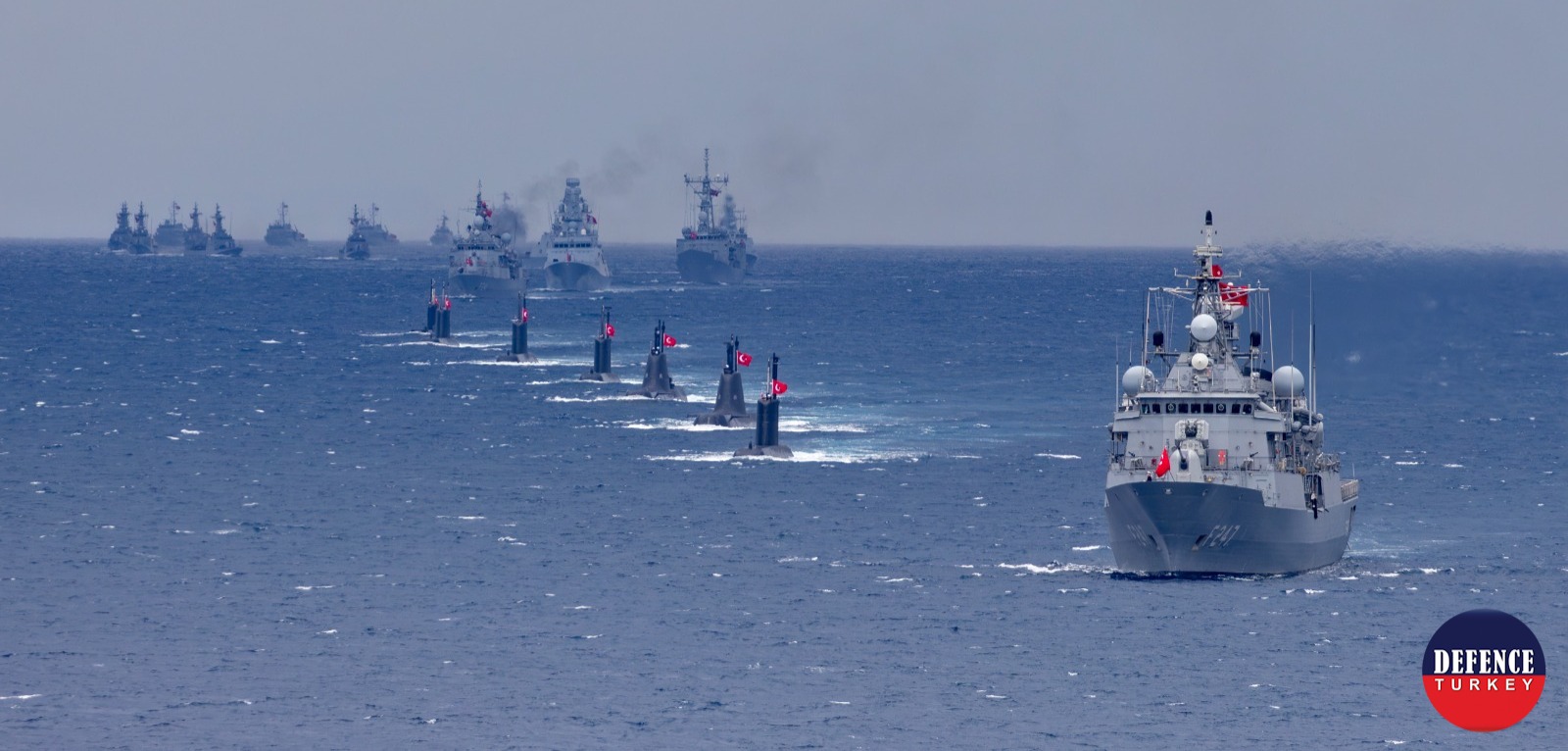
The Submarine Fleet Command, which is one of the most significant combat units that constitute the striking force of the Turkish Navy and the most strategic element in terms of its impact with its stealth feature, currently operates a total of 12 single-hull one-compartment diesel/electric submarines, including 4 AY Class (Type 209/1200), 4 PREVEZE Class (Type 209/1400), and 4 GÜR Class (Type 209/1400 Mod). The PREVEZE Class Submarines serve under the 1st Submarine Flotilla Command (Gölcük), the AY Class Submarines under the 2nd Submarine Flotilla Command (Gölcük), and the GÜR Class Submarines under the 3rd Submarine Flotilla Command (Aksaz).
Our Submarine Fleet Command Visit and My Impressions
On December 14, 2023, we visited the Turkish Navy Submarine Fleet Command, one of the largest submarine forces in the region, located at the Gölcük Naval Base in Gölcük, Kocaeli, to introduce its current capabilities and to provide our readers with firsthand information about the submarines in its inventory, the new generation REİS Class submarines, and our first indigenous design and production submarines, the MİLDEN Class, which will soon be in service. Initially, we conducted an exclusive interview with Rear Admiral (LH) Timur YILMAZ, the Commander of the Submarine Fleet. Following that, we toured the PİRİREİS Submarine, considered one of the world's most modern submarines considering its technological capabilities, accompanied by the captain of PİRİREİS, Captain Necati KARACA, and the Chief Engineer of PİRİREİS, Lieutenant Samet EROL. During the visit, we gained firsthand information about the technical specifications of the PİRİREİS Submarine and the new capabilities it will bring to the Submarine Fleet. I last visited the Submarine Fleet Command on April 4, 2014, as part of a Press Tour organized by the Ministry of National Defence to introduce the Submarine Fleet Command and to showcase the capabilities of the submarines to the public, attracting numerous reporters from the press.
During our visit on December 14, 2023, afternoon, TCG Preveze and TCG 18 Mart (both PREVEZE Class submarines) were moored at Başaran Dock. TCG PREVEZE underwent the MÜREN Modernization and has been successfully fulfilling its duties since then. The submarine conducted a firing test on the morning of December 14 with the AKYA Next Generation National Heavyweight Torpedo (HWT) in the training torpedo configuration. Rear Admiral (LH) Timur YILMAZ, the Commander of the Submarine Fleet, also participated in this firing with TCG Preveze. This test was actually a rehearsal for the AKYA Torpedo live firing test conducted on December 27, 2023, in the Gulf of Antalya. You can read detailed information about this firing in this issue.
On December 14, two PREVEZE Class submarines (one of them was TCG Sakarya) were undergoing maintenance, repair, and modernization at the dock across from the Submarine Construction Sheds at Gölcük Shipyard. Additionally, at the dock, we had the opportunity to see the TCG Oruçreis Frigate, which had completed its modernization under the BARBAROS Mid-Life Upgrade Project and was awaiting delivery while radar tests were being conducted. Likewise, we saw two submarines, believed to be the decommissioned AY Class submarines TCG Atılay and TCG Saldıray, moored at the dock. Furthermore, maintenance and repair work were carried out on the Tench Class TCG Uluç Ali Reis (S-338) Submarine, which was previously displayed at the Rahmi Koç Museum in the Golden Horn (Haliç). The submarine's maintenance was being conducted in a floating dock.
While on our way from the Submarine Fleet Command to the Gölcük Naval Shipyard, we were greeted by the PİRİREİS submarine, which was eagerly awaiting its commissioning to the navy and continuing preparations for its next sea trials. Right next to it, the second submarine of the project, HIZIRREİS, which was launched on May 25, 2023, was undergoing harbor trials.
The 6 REIS-class submarines, which are expected to be commissioned into service between 2024 and 2027, are PİRİREİS (S-330), HIZIRREİS (S-331), MURATREİS (S-332), AYDINREİS (S-333), SEYDİALİREİS (S-334), and SELMANREİS (S-335). Today, the average age of submarines in the Submarine Fleet Command is 33. With the introduction of the six REİS Class submarines, this number will decrease to 21, and the Navy will have a younger, modern submarine fleet.
The PİRİREİS submarine conducted its first sea trial on December 6, 2022, as part of the Sea Acceptance Tests (SAT), followed by a successful initial trim dive on December 7. A noteworthy transition in the REİS class submarines is adopting high automation capability, enabling a shift to entirely remote-controlled digital systems. This transition follows the "one-man control" concept, allowing a single operator to manage the submarine's diving, surfacing, and navigation processes through a single console (One Man Steering Console). This streamlining has replaced the previous setup, where three different personnel/operators used three separate consoles. The shift to a one-man control system not only enhances operational efficiency but also results in significant space savings within the submarine.
While the PİRİREİS Submarine differs from other submarines in service within the Submarine Fleet Command in terms of hull form and propulsion system, it also has a single-hull one-compartment design. The REİS Class Submarines possess distinctive capabilities compared to other class submarines in the inventory, including mine laying, covert deployment of special forces, retractable towed sonar, mine avoidance sonar, satellite communication (SATCOM) capability, and a floating Very Low-Frequency (VLF) antenna. The Submarine Fleet Command acquired the Towed Array Sonar capability for the first time with the REİS Class Submarines. Towed Array Sonar allows target detection from longer ranges thanks to its ability to operate at a distance from the submarine and its low operating frequency.
Our second stop during the PİRİREİS Submarine tour was the Diesel Compartment. The Main Propulsion System in the REİS Class features a 2.85MW/3,900kW/ 5,200hp Siemens Permasyn Electric Motor, 2x Diesel Generators (2x 1.130kW MTU16V396SE84L Diesel Engine and Piller GmbH product NTB56.40 generators), a total of 648 (2x 324) Exide Type 30PS15B Batteries housed in 2 separate battery pools, and 1 Fixed Pitch, 7-blade composite propeller.
Each REİS Class submarine is equipped with two BZM-120 (120kW) Fuel Cell Modules produced by Siemens, each with a volume of 500 liters and a weight of 900 kg. The Liquid Oxygen (LOX) Tanks (one tank on every submarine) are manufactured in Türkiye through a collaboration between STM and Arıtaş Cryogenics. These modules, each containing two Proton Exchange Membrane (PEM) Fuel Cell Modules with a capacity of 120 kW and no moving parts, allow the submarine to navigate quietly at speeds of 4 knots and 6 knots.
PİRİREİS Submarine's Combat Information Center (CIC) features six operator consoles with dual screens each, delivered by HAVELSAN as part of the Enhanced ISUS-90/72 Combat Management System (CMS). Additionally, there is a one-man steering console, an Electronic Chart (Plotting Table), a separate console for the Navigation Radar, an Underwater Telephone, and an Echosounder. Additionally, the equipment in the Combat Information Center (CIC) of PİRİREİS includes HAVELSAN's Submarine Data Distribution System Control Display Panels (CDP) and Siemens Integrated Platform Management System (IPMS) Engineering Control Console (ECC, twin consoles). Other features include the Sea Crypsis Torpedo Countermeasure (TCM) System's Launcher Control Panel and the HARPOON Guided Missile Control Panel. Thanks to the digital software, seamless transitions can be made between the six Operator Consoles of the ISUS-90/72 Fire Control System, which includes Tactical Navigation, Commanding, Weapon, SONAR I, SONAR II, and Link 11/22 Console. Furthermore, HENSOLDT product SERO 420 Attack Periscope and the OMS 100 Optronic Mast Systems can directly display images and video feed on the Operator Consoles. HAVELSAN provided and installed the Type 214TN Land-Based Test System. HAVELSAN has also delivered the Submarine Data Distribution System (DBDS) for the REİS Class submarines. The Multi-Data Link System (ÇAVLİS) capable of Link-11 and Link-22 used in the submarines was developed by MİLSOFT. Six Multi-Data Link Systems integrated into the Enhanced ISUS-90/72 Integrated Underwater Command Control System and one into the Land-Based Test System.
Another noteworthy feature of the REİS Class Submarines is the Semi-Automatic Weapon Transfer System. Using the control panel, this hydraulic system automatically transfers selected torpedoes or Sub-Harpoon Guided Missiles from the reserve pallets located just behind the torpedo room in the Combat Information Center (CIC). When a command is given from the computer, the system opens the lid of the torpedo tube, and the selected torpedo/Guided Missile can be automatically loaded. Heavyweight torpedoes like DM2A4 and AKYA, Sub-Harpoon Guided Missiles, and sea mines like MALAMAN can be launched from these torpedo tubes.
The PİRİREİS Submarine can carry one SAT Container at the back for underwater special operations missions. Two SAT Containers have been procured under the New Type Submarine Project, which can withstand up to the maximum diving depth of the REİS Class. SAT commandos exit the submarine while underwater at a certain depth using the hatch on the sail and swim to the section where the SAT Container is attached to the submarine hull with four legs. After arriving, the commandos open the lid and retrieve their stacked weapons, RHIBs (rigid-hulled inflatable boats), and other equipment before proceeding with the mission.
Although a crew complement of 43 personnel has been designated for the PİRİREİS submarine, the personnel count is planned to be 32-35 according to German standards. Accordingly, during the sea trials conducted within the SAT process, the submarine sets sail with 32 to 35 personnel. The Mk11 Emergency Escape Suit is also used in the REİS Class for emergencies.
On the other hand, studies to domestically produce the reactants of REİS Class Submarines have reached the final stage. The selected local contractor, who is also a current supplier, has largely completed preparations for domestic production, and the reactants used in REİS Class Submarines will be produced and filled with local capabilities starting in the second half of 2024. With the establishment of the liquid hydrogen production capability in Türkiye to meet the requirements of REİS Class Submarines, it will be possible to export reactants anywhere in the world upon demand.
Conclusion
The Turkish Submarine Fleet Command undertakes crucial missions, defending our beautiful homeland beyond our borders. While they navigate the depths of the 'Blue Homeland' day and night, it would be fitting for us to remember, even for a moment, the existence of these dedicated individuals and to express our wishes or prayers for their safety in performing their duties. We hope for their safe voyages in the blue depths. Fair winds and following seas!