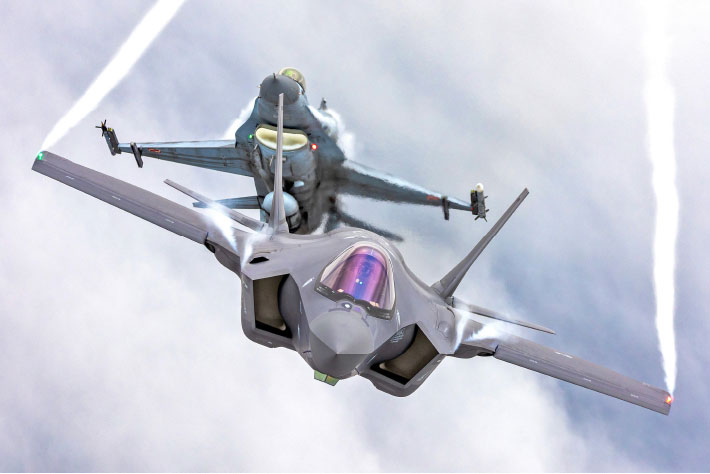
Update on TurAF F-16 Block 70 Procurement and Inside the F-16 Block 70/72 Fighting Falcon Cockpit Demonstrator

In February 2023, Secretary of State Antony BLINKEN publicly confirmed that the Biden Administration supports a possible sale of F-16 fighter aircraft to Türkiye, and has engaged Congress on the issue. According to January 2023 media reports citing unnamed U.S. officials, the Administration informally notified Congress of its intent to sell 40 new-build F-16s in the Block 70/72 Viper configuration and Viper upgrade packages for 79 existing fighters, along with 900 air-to-air missiles and 800 bombs, at an estimated total value of US$20 billion.
According to the Turkish MoND within the scope of F-16 Procurement a total of three meetings were held during December 2021, February 2022 and March 2022 and upon the formal invitation from the U.S., on August 15, 2023, a Turkish MoND Technical Delegation went to the U.S. to hold talks (4th round of meeting). Meanwhile, according to the MoND 2022 Corporate Financial Status and Expectations Report, which published in July 2022, the Letter of Request (LoR) for the procurement of 40 x new-build F-16 Block 70s and the Viper Modernization of 79 x F-16 Block-40/50+ aircraft and simulators in TurAF service was submitted to Office of Defense Cooperation Türkiye (ODC-T) on May 25, 2022. On November 1, 2023, the Turkish MoND disclosed that within the scope of F-16 Procurement technical talks between the U.S and Türkiye have been completed and they were awaiting the completion of the ongoing sales procedures in the U.S.
Meanwhile, in February 2019, Türkiye had submitted a Letter of Request (LoR) for Link 16 Multifunctional Information Distribution Systems (MIDS) Block Upgrade II (MIDS BU II) and Automatic Ground Collision Avoidance Systems (AGCAS) for 199 F-16 aircraft in the TurAF inventory. Procuring Link 16 MIDS BU II would be a main factor in enhancing Türkiye’s NATO interoperability. In April 2023, the Administration formally notified Congress of a possible sale of avionics that would apparently include these systems and in April 2023 the U.S. State Department approved a possible Foreign Military Sale (FMS) to the Government of Türkiye to support upgrading its current F-16 aircraft and related equipment for an estimated cost of US$259 million. The contract includes software upgrades of the operational flight program (OFP) avionics with the AGCAS capability and hardware modifications to enable integration of the MIDS BU II. For almost two years the TurAF has been experiencing problems with the Link-16 Tactical Data Link due to fact that the existing MIDS terminals (F-16C/D Block 40M and Block 50M) and MIDS-LVT terminals (F-16C/D Block 50+) onboard the F-16C/Ds became outdated and could not work with updated crypto since the U.S. Government has not approved so far (April 2023) the sale of MIDS BU II terminals to Türkiye and allowed hardware modifications to enable integration of the MIDS BU II terminals onboard TurAF F-16s. The MIDS terminals in USAF fighter jets have undergone Block Upgrade II (BU II) to meet crypto-modernization, enhanced throughput and frequency remapping requirements.
In case the U.S. Congress and/or Government would block and refuse the sale of 40 new-build F-16 Block 70 fighter jets and 79 F-16V upgrade kits for the modernization TurAF F-16C/Ds, Turkish MoND and TurAF have been seriously evaluating the Eurofighter Typhoon procurement option for more than two years. In this context, while initially there was information that Türkiye was planning to procure 20 second-hand Tranche 1 and 40-60 new-build 4.5th Generation Eurofighter Typhoon twin-engine fighter jets from the UK as a stopgap option, according to the latest information shared by the Ministry of National Defense (MoND) in November, Türkiye has requested to procure the latest version/configuration of the Eurofighter Typhoon aircraft (either Tranche 3+ already ordered by export customers Kuwait and Qatar or Tranche 4 already ordered by Consortium partner countries Germany and Spain). A total of 40 Eurofighter Typhoons will be procured in two batches (20+20) for the TurAF. On November 16, 2023, while answering questions from the members of the Turkish Grand National Assembly (TGNA) at the Planning and Budget Commission during the discussions of the Ministry's 2024 budget, Turkish Minister of National Defense Yaşar GÜLER disclosed that they are continuing their efforts to purchase the Eurofighter Typhoon fighter jet. MoND GÜLER said: “We want to buy the Eurofighter. A very effective aircraft. These planes are related to England, Germany and Spain. Both England and Spain say 'yes', and now they are working to persuade Germany. England and Spain say 'we will solve that problem'. "If possible, we plan to purchase 40 Eurofighter aircraft."
F-16 Block 70 Fighting Falcon & Cockpit Demonstrator
The Block 70 (a new-build equivalent to the upgraded F-16V) is the latest variant of the F-16 Fighting Falcon, fourth generation multi-role fighter aircraft manufactured by Lockheed Martin. New-build F-16 Block 70/72s leverage structural and capability upgrades that ensure the international F-16 fleet can operate to 2060 and beyond.
During the IDEF ‘23 Exhibition Lockheed Martin showcased the scale model of F-16 Block 70/72 Fighting Falcon at its booth with TurAF markings and livery carrying a Legion-ES™ (Embedded System) miniaturized infrared search and track (IRST) Pod on the left-underside of the forward fuselage, a SNIPER Targeting Pod on the right-underside of the forward fuselage, and TER-9/A Triple Ejector Racks under the wings armed with three AIM-120C Air-to-Air Missiles. TurAF F-16 Blok 70s and F-16Vs will be able to carry Legion IRST Pod and to be fitted with TER-9/A Triple Ejector Racks. Weighing under 300 pounds, measuring 77 inches in length and 9.75 inches in diameter, the Legion-ES™ IRST Pod’s computer processor is integrated into the F-16’s forward equipment bay.
Lockheed Martin also displayed the F-16 Block 70/72 Cockpit Demonstrator in an enclosed room at its booth. The F-16 Block 70/72 Cockpit Demonstrator simulates the fighter aircraft’s advanced technologies and combat capabilities in an interactive environment – showcasing how advanced features and integrated operations make the F-16 Block 70/72 the most advanced fourth generation fighter in the world. Lockheed Martin officials showed me some of the features of Block-70 and allowed me to had a brief opportunity to use the F-16 Block 70/72 Cockpit Demonstrator during the IDEF ‘23 Exhibition, in Istanbul. I managed to perform take off, engagement with a IRST Pod on a Mig-29 and land acceptably for someone who has never used a sophisticated flight simulator.
The F-16 Block 70/72 Cockpit Demonstrator is very representative of what the jet look like. As the first production aircraft to implement digital fly-by-wire controls the F-16 features HOTAS (throttle and stick) left and right of the pilot's hands. With the throttle (on the left), and sidestick (on the right), pilot has the ability to manipulate all the sensors on the aircraft. The throttle was in idle power at the beginning and in order to go faster I pushed it all the way forward to reach the military power. Then to perform take-off with afterburner I picked the throttle up and pushed it forward once. Located at the right-hand side the sidestick feels very sensitive, it was about that much exactly. I used pressure on the side stick so the more pressure I applied the faster the jet responded. The stick grip provides a variety of single and multi-function switch assemblies for flight control, autopilot override, nosewheel steering, aerial refueling, display management, air-to-ground weapon release, and a two-stage trigger for air-to air weapons release. During the flight all of the information related to what we did in the cockpit is displayed on the HUD. During a real flight the pilot will be wearing a helmet so he/she will have all this information on his/her eye.
One of the most important safety features of F-16 Block 70 is called Auto-GCAS, Automatic Ground Collision Avoidance System. In order to demonstrate this capability Lockheed Martin official, providing information to me on the F-16 Block 70/72 Cockpit Demonstrator, pulled the power back for a little bit to stimulate the G-LOC, the loss of consciousness. Then we watched my G, after 9G if a pilot were to go unconscious this is what probably going to happen the aircraft would be pointed to the ground. Thanks to Auto-GCAS capability the airplane recognized its impending status. Then a flashing "break-X" symbol appeared in the HUD to warn the pilot that Auto-GCAS is about to take over and an aural warning annunciated, "Fly-up! Fly-up!” Then the plane rolled up and flied away from danger. The Auto-GCAS can operate both completely automatic and as a pilot activated system. Any time the pilot would be disoriented the plane would always know where it’s at.
The Auto-GCAS is also able to operate under jamming conditions. It is based off a lot of different systems and it is constantly doing an evaluation of air speed altitude to define if it’s going to hit the ground. When it determines that it has a certain amount of time remaining. It initiates the recovery and then lets the pilot knows about to initiate. So, the mission planning system finds a large area where the airplane flying the mission and this would be uploaded before the pilot starting the airplane. The Auto-GCAS uses the database, terrain elevation data that has detailed information. It knows the altitude of every piece of land hill, mountain, building, so that's what the airplane knows where it exactly is and it defines a ring around it to the highest elevation so it knows exactly where it’s at. If the pilot flies over an unknown/unloaded area, there would be a notification in the HUD to the pilot to let him/her know that the system does not have that information. In that case pilot would rely on other things similar to cars but it's defined by elevation data.
At the F-16 Blok-70 features a big 6x8 inch a high-resolution Center Pedestal Display (CPD, which provides critical tactical imagery to pilots) which provides the pilot ability to have full situational awareness right in front of him while still maintaining the other sensors on the other two Colored MFDs and then also the helmet mounted display systems. The Block-70 provides the same amount of situational awareness within these displays. The F-16 Blok-70 also features Northrop Grumman AN/APG-83 Scalable Agile Beam Radar (SABR), the most powerful AESA radar that is on the F-16. The unique thing about the Block-70 is the pilot have the ability to air-to-air and air-to-ground simultaneously. This is an awesome capability. The pilot can do air-to-air, and air-to-ground and it doesn't matter what mode he/she is in, it will still work so he/she can go air-to-air and still have air-to-surface radar capability. In previous Blocks the radar had different modes but now pilots have the capability to do both. So, using the air-to-air function and air-to-ground function simultaneously all depends on the radar and how many tracks you have. For example, if the pilot has an air track, he/she could maintain a track while still doing the air-to-ground in the background. Absolutely, the radar has the timeline to do that. Now, if the pilot would try to do more advanced functions of the air-to-ground mapping that would be dependent on how long it takes the ground map to be generated. So, the radar is going to attempt to do everything the pilot has asked it to do. But if it doesn't have the timeline to do it, it won’t be able to do it. The APG-83 is capable of tracking more targets and to engage more targets than the old radar and then the ability of air-to-air capability as well as air-to-surface capabilities.
Link-16 is the primary data-link onboard the F-16 Block 70. It has been a legacy system for F-16. The pilot has the ability to get Link-16 and transmit Link-16 data in real time. In Block 70 the pilot has different options, he/she has the APG-83 SABR AESA radar, the Legion-ES IRST and the HST all providing different systems different track data. Just like radar the Legion-ES IRST has a scanning pattern. The pilot can cue the system in the direction of the target.
The Data Entry Display located right in front of the pilot provides feedback and information without looking anywhere else and also, we have all digital engine cues. In previous Blocks it was analog but now this is all digital. So, the pilot has the immediate notification on it. If it exceeds the tolerances they'll get notified right away by color code.
Both Block-70 and F-16V (as the best upgrade of the F-16 from a pilot perspective), have the ability to carry conformal fuel tanks, the fuel gauge in cockpit shows the total reserve every single tank at once. Now the pilot has reduced fuel check that used to take about 30 seconds can do it now in about two seconds, greatly reducing the time and providing better situational awareness. This is a huge thing and then for a safety factor there is a digital standby in the cockpit. Pilots are used to having an old paper page now that’s digital, it provides a backup for the air speedometer in the real time.
Since Lockheed Martin did not install the electronic warfare system on the F-16 Block 70/72 Cockpit Demonstrator, I did not find opportunity to test L3 Harris’ AN/ALQ-254(V)1 Viper Shield all-digital active and passive internally integrated EW Suite during the virtual flight. The APG-83 SABR AESA has been integrated with AN/ALQ-254(V)1 Viper Shield, which incorporates a new fully Digital Radar Warning Receiver (DRWR) designed to interface with the APG-83 radar.
It is also noteworthy that compared to previous Blocks, the service life of the F-16 Block 70/72 is increased by 50%. The Block 70/72 features an industry-leading extended structural service life of 12,000 hours. New production F-16 Block 70 aircraft can operate to 2060 and beyond. One difference between the upgraded F-16V and the new-build Block 70/72 lies in its ejection seat; the new-build aircraft using Martin-Baker's US18E seat in place of the Collins Aerospace advanced concept ejection seat (ACES II) used by all other F-16s (except the two YF-16 prototypes)