“We’re Not Going To Romania Just For Production, We Want To Increase Our Engineering Footprint There Too!”
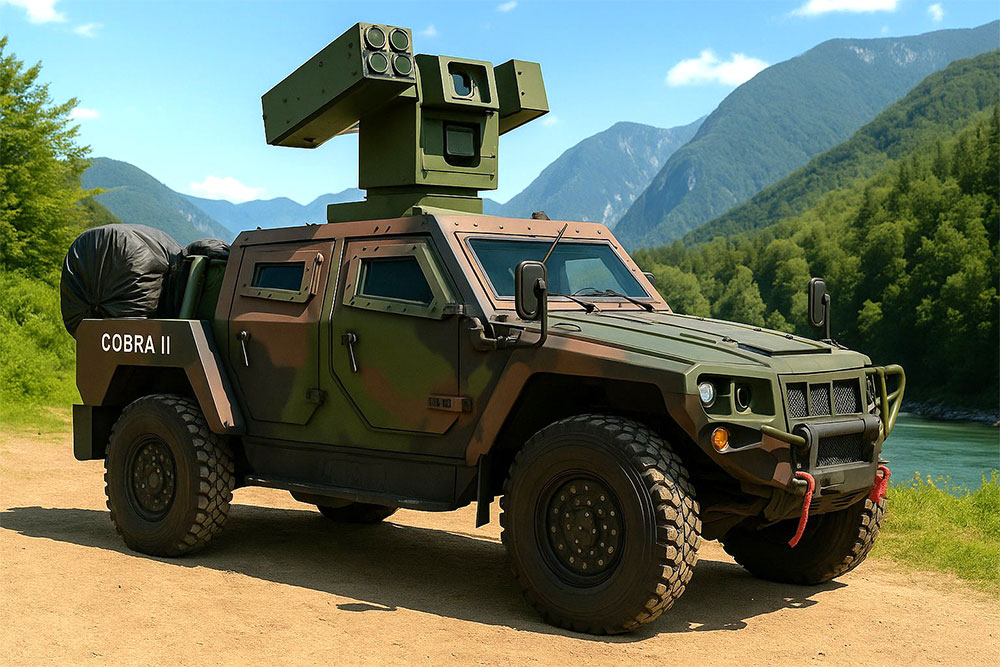
OTOKAR, Türkiye’s export leader in land vehicles with more than 33,000 military vehicles actively in service in over 40 countries and with more than 70 end-users, put on a real show at IDEF 2025, the International Defence Industry Fair held at the Istanbul Expo Center between July 22–27, by exhibiting 10 military vehicles in both wheeled and tracked types. At its booth OTOKAR displayed a wide product range including the COBRA II, ARMA, TULPAR, URAL and AKREP II armored vehicles with different turrets and mission kits. Under the contract signed with Romania, a single-order export deal for 1,059 vehicles, the largest single-package armored land vehicle export for Türkiye, OTOKAR introduced for the first time the COBRA II in the Armored Personnel Carrier configuration (open turret) produced at its Sakarya facilities, while also exhibiting in Türkiye for the first time a TULPAR variant fitted with Leonardo’s 120 mm HITFACT Mk II turret.
At IDEF 25, OTOKAR-origin ARMA 8x8 KORKUT Low Altitude Air Defence Vehicle, ARMA 6x6 PUHU Mobile V/UHF Electronic Support (ES) System Vehicle and ARMA 6x6 HPEM EJDERHA Anti-Drone High-Power Electromagnetic System vehicle were exhibited at ASELSAN’s booth.
Focusing on export markets in recent years, OTOKAR increased its total sales revenues in the first six months of 2025 to 19.8 billion TRY, up 13% compared with the same period last year. The company’s domestic sales revenues rose 29% to 7.8 billion TRY, while export sales revenues increased 5% to 12 billion TRY. Between January 1, 2025, and June 30, 2025, the share of OTOKAR’s export sales in total sales reached 61%. Military vehicle deliveries made a significant contribution to the increase in export sales revenues. The share of military vehicles in total sales, which was 11.9% in the same period of 2024, rose to around 20% in the first six months of 2025. In the second quarter of 2025, the military-vehicle share reached approximately 26%. With increases in both military and commercial vehicle deliveries and the positive effect of currency movements on export revenues, total sales revenues rose. As a result, between January 1, 2025, and June 30, 2025, the company’s gross profit increased 67% year-on-year to 4.4 billion TRY, and the gross margin was 22.1%. The 46% year-on-year increase in unit deliveries of military vehicles also contributed to gross profit. Between January 1, 2025, and June 30, 2025, a total of 3,430 vehicles were sold, compared with 2,247 vehicles in the same period of 2024. Thus, OTOKAR achieved a 53% increase in vehicle sales in the first half of 2025.
OTOKAR, the winner of the tender to meet the Romanian Ministry of Defence’s requirement for 4x4 Light Armored Tactical Vehicles, signed a contract on November 27, 2024, with Romtehnica (owned by the Romanian Ministry of Defence) worth approximately 4.26 billion RON excluding VAT (about 857 million EUR). Under the contract, which covers a total of 1,059 COBRA II 4x4 Tactical Wheeled Armored Vehicles (Wheeled Armored Vehicle) plus some integrated logistic support services and represents Türkiye’s largest single-package land platform export, production of the first 278 vehicles to be delivered in the first year is progressing rapidly at OTOKAR’s Sakarya, Arifiye facilities. The remaining vehicles will be produced locally in Romania at a new production facility where construction work is near completion and which is expected to begin serial production in the final quarter of 2025. Under the contract, the first batch of COBRA II vehicles produced at OTOKAR’s Sakarya Arifiye facilities were shipped at the beginning of June to Mediaș, Romania, where local integration work will take place. Sub-systems to be procured from local suppliers for these vehicles will be integrated at the Romanian production facility. The first vehicle deliveries to the Romanian Ministry of Defence are planned to begin in the final quarter of 2025 and to be completed in batches over five years. The contract covers production and delivery of ten different COBRA II Wheeled Armored Vehicle variants suitable for various missions: Personnel Carrier, Reconnaissance Vehicle, Personnel Carrier with Remote Weapon Station, Anti-Tank Vehicle, Command Vehicle, 120 mm Mortar Carrier, 81 mm Mortar Carrier, Engineering Vehicle, CBRN Reconnaissance Vehicle, and Ambulance.
For local production of the COBRA II Wheeled Armored Vehicle, OTOKAR signed a Joint Venture Agreement with one of Romania’s leading defence industry companies, Automecanica S.A. The Sarom Joint Venture company, established in Mediaș, Romania, is planned to carry out not only joint production of COBRA II armored vehicles but also engineering, marketing and after-sales support activities.
We held an exclusive interview with OTOKAR CEO İbrahim Aykut ÖZÜNER and OTOKAR Military Vehicles Business Development Director Tamer SIRCALI about IDEF 2025, the exhibited products and ongoing projects, principally the Romanian Ministry of Defence’s COBRA II Wheeled Armored Vehicle Project.
Defence Turkey: What can you tell us about OTOKAR’s participation at IDEF ’25 and your impressions of the fair?
Aykut ÖZÜNER: At the previous fair, this booth had three visitors from new technology companies, this year it has thirteen. So, there is a popular dynamism. This will continue, wherever in the world you are. As for our company, we exhibit almost our entire product range at the booth. You can see our ten products in categories such as 4x4, 6x6 and tracked vehicles, and with weapons like 25 mm, 120 mm and 105 mm. Events like this are also a good opportunity to make contact with countries with which we are constantly in touch. We talk about ongoing hot work or long-term projects. Right now, our top priority is Romania. We are even showcasing at the booth the vehicle we produced for Romania.
Defence Turkey: Could you evaluate for us the importance of the COBRA II Wheeled Armored Vehicle Project, the contract of which was signed on November 27, 2024, with the Romanian Ministry of Defence, and the project’s current status?
Aykut ÖZÜNER: This is a five-year project. We signed the contract last November. The period before that was also intense, but this year we have put the most effort into the Romania project. We have two important issues in the project. First, for the vehicle we displayed at the fair, getting the necessary approvals and producing 278 units in Türkiye and delivering them to Romania … that process is moving forward intensively. We have now passed 170 units in production. Acceptance processes will begin gradually within 1–2 months. The second is local production. At the beginning of the year, after we won this tender, we pressed the button to build the factory. Factory construction is also proceeding rapidly.
Defence Turkey: Will the factory belong to OTOKAR or to the Joint Venture company to be set up in Romania?
Aykut ÖZÜNER: We established a Joint Venture there. We have a Romanian partner. The company is called Sarom, and the factory is nearing completion. The whole investment will be almost finished in the last quarter; we will gradually start laser cutting, part production and then gradually hull assembly and testing. So, during the last three to four months of the year, while delivering the 278 units produced in Türkiye, we will also begin the first trial production runs next year for the vehicles we will produce and sell there.
Defence Turkey: Will the factory manufacture only vehicles for this project, or will it also produce other vehicles from OTOKAR’s product range?
Aykut ÖZÜNER: At the moment production will be entirely focused on this project i.e., COBRA II.
Defence Turkey: You mentioned that the ordered vehicles will be produced over five years. After five years, will the factory also serve as a maintenance and repair center for the delivered vehicles?
Aykut ÖZÜNER: We are entering Romania with a project, but there are many jobs we can pursue outside Romania in the next five years. We are delivering vehicles to Romania this year, but in the near term we have made sales to Europe within 2–3 years, for example Estonia. There have been serious projects we have followed over the past two to three years. Our primary aim in Romania is to deliver this project. The second is to respond to different needs; the continuation of this project or other needs Romania may have. Through this project we gain the capability to manufacture within the European Union. Thus, the projects we used to pursue, we will now pursue as OTOKAR with a factory in Romania.
The European Commission’s “Security Action for Europe (SAFE)” fund of €150 billion is available directly only to EU member states; others can participate only as subcontractors (in defence and security projects at least 65% of the project value must be procured from EU countries, with up to 35% from non-EU sources). There are many manufacturers in Europe and competition exists; but not every European company has a full product range. Therefore, there may be opportunities for us. But most importantly, as a company manufacturing in Romania we will be able to follow SAFE projects. Our goal is to fulfil our Romania project obligations and also pursue Romania and EU projects as candidates.
I would like to add one more point. In Romania we have both a joint company and our own company. The factory will start gaining experience in part production during the summer months. We are building a team there. In the future we want to use Romania for engineering and to increase our engineering footprint there.
Defence Turkey: Did the customer (Romanian Ministry of Defence) impose a local content requirement for the COBRA II Wheeled Armored Vehicle vehicles to be supplied?
Tamer SIRCALI: Yes, they have their own offset requirements similar to ours. As you know, our contractual obligation is 60%, but in Romania there is an 80% offset obligation. There are differences between us, but the basic logic is almost the same. Local production must be carried out. The army must gain maintenance capability. There is an intensive training program. In parallel with what Mr. Aykut mentioned, there are engineering works and local procurement topics. We have an offset obligation that is somewhat larger than what we are used to in Türkiye, including providing capabilities to the local industry, training organizations and test bodies there.
Defence Turkey: Does the contract include a clause for Integrated Logistic Support (ILS) such as a 3-year or 5-year period?
Tamer SIRCALI: As in every country, our standard warranty applies. But within five years, with training programs, spare parts and special tooling and support equipment, a capability will be created there so they can independently support these 1,059 vehicles. We will provide the first vehicles under warranty for the next two years, but the aim is that after two years, as vehicles gradually exit warranty, by increasing their independent capabilities in Romania, by the end of five years they will be able to support the 1,059-vehicle fleet on their own. They already have logistic maintenance concepts with users, units and then their own military maintenance centers. In those centers they will maintain the vehicles similarly to how we do. Our factory there will also provide Factory Level Maintenance and will be a flexible, capable facility able to support potential projects in Romania and across the European Union.
Defence Turkey: Is the COBRA II configuration you supplied to Romania the same as standard COBRA II vehicles in terms of ballistic and mine protection levels and technical specifications?
Tamer SIRCALI: Yes, fundamentally the same. The basic configuration as a base vehicle and the protection level are the same. Of course, the general layout has been adapted and modified to the needs of the end user. But from an engineering point of view, it’s the same vehicle. You can think of it as an adapted version of a proven vehicle.
Defence Turkey: What is the current status of the 8x8 RABDAN Infantry Fighting Vehicle (IFV) project in the United Arab Emirates? The initial agreement covered delivery of 400 RABDAN IFVs fitted with a 100 mm gun (BMP-3 turret). There were also talks for a second phase, covering an additional 300 vehicles in different configurations. Has there been any development on the second RABDAN order?
Tamer SIRCALI: We completed delivery of 400 vehicles. They have continuing needs in different configurations and variants. We continue discussions both for that configuration and for different configurations beyond the 400 RABDAN IFV (Infantry Fighting Vehicle). We are focusing more on vehicles tailored to special functions and mission profiles rather than strictly IFVs.
Defence Turkey: The UAE at one time planned MRAP procurements and OTOKAR had demonstrated KAYA I and KAYA II MRAP solutions.
Tamer SIRCALI: They did not procure MRAPs because, looking at their own inventory, they have sufficient MRAP vehicles. However, there are various unresolved different 4x4 projects concerning mine-resistant vehicles. Nothing has been finalized yet.
Defence Turkey: You have received orders for ARMA I/II 6x6 and 8x8 Wheeled Armored Vehicles from African and Gulf countries and from Estonia. Are there any ongoing tenders you are currently following?
Tamer SIRCALI: We have discussions with several countries in the 8x8 and 6x6 segments. European countries’ need for heavy turrets on combat vehicles has increased. For Africa it’s a tough configuration, an 8x8 vehicle with a heavy turret becomes financially challenging. Kazakhstan is also frequently mentioned in the public domain.
Defence Turkey: At a recent parade their formation included OTOKAR vehicles a few months ago. Has the Kazakhstan tender been officially concluded?
Aykut ÖZÜNER: Our products have passed validation tests there. There isn’t an issued tender yet; we are following it. Our vehicles have been included in the process; if a concrete step is taken, we will likely be a candidate.
Defence Turkey: Azerbaijan has used COBRA I/II Wheeled Armored Vehicles for many years and are quite satisfied. Are there any plans for procurement of 6x6 or 8x8 Wheeled Armored Vehicles?
Tamer SIRCALI: COBRA II and URAL have become somewhat standard in Azerbaijan. Regular deliveries are being made. 6x6 and 8x8 come up from time to time. It’s hard to predict the near term, but generally 4x4 is more predominant.
Defence Turkey: ASSAN is exhibiting a hybrid Powerpack with 1,000 BG capacity. Are you working jointly with other local companies on hybrid or fully electric systems for TULPAR or ARMA I/II Wheeled Armored Vehicles?
Tamer SIRCALI: As you know, we previously developed the electric AKREP and it performed very well. Our aim was both to turn it into a technology demonstrator and to gain experience in that area. As far as I know there is no electric armored vehicle in any army inventory worldwide at that weight and power. The state of technology has not yet reached the point where the energy requirement, in other words range, can be met by batteries. From what we see, technology needs to advance a bit more before we can integrate a reasonably sized battery pack into the vehicle and still achieve the desired performance off-road. A hybrid solution can bridge the gap between electric and current diesel engines. In such a hybrid the vehicle is essentially electric, but the diesel engine also generates electricity, acting like a generator to charge the batteries. That technology exists and we are working on it. We are developing a hybrid version of the AKREP, but there are few hybrid vehicles in world inventories. The primary capability of a hybrid vehicle is essentially silent operation. However, silent operation is not suitable for every vehicle type. For example, an AKREP or COBRA configuration which focuses on electronic payloads might be more suitable for silent operations concept