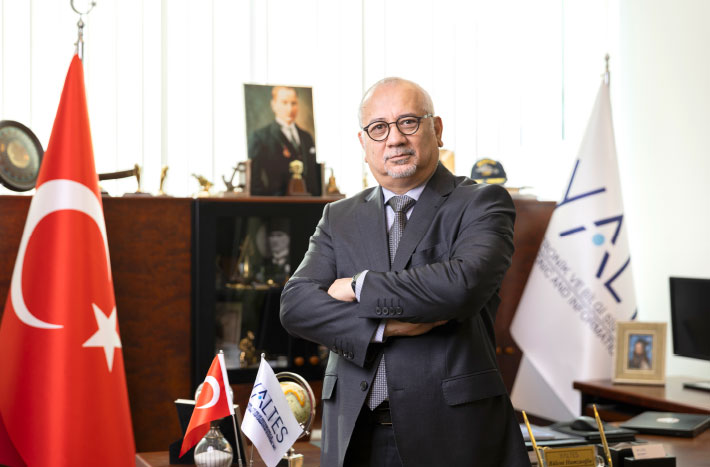
YALTES GM Bülent HAMZAOĞLU: “Our Biggest Goal for 2023 is to Sign the EPKİS/IPMS Contracts for the I-Class Frigates”
Defence Turkey: Can we start our interview by getting an assessment of YALTES's financial performance and turnover for the year 2022 from the perspective of the company? How did YALTES conclude 2022? What was the contribution of YALTES BV, the company established in the Netherlands, to the turnover?
Bülent HAMZAOĞLU: As YALTES, 2022 was a very good year for us in terms of sales and the delivery of commitments. Especially in 2020, at the beginning of the pandemic, we signed several international projects, such as the Pakistan projects and the equipment we provided for the UK frigate, and successfully delivered them quickly, which led to a significant increase in our revenue.
Compared to 2020, our revenue increased by around 50%. We approached the level of around €13 million in terms of revenue. Therefore, our revenue, which was around €7-8 million in 2020, increased significantly in 2022. Along with this, we have always placed importance on delivering on time and meeting the expectations of our customers. In that regard, 2022 was a very good year.
However, due to the delayed start dates of some projects, both domestically and internationally, which were beyond our control, it was a low year in terms of order intake. During this period, we were only able to reach approximately 60-65% of our normal order intake.
As you know, we established YALTES BV in the Netherlands, solely to provide spare parts and services. Its revenue is not combined with our company; it is evaluated separately. However, we cannot say that we received a significant number of orders in 2022. Two reasons come into play here. Firstly, in 2022, we went through an administrative process related to the transfer of the Foreign Procurement Organization, which was previously within the Turkish Naval Forces Command, to the Ministry of National Defence (MoND). Secondly, due to budget constraints, the Naval Forces did not place the orders they used to for spare parts. Only orders for urgently needed materials were received. However, we established YALTES BV, not with the aim of generating profitability or reaching a certain revenue but rather to increase customer satisfaction. We wanted to provide faster responses to the Naval Forces and supply the materials they needed more easily and directly. Previously, these were provided by various intermediary companies. We established it to prevent that. So, I cannot say that we had significant profitability expectations for both us and our Group there. Our main goal there was to increase customer support and customer satisfaction.
In summary, 2022 met our expectations in terms of sales, deliveries, and profitability they brought us, but the order intake fell slightly below our target.
Defence Turkey: How many personnel works at YALTES BV?
Bülent HAMZAOĞLU: At YALTES BV, there is only a team that coordinates the Thales Group companies there. They work part-time, but all the operational activities are still managed through our main YALTES here.
Defence Turkey: Is YALTES BV affiliated with you? Is there any connection with Thales there?
Bülent HAMZAOĞLU: Indeed, the company is established under our name, and our colleagues within YALTES Türkiye are responsible for overseeing the operations there. The critical aspect here is to monitor the tenders issued by the Turkish Naval Forces, the Ministry of National Defence, and the Coast Guard Command for spare parts. We provide appropriate proposals, ensure coordination, and then coordinate with the relevant Thales company to facilitate the provision of those spare parts. Because we didn't establish that company solely for Thales Netherlands spare parts; we established it to support various Thales systems, including Thales Germany, Thales UK, Long Horizon in France, MELTEM, GENESIS, and existing Thales systems used by the Turkish Naval Forces. Essentially, we aim to support systems provided by all four countries: France, the Netherlands, the UK, and Germany. However, all operations are conducted through YALTES Türkiye.
Defence Turkey: What products do you have in service with the Coast Guard Command?
Bülent HAMZAOĞLU: We are involved in activities related to the supply of spare parts and support for the four Variant Radars installed on the Search and Rescue Ships. We ensure the procurement of spare parts and provide ongoing support for these radar systems.
Defence Turkey: YALTES was established as a Turkish company with a foreign partnership (Thales Netherlands/TNL) on November 22, 2002 and celebrated its 20th anniversary last November. Can you briefly summarize for our readers the last 20 years of YALTES in figures? Over time, YALTES has transformed from a company that initially aimed to produce off-the-shelf products with outsourced designs to one that now designs and manufactures its original products and solutions. These products and solutions are utilized not only in domestic projects but also in international projects. Furthermore, YALTES has developed its own technologies, further establishing itself as a capable firm in the industry. Did YALTES achieve the initial goals set in the past 20 years? Do you think there could have been improvements in a certain field, or could you have introduced new products or solutions in a certain area?
Bülent HAMZAOĞLU: First of all, celebrating the 20th anniversary is a proud milestone for the young defence industry in Türkiye. Only a few companies manage to sustain their growth or maintain their position for 20 years. Defence industry companies generally fall into two groups. The first group consists of companies established for a specific project that gradually disappear after the project is completed. The second group consists of companies that continue their journey with stability and establish themselves in the field. YALTES aimed to be part of the second group. When we were initially established, we started with specific projects and products. These primarily included hardware and software components of open combat management systems, specifically the Long Horizon Integrated Maritime Surveillance System (IMSS) and GENESİS Projects. However, with the emergence of the MİLGEM project parallel to the progress made by the Turkish Naval Forces and the defence industry, we expanded our scope and ventured into another area. This area was Integrated Platform Management System, which became another key product activity for YALTES. Our biggest contribution to this expansion is owed to the MİLGEM Project, just like many other companies in the defence industry. While we faced challenges and even incurred losses in the early days, we patiently supported the project and reached a point where we now have 10 MİLGEM platforms, including 8 Corvettes and 2 OPVs. Additionally, with the of TCG UFUK (A-591 Test and Training Ship), as well as the MİLGEM orders from Ukraine and Pakistan, the total number of MİLGEM platforms has reached 18-19. In essence, we became the companies that steadfastly supported the project from its inception to its intended goal.
Initially, YALTES aimed to have a greater presence in the Combat Management System domain, but the circumstances, both domestically and internationally, as well as the positions of our parent company Thales, required us to position ourselves as a secondary support provider for HAVELSAN in Türkiye and Thales' own systems abroad. We had confidence in our capabilities and could have developed more unique products in this field. However, we evaluated that competing in this domain would not be meaningful, as this was the case not only for us but even for ASELSAN, which had to reach a certain point and halt its progress. Therefore, our current focus is to strengthen our position by maintaining the technological level and leading the way in new solutions for Combat Management System hardware and software components. We also engage in software development activities, interface development, and application software development related to these systems, both for HAVELSAN and Thales, albeit to a limited extent. However, where we truly excelled and achieved a significant position is with our own original product, the Integrated Platform Control and Monitoring Systems. Today, we are in an excellent position as the only company in Türkiye, especially for naval vessels, capable of providing an entire range of elements and components necessary for the control of a platform, not limited to alarm and monitoring functions. In addition to alarm and monitoring, we also provide solutions for combat damage control systems, training systems, ship stability systems, structural monitoring systems, control of controlled valves on different types of vessels, cargo and ballast control on tanker and TCG Derya DİMDEG-type vessels (Replenishment at Sea & Combat Support Ship), and all other elements related to platform control. We have become a company that can supply its own original products and provide continuous support, sometimes even surpassing our customers' expectations. The best indicator of this is the operational use of our systems on over 50 platforms in six different countries. This achievement is something that even many reputable companies worldwide in this field find challenging to accomplish. This year, as I mentioned earlier, we will continue to provide our systems for the 6th, 7th, and 8th ships of the İ-Class, demonstrating additional capabilities in that project. Thus, we take pride in the competence we have achieved in Combat Management Systems and our original solution, the Integrated Platform Management Systems, over these 20 years.
Combat Management Systems have not been limited to surface vessels alone. Since 2018, through contracts we have signed, we have also established a significant presence in submarines. Furthermore, with the addition of the GÜR-Class Submarine Modernization Project at the beginning of this year, we have begun supplying Combat Management System hardware for GÜR-Class submarines following AY and PREVEZE. We have also adapted this system to unmanned marine vehicles with EPKİS/IPMS (Integrated Platform Management System), in addition to surface platforms and manned vehicles. Our prototypes are currently in operation, and we have signed our first official contract. Therefore, we continue our activities centered around these two main domains.
Defence Turkey: Can we get a brief overview of the prominent activities and deliveries in 2022? Which projects were delivered? Which projects received new work packages? Can you briefly summarize the key developments of 2022 for our readers?
Bülent HAMZAOĞLU: In particular, the deliveries of the Pakistan projects that we signed in 2020, the Ukraine project that we signed in 2021, the İ-Class, and, and the HİSAR-Class Offshore Patrol Vessels (OPV) we signed in 2021, have started. Especially due to the project structure in the Pakistan MİLGEM (PN MİLGEM) Project, we had to deliver at each milestone, meaning the ships in Türkiye (1 and 3) and the ships in Pakistan (2 and 4) together. Since we carried out these productions in a limited area at Technopark, we had to complete the productions rapidly and deliver them in a complementary manner. Within this scope, we delivered both the combat system equipment and the Integrated Platform Control System equipment of the 1st and 3rd ships of the Pakistan corvette, as well as the 1st ship of Ukraine, followed by the Offshore Patrol Ship and the ongoing deliveries of the I-Class, we delivered the remaining parts. In addition, for the Type 31 Project, we signed with Thales for the United Kingdom. After making design and configuration changes to the Combat Management System (CMS) consoles, we continued their production in 2 sets. We delivered the first set last year and the second set at the beginning of this year. At the same time, these consoles were requalified for the United Kingdom. The qualifications were also completed with tests in the Netherlands. We made significant progress there as well. We also completed the deliveries of our standard products for the second vessel in the PREVEZE Project, TCG SAKARYA. We had tasks related to their commissioning in the LHD Project, the deliveries of which we had completed much earlier. That was a very important stage for us. We also completed the EPKİS/IPMS and CMS deliveries for DİMDEG. So, we have had a hectic year in terms of deliveries.
Defence Turkey: What can you tell us about your expectations and targets for 2023, as well as your planned domestic and international deliveries for 2023?
Bülent HAMZAOĞLU: Of course, our biggest goal for 2023 is to sign the EPKİS/IPMS contracts for the İ-Class Frigates. Our contract negotiations continue.
Defence Turkey: What else will be delivered in 2023? The construction of Ukraine's second ship had started.
Bülent HAMZAOĞLU: We have also signed the contract for Ukraine's second ship. These have already come one after the other at the beginning of 2023. First, Ukraine's second ship, then AKYA National Heavyweight Torpedo integration to GÜR Class Submarines. This is a highly important development because the most significant benefit of the modernization we have carried out is that our national heavyweight torpedoes can now be launched without relying on foreign countries. Our goal is to enable the firing of these torpedoes both with the MÜREN Combat Management System and the existing old ATLAS product Combat Management System using the cabinet we have developed.
Defence Turkey: So, there was a problem due to the embargo imposed by the German government in the Mid-Life Modernization of Pakistan Agosta 90B submarines. Therefore, the option of transitioning to a domestic combat management system for the last submarine was considered. Has this situation been clarified?
Bülent HAMZAOĞLU: Yes, that issue exists as well. HAVELSAN and STM have also been involved in this matter. We learned that the system applied to the first and second ships could not be applied to the 3rd Agosta 90B Submarine for some reason. There are two requirements there. The first is the equipment, and the second is the Submarine Combat Management System. Some capabilities were obtained from ATLAS by HAVELSAN. TÜBİTAK will likely provide those parts, and YALTES will provide the equipment. We are being asked for proposals and discussing them in technical meetings. However, this issue has not been fully clarified yet. However, it is good that systems without dependence on foreign countries have been developed in Turkey. In this regard, TÜBİTAK, HAVELSAN, METEKSAN, and YALTES have played a role that completes all links in the chain. The Combat Management System was completed with all its hardware, software, platform data distribution system, sonar interfaces, and torpedo interfaces and became ready. Of course, this situation will provide significant benefits for both the midget submarine projects that are the goal of various shipyards and STM, as well as MİLDEN (National Submarine Project). When we started MİLGEM, we were not so fortunate. The project was limited; no defense industry companies, ecosystems, and solutions were available. But when we started MİLDEN, at least we could benefit from advanced defense industry companies, technologies, and solutions in these areas. If we didn't have the capability to produce anti-surface warfare system equipment, we wouldn't have been able to make progress in MÜREN, AY, PREVEZE, and GÜR Class submarines. We have consistently improved upon our achievements. There is also a German project abroad, the F-126 Frigate Project, currently led by Thales. We expect a significant share of work in the F-126 Project because the Germans do not want off-the-shelf products from any company. They always want their own unique equipment and software on their ships. In this context, the design process of a new type of operator console called MOC High-end is currently ongoing. They are developing a new concept called Above Water Warfare System (AWWS). They are developing a concept that combines anti-surface and anti-air capabilities. Serious software and system engineering are being conducted there. We are also conducting serious engineering on our side regarding this equipment. The most critical aspect is that each equipment is cyber-secure, has TEMPEST capability and will be tested individually in Germany, not just one sample. We are talking about 200-300 pieces of equipment. Whatever we produce here, those products will go there and be tested.
Defence Turkey: What are the differences between this new operator console and the existing ones?
Bülent HAMZAOĞLU: Its most significant capability is the feature we call TEMPEST. The TEMPEST feature has been defined for the units we refer to as LRU (Line Replaceable Units). For example, the screen has its own unique TEMPEST feature. This means that the power and data are planned so that they do not interfere with each other. Our productions are also designed in the same manner.
Defence Turkey: What are their requirements in terms of material and cooling system?
Bülent HAMZAOĞLU: The material and cooling system will be similar again. There is no significant change in that regard.
Defence Turkey: Was there a choice between aluminum and composite materials for the console?
Bülent HAMZAOĞLU: We are still using aluminum and a type of composite called Corian. I don't think we will use any other material at this stage, but the consoles will be larger. The new consoles will not have auxiliary units placed between the consoles we currently use. The equipment in those auxiliary units will be integrated into the console. Moreover, in this submarine, following the criteria and test requirements of the user, we have switched from the 'rugged' MIL-STD-810 durability rating to the 'extremely rugged' MIL-STD-901 standard, including the sonar system equipment we developed with METEKSAN. In other words, we are developing products with very high levels of durability. When we mention TEMPEST and cyber security, electromagnetic shielding also becomes higher. Of course, while doing all this, we also aim to use the knowledge we have acquired in future domestic projects such as the TF-2000 and Turkish Type Fast Attack Craft projects, including the next-generation consoles.
We are also making export-oriented contracts with HAVELSAN. We are currently providing support for projects in Indonesia and two different projects. They are also pursuing several projects. If they are successful, we will collaborate. Our goal here is to have similar products so that there won't be any differences in logistics support in the future. We also signed DEARSAN's Nigeria Projects last year. A significant portion of our last year's order intake is related to those projects.
Defence Turkey: Nigeria is acquiring both offshore patrol vessels and carrying out a mid-life upgrade for flagship vessel NNS Aradu (F-89, MEKO 360H1). They will also buy a TUZLA-Class New-Type Patrol Boat.
Bülent HAMZAOĞLU: Yes, indeed. We had already provided the platform control systems and combat system equipment for the Tuzla-Class ship. That ship was ready. After that, we signed contracts with HAVELSAN for the combat equipment of two high-endurance Offshore Patrol Vessels (OPVs) and DEARSAN for the platform systems. They are currently being produced. Due to YALTES' significant experience with the MEKO-Class, we have been working with DEARSAN from the beginning for the NNS Aradu project as well.
Defence Turkey: It is said that the existing Combat Management System will be replaced with GENESİS ADVENT.
Bülent HAMZAOĞLU: Now, there's a situation there. We were mostly involved in surveying the platform systems and other systems related to the ship's platforms. Our expert colleagues went to Nigeria and conducted a survey of that ship. We prepared a suitable proposal for it. We are currently involved in the 3-D search radar integration, ESSM modernization, and the Mid-Life Upgrade (MLU) of BARBAROS. We have expertise in that area as well. We have also developed a solution for the platform management system. As far as I know, following the modernization in Turkey, the ship is planned to be a training vessel. Since it will be a training vessel, we currently don't have much information about the type of Combat Management System that will be installed or the amount of equipment that will be used. But the project has a tight schedule. The project has a timeline of 20 months. Within 20 months, the ship will be brought here, dismantled, and then new systems will be installed. We have confidence in ourselves because our systems have become standardized. But, of course, other things must be done on the ship. The ship will first be taken into the dock so that the condition of the hull can be seen and examined. I also worked on MEKO vessels before. So, working on the hull of MEKO ships can take a long time. Additionally, the ship is old, but the good thing is that the modernization will be done in Turkey. I believe SEFT will make the design changes. Hopefully, it will be a good reference. Although there may be some delays in the schedule, the Turkish Navy has requested to upgrade the platform systems of our MEKO vessels, the BARBAROS Class Frigates. We examined the ship and provided a proposal. If feasible, we will implement it on the first ship, TCG ORUÇREİS; if not, we will continue with the other ships.
Defence Turkey: Will this platform systems modernization be carried out after the ongoing Mid-Life Upgrade?
Bülent HAMZAOĞLU: After the MLU. We planned to do it along with the mid-life upgrade, but the ships have obsolescence issues. It's not a major crisis, but systems that are 25-30 years old need to be renewed. We also have alternative solutions. There are ongoing efforts in Portugal to modernize the Vasco De Gama Class Frigates (MEKO 200PN). Thales and EDISOFT are also involved there, and we will collaborate with them. If there are opportunities regarding Combat Management Systems and platform systems, we will implement them.
Defence Turkey: Do the figures for the past 6 months correspond to your expectations?
Bülent HAMZAOĞLU: 2023 is similar to 2022 in the sense that we have important deliveries to make. It is crucial for us to deliver these orders on time and with the desired quality. Those projects are challenging us. This year, we decided to keep more detailed records on a product basis. From the beginning of the year until the end of the fifth month, we have provided 150 systems, consoles, and cabinets. That's a significant number. We are working day and night. Of course, our sales are high. Our goal is to exceed € 15 million this year. We believe we will push for €16-17 million. Last year, we stayed around €12-13 million. We are continuously improving year by year. I'm not saying this in terms of the Turkish Lira; it reaches around 500 million, but we don't know what the exchange rate will be at the end of the year. We have profitability. We don't have significant losses in terms of profitability. The costs of our sales have remained within the levels we aimed for. As for orders, we reached US$8 million in the first half of the year. Since the İ-Class contract has not yet been signed, we reached around US$8-8.5 million. Considering the İ-Class and the projects we will receive from abroad until the end of the year, even though we keep some projects as backup scenarios, we estimate that we will receive orders of around €20 million. This means double the standard turnover and order intake of YALTES based on its history, which is usually around €10-12 million. In 2020 alone, we had an order intake of €18 million thanks to the Pakistan projects. We anticipate that we will push for € 21-22 million this year. Of course, the I-Class will bring the most significant share of that.
Defence Turkey: Can we get information about the share of exports in YALTES's turnover, as you mentioned earlier, about the ongoing main export activities of YALTES?
Bülent HAMZAOĞLU: Regarding the share of exports in our turnover, I can say that since we can export through two channels and now the defense industry also has export projects, we have always set our target as 50% local and 50% export so that exports can balance us when local projects slow down and vice versa, especially with large projects like the Pakistan Project, the Ukraine Project from Turkish shipyards, as well as projects with HAVELSAN in Indonesia and DEARSAN in Nigeria, plus the British-German project and various other export projects. Currently, we have many ongoing projects with Thales as well. We can say that we have achieved a 50-50 ratio when we balance all these projects.
Defence Turkey: Can you enlighten our readers about YALTES's perspective on R&D and the resources allocated from its turnover for R&D?
Bülent HAMZAOĞLU: We have set a target to allocate 3% of our turnover to research and development (R&D) activities. This demonstrates our commitment to investing in innovation and continuously improving our products and services. By dedicating a significant portion of our resources to R&D, we aim to stay at the forefront of technological advancements and maintain a competitive edge in the market.
Defence Turkey: For example, in the German F-126 Frigate Project, is there any R&D support for the new consoles you mentioned, or are you doing it with your own resources?
Bülent HAMZAOĞLU: We initially worked on that project using our own resources up to a certain stage. Additionally, for HAVELSAN's ongoing projects in Indonesia and DEARSAN's project in Nigeria, we utilized our R&D budget. However, there were both competitive factors and budget constraints for HAVELSAN. We proposed improving the consoles and continuing with a new generation. We updated our video system and made enhancements to the basic software of the consoles. We evaluated the feedback regarding the ergonomics of the consoles. Because we rapidly developed and produced these consoles consecutively for LHD, BARBAROS, Pakistan, with over 100 new-generation consoles. We particularly discussed with HAVELSAN which customer feedback was significant and which improvements would be beneficial. We then made developments in those areas. The new-generation console will have a second version or be named Block 2. We definitely conduct R&D for EPKİS/IPMS (Integrated Platform Control and Monitoring System) because we use COTS (Commercial Off-The-Shelf) materials there, and we constantly need improvements. We need to add additional features. For example, a Structural Monitoring System was requested in DİMDEG (Replenishment at Sea & Combat Support Ship). We developed it for the first time, but we will definitely use it on our frigates in the future because as the ship's size increases, it is more affected by sea movements. The Structural Monitoring System has two benefits. Firstly, in a severe situation where the ship is subjected to high loads, the commanding officer or the watch officer can adjust the maneuvers by detecting them. Secondly, it measures and records the stresses caused by the loads that occur, which helps in assessing the fatigue in the ship's hull. This contributes to the maintenance of the ship. Of course, this is particularly important for ships over 100 meters long. When we analyze ships with lengths of 120, 130, 150, and 200 meters, we can visually observe the twisted, collapsing, and stretching of the ship's hull, thus revealing weak points. Metal fatigue occurs when a load is constantly applied. As you know, when the ship enters the shipyard, hull surveys are conducted. When these weak points become apparent, and the results are shared with the shipyards, they directly address those areas during the surveys. As a result, the occurrence of issues such as buckling, collapsing, and corrosion in the future decreases.
Defence Turkey: Is this the first time you are using it in DİMDEG (Replenishment at Sea & Combat Support Ship)?
Bülent HAMZAOĞLU: We first used the Structural Monitoring System in DİMDEG. In fact, the Turkish Naval Forces also wanted to use it in the GABYA Class Frigates. This is because the GABYA Class Frigates started experiencing hull problems due to their age. However, if you don't install this system at the beginning of the ship's life cycle, you don't have the opportunity to collect data. You can see the real-time condition, but you cannot make extensive evaluations of the past or future. However, I am confident that it will be used in the TF-2000. We worked with a good company for that as well. Because there are two important aspects here. One is the sensors; the system has fiber optic sensors. The other is the analysis of the collected data. Then the results are shared and displayed through the EPKİS/IPMS, and we make backups. These are already part of our work. There are also algorithms that are derived from systems used in viaducts and suspension bridges. We worked with a Norwegian company and acquired this know-how from them. Some companies in Türkiye said they could do it, but we wanted to work with a more experienced company with a background in this field. These systems are primarily used in Norway to measure the structural integrity of bridges in fjords under extreme conditions and storms, and maintenance procedures are determined based on this data. It will be implemented in DİMDEG. After that, based on feedback from the Naval Forces, we can implement it on other ships as well. We also developed a cargo ballast system. When the cargo decreases on the ship, the hull needs to take in ballast, and this process must be automated. In the past, fuel tankers used to take ballast in the same fuel tank because the fuel would always remain on top due to density differences. However, in modern systems, fuel must be purified very well, so ballast and fuel cannot be taken in the same tank. In that case, you need to provide ballast by taking seawater to different tanks through an algorithm that compensates for the amount of fuel lost. There is also a significant density difference. The density of fuel is 0.80, while the density of seawater is 1.25-1.30. Due to the density difference, for example, when 100 tons of fuel is lost, you need to take in 87 tons of seawater. The software we developed calculates stability and determines where and at what rate the ballast should be taken, considering these factors. These are very beneficial for us. They also provide convenience to the operator. In the past, these calculations were done manually. We conduct R&D partially through projects and partially through our own resources. It also motivates our R&D engineers because they can invent something on their own. When you work within the scope of a project, you are limited by project constraints, budgets, and the customer. But on the R&D side, you are free. That's why we support it.
Defence Turkey: You mentioned improvements in operator consoles earlier. Is there anything else you would like to add?
Bülent HAMZAOĞLU: Indeed, in today's world, the number of electronic components is decreasing while their quality is increasing. Consoles have now become simplified, consisting of input devices and a single display for data entry. We are also following this trend in our designs.
Defence Turkey: Previously, there were discussions about replacing the Thales product AMASCOS Mission System and the consoles used in the Coast Guard and Naval Aviation Patrol Aircraft. Has there been any progress in that regard?
Bülent HAMZAOĞLU: We have conducted several studies on that topic, but we couldn't make much progress due to certification requirements. We have had discussions with our colleagues multiple times. The idea of using composites emerged, but ultimately, we couldn't actively pursue it. Additionally, we are also working on utilizing lighter materials and different products for ships, similar to aircraft. Within this scope, we have developed a concept. We aim to create lighter-weight, easily accessible, and foldable consoles. We want to use different materials, possibly having a metal skeleton covered with composites. However, the main point is that operator consoles are transitioning from complex products with hundreds of electronic units to a more aesthetic design with high-quality screens for data exchange. Computers have become much smaller, and processor speeds have increased. We are also enhancing the durability of the consoles.
Defence Turkey: Which is preferred in console production regarding TEMPEST and cyber security requirements, composite or aluminum?
Bülent HAMZAOĞLU: There are solutions for all of these. Of course, a metallic structure is always preferred because you are creating a Faraday cage. However, in composite materials, you also have the ability to create various layers with a metallic structure and form a Faraday cage. As you know, composites are made up of fibers and layers. To make a composite, you need to work with molds. There should be multiple units. Of course, aluminum or metal also have their own properties. This also depends on customer preference, price, and budget.
Defence Turkey: You developed and delivered PİKET 3000 EPKİS/IPMS. Afterward, PİKET 4000 was developed. What is the difference between them, and is PİKET 4000 operational now?
Bülent HAMZAOĞLU: The difference between them is that PİKET 4000 is more of an integrated bridge system, where radars and navigational aids used on bridges are brought together. In essence, both of them work on the same underlying architecture. In this context, we cannot provide 100% of our own product for each project. Because ASELSAN or HAVELSAN is involved in the projects and there are some shared responsibilities with other companies. However, for example, we are almost entirely responsible for console production in Unmanned Surface Vehicles. So, we provide PİKET solutions that incorporate both the 3000 and 4000 systems. This is also the current demand from abroad. For instance, in the projects we work on for Portugal, they want the bridge system to be as integrated as possible. Communication systems are becoming increasingly integrable because they have switched to an IP-based architecture. But, as I mentioned, since there are different companies involved in sharing responsibilities, I cannot say we do 100% of it ourselves, nor can I say we couldn't do it. As an example, we have developed a product where we achieved mechanical and electrical integration. So we can use them through the same console and stations. But if you ask whether there can be further functional integration, the answer is yes, there still can be.
Defence Turkey: PİKET 3000 EPKİS/IPMS, which is present on 13 MİLGEM platforms, including the HİSAR-class Offshore Patrol Vessels and Ukraine MİLGEM Corvettes, was also installed on the KILIÇ-class Fast Attack Craft TCG KILIÇ at the beginning of 2020. Did you receive any new orders for EPKİS/IPMS for the other KILIÇ-class Fast Attack Crafts?
Bülent HAMZAOĞLU: The order for that system hasn't come in yet, but both the users and the shipyard have embraced it. We have received feedback reports accordingly. We update the system as needed. Of course, this is not solely about us updating our system. There was another issue there as well. There were problems with the generators; some were obsolete. Therefore, in TCG KILIÇ FACs, we first replaced the diesel generators, then the power management system. Finally, we updated the platform system. At this stage, the follow-up ships are actually waiting for the generator replacement. We will continue with the same solution if there is a generator replacement. Based on their deficiencies and needs, we have created a similar solution for our MEKO-Class/BARBAROS-Class ships. The biggest advantage here is that we prepare them ready-made in the factory. We aim to complete the installation process onboard the ship within a very short time. Especially for KILIÇ-Class ships, they limited it to 3 months. They don't want to keep the ships in the shipyard for more than 3 months. Of course, it is not possible for frigates. We targeted 6 months for that. Within 6 months, during the ship's overhaul, we aimed to make these modifications comfortably. We continue with those solutions. I am sure these will be done, but it also depends on maintenance, repair, and sustainment budget constraints. Of course, like any company, we also aim to make a profit, but we do it not only for the continuity of the business but also to increase our footprint and to have similar systems on all Navy ships. We are ready to continue as long as it is needed.
Defence Turkey: As YALTES, what kind of solutions can you offer for the USV/Armed USV platforms to be produced in Türkiye? Within this scope, you were working on a Platform Management System based on EPKİS/IPMS 3000 for DEARSAN Shipyard's SALVO Armed USV. Can we get information about the current status of this project and the feedback received during the sea trials? Are you also having discussions with other USV/Armed USV manufacturers for similar requirements?
Bülent HAMZAOĞLU: Together with DEARSAN, we have established almost the entire network in SALVO, except for the external communication system, to enable the communication of both platform systems and other systems. We ensured communication between all the systems on the platform, not just the main engine, propeller, and rudder, but also all the other systems that would be present on the ship. Because in most other unmanned surface vehicles, the remote control is limited to the main propulsion system, which is the ship's propeller and engine. But we believe that one day, especially when a serious mission system is placed on top of these, auxiliary systems will be needed for that mission system. Hydraulic systems may be required; pressurized air may be needed to launch a torpedo, and there may be a need for a fire detection system or launchers to deploy sonar. We always say there should be a platform management system for USVs like a small ship. Later on, we will definitely use USVs in coordination with the mother ships, even from a coastal control station. In addition, we consider that these unmanned vessels will be deployed on the mother ships, at least for logistical purposes. In such a case, if our system is already on the mother ship, we will directly integrate the two and control the USV from anywhere on the ship. Currently, USVs can be controlled from the bridge or CIC for tactical purposes. However, in case of a technical issue or an alarm, they need to be manually handled by the crew. Just like how everyone has a role when such a situation occurs on the ship, it also needs to be planned for USVs. For example, HAVELSAN says they will do everything with ADVENT. We also say that since we are already establishing the data network of ADVENT on the MİLGEM ships, let's integrate the Platform Control System into both vehicles. We believe it will be much more efficient for the organization of the ship if we leave the sensor data and weapon commands to the CIC and the engine control to the platform. However, there haven't been clear operational concepts regarding these matters in Türkiye or the world. That's why we are developing these concepts to the best of our ability, utilizing the experiences of both our company and the people involved in these matters.
Defence Turkey: What about your work on other USV and Armed USV platforms?
Bülent HAMZAOĞLU: We are talking to all the companies. We have sent the documents. Some say they will consider if there is a project. Some say thank you; we have our own solution. For example, SEFİNE is working with ASELSAN. METEKSAN has its own solutions. As you know, they know platform control because they also make simulators. We were involved in SALVO and SANCAR. We worked with HAVELSAN. Now SALVO also has a contract with the SSB (Defense Industry Agency). DEARSAN will also deliver one to the SSB. We signed our contract there.
Defence Turkey: Is this something new? I think they announced something like that at SAHA EXPO last year.
Bülent HAMZAOĞLU: Indeed. They had announced that project before but only recently signed a contract with us. Currently, DEARSAN will also provide a USV to the Naval Forces. With the other four shipyards, the SSB now has a total of five USVs because the SSB is supporting all of them and assigning various tasks.
Defence Turkey: The Navy will test it for about a year.
Bülent HAMZAOĞLU: Exactly. Afterward, they will be used for the tasks set by the Navy.
Defence Turkey: SSB implemented a good project model there.
Bülent HAMZAOĞLU: Yes, it's important to involve everyone in the process. We shouldn't just assign the task to one person. They are also establishing a facility in Marmaris. I believe STM is contributing to that project. They have been given a task to establish a coastal station in Marmaris. Control antennas will be mounted, and the USVs will be tested there. Of course, besides their individual use, they aim to enable joint use with other manned and unmanned surface vehicles. As you may know, this approach is also being implemented in Portugal. SEFİNE had gone there. So, everyone is trying different things, but no one has developed a 100% concept yet. Additionally, you know that security, safety, intelligence, and the risk of falling into enemy hands are crucial for unmanned vehicles because they carry valuable payloads.
In certain situations, the USV/Armed USV may need to self-destruct. Drawing from my previous maritime experience, I believe USVs would be more beneficial when used together with mother ships. In the past, there were manned vehicles on ships. Instead, we will use these USVs. Even for logistical purposes, you can use this vehicle to send it ashore, receive supplies, and return it instead of using a boat with just three personnel. Similarly, for intelligence purposes, you can assign tasks such as going to the other side of an island for search and rescue, surveillance, and data collection.
Defence Turkey: The potential is quite high. You can use them both in coastal defence and in frigates, corvettes, and offshore patrol vessels. It can even be used on the TCG DERYA (DİMDEG) or TCG ANADOLU.
Bülent HAMZAOĞLU: You can use 2-3 USV with DİMDEG. You can use 8-10 with TCG ANADOLU.
Defence Turkey: If we succeed, it will open up new horizons for us.
Bülent HAMZAOĞLU: We are also in serious competition with Thales. Thales UK and Thales France jointly developed the only operational platform currently used for minesweeping. Even for minesweeping, there are two concepts. For example, France has developed a concept where they control these platforms through coastal control centers only to protect their own ports and bases. On the other hand, the British have developed a concept to conduct minesweeping operations using a deployable container that can be transported from one place to another within 48 hours. We receive valuable requests from there as well. For instance, it needs to fit through the rear door of an A400. Because based on that, you design the mast or other equipment of the USV accordingly. Or you make it foldable. Because we have the same capability, we can transport the USV with an A400M from one place to another. Of course, we can also do it by land. These methods are particularly useful in emergencies. Minesweeping operations are known to be dangerous and put people at risk. That's why we need to find such methods. We love this work. We hope to be involved in it until the end, both in Türkiye and in export projects.
Defence Turkey: Moving on to underwater systems, you started with the MÜREN AY project, then MÜREN PREVEZE, and most recently, you signed the MÜREN GÜR contract that you mentioned earlier. The first ship of the MÜREN PREVEZE project, TCG Preveze, was delivered, and work was continuing on the second ship, TCG Sakarya. What is the current status? What kind of work packages have you received for the GÜR-Class?
Bülent HAMZAOĞLU: Two submarines of the AY-Class and the first vessel of the PREVEZE-class are operational. They have all completed their firing exercises and passed all operational requirements successfully. We have delivered our products for the second vessel of the PREVEZE-Class. Ground tests have been completed, and they have been installed on the ship. I had the chance to visit the submarine recently as well. Compared to the modernization of other systems under the MLU (Mid-Life Upgrade) Project, we are ahead there, mainly because the MÜREN PREVEZE contract was signed earlier with the Turkish Naval Forces. The production of all the equipment for the 3rd ship has been completed. Only a few tests remain. We will deliver them to ARMERKOM in July 2023. Initially, we planned to deliver the equipment for the 3rd and 4th ships together, but we realized there was a much heavier workload than we anticipated, especially during the initial stages of the project. The products are more complex, and their production takes longer. We learned a lesson from that. We have made tighter plans for the GÜR-Class. Of course, we are a major supplier for the PREVEZE-Class. We provide 2 Weapon Control Cabinets, a Local Firing Panel, and 5 Multi-Purpose Consoles for each ship (a total of 4). We manufacture and assemble all of them here. The tests are conducted at ARMERKOM. Then, they are disassembled again at the Gölcük Naval Shipyard and reassembled inside the submarine. The MÜREN PREVEZE Project is at a significant stage, but we hope to complete the project by delivering the equipment for the 4th submarine. The GÜR Project will not be like the PREVEZE. We have made the contract for the first 3 ships. When it's time for the 4th ship, I believe a comprehensive modernization will be carried out at the MLU level for the GÜR-class. We provide 2 consoles and 1 cabinet for the first 3 ships.
Defence Turkey: Potentially starting from the 4th ship, just like what they did in PREVEZE, they will also nationalize the Combat Management System (CMS) of GÜR-Class.
Bülent HAMZAOĞLU: They will completely change it. In this case, MÜREN has evolved and become ADVENT-MÜREN. But as part of the GÜR project, integration of the AKYA torpedo will be carried out along with the equipment we provide. ATLAS product ISUS-90/33 CMS will continue to be used. I think they made this choice to ensure that the GÜR modernization is carried out quickly and gains torpedo-launching capability. Although it may not be within 2023, we will provide the equipment for GÜR within the first six months of 2024. But for us, the total package of the GÜR Project is equivalent to one PREVEZE-Class ship. In other words, we will provide 6 consoles, 3 cabinets, and 3 Local Firing Panels. Our deliveries for all submarines will be completed by this time next year.
Defence Turkey: The biggest project expected for underwater is MİLDEN (National Submarine). Last year, the new design of MİLDEN was shared. Have you received any requests for the MİLDEN Project? It was announced that the construction of the Test Hull would start in 2023.
Bülent HAMZAOĞLU: Of course, there is such a wish. But I think MİLDEN still needs some more time. Especially in these projects, the budget is important. The REİS-Class is currently ongoing, but the MİLDEN Project Office is also actively working. We also go to them and make presentations. We aim to provide our equipment for CMS with TÜBİTAK or HAVELSAN or with that group. TÜBİTAK wants it to have a more futuristic architecture, but ultimately, the work is shaped according to the Navy's needs and the realities of life. We will continue according to their requirements. We don't think anyone will compete with us in this project because we are currently much further ahead. We have qualified products. Of course, our goal here is to adapt EPKİS/IPMS used in surface vessels to submarines. There are several important different aspects here. The first is diving control, and the second is rudder control. There are usage concepts for controlling both the rudder and the engine by a single person. Some development work will be carried out. Our colleagues are working on that. We also have retired colleagues who have served in the submarine fleet. We receive feedback from them as well. The battery monitoring system is also crucial for submarines. Of course, they have not yet decided which battery to use. Will it be conventional or Lithium-Ion?
Defence Turkey: YALTES also closely follows Mini-Manned Submarine Programs such as SUB500 and STM500 within the scope of Platform Management System requirements. Will any YALTES product be included in STM500, for which resilient hull test construction activities began in the second half of 2022? What kind of solutions can you offer for Mini-Manned Submarines?
Bülent HAMZAOĞLU: We are discussing this with STM as well. We have made a presentation to STM. STM says they need to resolve other issues first, so there is still time for our solutions. However, with our colleagues, we have prepared a solution with DEARSAN for the mini-submarine project. It was discussed to involve TÜBİTAK in the project. We have provided models of all our equipment. The design team has integrated them into the vessel. I believe mini submarines are not like USVs (Unmanned Surface Vehicles). For example, you can build and demonstrate a USV, but this approach doesn't apply to mini-submarines due to various reasons such as cost, security, and certification. Nevertheless, we have solutions and proposals regarding all of our solutions. The mini-submarine project will further prepare us for MİLDEN. I hope we will sign a contract for one of the mini-submarine projects.
Defence Turkey: The star of the day is the İSTİF-Class. It has just set sail or will set sail soon. What are you doing there? Earlier, you mentioned differences in comparison to the ADA-Class in terms of EPKİS/IPMS, and you pointed out that some additional capabilities will be added. Could you share some more detailed information about this?
Bülent HAMZAOĞLU: We have additional work compared to the ADA-Class Corvettes. Together with the PN-MILGEM Project, we have taken over some of the sensors. Previously, they were being procured by shipyards. Shipyards, as you know, would buy whatever was cheaper. We focused more on the product and started acquiring products that would perform better and have a longer service life. In this context, especially the Tank Measurement System is now our responsibility. It is a critical component because ship stability calculation is based on its results. The calibration needs to be done more accurately. There are Threat Warning Panels on the ships. We have developed and made the Threat Warning Panels more software based. Threat Warning Panels are also a critical system because they determine the priorities for the commander and how the personnel will prepare accordingly. We also handle valve controls. Previously, we were dependent on a single company. I'm not saying the company was problematic, but the valves only worked with that company's control system. This, of course, brought about a significant single-source problem and increased costs. We started with the TCG UFUK Test and Training Ship. After that, we worked with another company to develop similar systems for OPVs. So now, we are developing systems that control actuated valves for three different companies. This allows shipyards and system providers to make independent choices. Otherwise, when you purchase a product from a company with a monopoly, they force you to also buy the other product from them, leading to substantial prices. The İSTİF-Class Frigates, compared to the ADA-Class Corvettes, are longer and have different systems, so the IO numbers increased, and some other concepts were introduced. We adapted EPKİS/IPMS to them. In other words, there was a considerable non-recurring cost. MİDLAS (National Vertical Launching System), helicopter control, and ASIST (Aircraft Secure and Traverse System) Systems also changed.
Defence Turkey: There is a 100 tons difference between TCG İstanbul and its sister ships.
Bülent HAMZAOĞLU:Yes, they do affect stability. Taking this difference into account, we have also integrated those systems. Because these added systems have certain critical features. MİDLAS has certain data, such as temperature and drainage of water that enters it. We have created interfaces for those sensors with ROKETSAN. So, although they may seem small, they are critical. They are both critical and can impact the ship's function if a problem arises, so we have carefully developed them. We are completing the HATs (Harbor Acceptance Tests), and the SATs (Sea Acceptance Tests) have begun. We hope to deliver the ship within this year. We have surpassed 80% in terms of localization rate.
Defence Turkey: Are there any remaining work packages for you on TCG İstanbul?
Bülent HAMZAOĞLU:We only have the activation of our systems left. As you know, our acceptance processes take a long time. Because we have interfaces with every system on the ship, the Harbor and Sea Acceptance Tests start almost as soon as the power is supplied to the ship. It's a process that continues until the temporary acceptance of the ship. We have completed all our deliveries. The ship cannot sail if we cannot provide the systems because our units are on the bridge, engine control, all the gas levers, radar, rudder, whistle, communication systems, they are all there. We hope the ship will be delivered if the tests are completed within this year. As I mentioned, we do not use any foreign systems or subsystems. They are all our own designs. Especially on the software side, we only purchase components that we need to buy from abroad.
Defence Turkey: At the beginning of our interview, you mentioned the work packages for MİLGEM 6, 7, and 8 ships, which will be constructed simultaneously by STM-TAİS Partnership and delivered to the Naval Forces Command within a 36-month schedule. Is there anything else you would like to add regarding that?
Bülent HAMZAOĞLU:The ships will not be exactly the same as MİLGEM-5 (İSTİF). There will be other changes that will affect us, such as the replacement of the main engine. Therefore, we will have some recurring costs and design changes in the 6th ship. But the biggest challenge here, from our perspective, is the project timeline. We will deliver them all together. We don't have a major issue with that; we can plan the production and outsource certain things. We outsource mechanical production, for example. However, I believe that the most critical challenge, not just for YALTES but for all project stakeholders, will be commissioning all the ships at the same time.
Defence Turkey: In my conversation with a senior official from TAİS at DIMDEX 2022 Exhibition, they mentioned that they planned to deliver the ships with a phase difference of 3 to 6 months. In other words, each ship would be delivered with a phase difference of 3-6 months within a 3-year timeline.
Bülent HAMZAOĞLU: The issue here is that certain tasks require expert personnel and specialized testing equipment. So, it's possible if the three shipyards are highly synchronized in their current work packages. Building a ship and outfitting it is a labor-intensive but doable task. You can work at night, work during the day, increase the shifts from two to three, and employ 30 people instead of 20 if possible. Let's say you've done that, but I'm sure that, for example, the coupling adjustment and shaft alignment of the main propulsion system cannot be done simultaneously on three ships because only 1 or 2 people in the Naval Shipyard can do that. As you know, even the Ukrainian ship, built by RMK Marine, was then sent to the Naval Shipyard just for that purpose. There are other projects, such as Pakistan's ships and Offshore Patrol Vessels. Because they all do more or less the same thing. We are trying to strengthen our team, increase the number of personnel as much as possible. For example, a group of critical personnel might be in Pakistan during the commissioning of the 4th ship. Of course, we would love to deliver all three ships simultaneously, but there are always different factors surrounding them.
Defence Turkey: You mentioned the Pakistan MİLGEM (PN-MİLGEM) Project. Are you also involved in the JINNAH-Class Frigate Project?
Bülent HAMZAOĞLU:We provided design training to the Pakistan team in the JINNAH Project. At one point, it seemed like they were asking for a price from us, but we discussed it with ASFAT there.
Defence Turkey: They will build the ships there, but the design activities are carried out here.
Bülent HAMZAOĞLU: Design training has been conducted. Of course, Pakistan's primary intention is to acquire the ship from Türkiye. However, their budget constraints are a factor. It's uncertain whether they would consider buying ships from China or elsewhere if the prices seem high in the future. Nevertheless, there is good synergy between our team and the Pakistani team that came for the JINNAH-Class Frigate Project. They are still in correspondence with us, asking for certain information. This makes us proud. In the past, we used to go and try to learn through technology transfer, but now others are doing it. We actively provide support in terms of design as well. However, we always consider not disrupting their comfort zone by doing anything independent of ASFAT. Yes, we have work packages with all the companies in the Ukraine Project, including HAVELSAN, METEKSAN, and ASELSAN. So, our involvement is not limited to EPKİS/IPMS alone. In particular, we provide solutions for METEKSAN's sonar systems and the Combat Management System of Pakistan's MİLGEM.
Defence Turkey: In the HİSAR-Class Offshore Patrol Vessel (OPV) Project, which includes TCG Akhisar and TCG Karahisar ships, YALTES was supposed to deliver PİKET 3000 EPKİS/IPMS. What is the current status?
Bülent HAMZAOĞLU: It will be the same there as well. Actually, in all of these projects, our core system is identical; only there will be some differences in sensors and similar equipment, as I mentioned.
Defence Turkey: They also have MAN engines.
Bülent HAMZAOĞLU: Yes, there are MAN engines. We will establish the interface with MAN. In fact, it was different in the Test and Training Ship (TCG UFUK). It had an MTU engine but a different type of MTU. In summary, we can communicate with any subsystem that has a technical agreement and an interface control document.
Defence Turkey: What can you tell us about the current status of the BARBAROS-Class Frigate CMS Modernization Project, in which YALTES participates as a subcontractor, and the deliveries you will make in 2023?
Bülent HAMZAOĞLU:I visited the ship a few weeks ago. We are also ahead of the MLU (Mid-Life Upgrade) project. We signed our contracts that way. In fact, we were prepared to produce and deliver the products for the 3rd and 4th ships this year, but as the project got delayed, we are also slightly delaying the deliveries along with HAVELSAN. We had already delivered the equipment for the second vessel. The second ship is currently undergoing combined acceptance tests at ARMERKOM. All the products for the first ship have been installed and powered. We are providing support there. Of course, in the project, we mostly wait for the status of other units, such as sonar, radars, and the gun fire control system. We also have other units, such as the Gun Fire Control System cabinets. The first ship will be completed, and then work will start on the second ship. Just like in new shipbuilding projects, you cannot simultaneously modernize four ships side by side. For example, in the PN-MİLGEM Project, you can build four ships simultaneously. But the Naval Forces do not deliver the second ship until the modernization of the first BARBAROS Frigate is completed because they are actively deployed ships. We will proceed under these conditions. Of course, our biggest excitement is that the ship's capabilities will reach a much higher level with the new sensors to be installed. That excites us. We will see the results together.
As a former naval officer, I am most curious about the 127mm Gun Fire Control System. As you know, the Gun Fire Control System is now a domestic product. During the MİLGEM Project, the 76mm Gun Fire Control System was extensively tested at Karapınar Test Range. Calibration shots were conducted. However, those activities will be carried out at sea on the ship in this project. The results of those activities are crucial because the system's calibration needs to be performed afterward.
It will probably take some more time as it will be done at sea. That's the most critical part. Apart from that, we are already very experienced in other aspects. Therefore, if any issues arise, we are in a position to intervene.
Defence Turkey: TCG Anadolu was delivered to the Turkish Navy on April 10, 2023. What kind of feedback are you receiving?
Bülent HAMZAOĞLU: The most pride-inducing aspect of TCG Anadolu for us is this: Firstly, we implemented the first new-generation consoles in that project. There are more than 35 consoles on the ship, and we also have more than 15 cabinets. In addition, we established a comprehensive video network for the combat system with around 30-40 large displays. There is occasional user feedback, but generally, there is no major technical problem with our systems.
Defence Turkey: As we conclude our interview, is there anything else you would like to add or any message you would like to convey to our readers?
Bülent HAMZAOĞLU: Thank you. Hope to see you at IDEF





