100th Anniversary of Japan-Türkiye Relations
Historical Background: A Foundation of Friendship
Japanese-Turkish relations trace their origins back to the late 19th century, when the two nations, despite being geographically distant, recognized the potential for mutual cooperation and understanding. The relationship between the two nations changed fundamentally in 1890 with a significant and tragic event that became a cornerstone of bilateral ties: the sinking of the Ottoman frigate Ertuğrul off the coast of Japan. The frigate, sent by Ottoman Sultan Abdülhamid II on a goodwill mission, encountered a devastating typhoon on its return journey, leading to the loss of most of its crew.
The compassionate response of the Japanese people, who rescued and cared for the survivors, left a lasting impression on both nations and laid the groundwork for a deep and enduring friendship. This historical event continues to resonate today, as highlighted by Turkish Minister of National Defense Yaşar GÜLER during his speech at a reception on board JS Kushima on August 9th. He stated, "Although the unfortunate accident of the Ertuğrul frigate, which sank while returning from Japan and resulted in the loss of most of our crew, deeply wounded us, it led to the establishment of a deep friendship that has bound our countries together. From that incident to the present day, strong and sincere relations have emerged, passed down from generation to generation."
Establishment of Diplomatic Relations
Diplomatic relations between Türkiye and Japan were officially established on August 6, 1924, almost one year after the founding of the Republic of Türkiye. This significant step was marked by Japan’s ratification of the Treaty of Lausanne, which subsequently brought the treaty into effect. The establishment of these relations underscored the importance both nations placed on fostering ties despite their geographical distance.
In a further demonstration of Japan's commitment to its relationship with Türkiye, the Japanese government chose Türkiye as the location for its first embassy in the Middle East, which was opened in 1925. This decision highlights the significance Japan placed on Türkiye at that time, reflecting a recognition of Türkiye's strategic and cultural importance in the region. The choice of Türkiye for this diplomatic milestone was not just a testament to the mutual respect between the two nations but also an indication of the long-term strategic vision that Japan held for its relations with Türkiye and the broader Middle East
Commemorative Naval Visits: Celebrating 100 Years of Diplomacy
To commemorate the 100th anniversary of the establishment of diplomatic relations between the two countries, a series of cultural and social activities were organized, including mutual port visits by warships from both nations. These visits not only celebrate the historical friendship but also highlight ongoing diplomatic and military cooperation.
TCG KINALIADA's Visit to Japan
On April 8, 2024, the Turkish corvette TCG KINALIADA (F-514) departed from her home port of Foça near İzmir for a 4.5-month deployment across Far East Asia, covering 23 ports in 19 countries. The highlight of this voyage was the visit to Japan, where TCG KINALIADA made three port calls.
This is the first visit of a Turkish warship to this country since TCG Gediz's visit to Japan in 2015. Before TCG GEDIZ, the frigates TCG GEMLIK in 2011 and TCG TURGUTREIS in 1990 and 2000 visited this country.
During this visit, TCG KINALIADA conducted various training activities with the Japanese Maritime Self-Defense Force
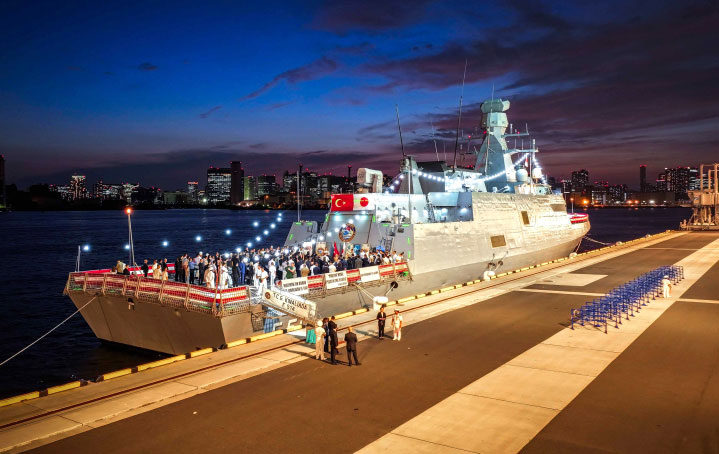
The first port visit was to KUSHIMOTO, where a ceremony was held at the Ertuğrul Martyrs' Cemetery to commemorate the 134th anniversary of the frigate’s voyage. A second memorial ceremony took place at sea, near the Funagora rocks, where the Ertuğrul sank. The ship then visited Tokyo, where a reception was held on board with notable attendees, including Her Imperial Highness Princess Akiko, Defense Minister Kihara, Minister for Digital, Administrative and Financial Reform Kono, and Komeito Party Leader Yamaguchi. The final port visit was to Hiroshima, where the corvette stayed from June 18 to 21. During its stay in Japan, the corvette was open to the public, attracting over hundreds of visitors, showcasing the strong interest of the Japanese public in the ship.
Minister of National Defense Yaşar Gül expressed gratitude for the hospitality shown to TCG KINALIADA during its visit, stating, "Türkiye was pleased with the kind hospitality shown to TCG KINALIADA during her visit to Japan, and we thank our Japanese friends for their valuable hospitality."
JS KASHIMA and JS SHIMAKAZE's Visit to Türkiye
In August 2024, Japanese training ships JS KASHIMA and JS SHIMAKAZE visited Istanbul as part of their 68th Overseas Training Cruise, marking the first visit of Japanese warships to Istanbul since 2009. The visit to Türkiye was part of a broader cruise that included stops in Brunei, Seychelles, South Africa, Senegal, and Italy, with plans to visit Spain, Germany, England, the USA, and Mexico before returning home.
During their visit to Istanbul, a reception was held on board JS Kashima, attended by Turkish Minister of Defence Yaşar GÜLER, Commander of the Turkish Naval Forces Admiral Ercüment TATLIOĞLU, and other high-ranking officers and diplomats. Rear Admiral Takahiro NISHIYAMA, Commander of the Japan Training Squadron, highlighted the purpose of the cruise: "The primary goals are to educate newly commissioned officers at sea, promote an international perspective, and strengthen defense cooperation with partner countries, aligning with Japan's strategic vision of a 'Free and Open Indo-Pacific.'"
The Overseas Training Cruise offers newly commissioned officers an opportunity to experience life on board a Japanese warship, regardless of their future career paths in the JMSDF. This experience is crucial for understanding maritime operations and fostering international cooperation, as emphasized by Rear Admiral Nishiyama: "Strengthening relationships through defense cooperation with visiting countries supports the realization of a 'Free and Open Indo-Pacific.' It's crucial for cultivating the international perspective of our future officers."
The Japan Ministry of Foreign Affairs describe the aim of this concept as to develop a free and open Indo-Pacific region as “international public goods”, through ensuring the rule-based international order, in a comprehensive, inclusive and transparent manner, attaching importance to ASEAN's centrality and unity, in order to bring stability and prosperity for every country as well as secure peace and prosperity in the region as a whole.
Looking Ahead: Strengthening Bilateral Ties
These naval exchanges symbolize the enduring friendship and mutual respect between Japan and Türkiye. By fostering military cooperation, cultural exchange, and diplomatic dialogue, both nations continue to build on a relationship that began over a century ago. As Japan and Türkiye look to the future, the values of cooperation and understanding will remain central to their bilateral relations, promoting peace and stability in the region and beyond.
Interview with the Rear Admiral Takahiro NISHIYAMA
The Commander of the Japan Training Squadron, Rear Admiral Takahiro NISHIYAMA answered our questions on board JS Kashima when the ship was in Istanbul.
Can you outline the main objectives of the Overseas Training Cruise 2024?
The primary goals are to educate newly commissioned officers at sea, promote an international perspective, and strengthen defense cooperation with partner countries, aligning with Japan's strategic vision of a “Free and Open Indo-Pacific.”
Who are the key participants in this year's cruise, and what roles will they play?
The Japan Training Squadron consists of two ships, “KASHIMA” and “SHIMAKAZE,” with about 560 personnel, including approximately 190 newly commissioned officers. Their primary role is to receive education and at-sea training.
What specific training activities will the trainee officers undertake during the cruise?
Officers will engage in fundamental seamanship, basic ship manoeuvre, onboard exercises (e.g., firefighting, watertight integrity, man overboard), and joint exercises with foreign navies to understand defense cooperation.
Why is on-the-job sea training crucial for trainee officers?
Regardless of their future roles, it is essential for officers to understand maritime operations and activities through hands-on sea training.
Why does JMSDF prefer grey-hulled training ships over sailing ships?
JMSDF doesn’t have tall ships, but both grey-hulled and tall ships offer unique training benefits. In Japan, other organizations like the Japan Agency of Maritime Education and Training for Seafarers use sailing ships for training.
What measures ensure the safety and well-being of personnel during the 175-day cruise?
We focus on fostering group life, maintaining work-life balance by scheduling “no exercise days,” providing refreshment opportunities during port calls, and ensuring communication with families through Starlink satellite internet.
What are the expected outcomes for the trainee officers by the end of the cruise?
Officers should acquire essential knowledge in maritime operations, seamanship, and basic command and leadership skills.
Who are the key international partners in the joint exercises, and how are they selected?
The United States is Japan's only ally, but we also cooperate with other nations that share the values of a “Free and Open Indo-Pacific.”
How does the Overseas Training Cruise align with JMSDF and Japan’s broader defense goals?
The cruise promotes friendship and mutual understanding through port visits and joint exercises, enhancing the international perspective of newly commissioned officers, who will be future leaders in the JMSDF.
How does the concept of a “Free and Open Indo-Pacific” influence this training cruise?
Strengthening relationships through defense cooperation with visiting countries supports the realization of a “Free and Open Indo-Pacific.” It's crucial for cultivating the international perspective of our future officers.
How does this cruise contribute to the “Free and Open Indo-Pacific” objective?
It directly supports the mission by fostering international cooperation and understanding, essential for realizing a “Free and Open Indo-Pacific.”
JS KASHIMA and JS SHIMAKAZE
JS Kashima is a purpose-built training ship for the JMSDF. She was approved in 1991 fiscal year and laid down in 1993. She was commissioned in 1995.
She is 143 meters long and 18 meters wide. The displacement is 4050 tons. The main propulsion is two Mitsubishi S16U-MTK diesels and two Rolls-Royce Spey SM1C gas turbines in CODOG configuration. The ship has one 76mm gun and two triple 324mm torpedo tubes and 40mm salutation gun. The ship has platform for one helicopter but does not have a hangar.
The ship has a complement of 320, 150 of which are the newly commissioned ensigns on the training cruise.
The second ship is the JS SHIMAKAZE. She was commissioned in JMSDF in 1988 as a guided missile destroyer.
She is 150 metres long and 16,4 meters wide. Her displacement is 6147 tons fully loaded. She was 2 Kawasaki/Rolls-Royce Olympus TM3B gas turbines coupled with 2 Kawasaki/Rolls-Royce Spey SM1A turbines in COGAG configuration. The total sustained power is 36,8MW for Olympus and 19,9MW for Spey turbines. The maximum speed is 30 knots.
Her original armament includes two 5-inch/54-caliber Mark 42 guns, one Mk13 Mod 4 launcher for 40 SM-1MR Block VIA missiles, one ASROC Mk112 octuple launcher with reload capability, 8 RGM-84C Block1B Harpoon anti-ship missiles, two 20mm Phalanx CIWS and two Type 68 triple torpedo tubes. The destroyer has platform for one SH-60J Seahawk helicopter but does not have a hangar. The ship has a complement of 260 on board.
The ship was converted to a training ship and redesignated as such in 2021. During this conversion some of her weapon systems were rendered inoperative although all of them are still in place. The ship has space for 40 Ensigns. They are rotated in biweekly basis with the Ensigns in JS Kashima.