Eurofighter GmbH Hosted Defence Turkey at Their Chalet in FIA24 Update on Eurofighter Typhoon Procurement Project
In order to meet the interim fighter jet requirement of the Turkish Air Force (TurAF), until the first squadron of indigenously developed KAAN National Combat Aircraft becomes fully operational in mid 2030s, both the F-16 Block 70 Procurement and F-16V Modernization Project, and Eurofighter Typhoon Procurement Project, dedicated for air superiority role, were initiated to bolster TurAF and enhance its air superiority capability, a move largely driven by the need to counter Greek Air Force’s Dassault Rafale F3R fleet and F-35As order, which will allow Greek Air Force to maintain a technological edge over TurAF.
Greece has already received 18 Dassault Rafale F3R aircraft, and another 6 aircraft were lated added. Greek Air Force plans to form two full squadrons of Rafales, totaling 36 aircraft. On the other hand, Greece has signed a Letter of Offer and Acceptance (LOA) in July 2024 for the purchase of initial batch of 20 F-35As at a cost of around $3,5 Billion. The LOA also includes an option for 20 additional aircraft, which would bring the total value of the deal up to around $8,6 Billion, according to the Greek Ministry of Defense. The jets will be delivered starting in 2028. The F-35As will provide the Greek Air Force with advanced strike and surveillance capabilities.
Although the United States Government approved Türkiye’s purchase of 40 F-16 Block 70 fighter jets and 79 modernization kits reportedly valued at $23 Billion in June 2024, Türkiye remains keen on the Eurofighter Typhoon aircraft. Türkiye plans to procure at least 40 of the latest variant of the Eurofighter Typhoon to bolster TurAF, which currently relies on F-16 fighter jets, a deal which has been under consideration since 2022.
With the Eurofighter Typhoon Procurement Project initiated by the Turkish Ministry of National Defense (MoND) in order to meet the TurAF’s requirement for modern aircraft with air interception and air superiority capabilities, it is aimed to supply two squadrons (each with 20 aircraft) of new production Eurofighter Typhoons (in the beginning negotiations were focused on Tranche 3+ (Block 7, the same configuration given to the Qatar Emiri Air Force with Leonardo’s ECRS Mk-0 AESA Radar.
Equipped with the European Common Radar System (ECRS) active electronically-scanned array (AESA) radar, the Eurofighter Typhoon is regarded as the most advanced European fighter jet, capable of serving until 2060. The ECRS Mk2 radar is one of several developments being undertaken across the four-nation Typhoon program to ensure that the aircraft remains relevant, especially as the Typhoon moves toward the Phase 4 enhancements (P4e) update, expected to come available in 2029. Even it is depending the contract award schedule, it is probably that Türkiye is starting to get it is Eurofighter Typhoons with the P3Ec Step 3 enhancement package. The P3EC enhancement package covers the replacement of the existing three 6x6 inch MHDDs and HUD with Large Area Display (LAD) and STRIKER II HMD as well as will allow the integration of the new ECRS Mk 2 radar. As the the last step of the P3EC software package and the next standard planned for the UK Typhoon that is due in service in the UK in 2025, the P3EC Step 3 will also introduce integrated operational mission support (giving intelligent or more automated mission data), a necessary step given the new radar’s even greater dependence on mission data.
The Eurofighter Typhoon, developed by a European consortium including Germany, the UK, Spain and Italy, represents one of the most advanced new generation multi-role/swing-role combat aircraft in operation today. It represents the peak of British, German, Italian and Spanish collaborative technology in avionics, aerodynamics, materials, manufacturing techniques and engines. Eurofighter Typhoon is Europe’s largest military collaborative program. A total of 680 Eurofighter Typhoons have so far been ordered over the duration of the program, with nine countries operating the type: the four Eurofighter nations plus Austria, the Kingdom of Saudi Arabia, Sultanate of Oman, Kuwait and Qatar. Eurofighter Typhoon offers cutting-edge air-to-air and air-to-ground capabilities, making it an attractive addition to TurAF’s ongoing modernization efforts. In the air superiority mission the Eurofighter Typhoon will typically be equipped with air-to-air missiles for the BVR and short-range combat. It is the combination of thrust, manoeuvrability, modern sensors and data fusion that makes the Eurofighter Typhoon the superior air combat platform.
Türkiye continues its efforts and negotiations to acquire the Eurofighter Typhoon fighter jets since 2022 and it is understood that despite Germany’s opposition Türkiye’s pursuit of the Eurofighter Typhoon has strong backing from the Governments of the United Kingdom, Italy, and Spain. Germany’s decision to block Türkiye’s request to purchase the Eurofighter Typhoon has also drawn criticism from industry stakeholders in the country, particularly defense companies and labour unions. German labour unions have been urging the Government to approve Türkiye’s application to buy 40 Eurofighter Typhoons, warning that a refusal could result in the loss of thousands of jobs in the European defense industry.
President Recep Tayyip ERDOĞAN has urged German Chancellor Olaf SCHOLZ several times to drop his opposition to the sale of the Eurofighter Typhoons to Türkiye in November 2023 (Berlin), in July 2024 (NATO Summit in Washington, D.C.) and finally on September 23, 2024 in New York, where they travelled for the UN General Assembly. In his statement issued on July 12, 2024 following his meeting with SCHOLZ that took place on July 11 during the NATO summit in Washington DC, President ERDOĞAN urged SCHOLZ to lift a block on the sale of Eurofighter Typhoon aircraft to Türkiye. SCHOLZ’s Government has blocked sale of Eurofighters to Türkiye. "We discussed the Eurofighter issue among ourselves. SCHOLZ did not have a negative approach regarding this issue. In the continuation of our discussions on the issue and in the meetings that my Minister of Defense held with his German counterpart in Germany, we saw that there was a trend in the most positive direction possible. There are such positive developments on both the German and British sides. We will all follow it together. I hope the outcome will be beneficial." German Chancellor Olaf SCHOLZ will visit Turkiye during the second half of October and will hold talks with ERDOĞAN on October 19, 2024 in İstanbul. It is expected that the issue of Germany's opposition regarding the sale of Eurofighter jets to Türkiye will also be on the agenda of their meeting. According to defence sources, it is possible that the lifting of the embargo may be disclosed to the public opinion after this meeting.
Briefing journalists at the Farnborough International Air show (FIA) on 23 July 2024, Eurofighter CEO Giancarlo MEZZANATTO also confirmed Türkiye’s strong interest in acquiring the Eurofighter Typhoon but revealed that the effort was blocked by Germany. MEZZANATTO noted that he had received strong interest in a Eurofighter acquisition from Türkiye. MEZZANATTO also noted that Eurofighter has already accumulated firm orders for 69 new aircraft from the consortium’s partner nations alone: Spain launched its Halcon II follow-on buy of 25 aircraft in September 2023; Germany announced an order for 20 more aircraft at the ILA Berlin Air show on 5 June 2024; and Italy announced on July 8, 2024 that it would acquire an additional 24 Eurofighters to replace its Tranche 1 aircraft. Beyond the Eurofighter partner nations (the United Kingdom, Germany, Spain and Italy) additional sales of potentially further Eurofighters to Saudi Arabia were opened up on January 7, 2024 when German Foreign Minister Annalena BAERBOCK announced that Germany would lift its embargo on more aircraft being sold to Riyadh.
Visiting the United Kingdom as an official guest of the Admiral Sir. Tony RADAKIN, Head of the United Kingdom’s Armed Forces and principal military adviser to the Prime Minister and Secretary of State for Defense, Chief of Turkish General Staff (TGS) General Metin GÜRAK met with Adm. RADAKIN in London on August 9, 2024. On the same day he also toured UK’s Strategic Command (previously Joint Forces Command) and the RAF Coningsby Air Base, where he inspected a Eurofighter Typhoon fighter jet and posed for photographs in front of a No.12 Squadron Eurofighter Typhoon, restarting discussions about Türkiye’s plans to procure these aircraft a deal that has been under consideration since 2022. Within the scope of his official visit, Chief of TGS Gen. GÜRAK also conducted inspections at NATO’s Maritime Command (MARCOM) on August 10, 2024.
On August 12, 2024, Yaşar GÜLER, Türkiye’s Minister of National Defense (MoND, former Chief of TGS) reaffirmed Türkiye’s interest in the Eurofighter Typhoon. Minister GÜLER expressed the hope that the Eurofighter partners (and particularly Germany) would give a positive response to Türkiye’s request. He acknowledged that little progress has been made so far.
Germany is reportedly reconsidering Türkiye’s request to acquire Eurofighter Typhoon fighter jets. In this context, ahead of German Chancellor SCHOLZ’s official visit to Türkiye on October 19, in it was reported that Germany has given the green light for the start of technical negotiations with Türkiye on a possible Eurofighter Typhoon jet sale to Ankara. “The German Federal Security Council in a secret meeting decided to allow the Eurofighter Consortium to share the specifications of the Eurofighter Typhoon fighter jet with Türkiye and begin technical consultations,” it was reported. The technical exchange of information would focus on what a deal would look like if the sale went through with Berlin’s approval and would include the complete technical details of the fighter jet, its procurement stages, training, spare parts management and maintenance protocols. However, the start of technical negotiations with Türkiye does not mean that the Eurofighter Typhoon sale to Türkiye has been finalized.
Meanwhile, at the weekly press briefing held by the Turkish Ministry of National Defense (MoND) on October 10, 2024, the following response was given to a question regarding the current status of the Eurofighter Typhoon procurement: "Technical-level studies on the procurement of the Eurofighter Typhoon aircraft are ongoing. As is known, we have a request to acquire a total of 40 aircraft, with 20 in the first phase. We expect positive developments in this regard."
Eurofighter GmbH Hosted Defence Turkey at Their Chalet in FIA24
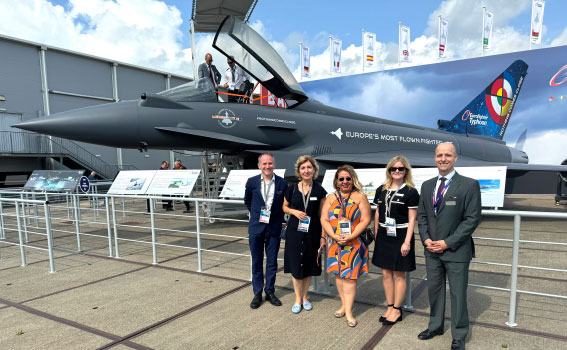
On the third day of the Farnborough International Airshow 2024 (FIAS), Eurofighter Typhoon hosted Defence Turkey at its chalet. The consortium, which represents the industrial partners of the four-nation European partnership, Airbus, BAE Systems and Leonardo, displayed a Full-Scale Replica of the Eurofighter Typhoon fighter jet supported by a comprehensive weapon display outside of its chalet.
During our tour of the chalet, expert briefers provided us with detailed insights in to technologies, including the BAE Systems STRIKER II Helmet-Mounted Display (HMD), the company’s most advanced fighter pilot helmet developed which features the latest technologies to integrate an all-digital night vision system and daylight readable color display, and the Leonardo European Common Radar System (ECRS) active electronically-scanned array (AESA) radar. The advanced ECRS Mk0 radar is in service on Typhoon with air forces in Qatar and Kuwait today and a prototype of the Mk2 radar, a standard being developed for the UK Royal Air Force (RAF), has been integrated on a single-seat Tranche 3, FGR4-standard test aircraft BS116 (ZK355,) which undertook its first flight on September 27, 2024 at BAE Systems’ flight testing facility in Warton, UK following the completion of ground-based testing. That flight represents the beginning of ECRS Mk2’s airborne test campaign. Collaboratively developed by BAE Systems and Leonardo in the UK, the ECRS Mk2 (also known as Radar 2) will give RAF Typhoon pilots the ability to locate, target, suppress enemy air defenses using high-powered jamming, and engage targets whilst beyond the reach of threats, making Typhoon even more potent part of the NATO frontline fleet.
Featuring a completely different antenna array compared to Mk0, the ECRS Mk2 (with fully digital wider band antenna utilizing GaN based T&R modules) will enable the RAF Eurofighter Typhoons to perform additional roles such as electronic attack and jamming. Both ECRS radars feature a unique positioning mechanism, allowing the antenna to rotate at much wider angles relative to its central axis and thus provides a significantly broader field of regard, greatly enhancing angular/azimuth coverage. Eurofighter Typhoon claims that the innovative swashplate re-positioner (providing a Wide Field of Regard of ~200 degrees) provides a field of regard that is some 50% wider than traditional fixed-plate systems. The Eurofighter consortium describes the ECRS Mk2 as “the world’s most capable combat air radar.”
With the objective of eliminating the movements of the old mechanical radar (CAPTOR-M radars on Eurofighter Typhoon Tranche 1, 2 and 3 configurations) and replacing it with electronic technology, development of the electronic version of the radar in 2002 the EuroRadar Consortium financed the development of the CAESAR demonstrator (CAPTOR AESA Radar). The CAPTOR-C (ECR-90C) was chosen as the basis. On May 8, 2007, the Eurofighter Development Aircraft 5 (DA5) flew with the CAESAR for the first time. The new radar consisted of GaAs transmit and receive (T/R) modules, which had to be liquid-cooled due to their power density. Development of the CAPTOR-E with its tilted antenna began on July 1, 2010. Also known as ECRS Mk0, it retains some of the ‘back-end’ of its progenitor but with a number of upgrades, which includes the replacement of the mechanical scanner with a new AESA antenna mounted on a double swashplate re-positioner. This is intended to increase the F-pole distance in air combat. Differing requirements and timelines led to the CAPTOR-E being subdivided into the ECRS Mk0 (a variant which was initially developed for export customers including Kuwait and Qatar), Mk1 (a variant for Germany and Spain, which is being developed under the leadership of Hensoldt), and Mk2 for the United Kingdom (collaboratively developed by BAE Systems and Leonardo in the UK). Each of these radars introduces an additional level of capability, with ECRS Mk2 being the most advanced. In 2011, it was reported that the CAPTOR-E would be able to detect an F-35 at 59km distance. Compared to Captor-M, Captor-E provides a significant increase in detection ranges and improved tracking accuracy, enabling full exploitation of the long-range Meteor missile.
Eurofighter Flight Simulator Experience
During our tour at Eurofighter Typhoon chalet at FIAS 2024, I was provided an opportunity to speak with a number of former RAF and German Luftwaffe Typhoon pilots, including Paul SMITH, Head of Typhoon Strategy Delivery, BAE Systems, about the impressive capabilities of the Eurofighter Typhoon and had the chance to check out a cutting-edge flight simulator.
The flight simulator at FIA chalet featured the current (Tranche 3+ with ECRS Mk0 AESA radar) Typhoon cockpit set-up with three 6 x 6-inch multifunction head-down displays (MHDDs) and the Head-up Display (HUD), the same standard that is in service with air forces in Qatar and Kuwait today. In BAE Systems’ exhibition hall at FIA24, it was displaying a future standard simulator equipped with a Large Area Display (LAD) display in place of the three existing MHDDs. The LAD is one of the three primary upgrades for the Eurofighter Typhoon being showcased by BAE Systems at FIA24, with the other two being the ECRS Mk2 radar and the STRIKER II Helmet-Mounted Display (HMD).
However, while the ECRS Mk2 active electronically scanned array (AESA) radar and the STRIKER II HMD have been contracted by the UK RAF for operation by the end of the decade, the LAD remains a BAE Systems company-funded initiative. The LAD has been designed to allow Typhoon pilots to handle vast quantities of information better and improve their decision-making in the more congested threat environment of the future. Measuring 12 x 22 inches, the LAD would replace the Typhoon’s existing three 6 x 6-inch MHDDs and the HUD. Since the new Large Area Display is intended to work with the new helmet (STRIKER II) it's not going to have a head-up display.
As a demonstrator, the cutting-edge flight simulator of the Eurofighter Typhoon on display at FIA24 gives a real indication of the performance capabilities of the aircraft. Regarding the existing software standard of the Eurofighter Typhoon mission system Paul SMITH, Head of Typhoon Strategy Delivery, BAE Systems, said: “This simulator represents the standard of aircraft which is in production now, but Eurofighter is the product of constant evolution to meet the threats of the future. Ever since it entered service, the aircraft’s capability has been growing to meet the demands of our customers through a program of what we call Phased Enhancements which are agreed and contracted by the Eurofighter partner nations and is available to all Typhoon operators.”
The cockpit displays of the Eurofighter Typhoon are very flexible and features pretty basic set-up, so you can move the displays around and put different layers of information on there with a GPS-style view on the displays. Whilst I was flying the simulator, I was joined by former RAF and German Air Force Luftwaffe Typhoon pilots who highlighted the extensive real estate of the cockpit in comparison with other modern combat aircraft, and pointed out this allowed for greater levels of information to be displayed to the pilot. Typhoon’s display space is more complex than an F-16 and features a lot greater detail of information and a lot more data fusion in the way I would expect to see in a 5th Generation aircraft such as F-35.
The pilots were able to use the simulator to demonstrate the ‘carefree handling’ of the Typhoon allows the pilot to concentrate on the mission — managing all the different sensors and making sense of the information that comes their way.
All Eurofighter Typhoon aircraft feature a centered control stick rather than side stick on the right-side panel preferred for the F-16s. The former Typhoon pilots I spoke with at FIA24 voiced their preference for a center stick which they explained gives flexibility to the pilots. A former Luftwaffe Typhoon pilot said: “I have experienced intercepting Flankers during an air policing mission. I had to take a picture of one aircraft whilst another was harassing my wingman. The center stick position gives you that flexibility.” A former RAF pilot added: “Having a bit of flexibility which with the center stick provides is a real benefit. I've flown the F-35 simulator and I've flown F-16 back seat and the side stick works fine and it gives you an arm level of support, but sometimes it is better to have your arm under tension from when you're G-loading. If your arm is relaxed, you get more bruising from the G-force you are experiencing, particularly in a Typhoon which can accelerate to 9G. On the newest build of Typhoons we have kept the center stick because of the benefit it brings but made some changes to the functionality.”
With BAE Systems progressing with the development of a LAD cockpit for future standards of Typhoon, I asked when we could expect to see this enter service, it was explained that this is currently being considered by the Eurofighter partner nations. Paul SMITH explained: “The case for a LAD is a compelling one because as pilots we realize that the difference between success and failure is the speed at which you receive information and how clearly and accurately it is presented to you. Typhoon is seeing huge advances in its sensors, not least through the ECRS radar, and this is going to bring a huge amount of extra information in to the cockpit – how quickly and clearly that information is presented to the pilot is what will make the difference. Currently the LAD is being developed under BAE Systems company investment and is yet to go on contract with any Typhoon operator nation, however, we all expect it to be a requirement of our customers in the future.”
During the FIA24, while discussing with officials from Airbus, BAE Systems, and Eurofighter Typhoon regarding the Turkish Air Force (TurAF)'s Eurofighter Procurement Project, they underscored the impressive capabilities of the Eurofighter Typhoon but stressed any offer for Türkiye is not finalized.
Speaking of Türkiye’s interest in Typhoon at Farnborough International Airshow (FIAS) 2024, Paul SMITH, Head of Typhoon Strategy Delivery, BAE Systems explained: “What I can tell you is that both the UK and ourselves are aware of Türkiye’s interest in Eurofighter, but how this progresses is a matter for the Turkish Government together with its counterparts in the UK and the other Eurofighter nations. There is a lot of interest in Typhoon at the moment with the Spanish Air Force already ordering further jets and the German and Italian governments both expressing an interest in ordering more as well. The beauty of Typhoon is that you have the flexibility to tailor the capability of the aircraft to the need of an individual nation and yet there is always room to continue to evolve the capability as upgrades become available. We are seeing this today with our customers in Qatar and Kuwait, for example, where we are continuing to develop the standard of the aircraft these air forces have in service today.”
Paul SMITH indicated that all of Eurofighter Typhoon user air forces are currently very busy. He said: “With the ongoing situation in Ukraine, Typhoon is seeing a lot of action and we believe more than 80% of all air policing missions carried out by Germany, Italy, Spain and the UK in the past two years have been using their Eurofighter fleets. That means we have had to deliver high levels of availability both at UK main operating bases and where those aircraft are deployed, for example in Baltic states on NATO air policing missions. But we are also seeing this with a number of our export customers, for example the Qatar Emiri Air Force, which not only operates from its bases in Qatar but also has taken its jets on a number of overseas military exercises, including at the 2023 Anatolian Eagle exercise in Türkiye. BAE Systems and our partners work alongside all our Typhoon operators to make sure that our customers have this level of availability.”
The Eurofighter Typhoon has one of the world’s most advanced electronic warfare (EW) suites on a modern combat aircraft which allows the aircraft to operate stealthily, evading threats and preventing engagement. Paul SMITH explains: “Typhoon ensures its operators have complete sovereign control of their own mission data, they can choose how to manage the data, manipulate it and who they wish to share it with. There are no black boxes which are restricted to a Typhoon operator as you may find with other aircraft.” The aircraft operates the Link-16 military tactical data link, the primary data link operated by all NATO forces, ensuring interoperability across Typhoon fleets from multiple operators within the NATO partnership.
The twin EJ200 aircraft engines which power Typhoon has flown more than 1.5 million flying hours and developed a reputation for great performance and reliability. Paul SMITH explains: “Every pilot will tell you they want more power and thrust and the EJ200s in Typhoon give you that. They offer on-demand serviceability which effectively means the jet will tell you when maintenance is required, but this is typically every 1.500 hours and means they very rarely have to come out of the aircraft. This means a higher performance, more available aircraft.”
ECRS Mk0 and Mk 2 AESA Radars
Today’s Typhoon aircraft operated by nations including Germany, Italy, Spain and the United Kingdom operate a mechanically-scanning (CAPTOR-M) radar, but aircraft operated by both Kuwait and Qatar are the first to operate the electronically-scanning European Common Radar System (ECRS). ECRS Mk0, operated by both Kuwait and Qatar, is designed and built the EuroRadar consortium, led by Leonardo UK incorporating knowledge and experience gained through the development of CAPTOR-M and technical demonstrator programs.
It operates an innovative mechanical re-positioner to extend the systems field of regard (F0R) by mechanically moving a fixed AESA’s field of view. This provides Eurofighter unparalleled situational awareness and freedom of manoeuvre whilst conducting core air-to-air and air-to-surface roles. The large number of Transmit Receive Modules (TRM) and high-power output, made possible by Eurofighters design, provides a step change in AESA functionality and performance.
The increase in detection performance of ECRS Mk0 provides capability against the most difficult of target sets within complex electromagnetic environments. Alongside tenacious air-air detection, tracking and engagement, supporting guidance of both AMRAAM and METEOR missile systems, ECRS Mk0 also has air-surface modes including ground moving target modes, surface mapping and sea surface search (SSS).
ECRS Mk0 capabilities perfectly compliment all elements of Typhoon’s weapon system and provide an excellent baseline for future upgrades. The increased performance, reliance and reliability ECRS Mk0 provides further improves Eurofighter Typhoon’s effectiveness and superiority over current and future threats.
Typhoon ensures its operators have complete sovereign control of their own mission data, they can choose how to manage the data, manipulate it and who they wish to share it with. That also gives nations the flexibility to respond to and counter new threats – essential in the rapidly changing threat environment. Mission data also controls the Defensive Aids system giving more comprehensive and coordinated protection than on other non low-observable aircraft ECRS Mk2 is a multi-function Active Electronically Scanned Array (AESA) designed and built by Leonardo to provide Eurofighter Typhoons with a world-leading Electronic Warfare (EW) and Electronic Attack (EA) capability alongside optimized traditional radar functions.
The system offers enhanced traditional radar modes providing Eurofighter Typhoon with increased situational awareness and lethality in the most complex and hostile future electromagnetic environments. The EW and EA functions increase threat awareness and provide operators with the ability to locate, identify and jam enemy radio frequency emitting surface-to-air systems, providing enhanced ownership and third-party protection whilst conducting a SEAD (Suppression of Enemy Air Defenses) mission.
The system has been developed using experience gained from the development and production of ECRS Mk0, RAVEN and CAPTOR M fire control radar systems, and has been specifically designed to meet the UK’s requirements for its Eurofighter Typhoon fleet.
Recognizing that ECRS Mk2 is being developed for the UK RAF, I asked Paul SMITH whether it would be available to other Typhoon operators. He explained: “Today, it is the UK RAF which is leading the development of ECRS Mk2 and funding this work led by BAE Systems and Leonardo on behalf of the Eurofighter consortium. However, in 2021, engineers from Leonardo’s Italian business joined the ECRS Mk2 joint industrial team underlining the interest from other Typhoon operators in this capability. As with all capability upgrades to Typhoon, our intent is to make them available to all operator nations and the same will be true of ECRS Mk2 as we continue to develop its capability”