2013 Figures of Turkish Defence Industry
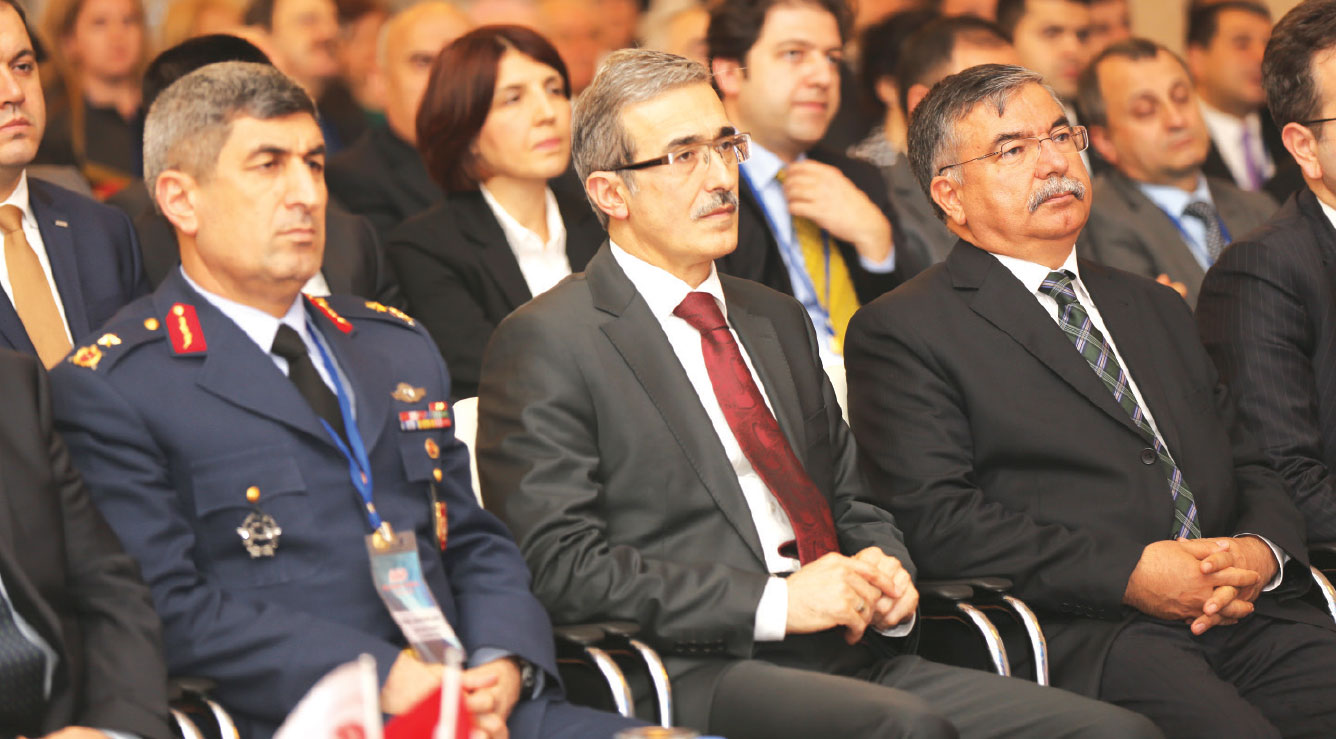
The 25th Ordinary General Assembly meeting of Defence and Aerospace Industry Manufacturers Association (SaSaD) took place on 18 April 2014. In the meeting where 77 delegates cast votes, election as principal and alternate membership to the Management, Audit and Discipline Committees took place. Muharrem Dörtkaşlı was elected as the Chairman of the Board of Directors together with Nail Kurt as Deputy Chairman and Mustafa Kızıltaş as Treasurer.
The General Assembly meeting also found the owners of the Turkish Defence Industry Awards. Based on the results, TAI came first, FNSS Savunma Sistemleri A.Ş. second and Yonca Onuk third in the awards. The awards were presented to the general managers of the companies by the Minister of National Defence H.E. Ismet Yılmaz.
General Appearance of Year 2013
Each year, Defense and Aerospace Industry Manufacturers Association collects data from its members to measure the annual performance of the Turkish Defense and Aerospace Industry. After being coordinated with the Undersecretary of Defense the results are released to all related parties for evaluation.
The turnover in the field of civil aviation and space have been included in the performance measures since 2009. The exchange abroad-saving services revenues of all our members have been included in the performance (turnover) as of 2013.
The data collected from the 65 members of SASAD is outlined under the headings below;
Turnover
Export
Import
R&D Expenditures
R&T Expenditures
Employment
General Evaluations
When a general assessment is made for 2013 the following developments are observed;
The rising trend achieved in the early 2000’s is still continuing
Turnover is continuing to increase
Product and technology development incentives are hot topcis
Success is achieved especially in export
Import is continuing to decline every year.
Turnover Sales
When it is compared with total sales in the year 2010 and earlier, it is observed that the world defense expenditures are decreasing. The reasons of this decrease are; the 2008 global financial crisis, defence budgets cuts in the advanced western countries, the change in threat perception, the termination of the Iraq operation and Afganistan operation getting close to end. The 2013 total turnover of the 100 Largest Defense companies of the World is 411 billion U.S dollars (ASELSAN and TAI are among these companies)in which the Turkish defense and aerospace industry has a share of 1.2%. The 2013 turnover of the industry is 5,076 billion US dollars. The foreign exchange earning service gains have been included in this amount. The industries’ average turnover per employee is 156.821 US dollars. When compared to the 2012 turnover per employee (142,019 US dollars), an important progress is observed. However, being below the sector average (317,580 US dollars) arises as an important problem of the industry.
During the 4 years period from 2010 to 2013, the total change in turnover has been identified as 63.91%.
When compared 2012 to 2013, total turnover increase is 5.75%. It is assessed that this data which is observed to be lower than the last 4 years average may be related to the billings which could not be realized due to the extension of the Lot Acceptance Tests of some significant programmes (such as ATAK and SG Search and Rescue Ship)
The Share of Turnover per Employee
The number of total employees working in the Defense and Aerospace Industry in the achievement of the turnover has been identified as 32,368. According to the datas, the largest return of turnover per employee is 168,715 US dollars in the Defense Aerospace sub sector followed by the Civil Aviation sector with a return of 151,122 US dollars. Since the Turkish Aerospace has not yet export aerospace platforms. It can be evaluated that the turnover per employee includes spare parts production, workshare in the joint projects, MRO and Offset activities.
Export
The Turkish Defense and Aerospace Industry Exports reached 1,569 billion US dollars in 2013.Acccording to the Defense and Aerospace Exporters Union, this value is 1,4 Billion US dollars. The difference between two figures arises from the addition of exchange currency earned by companies due to their services such as repair, maintenance, modernization and engineering to export income by SASAD.
Export sales outside Europe is striking, with an increase of 137% when compared to the previous year. The share of aviation sales to the United States and the Gulf countries holds an important place in this increase. While the cutoffs in the defense expenditures of developed counties cause reduction in the development of new platforms, the expenditures are focused on the MRO, renewal and modernization of the systems present in inventories of the worlds’ armed forces. These areas could be expected to be sought capabilities for the market. In the world market of civil aviation, space and unmanned air vehicles big leans are taking place and it is assessed that this expansion will continue. While these are the new favorites of the market, logistics (service/market) is stunning as another developing area. The sector has been successful in marketing its new products and emerging technological capabilities and should support the marketing activities with the logistic support of the systems that are in the inventory and by increasing the performance of the products it directs to the civil aviation, space and services.
Exports to Europe and western countries are mainly concentrated in the areas of sub systems and information Technologies. It is observed that sales in the countries of the Gulf and Central Asia, etc. contain system-level products. The persistent application of Offsets during public procurement has led and will continue leading to positive developments in export in the defense and especially in the aviation field.
The export to Europe which was 694 million US Dollars in 2011 has decreased by half in 2012. Naturally, the Outside Europe export has increased. A large partition of the export to Europe and USA consists of sub systems, machine molds, components and software. A large partition of the export consists of offset based goods and services. This picture has not changed in 2013.
Import
When compared to 2012, in 2013 the import has decreased 6%. Rather than the import values, the product or services that have been imported has a great importance. Presently, Turkey has to import power units in all main sectors. A large part of the import items are in this content. A second import items are qualified material (sensors/detectors/special alloy metals, chemicals, etc.), semi-finished items and finished items. However, it is important that export compensates import where the compensation ratio is 118%.
R&D and R&T
Since 1985, Turkey has become a local world power from the defense and aerospace. The policy on providing the needs of Turkish Armed Forces by local and indigenous products contributes to the Turkish economy. All small or large scale companies has taken important achievements by public support and incentives. With enacted incentive laws, founded Technoparks and university-industry cooperations the sector has taken some developments in the international market.
The Defense and Aerospace sector, when compared to all the other sectors, is the one has the largest product and technology development expenditures.
In 2012, in the field of product and technology development, 772 million US dollars, including 200 million US dollars from its own local resources, has been spent in the sector. This value is 16% of the turnover. In 2013, 927 million US dollars have been spent in the same context which corresponds to 18% of the turnover. The total product and technology development expenditure per person is 29,178 US dollars.
The results for the turnover and export show that the support, incentives and local resources allocated for production and technology development mediate the sectors requirement of developing indigenous products and technologies.
Employment
The employment performance is 32,368 employees according to the information collected from the companies.
Conclusion
The following issues have been pin-pointed with regards to the general assessment sector’s performance data .
The sectors tendency to develop is continuing.
The increase in the total sales is slightly lower than the previous years’. Although at a first glance, this may be expressed to be related to the billings which could not be realized due to the extension of the Lot Acceptance Tests of some important systems similar problems repeat each year at different levels of sales values. Therefore, for sustainability of the sectors competencies, this issue should be analyzed in depth, the causes should be identified and necessary precautions should be defined.
The improvement in export is evaluated as a positive development. It is assessed that due to the narrowing of the resources in their defense budgets, the manufacturers of the advanced western countries will expend their activities in the regions will try to take a more active role in emerging markets. Defence players will be faced with more intense competition. Therefore, it is evaluated that it is important to expand the range of saleable products, in order to enter the new market with more affordable prices. Despite the positive development, the production per person is still under the world average (250-360 thousand US dollars). This will be a handicap. On the other hand technology transfer, positive approach for the domestic contribution/offset requests, setting up partnerships (joint ventures) are important tools the achieve in the sector. In the short and medium term it is expected that demand of the civil aviation will increas so the sector will need new suppliers.
Unmanned air vehicles, helicopters, satellite (communications, intelligence), smart cities / homeland security (including cyber security), marine systems, land systems modernization, precision munitions, will be the main and promising fields.
It is observed that positive steps are being taken to decrease the foreign dependency and that import expenditures are tending to decrease. In this context, it is evaluated that it is important to focus on the use of COTS products in the designs in order to focus on subsystem, component and technology development studies.
It is a reality that the entegrator and system producer companies, which are going to enter the competition in the World markets, have not yet reached the sufficient size. Effective competition is assessed to be an indispensable condition for growth. Therefore it is evaluated that relevant precautions and possible measures should be implemented.
The evaluated data shows that in order to achieve its allocated objectives the Turkish Defense and Aviation Industry should review its strategies and policies in terms of the evaluations above and take possible precautions. From this year on, all players are expected to take realistic steps in sustainability and in further developing their competition in external markets.