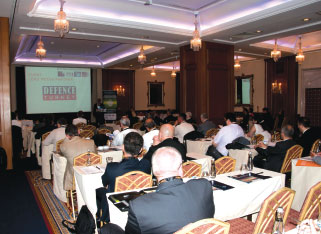
2014 Border Management & Technology Summit Held in Istanbul
Lasting 3 days, many participants and speakers from Afghanistan, Kosovo, Albania, Georgia, Macedonia, Iraq, Saudi Arabia, Serbia, Belarus, Litvania, Switzerland, Tajikistan, Germany, France, Netherlands, UK, U.S. and Turkey were present. The Summit saw important contributions on current work and experience on border security policies, restructuring, activities conducted on illegal refugees, clearing of mined fields and future collaboration. The first topic on the agenda was Turkey’s border security and management in the opening speech of Chairman of Identity Counsel International Joseph Atick.
Fetih Etem, Head of the Department of Migration of the Ministry of Foreign Affairs gave a presentation on the current number of immigrants and refugees in Turkey, shelter possibilities, the work conducted on placing Syrian refugees in Turkey and measures and solutions to counteract immigrants and refugees in particular on the Southeast Anatolian border in future years.
Etem: Number of Syrian Refugees has Surpassed 1 Million
In his presentation Etem indicated that after the conflict and turmoil in Bulgaria during the 1980s and in Iraq during the 2000s a large influx of immigrants and refugees took place and that many people from these regions sought refuge and said that we didn’t have the chance to say no to these people. The same situation is also true for Syria; in particular abnormal conditions exist in Syria. We are talking about a long border that includes many countries and it is very difficult to control this border. Stating that there are now more than 1 million refugees in Turkey, Etem added that to turn the regions conditions to normality important work is being conducted on many platforms in national and international arenas.
The Number of Mines on the Turkish Border Exceeds 900,000
An important topic on the agenda of the panel was the policies conducted on the land mines on the Turkish borders, their numbers, the area of coverage and the clearing of these mines. Rt. Eng. Col. Kamil Usun provided important information to participants on the area size where mines are present, the history where mines were laid in these regions, the total number of mines and work previously conducted on clearing these mines. Usun, indicating that there are 906,490 mines covering an area of 212,116,000 m2 in Turkey and that Turkey had carried out important work during the last decade on this issue. Turkey had participated in the Ottawa Convention in 2003 said Usun and pointed out that work on mine clearing started in 2004. On the question of clearing all mines by 2014, Turkey had given a guarantee at the Ottawa Convention in 2004 said Usun but that after, in particular, the turmoil in Syria, the resulting delays had led Turkey to submit a new proposal in the second half of 2013 and the revised period was set as 2022. Usun added that during the last decade 974 antitank mines, 25,047 antipersonnel mines in various regions as well approximately 3 million land mines in the depots of the Turkish Armed Forces were destroyed and reported as such. Indicating that with the clearing of land mines, in particular on the border, this would revive the Turkish economy and emphasized that with the opening of these areas to agriculture and commerce these areas would significantly contribute to the Turkish economy.
Rt. Eng. Col. Gürkan Keskin, as an expert that has carried out important duties within the Armed Forces on mines in the past, provided important information on the land mines and the projects implemented in clearing them on Turkey’s border with Syria and the North West and Eastern borders.
Keskin: There are Approximately 600,000 Land Mines on the Syrian Border
Indicating that the Turkish Syrian border is a 900 km long border, Keskin added that there are about
600,000 mines there are presently ready to be diffused. An agreement had been signed between the Ministry of National Defence and NATO Support Agency (NSPA) at the beginning of 2011 to clear the this region of mines and subsequently a tender had been opened in April 2011 among companies that could carry out this cleaning said Keskin. Keskin added that during first stage of this mine clearing project, companies participating in the tender had been invited to undertake various inspections in the 527 km area stretching from Çobanbey region to Cizre in May 2012 and participating companies had conducted these inspections. After these activities, final work was carried out in the second half of 2012 to select the tender winner’ however, conflict that erupted in the region had led to a suspension of activities and the project was put on hold for the conflict to cease.
The program to commence after the conflict on the Syrian border had ended was foreseen to be completed in 42 months, said Keskin and, in addition, work had started to clear the East Anatolia region of land mines in three stages as was the case with the Syrian border. Keskin indicated that they had targeted a 22 million m2 area to be cleared of mines within the scope of this program. Stating that tender work on this project was ongoing, Keskin added that the target was to remove mines at each stage for a period of approximately 2 years. Work on clearing these mines from these regions was the first stage, stated Keskin. Subsequent to this process there would be a need for 4x4 reconnaissance and monitoring vehicles, ground based monitoring radars and electro-optic sensors to enable border security and that during the second stage technological border monitoring equipment would be procured.
The Turkish Syrian border mine clearing program currently suspended due to the conflict in Syria is being carried out by the Ministry of National Defence under the coordination of NSPA (previously NAMSA). It is expected that the process will restart with the end of the conflict on the Syrian border. On the other hand, military sources stating the importance of utilizing national resources have indicated that in particular they have the qualified military personnel and the local means on the issue of mine clearing in Turkey and that these military personnel have carried out important duties on many national and international projects. As is the case worldwide, it is necessary that Turkey, in particular, must set its own International Mine Actions Standards (IMAS). Military sources have stressed that a centre must commence activities on this issue immediately and these same sources have made known that additionally, in clearing these mined regions, there was a need for new laws that would support and protect national ammunition and explosive producers that place by local means in accordance with Turkish IMAS standards and that current laws did not meet these requirements.





