A LOOK AT THE BADEN WURTTEMBERG (F-125) CLASS FRIGATES OF THE GERMAN NAVY

The first decade of the 21st century was a particularly difficult time for many naval forces. After the end of the Cold War and dissolution of the Warsaw Pact many European Navies had a kind of identity crisis. Their old reason for existence now gone, they looked for new reasons to exist and new tools to solve newly found problems.
The German Navy had one of these existence crises. During the Cold War the main mission of the German Navy was to keep the Warsaw Pact navies bottled up in the Baltic Sea, to prevent them doing amphibious operations against the Danish Straits and north Germany. However, following the collapse of the Soviet Union and consequently with Poland joining the EU, there was little for the German Navy to do.
While the possibility of an all-out war in Europe diminished, regional instabilities and other threats started to emerge all over the world. One of them was piracy off the coast of Somalia causing big trouble for the shipping industry and forcing navies to send their highly complex warships designed to operate against the forces of the Warsaw Pact to the region to chase off small skiffs or small boats with outboard motors. This was the naval equivalent of cracking a walnut with a hammer.
Conducting long patrols on the high seas and hailing merchant ships and occasionally boarding them became another important task for the naval forces. Such policing missions required long deployments away from home.
It was against this backdrop that the Germany Navy started a program to replace the Type-122 Bremen type frigates in service since mid 80’ies. At that time the Germany Navy already possessed good anti-submarine warfare frigates, Type-123 Brandenburg Class and air defense frigates Type-124 Sachsen Class. With an increasing focus on policing missions the Germany Navy instructed the industry to provide a ship that can undertake sustained deployments at long distance from Germany, cheap to operate, able to conduct a wide range of missions, and to act as a mother ship for a detachment of special forces.
The initial design developed in 2005 to meet the Navy’s specifications was similar in size to the Sachsen Class Frigates and novel weapon ideas such as the MONARC (modular naval artillery concept) turret. A 155mm gun based on the PzH 2000 self-propelled howitzer in use with the German Army and a navalized GMLRS multi barreled rocket system.
When the contract for the construction of 4 Type 125 ships was signed in June 2007 with the building consortium ThyssenKrupp Marine Systems (TKMS), Lürssen Werft and Blohm & Voss, the ship had not only grown in size and weight, but it also had acquired more conventional weapons.
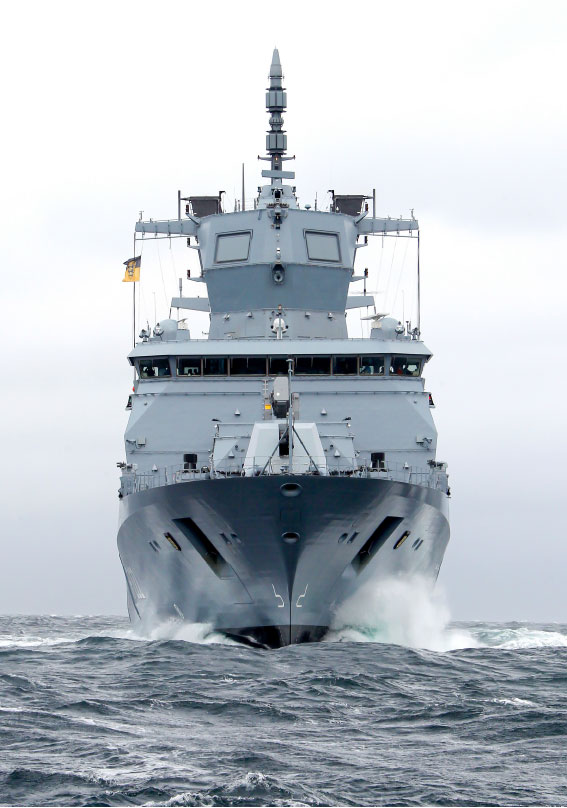
The Type 125 Class has a length of 149.5 meters and a beam of 18.8 meters. The designed draught is 5 meters. With a displacement of 7,200 tons in fully loaded, these vessels are the heaviest frigates in the German Navy.
The ship’s unique design with a twin island structure and all side surfaces at different angles demonstrate the high priority the German Navy places on survivability. The twin islands separate the key sensors, and the X design form largely reduces the radar echo of the ship.
The survivability factor is more than skin deep on these ships. Like Type 123 and Type 124 class frigates, Baden–Württemberg Class Frigates have triple armored girders and vital spaces such as magazines, CIC are provided with protection against splinters.
The Type 125 has the first CODLAG configuration in the German Navy. The two pairs of MTU 20V 4000 M53B diesel generators are located on different sections of the ships far apart as possible and provide up to 12MV of electrical power both for propulsion and hotel functions. These diesel engines power up two 4.7MW Siemens electric motors. With electric motors alone the ship can reach up to 20 knots. When the single GE LM2500 Gas Turbine is activated, all engines can propel the ship up to 26 knots. The cross connection of the electric motors and the gas turbine is made by a gearbox design by the RENK company.
The main offensive weapon on board the Baden-Württemberg class frigates are four RGM-84D Harpoon anti-ship missiles. It is possible that in the future these missiles are replaced by Saab RBS 15 MK3 missiles currently on board Braunschweig K-130 Class Corvettes or by Kongsberg Naval Strike Missiles to be fitted on the Type-126 class frigate later in this decade.
The main gun on the Type 125 Class is one 127mm/64 Leonardo gun. This gun is fully automated and is capable of using new Vulcano series extended range munitions. The Vulcano rounds have a range longer than 100km enabling ships to hit targets far inland and away from the shore. To combat asymmetrical surface threats such as fast boats or to provide additional protection against incoming air threats the ships are fitted with two Rheinmetal MLG 27 cannons. These remotely operated weapon stations, armed with a 27mm gun originally designed for the Tornado fighter planes, can fire 1,700 rounds per minute. Furthermore, these ships are armed with 5 12.7mm Leonardo Hitrole remotely controlled weapon systems. Three of these RCWS’s are located on top of the helicopter hangar, while the remaining two are located just aft of the main gun.
Like all other main surface vessels of the German Navy these frigates are fitted with RAM Mk31 guided weapon systems for close range against air borne threats. Two Mk31 launchers each carrying 21 RIM-116 RAM missiles are on board. One launcher is located just below the bridge and the other at the top of the helicopter hangar.
The sensors on board of the Type 125 frigates are divided in two groups and placed on each island. At least half of the sensors on board will survive and continue to function even if one of the islands receives a hit and becomes unusable.
The main sensor on board is the Hensoldt TRS-4D radar. This fixed panel radar has two panels on the front island and two panels on the aft island providing 360-degree coverage. According to the manufacturer, the instrumented range of the radar is 250km. It can detect targets with a 0.01m² RCS and track 1,500 targets. The frigates also have two sets of navigation and two sets of surveillance radars. There are two MSP-600 electro optical trackers. One of the prominent features on the front island is the large mast housing the KORA 18 RCESM system.
The ship has two separate helicopter hangars, each capable of holding one NH-90 size helicopter. However, according to the German Navy usually only Sea Lynx Mk88A type helicopters are embarked on missions.
Each ship carries four 10 meter rigid hulled inflatable boats, which are housed on both sides of the ship behind the covered bay. These boats have a range of around 130 kilometers and each transport a maximum of 15 passengers at up to 40 knots. They can be used to transport special forces, improve the protection of a civilian convoy against small, fast attackers or evacuate people in dangerous situations and in visit, board, search, and seizure (VBSS) missions.
One important aspect of the Baden-Württemberg Class Frigates is the attention given to their concept in enabling these ships to operate for extended periods away from Germany. Each of the four ships will have two sets of crews of 126 onboard. The frigates have space to accommodate an additional 70 persons.
When the decision to proceed with the next generation of frigates was made in early in the first decade of the 21st century the German Navy opted for a ship that it can use for stability missions, policing the high seas where the ship will face low to medium level threats.
First, after the annexation of Crimea by the Russian Federation and the fighting in the Donbass region of Ukraine made a once very distant notion of an armed conflict on European soil very real again.
Second, the increasing assertiveness of China and the increasing strength of the People's Liberation Army Navy forced the EU to look closer at the Indo-Pacific region. The German Navy deployed its frigate Bayern to this region to show the flag and to demonstrate that it is a reliable political instrument for Germany that can be used worldwide.
Both the Russian Navy and PLAN are peer adversaries of NATO and EU navies, and they need to be opposed symmetrically.
The German Navy should come up with new ways to use the Type 125 Class Frigates in this new threat environment otherwise the Baden-Württemberg Class Frigates designed and fitted for stability operations and policing missions may have already be rendered obsolete by the events that have happened since their conception and their commissioning