ADEX: Azerbaijan; the Door to Caucasia
The first of ADEX (Azerbaijan International Defence Industry Exhibition) took place in Azerbaijan’s capital Baku between 11th and 13th September 2014.
Azerbaijan is the largest country of the South Caucasia region and a total of 168 companies and associations from 33 countries attended the first ADEX. Equipment, weapons and armament for air, land and naval forces, defence systems, IT technologies, military logistics and technical support systems were displayed in the exhibition.
As it was organized for the first time just this year, compared with other international exhibitions, ADEX falls quite behind its rivals. Unfortunately, due to inconveniences in international delegation-official delegation participation, international attendance and organization, ADEX currently could not be considered as an international exhibition. However, one should acknowledge that Azerbaijan is very willing to adapt to the developing technology swiftly and is the rising country in its region. No matter how advantageous it is for Azerbaijan to exist in a region opening to Caucasia and Turkic Republics, ADEX’s ability to reach an international identity seems difficult in the short run. However, it is hard to deny that the exhibition would accomplish the aforementioned criteria within five years through required investments and a proper organization.
Considering the strong ties between Turkey and Azerbaijan, the most prominent country of the exhibition was undoubtedly Turkey. Participating in the exhibition with 37 companies and associations, Turkey managed to become the country to provide the greatest participation in ADEX 2014.
Minister of National Defence İsmet Yılmaz and Undersecretary for Defence Industries Prof. İsmail Demir represented Turkey in the official delegation and Aselsan, TAI, Havelsan, Roketsan, Otokar, MKEK, STM, Vestel Defence, AYESAŞ, Dearsan, Selah Shipyard, GATE, TEKSAV, Figes, Öztiryakiler ,İşbir, Milsoft, Turmaks, Makel, Timsan, Transvaro, Simsoft, Repkon, TÜBİTAK Bilgem, Foster, Sarsılmaz, Savronik, Yakupoğlu, TİSAŞ, Yonca-Onuk, Adam, AVS, C2tech, Eratash, Koza and Elibra companies took part in the Turkish Pavilion under the leadership of the Undersecretariat for Defence Industries (SSM).
The first day of the exhibition was very crowded due to the official opening and there was intensity in the Turkish pavilion. The Azerbaijan President İlham Aliyev paid a visit to the Roketsan and Aselsan stands accompanied by security guards on the first day of the exhibition. Aliyev obtained information from the representatives of Roketsan in company’s stand on Multi Barrel Missile Launcher “Kasırga” with a range of 150 km. Roketsan recently started delivering the launcher to Azerbaijan. From Azerbaijan, the Minister of Defence Yaver Camalov, National Security Minister Eldar Mahmudov and Azerbaijan’s Chief of Defence Necmeddin Sadıkov visited the Turkish stand during the exhibition. On the other hand, Minister of Defence İsmet Yılmaz, accompanied by the Undersecretary for Defence Industries and the delegation, visited the Turkish companies on the first day of the exhibition and gathered detailed information from the representatives of the companies on the products displayed and studies conducted in the region.
Strong Cooperation between Azerbaijan and Turkey is the Priority
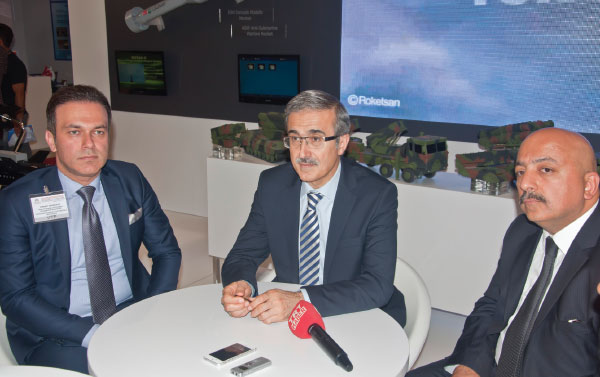
On the second day of the exhibition, Undersecretary for Defence Industries Prof. İsmail Demir and Defence and Aerospace Exporters’ Association’s Chairman Latif Aral Aliş met the press members and answered questions regarding the agenda and the exhibition. Demir stated that Turkey participated in ADEX 2014 held for the first time in Azerbaijan with 37 companies and associations under the auspices of SSM and said “Almost one-third of the exhibition arena consists of Turkish companies and this indicates the importance attached to Azerbaijan by Turkey”. Demir stressed that the two countries could cooperate in any area and mentioned that Azerbaijan’s defence industry was in progress and that it was taking importance steps towards this end. “Perhaps, they will go through the passages and difficulties we have been through and without hesitation we will convey our experiences to them and offer assistance as much as possible. We can create a comprehensive cooperation while taking such steps. Especially activities such as cooperating in certain areas, joint production, establishing facilities in two countries and operating them jointly, partnership in certain products, sales and even developing some products and introducing them to world market, conducting research and development studies in basic technology areas and involving the universities and research institutions may form the content of this cooperation” said Demir.
Rise in Defence Industry’s Export to Azerbaijan Continues
Defence and Aerospace Exporters’ Association’s Chairman Latif Aral Aliş commented on the status of the defence industry’s exports to Azerbaijan to press members. “Turkey accomplished an export of 18 million USD to Azerbaijan in 2013. This figure constitutes a ratio of 1.5% of all the defence industry’s exports in 2013. As of now, including August, the figure is at the level of 28 million USD. Compared with the previous year, this 60% increase is the indicator of a new era between the two countries, yet this rate in Turkey’s whole defence industry export has still not reached the expected level. With this increase rate, we expect that Turkey’s defence industry export to Azerbaijan will reach to 4% by the end of the year” said Aliş.
Odds are on which Party at T-LORAMIDS Program?
Undersecretary for Defence Industries Prof. İsmail Demir gave significant information to press members on T-LORAMIDS (Turkish Long Range Air Missile and Defence System) which is amongst Turkey’s priority issues and still remained uncertain.
Before taking these comments into consideration, let’s examine the 12-month-period briefly. What happened during the 1-year-period following the tender?
Within the scope of T-LORAMIDS Program, as per Defence Industry Executive Committee’s (SSIK) resolution of September 26, 2013, Turkey decided to initiate contract negotiations with the CPMIEC Company of People’s Republic of China. Turkey would be negotiating with the France-Italy consortium Eurosam in the second rank in case an agreement was not reached with the Chinese. However, almost 12 months passed over the SSIK’s resolution and a final result has still not been reached within the program. Turkey’s criteria especially on technology transfer and joint production is still not satisfied and this probably constitutes the greatest obstacle before the contract award. On the other hand, while talks with the Chinese party continues, in order to avoid other proposals in the tender losing their validity, Turkey decided to extend the validity of the proposals twice within this period for maintaining their validity (revision of the proposals). Undersecretariat for Defence Industries announced its latest extension decision with a written statement to the press members on August 26, 2014. In the Undersecretariat’s written statement, it was mentioned that the planned aerial defence system to be supplied is a complicated system which is composed of many systems and subsystems. It was stated that for the provision of such a system, according to Turkey’s strategic plan many detailed studies and examinations have been conducted on issues such as domestic infrastructure to be established, joint production areas, technology transfer, industrial participation and it was underlined that this progress was common. In this statement, it was also declared that the validity of the offers was extended once more until 31 December 2014. Following this written statement, a comment has been for the first time given from the top of the government. During the flight from NATO Summit in the beginning of September, President Recep Tayyip Erdoğan told the members of the press, “There have been some conflicts on joint production and know-how transfer at the missile defence system during talks with China. Nevertheless our colleagues are continuing the negotiations but France in the second rank made new offers. Currently, our talks with France also continue. Joint production is of vital importance to us”. Following this comment, during ADEX 2014, Undersecretary for Defence Industries was asked once more to comment on President’s statements and the future of T-LORAMIDS program. Prof. İsmail Demir said, “I read President’s comments as well. Please carefully evaluate those comments word by word, the words are selected very attentively, if you fully understand those words then the message is quite clear, there is not much to add. He really used the words very cautiously. I quote what the President said: ‘We have had some issues with China on know-how and technology transfer issues but the talks continue’. Our President made a statement exactly with these words. Our negotiations with the Chinese party continue, while all countries make new offers. We evaluate them but as I mentioned previously, there is one party with whom we conduct our contract negotiations very seriously and we went through the details of the contract with this party. Yet other offers are being presented and we do not intend to close our doors to anyone”. Undersecretary Demir added to his words that they were executing negotiations on the general framework of one of the offers.
In light of these statements from the top levels of the state, we understand that a break has been taken between the parties of Turkey and China. It is also understood that Turkey would not be taking a step unless its criteria on maximum domestic participation, industrialization, joint production and technology transfer are fully met. Currently, the ball is on Chinese side, but the French-Italian consortium is in the field now and is really eager to get the ball. What will happen within the coming 3-4 month period? Who will be getting the ball?
On the other hand, remarkable statements were made in ADEX 2014 regarding the Long Range Air Defence System that is planned to be developed with indigenous-local resources and progressing in parallel with the T-LORAMIDS program. Roketsan Chairman of the Board Dr. Eyüp Kaptan and Aselsan Chairman Hasan Canpolat made statements to Teoman Korkmaz from TRT (Turkish Radio and Television Corporation) in Baku and claimed they were ready to develop the Indigenous Long Range Air Defence Systems with Aselsan’s and Roketsan’s experiences in Low and Medium Altitude Air Defence Systems. “We discussed with Aselsan the technical framework. We reached a certain level on the low and medium altitude and we decided that we could repeat this achievement in high altitude as well. We believe we can accomplish this in a five-year period” said Roketsan’s Chairman Dr. Eyüp Kaptan. Undersecretary for Defence Industries Prof. İsmail Demir stated that independent from T-LORAMIDS, the program remained in their agenda and that Turkey did not give up on this program and continued its studies towards this end.
Final Draft Law on Interstate Sales similar to FMS reached
At ADEX 2014, Undersecretary for Defence Industries Prof. İsmail Demir commented on the Interstate Sales Law that will greatly reinforce Turkey in Defence Industry exports. Demir expressed that they have been working on this issue for a while and added “We matured the legislative studies for the Interstate Sales Law which was initiated in order to provide a mechanism that contains a state guarantee and convenient payment terms to the customers of Turkish defence industry products. This mechanism will be similar to Foreign Military Sales (FMS). As it is a draft, I can assess that it is at a highly advanced level in terms of our internal preparations. We are planning to introduce it soon to the relevant parties after completing the draft we work upon”.