Airbus in Spain: A Pillar of Aerospace Innovation and Global Impact

The story of Airbus Spain begins in 1923 with the founding of Construcciones Aeronáuticas S.A. (CASA) by José Ortiz-Echagüe. CASA quickly established itself as a trailblazer in European aviation, designing and manufacturing aircraft that laid the groundwork for Spain’s aerospace ambitions. A pivotal moment came with the invention of the autogyro by Juan de la Czerva, a precursor to modern helicopters that showcased Spain’s early engineering ingenuity. Over the decades, CASA collaborated on international projects, cementing its reputation as a key player in European aviation.
In 1970, the formation of Airbus Industrie as a European consortium marked a turning point. CASA’s expertise in aircraft design and manufacturing made it a natural partner, and Spain became one of Airbus’s four founding nations alongside France, Germany, and the United Kingdom. By 2000, CASA fully integrated into the European Aeronautic Defence and Space Company (EADS), which later rebranded as Airbus SE in 2015. This merger unified Europe’s aerospace capabilities, positioning Airbus Spain as a leader in the global market. Today, Airbus Spain accounts for 56.4% of the nation’s aerospace and defense revenues, a testament to its enduring legacy and forward-looking vision.
Airbus Spain’s success is powered by its workforce of over 14,000 employees, a diverse group of engineers, scientists, technicians, and support staff spread across eight sites in Madrid, Castile-La Mancha, and Andalusia. Approximately 9,000 employees work within Airbus Defence and Space, focusing on military aircraft and space systems, while around 3,400 are dedicated to commercial aircraft production. Airbus Helicopters employs over 500 professionals, primarily at its Albacete facility. This skilled workforce is bolstered by collaborations with over 1,300 Spanish companies, including industry leaders like Aernova, Indra, ITP Aero, and Siemens, creating a vibrant ecosystem that supports innovation and economic growth.
The company’s commitment to education and talent development is evident in initiatives like the Airbus Flying Challenge, which inspires students to pursue careers in aerospace. Airbus Spain also partners with universities, technology centers, and think tanks to foster research and development (R&D). With an annual R&D investment of €555 million and 42 European patents filed yearly, Airbus Spain ensures its workforce remains at the forefront of technological advancement. The company’s inclusive workplace culture, supported by employee resource groups and diversity initiatives, further enhances its ability to attract and retain top talent.
Airbus Spain operates a network of advanced facilities that serve as hubs for design, manufacturing, and innovation. In Getafe, near Madrid, the company produces horizontal stabilizers for all Airbus commercial aircraft and leads engineering efforts for unmanned aerial vehicles (UAVs) and mission systems. Getafe is also home to Airbus UpNext and the Zero Emission Development Centre (ZEDC), which focus on hydrogen-powered aviation and sustainable technologies. The Illescas facility specializes in carbon fiber composites, hosting Airbus’s global center of excellence for these lightweight, durable materials critical to modern aerostructures. ZEROe program aims to develop hydrogen-powered aircraft by 2035. ZEDC is researching hydrogen technologies, while Airbus UpNext explores disruptive innovations like hybrid propulsion and advanced aerostructures.
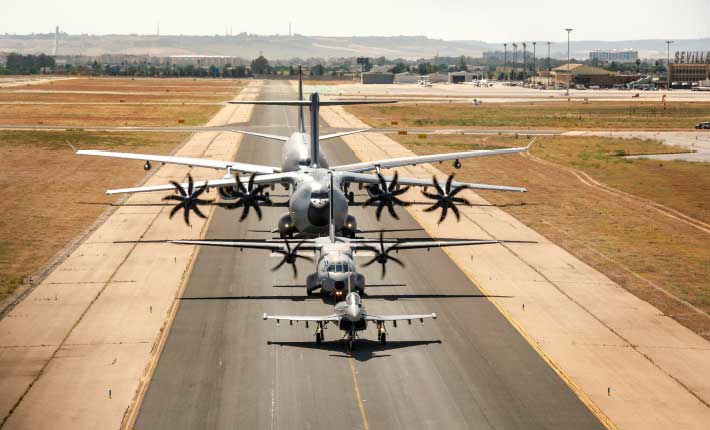
The San Pablo and Tablada sites in Seville form the epicenter of Airbus’s military transport business. These facilities house final assembly lines for the A400M Atlas, C295, and CN235, as well as maintenance and retrofit operations. Seville’s role in the Andalusian Aerospace Cluster strengthens regional collaboration by uniting suppliers, universities, and government stakeholders to enhance Spain’s global competitiveness. Contributing €3.57 billion to Spain’s GDP and supporting over 120,000 direct and indirect jobs through its supply chain. The company’s €2.2 billion annual investment in domestic suppliers fosters growth for small and medium enterprises, while its €4.3 billion in exports strengthens Spain’s global trade position.
Albacete serves as the headquarters for Airbus Helicopters in Spain, functioning as a global center of excellence for helicopter rear fuselages and producing components for the NH90 and Tiger helicopters. The site’s new logistics center supports European factories, reinforcing Albacete’s strategic importance. Supplying the Spanish Armed Forces, Guardia Civil, and National Police with models like the NH90, Tiger, and H135, the facility’s manufacturing capabilities include fuselage sections and tail booms, while its maintenance, repair, and overhaul (MRO) services ensure operational readiness for both civil and military fleets.
The Tres Cantos facility near Madrid focuses on space technologies, producing electronic products for satellites and exploration missions. Meanwhile, Puerto Real in Andalusia contributes to composite manufacturing, and the Barcelona site specializes in geo-information and defense solutions, supporting programs like Eurodrone. These facilities collectively enable Airbus Spain to deliver cutting-edge products across commercial, defense, and space sectors, while driving economic impact through a €2.2 billion annual supply chain investment and €4.3 billion in exports.
Airbus Spain’s activities span the full spectrum of aerospace innovation, from commercial aircraft to military transports, helicopters, and space systems. In the commercial sector, the company produces critical components like horizontal stabilizers and carbon fiber aerostructures for aircraft such as the A320, A330, and A350. Its expertise in composites, recognized globally through the Illescas center, enhances fuel efficiency and reduces emissions, aligning with Airbus’s goal of net-zero carbon emissions by 2050. Airbus Spain is also a powerhouse in the space sector, designing and manufacturing carbon fiber structures for launchers like Ariane 6 and Vega-C, as well as payload adapters and active antennas for missions such as Galileo and SPAINSAT NG. The Tres Cantos site produces instruments for European Space Agency (ESA) satellites, including SMOS and JUICE, and supports NASA’s Mars rovers with high-gain antennas and weather stations.
In defense, Airbus Spain leads the production of military transport aircraft, including the A400M Atlas, a four-engine turboprop designed for tactical and strategic missions. The Seville facilities assemble the A400M, C295, and CN235, while also supporting the Eurofighter Typhoon, Europe’s premier multirole fighter. The A330 Multi-Role Tanker Transport (MRTT), equipped with an innovative automatic air-to-air refueling system, exemplifies Airbus Spain’s advancements in dual-use civil-military technology. The company also plays a leading role in unmanned aerial systems, with Getafe driving development for programs like Eurodrone and Sirtap.
One of Airbus Spain’s flagship projects is the A400M retrofit program, a critical initiative to enhance the capabilities of the A400M Atlas airlifter. Since its introduction in 2013, the A400M has faced its share of challenges, from engine issues to structural concerns. To address these and enhance its capabilities, Airbus launched the A400M Retrofit Program, a comprehensive effort to upgrade the aircraft to meet modern operational demands. The retrofit program, primarily conducted at the Seville facilities, upgrades the aircraft’s avionics, propulsion systems, and mission capabilities to meet evolving NATO requirements. These enhancements improve the A400M’s interoperability, aerial refueling capacity, and medical evacuation functions, ensuring it remains a cornerstone of European defense.
A330 Multi-Role Tanker Transport: Strategic Excellence from Getafe and Seville
Assembled, converted, and upgraded at the Getafe and Seville facilities, the A330 MRTT transforms the commercial A330-200 airliner into a strategic platform for air-to-air refueling, troop transport, cargo delivery, and medical evacuation. With 76 units ordered by 15 nations and over 275,000 flight hours accumulated, the A330 MRTT is the world’s leading tanker-transport, delivering unmatched capability and interoperability, with Airbus Spain at the forefront of its development and support.
The A330 MRTT’s air-to-air refueling capabilities are powered by advanced systems designed and integrated in Getafe. The fly-by-wire Aerial Refueling Boom System (ARBS) delivers fuel at up to 3,600 kg/min, enabling rapid refueling of large aircraft like the C-17, F-15, and F-35A. Cobham 905E under-wing pods and the 805E Fuselage Refueling Unit provide hose-and-drogue refueling at 1,300 kg/min and 1,800 kg/min, respectively, supporting probe-equipped aircraft such as the Eurofighter Typhoon, Rafale, and C-130. The Automatic Air-to-Air Refueling (A3R) system, a pioneering technology from Airbus Spain, uses 2D/3D digital cameras and artificial intelligence to automate refueling, reducing operator workload and enhancing safety. An Enhanced Vision System (EVS) with high-definition cameras ensures day, night, and adverse-weather operations, with a 270-degree view and video recording capabilities.
Beyond refueling, the A330 MRTT acts as a strategic transport, carrying up to 300 passengers in a two-class configuration or 45 tons of cargo, including 26 NATO pallets or eight LD3 containers across three lower-deck compartments. Its 120 cubic meters of usable volume, unpenalized by additional fuel tanks, surpasses competitors like the KC-46 and IL-78. For medical evacuation, the aircraft accommodates up to 130 stretchers or two intensive care stations with 32 stretchers and 88 seats, enabling rapid conversion for humanitarian missions. With a range of 14,800 kilometers and 111 tons of fuel capacity, the A330 MRTT supports long-range deployments, as demonstrated by its ability to refuel four Typhoons from the UK to Nevada in two days, compared to four with legacy tankers.
Airbus Spain’s Getafe site leads the integration of the Air Refueling Console, located in the cockpit for enhanced crew coordination, while Seville’s Tablada facility handles conversions, maintenance, and upgrades, including IFF Mode 5 and ADS-B systems. The aircraft’s glass cockpit, featuring advanced avionics and fly-by-wire controls, reduces pilot workload, with side-stick controllers and reconfigurable screens ensuring precise operation. The Smart MRTT initiative, driven by Airbus Spain, introduces enhanced connectivity (Link 16, SATCOM), automation (A3R, Enhanced Maintenance and Adjustment System), and covert operation capabilities, positioning the aircraft for future missions. Operated by Spain’s Air and Space Force and nine other air forces, the A330 MRTT has achieved a 97% mission success rate in deployments, from Middle East operations to global relief efforts. Airbus Spain’s tailored in-service support, including the DCare package and Seville’s training facilities, ensures high availability through maintenance, repair, and overhaul services.
The Airbus C295: A Versatile and Reliable Tactical Airlifter
Earning its reputation as a reliable workhorse for armed forces across the globe, the Airbus C295 stands as a cornerstone in modern tactical airlift. With 215 aircraft contracted by 33 operators in 30 countries, the C295’s widespread adoption underscores its exceptional performance, versatility, and cost-effectiveness. Accumulating over 500,000 flight hours, with the fleet leader exceeding 7,000 hours, the C295 has proven its durability and dependability in demanding operational environments.
Designed to address the evolving needs of modern armed forces, the C295 excels in a variety of conditions, from day or night operations to civil or military airspace. It performs equally well in extreme temperatures and on diverse terrains, whether operating from a main base with a paved runway or a remote dirt airstrip. Its reliability shines during arduous deployments, achieving availability rates above 95%. For instance, the Spanish Air Force deployed two C295s to Chad for 11 months, logging approximately 160 flight hours per month in support of a EUFOR mission, demonstrating the aircraft’s robustness and ease of maintenance.
The C295 boasts the longest cabin and largest floor area in its class, measuring 12.69 meters in length with an obstruction-free design. This spacious cabin enables transport of up to 70 troops, 48 paratroops plus a jumpmaster, eight containers, five pallets, 24 stretchers with seven medical attendants, or six VIPs with 24 support staff. A self-propelled pallet transfer system on the ramp facilitates rapid loading and unloading of 88” x 108” cargo pallets, even in austere locations without forklifts. The three-meter-long cargo ramp extends fully to the ground, allowing wheeled or tracked vehicles to be driven on and off with ease.
With a maximum cruise speed of 480 km/h, a normal operating altitude of 7,620 meters, and a ferry range of 5,750 km, the C295 offers impressive performance. Its payload capacity ranges from 6,000 kg over 2,000 nm to 3,000 kg over 2,700 nm, with a maximum range of 3,100 nm without payload. The aircraft’s dimensions, including a 27.59-meter wingspan and 24.50-meter length, combined with its ease of reconfiguration and low operating costs, make it the market leader in its category. The Airbus C295 continues to set the standard for tactical airlift, delivering unmatched reliability, versatility, and value to operators worldwide.
Powered by two Pratt & Whitney Canada PW127G turboprop engines, each driving a six-bladed Hamilton Sundstrand Type 568F-5 propeller, the C295 benefits from a power plant with a proven track record. The PW100 engine series has accumulated 160 million operating hours across more than 6,000 aircraft worldwide. The aircraft’s strong landing gear is designed for routine operations on rough, unpaved surfaces, allowing landings at maximum takeoff weight with a sink rate of up to 10 feet per second. The landing gear’s flotation characteristics permit over 200 passes on airfields with a California Bearing Ratio (CBR) index of 4, such as turf or moist clay, making it accessible to terrains unsuitable for heavier airlifters. The C295 can start its engines using only its batteries, allowing operations in remote areas without ground support equipment. The left engine features a propeller brake, enabling the gas generator to function in APU mode, delivering electrical power and bleed air for aircraft systems without time limitations. This system provides the functionality of an onboard APU at a fraction of the cost, weight, and complexity.
The C295’s avionics suite features Collins Aerospace Pro Line Fusion. Four 14.1-inch touchscreen displays provide an intuitive human-machine interface, reducing pilot workload through reconfigurable screens, graphical flight planning, and electronic checklists. The system incorporates synthetic vision, terrain awareness and warning systems, and overlaid weather radar information, enhancing situational awareness. Optional features include a head-up display and enhanced vision system. The avionics are future-ready, complying with current and forthcoming requirements such as ADS-B Out, TCAS II v7.1, and RNP/RNAV, ensuring long-term operational relevance.
The C295 achieves the highest aircraft availability and lowest life cycle cost in its segment, with a life cycle cost 50% lower than competitors, saving tens of millions of dollars in fuel and maintenance over its operational life. Its design minimizes weight, maintenance, and operational costs, ensuring ease of maintenance and high availability. The aircraft’s performance on short and soft unpaved runways further enhances its operational flexibility, requiring only 670 meters for takeoff and 320 meters for landing under standard conditions