The Evolution of A400M `Atlas` Europe`s Tactical and Strategic Airlifter

The A400M's story begins in the early 1980s with the formation of the Future International Military Airlifter (FIMA) group in 1982. Established as a collaborative effort among Aérospatiale (France), British Aerospace (UK), Lockheed (USA), and Messerschmitt-Bölkow-Blohm (MBB, Germany), FIMA aimed to develop a modern replacement for aging tactical airlifters like the Lockheed C-130 Hercules and Transall C-160. The goal was to create an aircraft with greater payload capacity, extended range, and enhanced versatility to meet the diverse requirements of NATO-aligned air forces. Progress was slow due to differing national requirements and the complexities of international politics. In 1989, Lockheed withdrew from FIMA to focus on its C-130J Super Hercules, a modernized version of the C-130. The remaining partners, joined by Alenia (Italy) and CASA (Spain), reorganized as the European Future Large Aircraft Group (EUROFLAG). By 1995, the Airbus Military took over the program, formalizing the aircraft's designation as the A400M. The project transitioned from conceptual studies to a concrete development plan, with a focus on a turboprop-powered aircraft to balance tactical agility with strategic reach.
Project History
The Airbus A400M Atlas is a European four-engine turboprop military transport aircraft designed by Airbus Military (now Airbus Defence and Space) to meet the evolving needs of modern air forces. Positioned as a tactical airlifter with strategic capabilities, it bridges the gap between the Lockheed C-130 Hercules and the larger Boeing C-17 Globemaster III. The A400M is praised for its ability to carry heavy and oversized loads, operate from short and unpaved airstrips, and perform diverse missions such as aerial refueling, medical evacuation, and humanitarian aid delivery.
The A400M program faced significant hurdles during its development phase. A contract for 212 aircraft was signed in May 2003 between Airbus Military and the Organization for Joint Armament Cooperation (OCCAR), representing Belgium, France, Germany, Italy, Spain, Turkey, the United Kingdom, and Luxembourg. However, Italy later withdrew, reducing the order to 180 aircraft. The program was initially slated for a first flight in 2008 and deliveries starting in 2009, but technical and financial challenges delayed these milestones.
One major issue was the selection of the Europrop TP400-D6 turboprop engine, developed by a consortium including Rolls-Royce, Safran, and MTU Aero Engines. Political pressures favored a European engine over a competing Pratt & Whitney Canada PW180, despite the latter's lower cost and maturity. The TP400-D6, a new design, encountered development delays due to software issues and the inexperience of the consortium, contributing to a three-year schedule slip. Airbus CEO Tom Enders later acknowledged that underestimating engine challenges was a significant misstep. Financially, the program was plagued by cost overruns. By 2009, the A400M was €5 billion over budget, with a PricewaterhouseCoopers (PwC) audit projecting a potential €11.2 billion overrun. Airbus admitted the program would lose at least €2.4 billion and could not break even without export sales. Between 2009 and 2010, the program faced cancellation threats as nations like South Africa (which canceled its order for eight aircraft) and others considered alternatives like the C-130J. To salvage the project, partner nations provided a €1.5 billion loan in November 2010, and order reductions were negotiated: Germany cut from 60 to 53 aircraft, and the UK from 25 to 22, lowering the total to 170.
Beyond engine issues, the A400M faced other technical challenges. In 2009, reports surfaced that the aircraft was overweight, potentially limiting its payload capacity to 29 tons instead of the targeted 32 tons. This raised concerns about its ability to carry heavy military vehicles like the Puma infantry fighting vehicle. Airbus implemented weight-reduction measures to address this. In 2011, quality control checks revealed cracking in a fuselage part made from a 7000-series aluminum-zinc alloy. While not a safety concern, the issue required repairs during regular maintenance and led to the alloy's exclusion from future aircraft.
A tragic setback occurred on May 9, 2015, when an A400M intended for the Turkish Air Force crashed during a test flight in Seville, Spain, killing four crew members. The crash, attributed to a software error in the engine control system, prompted a temporary grounding of A400Ms in several countries. France limited its fleet's operations, and Spain halted testing until the cause was resolved. The incident underscored the risks of a complex development program but did not derail the project.
Despite these challenges, the A400M achieved key milestones. The first flight took place on December 11, 2009, from Seville Airport, Spain, with the aircraft, nicknamed "Grizzly" during testing, completing a three-hour test flight. In March 2013, the A400M received European Aviation Safety Agency (EASA) certification, paving the way for deliveries. The first production aircraft was delivered to the French Air Force on August 1, 2013, marking the start of operational service. The A400M's development showcased multinational collaboration, with components manufactured across Europe: wings in the UK, fuselage in Germany, cockpit and landing gear in France, and final assembly in Seville, Spain. Airbus Beluga transporters facilitated the movement of major assemblies, and the program aimed for a production rate of 30 aircraft per year.
A400M Retrofit Program Overview
Airbus also has an ongoing retrofit program to bring older aircraft, delivered at an earlier standard, to the same standard as those aircraft now rolling off the production line. The retrofit applications include different capability standards (Standard of Capability/SOC) determined by Airbus Defence & Space Company for A400M Retrofit operations. There are three different levels of retrofit for A400M Aircraft: SOC 2, SOC 2.5, and SOC 3. Airbus, in collaboration with the Organisation for Joint Armament Cooperation (OCCAR), launched the retrofit program to bring all A400Ms up to the latest capability standards, ensuring they can perform complex missions like low-level flight, parachute drops, and aerial firefighting while improving reliability and safety.
The retrofit program touches nearly every aspect of the A400M, from its engines to its defensive systems. Here’s a look at the major enhancements:
Engines and Propellers: The A400M’s EuroProp TP400-D6 engines have been a focal point. Early issues with propeller gearboxes led to a permanent fix, known as Pack-II, which includes upgraded gearboxes and torque sensors. Since July 2022, new aircraft are delivered with these improvements, and older ones are being retrofitted to match. These upgrades boost engine reliability, critical for demanding missions.
Tactical Capabilities: The A400M can now perform simultaneous parachute drops from both side doors, carrying up to 116 paratroopers. It supports automatic low-level flight at altitudes as low as 150 feet and precise air supply missions.
Defensive Systems: To counter missile threats, the A400M is being equipped with advanced Directed Infrared Countermeasure (DIRCM) systems. Germany’s air force uses Elbit Systems’ J-MUSIC, while Spain’s A400Ms are fitted with Indra’s IndShield. These systems enhance survivability in hostile environments.
Avionics and Software: Upgraded avionics and software improve mission planning and execution. Notably, software fixes have addressed critical issues, such as a 2015 crash caused by faulty fuel supply management, ensuring safer operations.
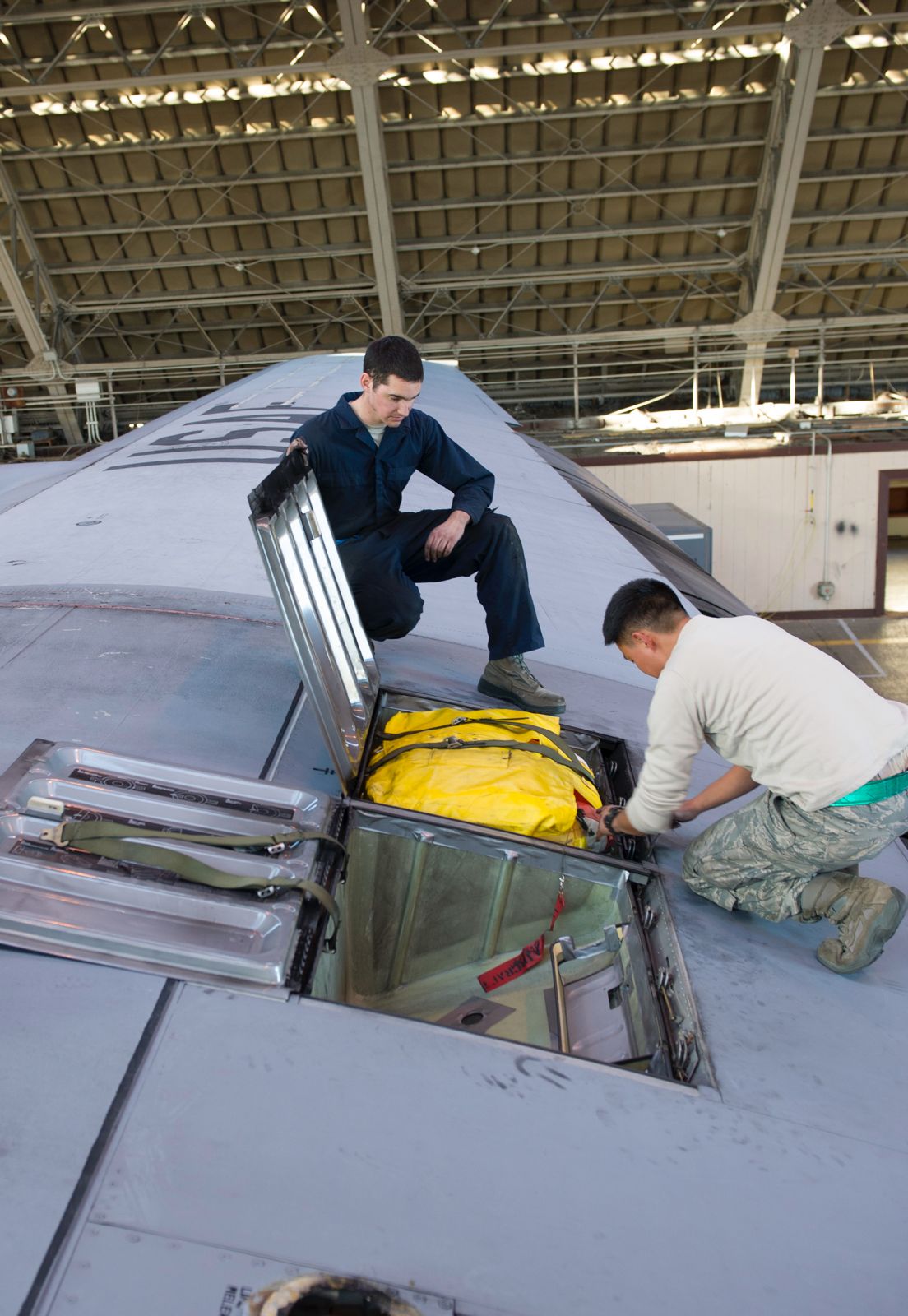
Structural Fixes: A key retrofit replaces a 7000-series aluminium-zinc alloy in fuselage frames, which showed cracking risks. This complex process, which can take up to seven months per aircraft, ensures long-term structural integrity.
Firefighting Capability: In a nod to emerging needs, Airbus developed a roll-on/roll-off firefighting kit, tested in 2022 and 2023. This kit allows the A400M to drop 20,000 liters of fire retardant without requiring permanent modifications, offering a flexible solution for disaster response.
The retrofit program is a global effort, with work concentrated at specialized facilities. The primary hubs are Airbus’s Final Assembly Line in Seville and the Getafe facility near Madrid. Getafe has expanded to handle four aircraft at once, with upgraded hangars and tooling to streamline retrofits. Turkey’s 2nd Air Maintenance Factory Directorate in Kayseri is certified to perform depot-level maintenance and retrofits for the Turkish Air Force’s A400Ms. Since starting its first retrofit in December 2020, Kayseri has completed upgrades on five of Turkey’s ten aircraft by June 2023. Its efficiency—completing retrofits in under two months compared to six months abroad—has saved time and resources, positioning Kayseri as a potential hub for allied nations. Only four facilities worldwide, including Seville, Getafe, and Kayseri, are equipped to perform these retrofits, underscoring the program’s technical complexity.
Technical Specifications and Capabilities
The A400M Atlas is a high-wing, four-engine turboprop aircraft powered by Europrop TP400-D6 engines, each delivering 11,000 shaft horsepower. The A400M incorporates a fly-by-wire flight control system, featuring sidestick controllers and built-in flight envelope protection. It boasts a full glass cockpit, which is consistent with other Airbus designs. Many of its systems draw inspiration from the A380 but are tailored for military applications. The aircraft uses a dual hydraulic system operating at 20.7 MPa (3,000 psi), which drives the primary and secondary flight controls, landing gear, brakes, cargo door, and an optional hose-and-drogue refueling system. It relies on two electrical systems: one with dual channel electrically powered hydraulic actuators and another with hybrid actuators that combine electrical and hydraulic power. This varied redundancy enhances resilience against combat damage.
The aircraft is 45.1 meters long, has a wingspan of 42.4 meters, and stands 14.7 meters tall. Its maximum takeoff weight is 141,000 kg, and it can carry a maximum payload of 37,000 kg. The cargo compartment measures 17.71 meters long, 4 meters wide, and 3.85 meters high, with the height extendable to 4 meters behind the wing. The A400M cruises at Mach 0.72, equivalent to 485 mph or 780 km/h. It has a maximum range of 8,900 km with no payload or 4,500 km with a 30,000 kg payload. The service ceiling is 40,000 feet, and it requires 980 meters for takeoff and 770 meters for landing on tactical runways.
Over 30 percent of the A400M's structure utilizes composite materials. Its 42.4-meter (139-foot) wing, primarily constructed from carbon fiber-reinforced plastic, includes components like the wing spars and the 19-meter (62-foot) long wingskins, which range from 12 to 14 mm (0.47 to 0.55 inches) in thickness. The wing, weighing approximately 6,500 kg (14,330 lb), can hold and lift up to 25,000 kg (55,116 lb) of fuel. It features an aspect ratio of 8.1, a 5.6-meter (18-foot) wide chord, and a 15-degree sweep at 25 percent of the mean aerodynamic chord.
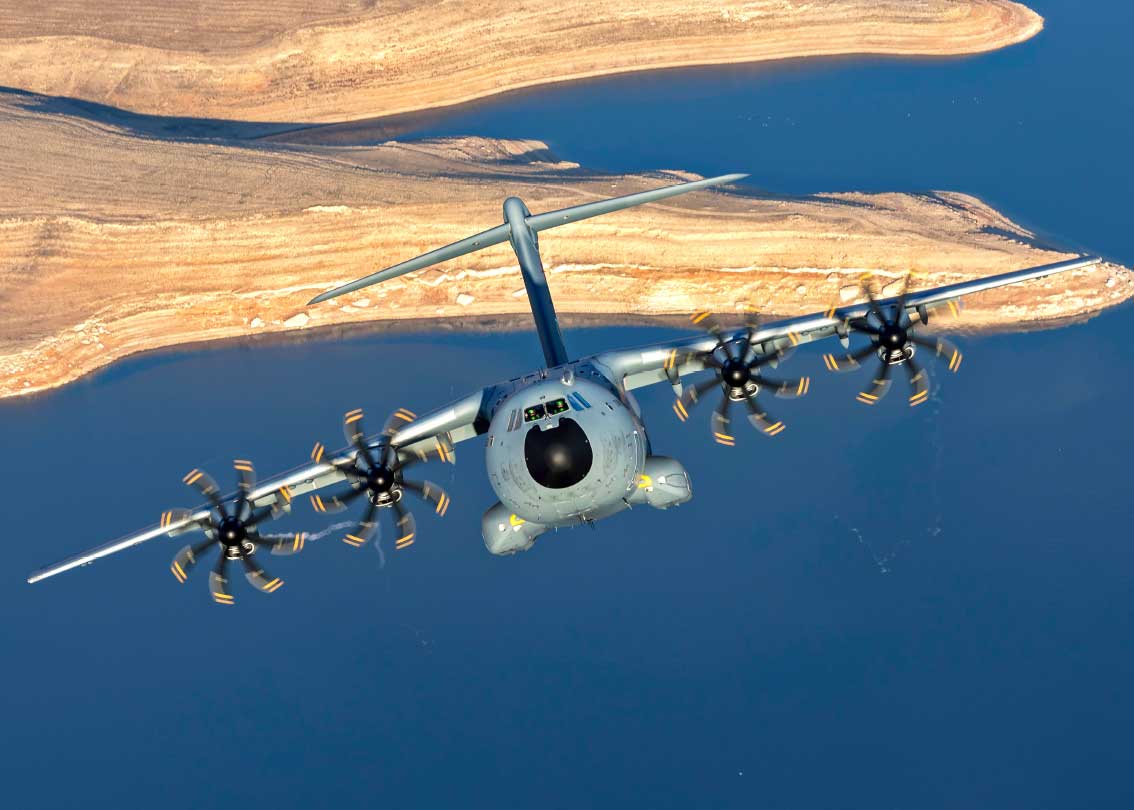
The A400M has a T-tail configuration, with an 8.02-meter (26.3-foot) tall vertical stabilizer and a 19.03-meter (62.4-foot) wide horizontal stabilizer, swept at 32.5 degrees. Its Ratier-Figeac FH385 and FH386 propellers rotate in opposite directions—counterclockwise for the former and clockwise for the latter. These eight-bladed scimitar propellers are crafted from woven composite materials. Four Europrop TP400-D6 engines, each delivering 8,250 kW (11,000 hp), power the aircraft, making the TP400-D6 the most powerful turboprop engine in Western operational use.
On each wing, the propeller pair rotates in opposite directions, with blade tips moving downward toward the midpoint between the engines. This differs from most multi-engine propeller aircraft, where propellers typically spin in unison. The A400M achieves this counter-rotation through gearboxes on two engines, allowing the propellers to turn opposite while the engines themselves remain identical. This setup simplifies maintenance by eliminating the need for different engine types. Known as the down-between-engines (DBE) configuration, it boosts lift, reduces torque and prop wash on the wings, and minimizes yaw if an outboard engine fails. As a result, the vertical stabilizer is 17 percent smaller, and the horizontal stabilizer is reduced by 8 percent.
The A400M is designed for versatility, performing well in tactical and strategic airlift, aerial refueling, and medical evacuation. It can carry up to 116 fully equipped paratroopers, 66 stretchers with 25 medical personnel, or 37 tons of cargo, including heavy vehicles, helicopters, or 40-foot ISO containers. It supports mixed paratrooper and cargo drops and can perform airdrops from 150 feet to 38,000 feet. For tactical operations, the aircraft's 12-wheel main landing gear and turboprop engines with protection against Foreign Object Damage (FOD) allow it to operate on short, unpaved, or rough airstrips. Its Automatic Low-Level Flight capability, certified for both visual and instrument conditions, enhances its tactical flexibility.
The A400M is equipped with a forward-looking infrared enhanced vision system (EVS) camera that improves visibility in challenging conditions like fog or darkness. This EVS feed is projected onto the head-up display (HUD), aiding pilots during low-altitude tactical flights, especially at night or in cloudy skies. For missile defense, EADS and Thales supply the Multi-Colour Infrared Alerting Sensor (MIRAS), enhancing the aircraft's threat detection capabilities.
A detachable refueling probe, positioned above the cockpit, enables the A400M to refuel mid-air from drogue-equipped tankers. Alternatively, this probe can be swapped for a fuselage-mounted UARRSI (Universal Aerial Refueling Receptacle Slipway Installation) receptacle to connect with boom-equipped tankers. The A400M carries up to 51 tons of internal fuel. When configured as a tanker, the A400M can be fitted with either two wing-mounted hose-and-drogue refueling pods or a central Hose and Drum unit, delivering fuel to other aircraft at a rate of 2,640 lb/min (20.0 kg/s). For paratroop operations, deployable baffles near the rear side doors shield jumpers from the aircraft's slipstream, giving them time to safely clear the plane.
The A400M aircraft is fitted with a Defensive Aids Sub-System (DASS) incorporating a Missile Warning System (MWS), Radar Warning Receiver (RWR), and SAPHIR-400 Expendables Dispensing System to eject flares and radar-confusing chaff. The DASS for all A400Ms is integrated by Airbus Defence and Space at Ulm. Airbus Defence and Space selected the J-MUSIC Directed Infrared Counter Measure (DIRCM) system as part of the A400M Defensive Aids Sub-System (DASS) for the German Air Forces' Airbus A400M aircraft. The DE DIRCM system is provided by Diehl Defence GmbH & Co. KG, which is based on a J-MUSIC™ System from Elbit Systems Ltd.
The A400M excels in short-field performance, operating from runways as short as 770 meters, making it ideal for austere environments. The RAF has demonstrated its ability to land on beaches in South Wales for training exercises. Compared to the C-130J, the A400M has a 50% larger cargo hold, double the payload, and a cruise speed of 100 mph faster. It is more fuel-efficient than the C-17 at low altitudes but faster than the C-130 at higher altitudes, making it a unique blend of tactical and strategic capabilities.
User Countries
As of February 2025, ten countries have ordered the A400M, with 130 aircraft delivered and 48 orders still pending. No delivered aircraft have been retired. Below is a breakdown of user countries, their inventory, and operational roles.
France
France ordered 50 aircraft and has received 24 as of 2025. They are based at Orléans-Bricy Air Base, operated by Transport Squadrons 1/61 Touraine and 4/61 Béarn. France was the first to receive the A400M in August 2013 and has used it extensively in military and humanitarian missions. These include Operation Serval in Mali in 2013 for airlifting troops and equipment, Operation Chammal against ISIL from 2014 to the present for transporting equipment to Jordan, Operation Barkhane in the Sahel from 2014 to 2022 for anti-terrorism efforts in Niger and Chad, Operation Apagan in Afghanistan in 2021 for evacuating personnel from Kabul, Operation Sagittaire in Sudan in 2023 for evacuations, and Operation Pégase from 2022 to 2023 for supporting Rafale deployments to Indo-Pacific territories. France reduced its order from 70 to 50 aircraft in 2013 due to budget constraints and bought four C-130Js in 2016 to address the A400M's limitations in helicopter refueling.
Germany
Germany ordered 53 aircraft, reduced from 60, and has received 47 as of 2025. They are based at Wunstorf Air Base, with plans for a multinational airlift wing at Lechfeld Air Base canceled in 2022 due to a lack of interest from partners. German A400Ms supported evacuations in Kabul in 2021, airlifting 5,347 people over 35 flights, and anti-ISIL operations in 2019, where a German A400M tanker replaced an Airbus A310 MRTT in Jordan for refueling allied aircraft. Germany tried to sell 13 surplus A400Ms but, unable to find buyers, integrated them into service. The Luftwaffe also operates C-130Js for specialized missions.
United Kingdom
The UK ordered 22 aircraft, reduced from 25, with all delivered by May 2023. They are based at RAF Brize Norton, operated by No. LXX Squadron and No. XXIV Squadron for training. Designated Atlas C.1, the RAF's A400M replaced the C-130J fleet by 2023. It has been used for humanitarian missions like relief operations in the Caribbean after Hurricane Irma in 2017 and COVID-19 response efforts, including transporting patients, equipment, and vaccines. It also supported evacuations in Kabul in 2021, airlifting 17,000 people, and in Sudan in 2023, as well as Gaza airdrops in 2024 to deliver supplies. The A400M has airlifted personnel and cargo for NATO operations following Russia's invasion of Ukraine. The RAF considered buying more A400Ms but found them unaffordable, so it instead focused on an Availability Improvement Programme. The Enhanced Vision System was critical during the Kabul airlift in low-visibility conditions.
Spain
Spain ordered 27 aircraft and has received about 14 as of 2025. They are based at Zaragoza Air Base and have supported Kabul evacuations in 2021 and NATO airlift operations, as well as domestic and international humanitarian missions. Spain has 13 outstanding orders, indicating steady integration into its air force.
Türkiye
Turkey ordered and received 10 aircraft by 2022. Based at Kayseri Air Base and operated by the 12th Air Transportation Main Base Command, they supported Kabul evacuations in 2021 and regional humanitarian missions. Turkey joined the program in 1988, Turkish Air Force received its first A400M Aircraft in April 2014 and the 10th and last A400M Aircraft in March 2022. The A400M has demonstrated outstanding performance in Turkey since it entered service in 2014. As of April 2024, the A400M fleet of 10 aircraft within the Turkish Air Force has completed more than 15,000 flight hours (as of April 2019, this period was 4,000 hours) and achieved an impressive mission readiness rate of 75%.
The 2nd Air Maintenance Factory Directorate was certified by Airbus Defence and Space (ADS) to provide C-Level Overhaul (C-Check) service for A400M Aircraft after a year-long inspection, and the certificate was presented at a ceremony held in February 2018. CL (Intermediate Level) and CH (Depot Level) maintenance have been carried out for A400M Aircraft by the 2nd Air Maintenance Factory Directorate since 2017. The maintenance periods in question are 24 months at the C1-L level, 48 months for C2-L, 96 months for C3-L, and 144 months for C2-H. CL maintenance is completed within 45 working days, and CH maintenance is done within 75 working days. Heavy Maintenance, which usually lasts 6 months, is carried out in accordance with EMAR-145 (European Military Airworthiness Requirements) standards, and the working personnel have the A400M Type Certificate.
The A400M Aircraft Maintenance-Repair-Retrofit Contract was signed between ADS and ASFAT (Ministry of National Defense - Military Factory and Shipyard Management Inc.) at a ceremony held on October 3, 2019. The contract paved the way for the 2nd Air Maintenance Factory Directorate to provide retrofit services for the A400M Aircraft in the Turkish Air Force's inventory and the A400M Aircraft in the service of friendly and allied countries in the region. The 2nd Air Maintenance Factory Directorate is currently the only maintenance center in the world that can retrofit outside Airbus facilities.
The first retrofit activity for the A400M aircraft began on December 7, 2020, and was completed on July 30, 2021. As part of the project, the second aircraft was delivered to the Turkish Air Force on April 7, 2022, the third aircraft on October 27, 2022, the fourth aircraft on May 2, 2023, and the fifth aircraft on 3 November 2023, AMFD is still continuing to sixth & seventh aircraft retrofit activities in their facilities.
Belgium
Belgium ordered and received 7 aircraft by 2023. Operated by the 15th Wing at Melsbroek Air Base, they participated in the Kabul airlift in 2021 and support NATO and humanitarian missions, often coordinated with European partners. Belgium's small fleet is highly active in multinational operations, supported by shared logistics through the Movement Control Center Europe.
Malaysia
Malaysia ordered and received 4 aircraft by 2017. Operated by the Royal Malaysian Air Force at Subang Air Base, they are used for regional transport, humanitarian aid, and disaster relief, taking advantage of the A400M's ability to operate from austere airstrips in Southeast Asia. Malaysia, the first non-European operator, joined the program in 2005, expanding the A400M's global presence.
Luxembourg
Luxembourg ordered and received 1 aircraft in 2020. Operated jointly with Belgium's 15th Wing at Melsbroek Air Base, it supports NATO missions and humanitarian operations, often in collaboration with Belgian forces. The single aircraft reflects Luxembourg's modest but symbolic contribution to the program.
Kazakhstan
Kazakhstan ordered 2 aircraft in 2021, with potential for more, and received 1 aircraft in December 2025. The A400Ms are intended for strategic airlift and regional support to enhance Kazakhstan's military and humanitarian capabilities. Kazakhstan became the ninth customer, signaling the A400M's growing appeal in Central Asia.
The A400M has 178 total orders, with 130 delivered and 48 pending. Outstanding orders include 26 for France, 13 for Spain, 6 for Germany, 2 for Indonesia, and 1 for Kazakhstan. Indonesia's 2021 order for two A400Ms includes options for four more, potentially expanding its fleet to six. Australia has evaluated the A400M to replace its aging C-130J fleet but has not placed orders. Airbus proposed 118 A400Ms to the USAF Air Mobility Command, leveraging its Alabama facility, but political and economic barriers make this unlikely soon. Other countries with aging C-130 fleets, like Canada and Chile, may consider the A400M in the future, as may India, though no firm commitments exist.
Airbus aims to produce 30 A400Ms annually at its Seville plant, though delivery rates vary due to demand and technical issues. The program reached a milestone in May 2021 with the 100th aircraft delivered. Most operators expect remaining deliveries by 2025, with Indonesia's deliveries extending beyond this timeline.
The A400M has logged over 200,000 flight hours, proving its reliability across diverse missions. It has delivered aid after natural disasters like Hurricane Irma in the Caribbean in 2017, wildfires in the UK, and during the COVID-19 response, transporting vaccines and medical equipment. In conflict zones, it has supported operations in Mali, Afghanistan, Sudan, and against ISIL, operating in high-threat environments. Since Russia's invasion of Ukraine in 2022, European A400Ms have airlifted personnel and cargo and refueled fighter jets on NATO's eastern borders. The aircraft's tactical capabilities have also led to evaluations for aerial firefighting roles, particularly for wildfires in Europe. With 178 orders, the A400M is the world's second most popular medium-lift tactical airlifter after the C-130J, which has 252 orders across 21 countries. Its superior payload, range, and speed make it a top choice for nations seeking a modern, multi-role airlifter