An Overview on Turkish Land Platforms

By Cem Akalın
Main Battle Tank
TNMBT Altay Project
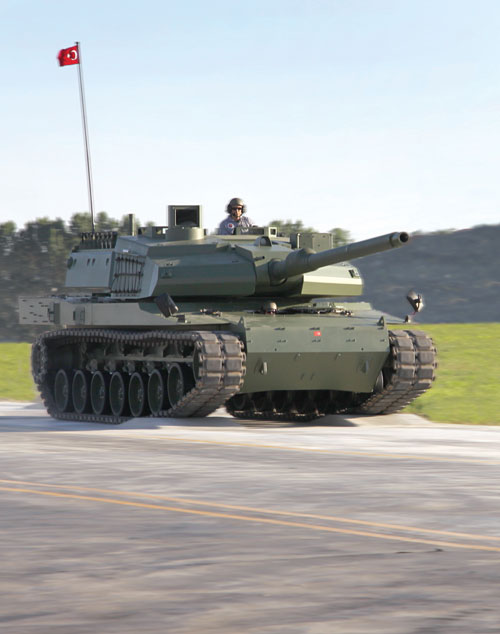
SSM signed Altay Project Phase I contract with Otokar, which covers the design, development, production, test and qualification of the Turkish National Main Battle Tank (TNMBT) Prototypes in 2008. The prime contractor Otokar’s subcontractors in this Project are MKE, Aselsan, Roketsan, MTU/RENK and Rotem (South Korea). Within the scope of the Project, MKE designs and produces 120 mm 55L Main Gun System; Roketsan shall design, develop and produce Modular Armour Package; Aselsan designs and produces Fire Control System and Command Control Communication Information System; MTU/RENK, shall develop and produce 1500hp Euro-Power-Pack. Besides, Rotem – South Korean Company – provides technical consultancy to MKE and Roketsan in this Project. According to Project Implementation Schedule, Phase I of the Project lasts for 78 months and consists of the following 3 stages: Stage I: Conceptual Design; Stage II: Detailed Design; Stage III: Prototype Development, Qualification and Acceptance. Following the completion of "Conceptual Design Phase" in 2010, the mock-up of Altay tank was introduced to public in IDEF 2011.
The "Preliminary Design Phase" taking part within the scope of the second critical "Detailed Design Phase" was completed within the last quarter of 2011. During this phase, the production of preliminary prototypes was initiated in parallel. In Altay Project, two preliminary test prototypes, Mobility Test Rig (MTR) and Firing Test Rig (FTR) will be developed and tested. According to the test results of these Test Prototypes, the design of Altay tank will be upgraded and Detailed Design Stage will be completed. MTR prototype was completed in October and the test phase was initiated. MTR covered over 2000 km within a month after the completion of prototype.
FTR prototype was completed before the planned date; the firing control system and gun of which was planned to be mounted at the end of November and set its stall out in the presentation of Altay Main Battle tanks’ prototypes at Otokar facilities on November 15th. The firing tests of FTR prototype are planned to be made in the first months of 2013. On the other hand, the tests will be conducted for the two prototypes and the outcomes of trial-and-error and performance verification will apply to the main prototypes. These main prototypes are planned to be produced in 2014 and 2015. The production of all prototypes and implementation of all tests are planned to be completed at the end of 2015. Following the delivery of four prototypes and submission of technical data package to the Undersecretariat for Defence Industries, the Altay Project will be concluded. Depending on the success of the produced prototypes and based on the needs of Turkish Armed Forces and facilities of the period, the mass production in Altay Project will commence in 2016.
The Future of Main Battle Tank; Altay
Altay is a third-generation main battle tank and it is named in honour of Army General Fahrettin Altay (1880–1974) who commanded the 5th Cavalry Corps in the final stage of the Turkish War of Independence. The front side of the tank will have special modular reactive composite armour protection. Altay will be protected against chemical, biological and radioactive (CBR) attacks. The tank is projected to have a 120 mm smoothbore gun in 360 degree powered traversing turret allowing for unfettered engagement of targets from any angle. TNMBT will use an advanced computerised Aselsan’s Volkan-III modular fire control systems (FCS). Aselsan has successfully completed the development and started the serial production of Volkan FCS for Leopard 1 upgrade in 2006. Volkan FCS provides MTB’s; High First Round Hit Probability, during day and night under adverse battlefield conditions, even while the tank/target or both are the move. The Volkan system includes the following components; Gunner’s mirror stabilised periscope system; Commander’s control display; providing the commander with access to thermal and Tv images from the gunner periscope. The commander also has independent view selection and control of the thermal imager.
Tank Command Unit: Providing the gunner with an interface with the fire- control computer, view/control of gun laying, access to sensor, range-finder, ammunition and barrel life information, adjustment of stabilisation, line-of-fire and line-of-sight. Fire-Control Computer; Providing ballistic calculation for the main and coaxial guns, automatic super elevation and lead angle determination without removing the line of sight from the target, two axis gun stabilisation, line-of-fire and line-of-sight synchronisation, automatic target tracking and correction for inclination. The system is based on an open architecture design for future upgrades and the introduction of new ammunition types Ammunition selection unit: With provision for five ammunition types, fire/safe modes and loading/ammo ready modes, Ammunition temperature sensor, Meteorological sensor: Determining wind direction and velocity, barometric pressure and weather conditions Inclinometer; Determining yaw and pitch inclination, Turret azimuth and elevation position encoders, Global positioning and north finding system, Driver’s image intensifier periscope, Gunner’s additional command unit, Power distribution and cabling.
Tracked ACV
ACV15
The Armoured Combat Vehicle15 (ACV15) was developed by FNSS to meet the requirement of the Turkish Army for a heavily armoured vehicle in the 13-15t class that is able to operate alongside tanks in a combined arms team. The platform design allows integration of different subsystems to meet different roles. The Advanced Armoured Personnel Carrier (AAPC) chassis forms the base vehicle for all other members of the ACV family, which includes an IFV available with a variety of weapon stations and turrets up to 90mm, command post, ambulance, repair and recovery and 120mm mortar carrier.

The ACV15 is a fully tracked (five road wheels), low-silhouette vehicle capable of high-speed operations in desert conditions, cross-country and on road. Access to the vehicle is through a hydraulically operated ramp, with personnel door, on the rear of the vehicle or through the driver and commander’s hatches on the top deck. A large cargo hatch cover is provided in the top deck behind the weapon station opening. Two armoured fuel compartments are located in the rear of the vehicle for weight distribution and crew safety. The hull is constructed of ballistic aluminium plate. The engine and the driver and commander’s compartments in the forward area utilise about half of the space, while a weapon station opening located on the right middle section, and the personnel compartment in the rear, utilise the remaining half. FNSS produced 2,249 ACVs for Turkey and exported others to Malaysia, the Philippines and the UAE.
ACV19
The Armoured Combat Vehicle19 (ACV19), developed and manufactured by FNSS, is a family of 15-19t class vehicles derived from the successful FNSS ACV15. Besides offering performance improvements, the ACV19 offers commonality with the ACV15 family. The ACV19 has been sold to the Royal Saudi Land Forces in a tactical command post configuration, and a 120mm mortar vehicle has been built for the Malaysian Army. The primary differences between the ACV19 and ACV15 are a longer hull with six road wheels, heavy-duty final drives and more aggressive suspension. The AC19 offers a larger volume under armour and more payload capacity than the ACV15, and mobility equal to or better than an MBT. The ACV19 chassis can carry high payloads such as two-man turrets or 120mm mortars, and still provide the same performance as a standard ACV15 without a turret. The ACV19 family includes a Tracked Logistic Carrier (TLC), which retains the front of the vehicle with the driver on the left and power pack on the right, with additional space to the immediate rear for the vehicle commander and one additional crew member; behind the crew compartment is a flatbed with tie-down points, as well as drop sides and drop tailgate, which can be quickly removed if required. The TLC can carry a maximum payload of 6t. It has an HIAB 182R hydraulic crane fitted on the roof of the crew compartment to assist in loading and unloading cargo. This can be operated by remote control up to 1m away and can lift 1.6t at a reach of 3.3m. The ACV19 chassis features a unique, spaced laminated armour system combining steel and aluminium technology to provide a high level of protection against direct KE threats. The hull provides protection against mines.
Self-Propelled Howitzer
T-155 Fırtına (Storm)
In the light of the lessons learned from the 155 mm M-44T and M-52T self-propelled howitzer programs operated by the Turkish Land Forces Command and bearing in mind the tactical and technical concepts used by the Turkish Land Forces Artillery Units and the fire support requirements of future battlefields, the T-155 Fırtına Modern Howitzer Development Program commenced in 1995. The design and prototype production project started in 1995 by the Technical and Project Management Department of the Land Forces produced the first prototype with a maximum range of 30 km and a 155 mm/39 calibre barrel in 1997. However, as a result of a need for a longer range, it was decided that the new howitzer would possess a 155/52 calibre weapon system and towards the requirements of the Land Forces Command, a second prototype howitzer production with a 40 km range, 155/52 calibre weapon system commenced during 2000. Following this process, the first T-155 Fırtına was included in the inventory of the Turkish Armed Forces in 2004.

The Fırtına’s main weapon, where the production line is located at the First Army Main Maintenance Center Command attached to the Land Forces Command, is produced by the MKE and the fire control systems by Aselsan. The 52 calibre barrel with a length of approximately 8 meters together with over 40 km firing range with rocket assisted projectile, on carriage fire control management computer, global positioning system, automatic barrel guidance system and automatic shell handling system provides Fırtına with high firepower. The Fırtına 155 mm Howitzer has been designed to fire all types of NATO standard ammunition. This feature allows Fırtına the opportunity of joint use with allied nations. Able to undertake tasks within an NBC environment, the Fırtına is ready to fire within 30 seconds when on the move and can fire 8 rounds within 1 minute and within the first 15 seconds as simultaneous impact firing. With its advanced fire control system, the T-155 Fırtına, firing 3 rounds simultaneously each in different trajectories and arriving on target at the same time at distances between 8 and 25 km, is equivalent to the firepower of 3 howitzers. Having a combat weight of 47 tons, the Fırtına Howitzer with its 1,000 HP engine possesses mobility under all land conditions. Subsequent to completing its firing task, the Fırtına is able to leave its position within 30 seconds. With its automatic barrel path lock system that can be internally controlled, the Howitzer is able change its position within a short time and thus minimizes the risk of being exposed to the counter fire of the enemy.
Tactical Wheeled Armoured Vehicles
Pars
FNSS has developed a new generation of wheeled AFVs in 6x6 and 8x8 configurations with a special emphasis on mobility, protection, payload and growth potential. FNSS has named the vehicle Pars, which in Turkish means Leopard. Pars is designed not only to have a high level of ballistic and mine resistance, but also carry a variety of weapon stations and provide a high internal volume, which allows for a full complement of infantry soldiers with all of their equipment. One of the most significant features of the Pars vehicle is situational awareness. A unique feature is that the vehicle commander and driver sit side-by-side. For enhanced visibility, there are two thermal cameras and two optical cameras at the front and rear. An important feature of Pars is its very high mobility that comes from its newly developed active pneumatic independent suspension system. The vehicles are equipped with independent suspension at all wheel stations, providing commonality between each station, thereby reducing logistics and improving life-cycle costs. Pars’s centralised engine location, made possible by the suspension design, provides for a very adequate passage to and from the rear of the vehicle. The modular design of the Pars will incorporate external turrets or weapon stations depending on user requirements. It could be a one or two-man turret or a remotely operated weapon station.

The Pars forms the basis of the 8x8 AV8 vehicle, which DEFTECH, in cooperation with FNSS, is developing for the Malaysian Armed Forces. FNSS would be responsible for the development of vehicles, shared production of the platforms for vehicles, subsystem integration and system integration and system performance within the framework of the project. The very first prototype, of which the hull production and installation will be accomplished, is aimed to be delivered to Malaysia in 2012. Together with this vehicle the 25 mm Sharpshooter Turret will be sent for qualification procedure. Unless a delay occurs the delivery of the second prototype is expected to take place in the first quarter 2013. The qualification procedure will commence following the delivery of the prototypes. After the qualification is completed, the produced parties will be accomplished by the end of 2013. 257 8x8 AV8 wheeled armoured vehicles with 12 different configurations will be built for the Malaysian Armed Forces within the scope of project.
Arma
Arma vehicle’s development started in 2007. Otokar developed amphibious tactical wheeled armoured to target the Turkish Land Forces’ Special Purpose Tactical Wheeled Armoured Vehicle project. At Eurosatory June 2010 , Otokar present the first time to the public, his new wheeled armoured vehicle, the Arma 6x6. Arma 8x8 version development and production phase was completed in last quarter of 2010 and has unveiled IDEF 2011. Otokar received the first contract for its new 6x6 tactical armoured vehicle Arma from abroad. The contract is valued in excess of $10.6 million including the vehicles, spare parts and training. In June 2011, Otokar has been awarded a $63.2 million second contract for its new 6x6 tactical armoured vehicle Arma.
Arma vehicle platform with superior tactical and technical features will be an outstanding and cost effective product among competitive products. Thanks to the high level of ballistic and mine protection as well as, the outstanding design allowing the integration of various types of weapon stations and mission equipment, Arma will be an adaptable platform for evolving mission needs in a modern battlefield. The engine is located at the right front of the vehicle, allowing a comparably high internal volume to be efficiently and ergonomically used. With this internal layout, all the personnel especially the commander can keep eye contact continuously among each other.
.jpg)
Arma 6x6 has an 18.500 kg combat weight ,carries a driver, commander and eight dismounts in its fully NBC protected hull. The vehicle payload capacity is 4500 kg. Arma is C-130 air transportable in standard configuration. The vehicle can be driven in 6x6 or 6x4 modes depending upon the terrain conditions. Arma uses a 6 x 6 chassis and is motorised with a 450hp water-cooled turbo diesel capable of running on F-34 or F-54 fuel drives the wheels through an automatic gearbox and single-speed transfer box, giving it a top speed of 105 km/h and a power/weight ratio of 24.3hp/tonne. This also powers the on-board 24 V DC electrical system, which incorporates two maintenance-free 125 Ah batteries and a 3.3 kW converter. Arma’s front two axles are steerable enabling it to make a turning radius of 7.85 m and the vehicle rides on independent hydro pneumatic suspension, offering respectable off-road mobility and comfort. It can negotiate a 45-degree approach and departure angles leading onto 60 per cent inclines and 30 per cent side-slopes. It can also cross 1.2 m-wide trenches and climb over 60 cm obstacles. Arma 8x8 transports 10 dismounts, the driver and the commander and a maximum load weight fo 24 tons. The Arma 8x8 vehicle electronic system was developed by Otokar. With this system, the vehicle’s driver with the use of a thermal camera can see the road and the surroundings and continue forward the dark, in the fog and in smoke without opening a light. The same camera can see the back of the vehicle when the driver is driving the vehicle in reverse. Arma is amphibious and driven by 2 hydraulically driven propellers in water allowing a high seagoing performance with a pivot turn capability. The Arma 8x8 can move in water at 8 km per hour without any preliminary preparation. Arma’s ballistic and anti-mine protection is provided by high hardness monocoque stell hull and all personnel is seated on anti-mine seats. Arma can be used for various purposes including command control vehicle, reconnaissance vehicle, NBC reconnaissance, ambulance, mine disposal vehicle.
Kirpi MRAP
With the contract signed on 27 March 2009 between the Undersecretariat for Defence Industries (SSM) and BMC in order to meet the requirements of Turkish Land Forces for vehicles to carry/transfer weapon, material and personnel safely and quickly. Within the scope of project, 468 vehicles are going to be procured.
At the International defence exhibition of Paris, Eurosatory 2010, BMC has unveiled 4x4 MRAP Kirpi. The First MRAP’s were delivered to Turkish Land Forces in March 2011 and 273 MRAP have been delivered to TLF in last quarter of 2012. Deliveries are expected to be completed in early 2013.
Kirpi, the mine resistant ambush protected vehicle, which is actively used by Turkish Armed Forces at hot spots of terrorism attacks, has 350 PS engine, fully automatic transmission and 4x4 or 4x2 wheel drive capability according to the road conditions. Kirpi can be run at a maximum speed of 105 km/h with a maximum range of 800 km with 13 soldiers. It can power-up steep gradients and even cling to 60% steep slopes. The vehicle has 120 cm water fording capability without any preparation. Running between -32 and + 55 C temperature, the bottom part of Kirpi is protected against grenades and land mines and rapidly repairable when exposed to mines. Passing severe mine and ballistic tests according to the NATO standards, Kirpi has a run-flat system which enables 40-meter moving away in case of blowout and a central tire inflation system (CTIS) activated by a single button that allows cross country mobility. Kirpi uses a V-shape chassis to increase vehicle and crew survivability by deflecting an upward directed blast from a landmine away from the vehicle, while also presenting a sloped armour face Kirpi features the latest technologies of shock absorber seats and interior accessories, as GPS system, rear view camera and automatic fire suppression system. The soldiers can enter and leave the vehicle through a large hydraulically operated ramp at the rear of the hull. Kirpi has five firing ports and four bulletproof windows in either side of the troop compartment. Kirpi can be used for various purposes including command control vehicle, reconnaissance vehicle, antitank weapon system, machine gun weapon system, grenade launcher system, ambulance, mine disposal vehicle, recovery vehicle and maintenance vehicle.

BMC unveiled the new version of MRAP 6x6 in June 2012 at Eurosatory exhibition, the new version has the same ballistic protection and equipment with 4x4 model, the personnel as well as useful load carrying capacity is planned to be increased in 6x6 versions. With a rubber suspension and third shaft mounted to 4x4 versions weighing at nearly 20 tons, the payload is planned to be increased to 25 tons. The 6x6 Kirpi, the prototype of which is planned to be concluded at the end of 2012.
Kale MRAP
Kale, which was developed by Otokar in order to meet the vehicle requirements of Turkish Land to carry/transfer weapon, material and personnel safely and quickly with the contract signed in 2009 for Tactical Wheeled Vehicle Project, was presented for the first time at IDEF in 2009. Having 16.500 kg weight and 456 mm ground clearance, Kale uses 6-cylinder 300hp water –cooled turbo diesel engine. Having high performance even at terrain conditions, Kale is able to carry 13 crews including driver. Kale can run at maximum road speed of 100 km/h with a max range of 800 km and it has in standard a run-flat system to enable the movement of vehicle even if the blowout as well as air-conditioning system and interior dome light with dim-out feature. Optionally, self-protection crane, protection rig against NBC attacks, radio internal communication system, positioning system, automatic fire fighting system, front and rear cameras as well as hydraulic driven ramp door can be equipped in the vehicle. It has 360-degree manually traversing turret system on the vehicle which can be mounted 7.62 mm or 12.7 mm machine gun or 40 mm automatic grenade launcher.
Vuran MPAV
BMC has evaluated the needs of Turkish Armed Forces as well as Friendly and Allied Armies, and developed BMC – Vuran Multi-Purpose Armoured Vehicle and BMC – Vuran Weapon Carrier Vehicle. The vehicles were exhibited in IDEF 2011 Defence Exhibition. Main concept of this vehicle covers convenient use by Armed Forces for various purposes and increased ballistic and mine protection including windows. Fully equipped personnel carrying capacity is 6 to 10 persons. The vehicle has total 5 doors including 2 at each side and 1 rear door. The vehicle has (4x4) driving capability on all terrain conditions, and is provided with increased ergonomics. The vehicle has helical springs and independent suspension. Vehicle concept is designed in order to meet various requirements including various manual or remote controlled weapon stations; anti-aircraft weapon station; machine gun weapon station; 40 mm grenade launcher weapon station; TOW, MILAN antitank weapon station; reconnaissance vehicle; command control vehicle; and radar vehicle. The vehicle is equipped with high engine power and automatic transmission. The body is designed as monocoque in order to provide full protection. The vehicle covers 800 km with one full fuel tank. Vuran allows remote firing from inside the vehicle. The vehicle is equipped with a camera to maintain comfortable driving for the driver. There are firing ports at each side. Run-flat, CTIS, and NBC protection systems are applied on the vehicle. It is possible to place firing ports on the windshield to allow firing from inside the driver’s cabin.
Kaya MPV
Kaya is designed and developed by Otokar as a mine-protected vehicle. It’s based on the proven Unimog 5000 chassis for high level cross country mobility. Kaya 4x4 mine protected vehicle with its flexible body configuration can easily be configured for different missions along with varying user needs.
.jpg)
Kaya has two variants, one being the armoured personnel carrier (APC) with armoured driver’s cabin in the front and armoured troop compartment in the back that can carry 12 fully equipped troops, and it provides the ability to respond possible threats with its weapon turret. Due to its flexible design, the APC variant can be adapted into an ambulance or a command post vehicle. The second variant is a cargo carrier with protected driver’s cabin but without the troop compartment in the back, instead having an unprotected flatbed cargo area. The troop’s compartment is at the rear with the lower part in V-shape for a higher level of protection against anti-tank mines. The Kaya MPV can run at maximum road speed of 96 km/h with a max range of 800 km. Besides, Otokar has unveiled its new model Kaya 2, which was developed for export at Altay TNMBT prototype presentation. Kaya 2 weighs 2000 kg more than the previous model and has an increased ballistic protection. The engine of this version is also more strengthened than the previous version. Instead of 4-cylinder 4.8 litre 218 hp supercharged diesel engine used in previous model, it has now 7.2 litre 300 hp water-cooled supercharged Euro III diesel engine. The crew capacity of the previous version was 12 whereas it is now 10 including driver and commander.
Cobra
Significant technological, engineering and marketing investments have been made for Cobra Project, which was initiated by Otokar with the support of Tübitak 1997. During its design phase several tests like performance in Acclimatized Wind Tunnel, Brake Performance Tests with 5th Wheel, Environmental Tests, Gradability Tests, Fording Capability Tests, Side Slope Capability Tests, Mobility Performance Tests and Mine Resistance Tests were realized successfully at different locations within and outside the country and under different weather and geographical conditions.
The Cobra has an all-welded steel hull for improved protection against different versions of small arms fire as well as mines. If required, the Cobra can be delivered with a higher level of armour protection utilizing add-on armour.
The power pack is at the front, with the driver being seated at the front left and the vehicle commander to his right. To the front and side of the commander and driver are bulletproof windows with those to the front being provided with a washer and wiper. On either side of the hull is a forward opening door with a bullet proof observation window in the upper part. If required, these single piece doors can be configured as two part hatches.
The troop compartment is at the rear with three men seated behind the commander and driver and facing the front. The centrally seated member of whom normally mans the weapon station. Three men are seated down each side of the Cobra facing each other on individual seats which fold up when not required. A large door is provided in the rear of the hull which opens to the left.
In the APC version, either side of the troop compartment there are two bulletproof vision blocks with a firing port below. The weapon station is normally mounted on the roof to the rear of the commander and driver with a single piece hatch to the rear.
The water-cooled turbo charged diesel engine develops 190 hp and is coupled to a four speed automatic transmission with permanent 4x4 drive and a two-speed transfer case. The exhaust pipe runs from the engine compartment up to the left side of the roof. The Cobra vehicles has a maximum 115km/h, acceleration of 0 to 60km/h in 13 seconds and a range of 720 km.
Single speed Torsen differentials are standard with the suspension at each wheel station being of the double A-frame type with coil springs which provides good cross-country mobility. Hypoid single reduction differentials are mounted under the hull and are coupled with independent half shafts.
Power steering is fitted as standard, as is an air conditioning system, blackout system, start socket, main cut off switch, gun clips, combat type seat belts, front and rear recovery hooks, thermal insulation inside the hull, pioneer tool kit and run-flat tyres. Optional equipment includes a central tyre inflation system (CTIS), electric winch, NBC system, smoke grenade launchers, driver periscopes and various types of communication equipment.
.jpg)
Various types of weapon station and turret can be adapted to the Cobra Vehicles; Open Cupola Weapon Station(7.62mm MG/12.7mm HMG/ 40 mm AGL), MKT Closed Turret (7.62mm MG/12.7mm HMG), Remote Controlled Weapon Station –Keskin (7.62mm MG/12.7mm HMG/ 40 mm AGL), 20mm Cannon Open Cupola Weapon Station ,7.62mm/12.7mm Retractable Gun Mount, Tow/Milan/Kornet-E Antitank Missile Launcher. Cobra can be used for various purposes Personnel Carrier, Command Control Vehicle, Command Post Vehicle, Reconnaissance / Surveillance Vehicle, CBRN Reconnaissance Vehicle, Jammer Vehicle, Patrol Vehicle, Recovery Vehicle, Ambulance, EOD Bratt, Amphibious Variants. An optional amphibious kit consists of double hydraulic thrusters with joystick control and closing louvers. The system allows the vehicle to enter water without preparation.
Cobra vehicles are in service with different variants in the Turkish Land Forces Command and Gendarmerie at present. Also it was entered into service more than 10 country inventory and UN operations with different variants.
Specialized Vehicles
Armoured Amphibious Assault Bridge (AAAB)
In 2007, FNSS has awarded a contract with TLFC for the design, development and production of Armoured Amphibious Assault Bridge. Within the scope of project, 52 AAAB vehicles are going to be procured. The first prototypes that being manufactured in 2009, were completed the following year first prototype began to be operated on land. 4 training sets of Amphibious Assault Bridge, delivered to Land Forces Command in September 2011, were subjected to challenging durability tests for land and sea tasks during 10 months and succeeded such tests. Being under mass production phase, 52 AAAB vehicles are planned to be delivered to the Land Forces Command in mid of 2013.
The AAAB System is a bridge and ferry system designed for Turkish Armed Forces’ fast and safe transport through the rivers in the battlefield.
With its diesel engine, automatic transmission, pneumatic suspension and hydraulic brake system, the AAAB system can climb up to 50% gradient and move on 30% side slope. The system, different from the similar systems in the market, has an 8x8 drive system with a central tire inflation system.The AAAB system has two water pump jets that provide the water operations and 360° movements in the water. The system can operate in water currents up to 2.5m/s.
As a ferry, the AAAB system can transport MLC 21 tracked vehicles. By deploying the ramps, which are carried by a hydraulic crane, and joining two systems, MLC70 T vehicle can be transported. By coupling three systems from ramp to ramp MLC100 W vehicle can be transported through a river. As well as the role as a ferry, 12 AAAB systems can be coupled and constructed as a 150m long bridge for crossing of vehicles up to MLC100 W.
For the safety issues, AAAB system has a self-recovery winch, an automatic fire suppression system, a fixed fire extinguishing system, portable fire extinguishers, and positive pressure NBC system.
As nationally designed and developed amphibious bridge system in Turkey, the AAAB system has some additional specifications among its kind. It can carry 4 ramps on a single system. AAAB system has also standard anchoring system (both emergency and land anchoring systems), ballistic protection, and easy fault detection with CAN system.
Armoured Amphibious Combat Earthmover (AACE)
During the river passage operations to be performed by the Armed Forces, the riverbanks are not always available for the entry and exit of amphibious vehicles to/from the rivers or the available riverbanks can be disadvantageous for the military operations. Being flexible in the selection of amphibious operation area is critical for the increase of Armed Forces’ mobility and operation capability.
In order for the amphibious vehicles having launched down to the water, the riverbanks (their slope, width, soil hardness, surface flatness and etc.) should be made available for the capabilities of different vehicles. There are standard military work machines used for this purpose but since they fail to float, their most disadvantageous aspect is not being able to make the opposite shore available similarly. For this reason, the transportation of these vehicles to the opposite side of the river is a must. The transportation requirement reduces the flexibility and success of the operation and at the same time affects the duration of mobility. Another restriction for the utilization of such standard work machines is that the need for another transporting vehicle in order for them to be transported to the mobility area. In order to eliminate such vulnerability, an amphibious vehicle was needed to ensure the availability of both shores for the river passage operations of Turkish Armed Forces and AACE project was developed for this reason. FNSS was the successful bidder in the tender opened as a local development model. Initiated on June 15th, 2009, the project covers the delivery of 12 AACE vehicles, its technical documentation and user manuals, spare parts and ancillary equipment/hardware within 42 months, which is deemed very short for the development of a military vehicle. Realized with fully local design and development, and with widely local production, FNSS’ structural design, product technologies, resource technologies and hydraulic electronic system design capabilities were used in the design studies of AACE project. The modelling and simulation infrastructures of the universities were used and cooperation with universities and research centres was made.

AACE basically is an amphibious, armoured and a tracked fortification work machine that can be used 1 operator and 1 crew. As a work machine, it is able to make shovelling, flattening, transporting and plowing activities.
As compared to standard work machines, AACE has the capability to take in ballast from the soil ground to its ballast canister when necessary and discharge it at the end of the operation. In standard work machines, the dozer blade is swinging while the vehicle is stable however in AACE it is fixed to the vehicle. With its superior hydraulic suspension system, the front side of AACE can be lifted down or up and by this way its blade or ballast canister can touch and access the ground. As a result, more efficient shovelling and plowing can be made. These activities can also be made while the vehicle is mobile.
AACE distinguishes from M9 ACE of BAE Systems, with its new technology and advanced technical features.
One of the most important features AACE has is that it is amphibious and has the capacity for 2 crews. Besides, AACE has modern electronic systems like day and night cameras, multi-function LCD monitor and air-condition. The hull of AACE was designed with aluminium material by taking into account its floating requirements. Its hydraulic, power and power transmission systems were equipped with modern equipment and tools and by this way the vehicle has higher manoeuvre capability and performance.
At AACE’s power assembly, Allison full automatic transmission is coupled with Cat diesel engine. AACE can move 45 km/h speed at land and can reach the operation area together with other military vehicles without need for transportation. It can travel in the flowing water with 360° high-manoeuvred capability through its 2 water jets.
AACE project is planned in three phases as design, prototype development and mass production. In design and prototype development phases, 14 wide range system and subsystem qualification tests were made with the detailed design of the product and one prototype vehicle developed.
The qualification tests were initiated with Mine Test which was performed in Konya Karapınar in 2011 and then with Ballistic Tests which were performed in internationally accredited laboratories. Through these tests, the endurance of AACE against land mines and armour-piercing ammunitions is proven. Later, the operational performance test took place and its shovelling, flattening, ballast carrying and plowing capabilities as a work machine were approved by SSM and Turkish Land Forces committee.
The EMI/EMC compatibility tests were applied under the supervision of TÜBİTAK for the first time to a land vehicle at an open terrain and AACE satisfied all EMI/EMC conditions that a land vehicle would meet. In June 2012, Water Performance tests were made for testing AACE’s amphibious feature. AACE accomplished the operation in the water with 1,5/sec flow speed and its manoeuvre capability was approved.
Other qualification tests that AACE was subjected to are the Land Performance Test, Fuel Consumption Test, Cold Running Test and Cooling System Test. In the mass production phase, the production, acceptance and control tests of 12 AACE vehicles are planned to be completed until the end of 2012.
Battle Tank Transporter Vehicle and Semi Trailers
In 2009, an agreement was signed between HEMA Industry and Undersecretariat for Defence Industries for the production and procurement of 46 tank transporters including one prototype and trailers within the framework of the Turkish Land Forces Command’s TTAR (Tank Transporter and Semi-Trailer) Project with a capacity of 70 tons designed to meet the Main Battle Tanks’ transportation needs. These tanks and trailers should be produced with domestic resources. Following the design and production period that lasted for two years, the TTAR went through nearly 150 tests within 6 months. After the acceptance tests, 46 tank transporters and trailers were delivered to the Turkish Armed Forces in April 2012. TTAR shall transport the following main battle tanks in the Land Forces inventory to the battlefields when needed: Altay Turkish Main Battle Tank standing first on the list, and M-60, Leopard 1A4, Leopard 2A4 NG.
The next generation TTARs having a payload of 70 tons can easily climb 30% uphill inclinations and transport a tank battalion from one end of Turkey to the other within 24 hours without any need for refueling.
Having 480 horsepower and 77-ton carrying capacity, the loaded weights of these vehicles is 115 tons. These Tank Transporter vehicles realized under the TTAR project are deemed as one of the fastest tank transporters manufactured up to now. These vehicles with a speed of 100 km/h under normal conditions will not exceed 65 km/h thanks to a special system. Moreover, breaking distance of the vehicle, when loaded, is than 8 meters from 35 to 0 km/h.
Having the climbing capability at 30% up-hill inclination thanks to special transmission, these vehicles are also able to move in 20% side slopes. The range of Tank Transport and Semi-Trailer is 1200 km in full load and without refueling. The Tank Transporter and Semi-Trailer is also capable of concurrently carrying 2 APCs (Armored Personnel Carrier).
Tank Modernization Programme
Leopard 1 T Modernization Programme
Totally 397 Leopard 1 Main Battle Tanks take part in Land Forces Command’s inventory. For the improvement of firing control systems of these tanks, a contract was signed between SSM and Aselsan for the indigenous design, development, integration and mass production of such firing control system. In 2006 the mass production phase was initiated and the project was completed upon the delivery of the last Leopard 1 T MBT tank to Land Forces Command in 2009.
Within the scope of Leopard 1 Modernization Project, which was the first tank modernization project realized through indigenous design and capabilities, totally 171 Leopard 1A1/A1A4 and Leopard 1A3T main battle tanks were modernized by Aselsan – 1st Main Maintenance Centre Command and the studies were initiated in order to enhance the current firing systems to third generation main battle tank level through Volkan Firing Control System.
.jpg)
Through Volkan Firing Control System, Leopard 1 Main Battle Tanks gained the capabilities for target determination / recognition in day, night as well as severe weather and battle conditions in 3500 meters range as well as tank engagement and high accuracy in 2000-2500 meters range and other armoured vehicles in 3000 meters range. Efficient hit capability from moving and stable tanks to moving and stable targets was achieved. Leopard 1 MBT was also equipped with additional armoured plaques within the modernization scope. Following the modernization studies, such tanks were classified as Leopard 1T.
M-60T Modernization Programme
The modernization of 274 M60A1 Main Battle Tanks taking part in the inventory of Land Forces Command was decided in 2000 as per the requirements of the period and the contract of the modernization project covering 170 of them was signed between Israeli (IMI) company and SSM on March 29th, 2002. Following the contract negotiations, such negotiation contract entered into force on September 30th, 2002 and 170 M60A1 tanks were decided to be produced and assembled within the country through technology transfer. Within the scope of the project related with the transformation of M60 A1 tanks into M60 T tanks, 120mm 44mm calibre smooth-bore gun Main Armament and Ammunition integration was realized in MKE and Electronic Gun and Turret Drive System was produced in Aselsan under the supervision of Israeli Military Industries (IMI) as prime contractor. The prototype tank was produced by IMI Company as per the contract. The hull and turret modifications of the other 169 tanks were realized by 2nd Main Maintenance Centre Command at modernization line in Kayseri. Initiated in 2002, the project was extended due to several technical problems and completed in 2010 upon the delivery of 170 tanks to Land Forces Command after an 8-year period.
The power capacity and suspension system of tanks were improved through the project and 1000BG MTU 881 engines and Renk 304 automatic power transmission structures were equipped on tanks as a results the mobility of tanks was increased. Within the scope of modernization studies, the range of tanks and destruction capabilities were enhanced through 120 mm new guns as well as combat capabilities at night conditions were ensured though thermal vision systems. Besides, the current armour was further strengthened as per the project specifications and hybrid reactive armour plaques were mounted on hull and turret of M60 T tanks.
Leopard 2 A4 Next Generation
Within the scope of the project covering the modernization of 298 Leopard 2A4 tanks taking part in the inventory of Land Forces Command, the Leopard 2A4 NG prototype was firstly unveiled at IDEF 2011.
This prototype configuration, named as Leopard 2 NG (Next Generation) is a state of the art upgrade solution, is far beyond any existing MBT, and shall meet all the requirements for any Leopard 2 midlife upgrades.
In the construction of this upgrade configuration, besides improving system performance, Aselsan’s utmost priority was to present a tank with minimum Life Cycle Cost and Maximum Operational Availability. With a partial, patchwork upgrade approach such as replacement of some of the units/components of the existing systems, initial acquisition cost for a midlife upgrade might be lower. But if the Life Cycle Cost is considered, retaining the 20-30 years old systems should result a much higher overall Life Cycle Cost. May be worse than this, because of the obsolescence problems of the spare parts of the existing systems which will be faced in time, there will be a real threat on the operational availability of the MBTs.
So with the Leopard 2 NG upgrade configuration, Aselsan replaced all of the electronic, electro-optic, electro-mechanical and electro-hydraulic systems of the Leopard 2A4 MBTs with newly developed state of the art systems. This leads to increased performance and reduced Life Cycle Cost to incomparable levels to any Main Battle Tank has. Aselsan MBT systems are based on today’s modern technology, so in the serial production phase, they will be the most up-to-date systems developed, tested and deployed on Leopard 2 MBTs. This will guaranty the utmost life cycle and the minimum Life Cycle Cost as possible.
Leopard 2 NG is equipped with Aselsan’s Next Generation Fire Control System which is based on two independent periscopes - one for gunner and the other for commander - each can perform all tank fire control functions, and also can take over each other’s fire control functions. Superior image quality electro-optical periscopes managed by the gunner and the commander provide both gunner and commander accurate target engagement in day, night and severe weather conditions. In case of a failure of one of two periscope systems, the tank shall be operational in the battlefield with full performance, a feature that is beyond the capability of the current fire control systems. The fire control functions, ballistic calculations, stabilization algorithms and all other computations are performed by both Gunner’s and Commander’s Periscope’s. Thanks to automated system functions and unique simplified user interface both for gunner and commander, training for Leopard 2 NG is further simplified significantly when compared to Leopard 2A4.
In order to eliminate the danger of a hydraulic fluid fire, achieve lower noise level with lower power consumption and lower heat generation and to improve reliability and attain lower maintenance, Leopard 2 NG is equipped with Electrical Gun Turret Drives. To obtain high hit probability on moving tank, gun/turret control and stabilization is achieved by the Gunner’s and Commander’s Periscope’s through the electric drives.
Apart from the classical fire control systems, Next Generation FCS includes Inertial Navigation Sensor to achieve a very high First Shot Hit Probability in Moving Tank / Moving Target scenarios. Based on the extremely accurate automatic target tracking function, and target state estimation capability depending on the Inertial Navigation Sensor, this configuration has an extremely high hit probability against rotary wing aircrafts, either using Gunner’s or Commander’s Periscope.
A Battle field Management System (BMS) is also integrated in Leopard 2 NG to support the commander in situational awareness, collaborative planning, fast and precise decision making and to provide operational flexibility. Use of BMS shall ensure fast and accurate acquisition, exchange and use of the battlefield information, providing a clear and accurate representation of the commander. BMS allows tailoring of the situational representation to the needs of the commanders at each level of command providing support for planning, execution and after mission evaluation.

Leopard 2 NG is equipped with a Driver’s Vision System (DVS) composed of a Forward Thermal Camera, Rear Thermal Camera and Rear CCD Camera. DVS provides the driver 24-hour manoeuvring capability under severe weather and harsh battlefield conditions, in addition gives Leopard 2 NG the ability to maintain continuous mission operations while providing a safe driving environment through enhanced situational awareness.
Leopard 2 NG is equipped with a Remotely Operated Stabilized Weapon Station (RWS) that enables the tank to defend itself against air and ground attacks and also can be used in urban areas against asymmetric warfare. Depending on warfare requirements, 12.7 mm Heavy Machine Gun, 40mm Automatic Grenade Launcher or 7.62mm Light Machine Gun can be interchangeably installed. RWS is fully integrated with FCS and all the controls are accomplished by the commander by his own FCS user interface. In addition, the RWS can also be controlled by the loader using his own user interface and by RWS’s own thermal sight.
Leopard 2 NG is also equipped with Laser Warning Receivers (LWR) for enhanced survivability. LWR is a state-of-the-art threat warning system to detect, classify, identify and give warning of laser threats (Laser Range Finders, Laser Designators and Laser Beam Riders) aiming on the platform, and immediately enable the smoke launcher system to mask the MBT by smoke from the hostile force. LWR is closely integrated to the FCS, so that the commander and/or gunner periscopes together with the main/secondary weapon shall automatically slew to the threat direction detected by the LWR, and enable the gunner and/or commander to immediately engage on the hostile force.
Furthermore, to provide the demanded survivability of today’s battlefield, Leopard 2 NG’s ballistic protection is increased with add-on armour modules with a combination of several systems providing protection against different threats. The enhanced protection is provided by turret and hull add-on modules, roof protection, heavy track skirts, SLAT armour and the spall liner. Ceramic faced armour modules including composites and light alloys enable the protection system to absorb and minimize the impact effect of attacking today’s projectiles such as KEs, ATGMs and RPGs. With turret and hull inside liner, the potential spall effects are drastically reduced, and with roof protection the protection against bomblet threats is improved. Hull belly protection modules as well as the hull inside structural modifications and suspended driver seat protects tank crew against light and heavy mines, while IED protection provides protection against different IEDs. Moreover, in order to increase survivability, Leopard 2 NG is equipped with a halon-free fire suppression and extinguishing system for crew compartment.
With improved protection, the weight of Leopard 2 NG is still kept within ML 70 level by using advanced materials, and the original stopping distance after the weight increase is also retained by transmission brake upgrade.