Radar and Electronic Warfare in Land Platforms
In looking at the historical past of the formation and change of the organizational structure of military doctrines, strategies and powers, it can be seen that certain technological, political and social developments have played an effective role. The French Revolution in 1789 and the Industrial Revolution that took place in the mid-19th century can be given as examples of these types of events. The last example in this area took place as of the beginning of the 1970s with the big leap taking place in technology.
In considering military operations in recent times, the key factors that determine the results is the rapid and correct compiling of information from the combat area, analyzing this information, transferring the analysis results to relevant elements and knowing that the other side has the capability to obstruct access to this information. For these reasons, we can state that a complete information war is being waged at the present time. In order to obtain an edge in the information war on the battleground, not only is the use of correct information regarding the opposing side at the right time, at the right place and with the right resources are important, but also preventing access to information on friendly elements by the opposing side is important as well.
Obstructing access to information can be the complete elimination of relevant systems, stopping operations for a particular time or providing disinformation (deception). In this sense, the capability of Electronic Warfare (EW) comes to the forefront, for the function of gathering information and dissemination (transfer) takes place by utilizing the electromagnetic spectrum. The basic purpose of EW is to decrease or completely eliminate the warfare capability of the opposing side by controlling the electromagnetic spectrum and by enabling its effective use by allied units protecting combat strength.
As we emphasized above, success in EW is closely related to the correctness of information gathered on the opposing side. This information gathering activity is a continuous activity. It commences during peace time, continues during times of crisis and reaches its highest level during operations. By monitoring the electromagnetic spectrum activities of the opposing side, information is obtained on their strength and placement and by interpreting variances; attempts are made to detect their intention and next move. The analysis of assembled information while providing information on the capabilities of the opposing side, also provides their weak and open sides to attack. For this reason, the information gathered is also used to deceive or to make unusable the opposing side’s critical sensors and command and control infrastructure.
Radar And Electronic Warfare
Radars that can guide weapons with reconnaissance, surveillance, target detection and sensitive strike capabilities to their target and which can accomplish these functions under adverse weather conditions is one of the critical sensors of military strength. For this reason, EW activities conducted against radar have a high degree of significance.
Radar and Electronic Warfare is conducted under two basic activities: Radar and Electronic Support (ES) and Radar and Electronic Attack (EA).
ES activities encompass target radar transmission search, detection and recognition, position determination and formation of Electronic Combat Range (ECR) functions. EA activities, on the other hand, are carried out with the purpose of reducing the effects of target radars or to cease their operations for a particular time.
In general, ES and EA activities take place with systems mounted on land or air platforms. Air platforms complement or in some cases take place as alternative platforms. Due to the fact that they can undertake missions at high altitudes; avoid the negative effects of land formations; long range; the ability to move rapidly and mission flexibility are some of the features that provides air platforms with advantages in certain applications. However, the constraints it brings in size, weight and power supply, limitations in placing antennas, reflections from the platforms, and as a result, the performance constrains that arise, are some of the issues that must be born in mind in air platform applications.
Radar ES and EA Systems in Land Platforms
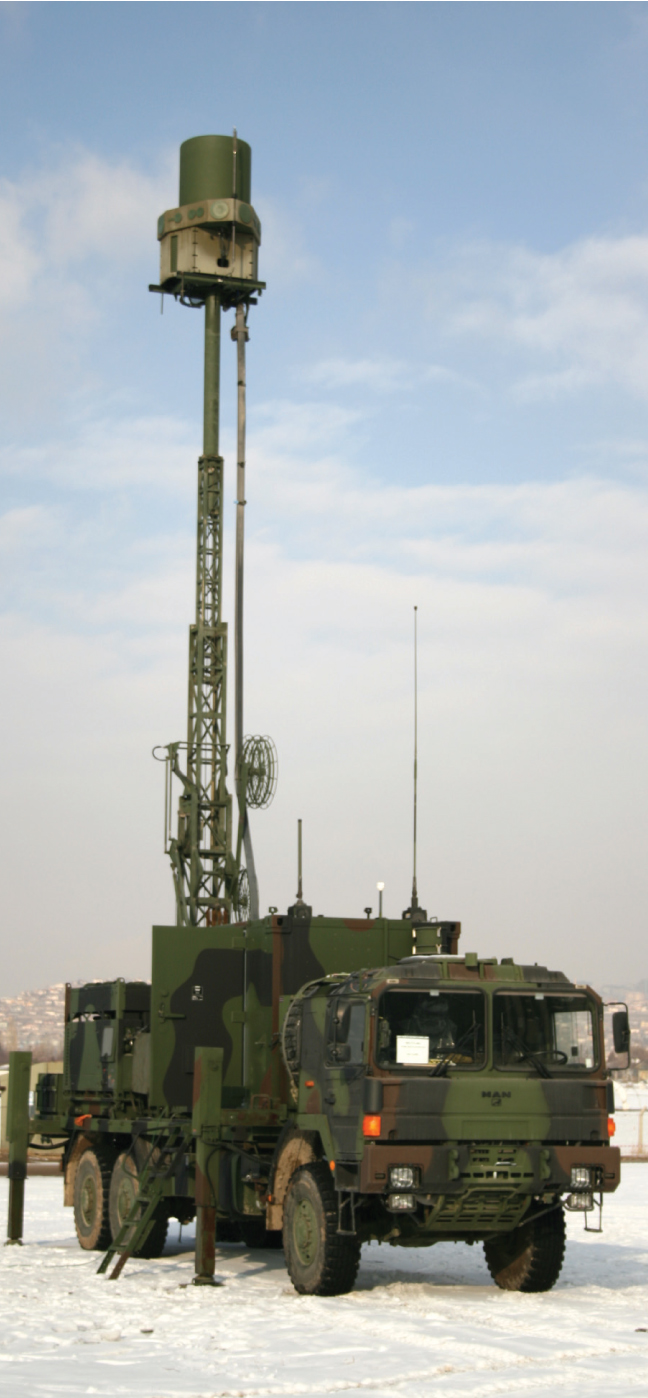
Land based systems are divided into three classes as fixed, mobile and portable. Despite the fact that Radar ES and EA in land platforms are commonly placed on mobile platforms, this article also provides comments relating to fixed and portable system solutions.
Mobile Radar ES and EA Systems in Land Platforms
Operational requirements and usage features identify system solutions, the capability to be obtained and the activity to be attained. The basic factors that influence system solutions in Mobile Radar ES and EA Systems in Land Platforms are examined in other sections following this article under the relevant headings
Configuration Selection
All attacks require guidance and evaluation of effects after application. For example, guiding the firing of artillery units and evaluating the post firing effects are accomplished with forward observers. This function in EA applications is performed by ES systems.
During times of peace and crisis, with search, detection, recognition and location designation functions, the Radar ES Systems, by obtaining information on the opposing side’s radar, undertakes the task of EA applications with the start of operations. Tracking the reactions of the target applied by EA by an ES system is important in ensuring that the effectiveness of EA is perpetual. In the mobile applications of land platforms, the Radar ES function is generally carried out by systems that have been mounted on different platforms. The basic reason for this is to escape from the high power emission of the Radar EA. In the event both functions are on the same platform, it can be observed that high isolation requirements are mostly not obtained and, related to this, that both the ES and EA systems do not operate at the same time towards the same target. In these types of applications the use of the "look-through" method together with tracking the changes in the target radar are also related to the effectiveness of the method, the target numbers that the EA is involved with and the features of the target.
Operation Frequency Range, Range, Instantaneous Bandwidth and Angular Coverage
The operating frequency range, range, instantaneous bandwidth and angular coverage features of Radar ES and EA Systems should be determined in a manner that is compatible with the "Analysis of Target Radars" and suitable to the conditions of the region where the system is to undertake the mission.
Naturally, on a single vehicle, solutions that include a wide operating frequency range, high instantaneous bandwidth, long range, and wide angular coverage should be preferred. However, meeting all of these requirements together is sometimes not possible depending on the features of the carrier platform or in order to meet these requirements large, non-standard configured vehicles are used thus, due to reduced maneuverability in the tactical area and location congestion, in terms of maintenance and repair, system solutions that create a disadvantage may occur.
The operating frequency range is a direct determining parameter based the dimensions of the antenna. A two-fold change in the lower limit of the operating frequency, on the condition that the same antenna gain is protected, results in a roughly four-fold increase in the antenna’s range.
Range together with the features of the target radar (operating frequency, output power etc.) is dependent on the antenna gain and level of sensitivity for Radar ES Systems and on output power for Radar EA Systems, and thus on the antenna gain. An antenna gain for the same operating frequency can only be enhanced when the antenna range size is increased. The dimension of the antenna to be used, in large measure, is determined by the platform to which the antenna is mounted. For example, since the size and weight limitations for fixed land-based systems are less, it is possible to use much higher productive (heavy and larger size) antennas in land platforms compared to mobile systems. For this reason, in systems used for the same task, it is only natural, depending on the platform to which they are mounted, to see differences in feature (capability).
Instantaneous bandwidth is an effective parameter on "target capture possibility" for Radar ES Systems. Systems with high instantaneous bandwidth together with the possibility of a higher target capture possibility also result in the degradation of system sensitivity levels with an increase in instantaneous bandwidth. Since the sensitivity level affects the target detection range for the systems with the same antenna gain, different ranges are obtained depending on the instantaneous bandwidth.
In a similar way, increasing instantaneous angular coverage also increases the target capture possibility. However, since angular coverage is related to antenna beam width and the number of total antennas and by increasing beam width antenna gain will decrease, it will be necessary to increase the number of antennas to be used in the system.
It is also possible to come across similar results in terms of Radar EA Systems. Although it is considered that high instantaneous bandwidth or wide angular coverage increases the effects of EA, because of its effects on other system units and the constraints arising from the carrier platform it does not always make it possible to reach workable solutions.
As can be seen, many performance parameters in Radar ES and EA Systems are associated with each other. Improving one parameter results in the degradation of others or where it is a cumbersome system consisting of many units makes it compulsory to seek solutions.
For this reason, in determining the performance requirement of systems, a decision based on target analysis and mission region conditions and producing system solutions that meet operational requirements, easy maintenance and repair with high "ready for mission possibility" are of critical importance.
Vehicle Type, Number and Mobility
Mobile systems in land platforms are mounted on military vehicles with different size transport capacity (4x4 5 ton class, 6x6 10 ton class etc.) thus, the maneuver capability of these vehicles in the tactical area differ. Naturally, since the turning diameter of large vehicles is longer compared to smaller vehicles, their maneuver capabilities are much lower.
In general, whenever possible, small vehicles that carry all system units should be preferred. However, since the capabilities of mission systems and their performance features are directly limited to carrier platform capacity, in certain applications, a vehicle together with a trailer or the use of more than one vehicle may also be on the agenda. Transporting some system units to a second vehicle provides the possibility of deploying smaller vehicles according to single vehicle configuration and in generating "agile" system solutions in the tactical area.
It is known that military systems undertake missions in regions where ideal transport conditions such as a level asphalt and low-sloped roads do not exist. Therefore, bearing in mind the transport conditions of the regions where the mission is to take place, it is necessary to identify the size of the vehicles. Placing system units on more than one smaller vehicles (maneuver capability suitable to transport conditions in the mission region) can be a sound option.
Mobility of mobile Radar ES and EA Systems in land platforms must be compatible with other elements of the unit to which they are attached. For example, if the other elements of the unit that are deployed change location frequently and rapidly, the Radar ES and EA Systems must be placed on vehicles suitable for use. This requirement plays an important role in the selection of the vehicle that will carry these systems.
Use During Mobility
In land platform mobile applications, the use of ES and EA functions while the vehicle is on the move is dependent on land conditions and the physical limitations brought about by the antenna and conditions in raising it.. However, performance degradation due to not being able to completely raise the antenna, the serious negative effects due to vibrations caused by direction finding accuracy and unsuitability of the operational environment in terms of the operators and similar reasons, lead to Radar ES and EA Systems in general not being preferred while in motion. The widespread use of these systems is in the form of fixed use after the transfer of antenna raising mechanisms in a closed manner to the mission area takes place, the antenna being raised and, after the necessary adjustment and calibration has taken place.
High Power Requirements
As with the Radar EA system, the generators of systems with high power requirements must be heavy and in large sizes. In mobile systems, "increasing reliability" with the use of dual (reserve) generators is one of the preferred methods. In applications where the generators take place on the same vehicle with mission systems, the negative effects this creates for the vehicle’s carrying capacity and in terms of deployment can be frequently observed. Since placing generators on trailers and being pulled by the vehicle negatively affects the maneuver capability of vehicles on mission, in particular during difficult conditions, it is mostly far from being a suitable solution. Another solution is transportation by smaller vehicles where the generators load-carrying capacity and loading area is suitable. Due to the improvement obtained in placing mission systems on a separate vehicle, "accessibility" is increased and consequently ease of maintenance and repair is obtained.
Field Placement Features
As with all land-based systems, the performance of the Radar ES and EA Systems varies based on the constraints (height, land formations etc.) brought about by placement in the field. The issues that must be taken into account on the matter of land formations are summarized below:
In order to meet the range requirements and to obtain an open line of view, where possible it must be placed at the highest point.
Radar ES and EA Systems must cover the same target region.
Attention must be given so that Radar ET activities are placed in a manner where it will have the least effect on Radar ES and other elements of allied units. The use of antennas with high versality and the placement of radar EA Systems at the forefront compared to other elements are among the measures taken to reduce interaction.
Radar ES and EA Systems should be placed at a point where communications between these Systems, with command and control centers and other EC elements are possible which is important in obtaining a regular flow of information.
In the event of an attack by the opposing side, placement should be at a point where rapid gathering and easy change in location is possible.
Where necessary, a point should be selected where logistic support can take place and supplies can be easily provided.
Fixed-based Radar ES and EA Systems
Another application option in land based systems is systems that are set-up at fixed installations. Since these type of fixed systems, which provide great advantages in terms of meeting weight, size and power requirements compared to mobile land platforms, are set-up at dominant points, they are less likely to be effected by constraints that originate from land formations. However, due to adverse environmental conditions (high wind speed, snow, ice etc.) that height entails, there are access and communication difficulties. Additionally, even passive systems such as Radar ES Systems become more exposed to visual discovery, that require taking special protective measures against hostile effects.
Portable Systems
In terms of portable systems, the biggest constraint is weight and size. Due to this constraint, in systems where it is required to be carried by individuals for extensive periods under adverse land conditions, due to the reason of the antenna being small and low gain (and therefore short range) antennas not able to be extended, the restrictions on the line of view and again for the same reasons, serious performance degradation from reflections coming from the ground, low volume thermal problems that take place and not being able to provide high power requirements in sufficient periods of time, are some of the negative effects that first come to mind. For these reasons, the use of portable Radar ES and EA Systems that do not require high performance, narrowband, low power application needs, gains importance.