An Up-Close Opportunity to Experience Live, Virtual and Constructive Training by Rockwell Collins
Rockwell Collins recently hosted an Innovation and Technology Media Day on 28 June, 2016 at the company’s Headquarters in Blagnac near Toulouse, France. Mr. Claude Aber, Vice President & Managing Director EuMEA welcomed journalists with an overview and corporate presentation saying “Trust is part of our DNA, building trust everyday, this is the foundation of the way we are addressing our customers.” Other presenters included Mr. Jean-Louis Lair, Director Marketing & Business Development EuMEA and Mr. Jean-Louis Lair / Mr. Andrew White, Pr Marketing Manager Simulation & Training Solutions EuMEA.
In the presentations it was mentioned that Rockwell Collins provides innovative aviation and high-integrity solutions covering Integrated avionics for manned and unmanned aircraft, Head-down, head-up and helmet displays, Integrated mission and training solutions, precise navigation and targeting and simulation, training and services for both commercial and government applications by its 80 locations worldwide such as Australia, Brazil, Canada, China France, Germany, India, Japan, Singapore, United Arab Emirates and United Kingdom .
Rockwell Collins Demonstrates Live, Virtual and Constructive Training Exercise Connecting France, U.K. and U.S. Operations
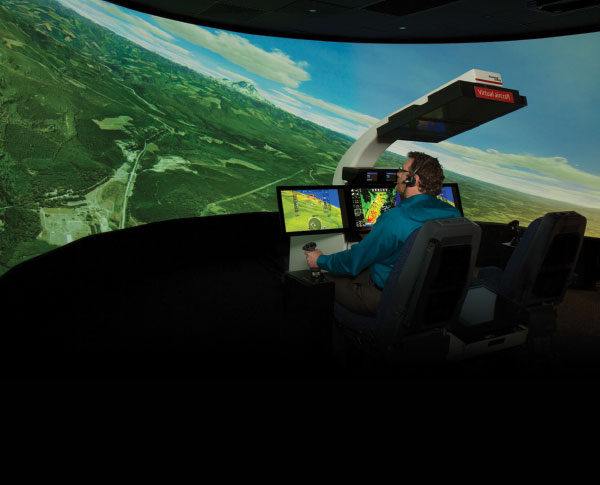
Members of the press were given a unique and up-close look at the innovative technologies of Rockwell Collins with an all encompasing perspective of what the company can do and how they can bring all of the various technologies together. Defence Turkey Magazine was in attendance with other journalists, watching from a command and control room as several participants executed a scenario on simulators and aircraft. Simulators and live aircraft in France, the U.K. were connected in a true to life Live, Virtual and Constructive (LVC) training demonstration. LVC provides interoperability under critical conditions so warfighters on the ground, in the air and at sea can all train simultaneously, regardless of location.
Live Virtual and Constructive (LCV) training capabilities create an atmosphere of complete technological connectivity in which warfighters from around the world train together in one correlated simulation environment enabling a common environment for all participants. Due to the realistic capabilities of the simulation and training technologies available today, LVC offers the interoperable warfare environment that is characteristic of live operations. LVC systems require interoperable, open system architectures in order to connect with multiple networks to create an environment with realistic weapons and command, control, intelligence, surveillance and reconnaissance systems.
“This marks the most comprehensive LVC demonstration that we’ve successfully conducted,” said Mr. Claude Alber, vice president and managing director of Europe, the Middle East and Africa for Rockwell Collins. “This demonstration signifies the ability to train users in multiple locations using simulated and live missions to drive down costs.”
“We see that the future lies around the live virtual constructive domain, as an organization we wanted to prove that’s the kind of technology that we are embracing and the domain that we work in and we can bring this kind of technology to our customers.” Mr. Andrew White, Pr Marketing Manager Simulation & Training Solutions EuMEA said.
During the demonstration, from the command and control center in Toulouse, users operated the Joint Terminal Attack Controller (JTAC) simulator and Air Superiority Operation Center RealFires™ Simulator. All simulators were connected to a live aircraft in Cedar Rapids, Iowa, to complete the scenario. A part of the demonstration in Toulouse was a C-130 Simulator and Helicopter Simulator. The last simulator in the demonstration, a fighter jet, was operated out of Burgess Hill, U.K. In addition, connecting various live or simulated platform assets can now be done securely with a certified Multiple Independent Levels of Security (MILS) system, which was also demonstrated during this exercise. A MILS architecture enables connection of entities with different levels of security, from top secret to unclassified and Rockwell Collins’ MILS approach remains the only airborne system certified by a government agency.
Mr. White explained the rationale and concepts to the participants so that the benefits of the technology in the demonstrations were easily understood “with a multi independent level security system, and the challenge of multiple agencies, for example, an issue such as the F35 might not want to share all data with your L29, it’s ok for a national training event, but if you are doing an international event, you may not want to share all of the data from all the simulators and all the live assets that are playing in that training scenario. The idea behind the MILS software security layer is that the data can be segregated. An excercise controller can segregate data in 4 different ways.”
The new PSR-500 Perimeter Surveillance Radar Launched at Eurosatory
Rockwell Collins also recently introduced its PSR-500 Perimeter Surveillance Radar (PSR) at Eurosatory, June 13 -17, 2016. PSR-500 is a high resolution, compact radar with the capability to track and record intrusions in all weather, identifying mobile targets in all weather conditions, including rain and fog, 24 hours a day. It adapts to the surveillance needs of many types of locations, due to its relatively short range and target behavior analysis algorithms. The radar sensor can be combined with a camera that is controlled by radar detections, allowing for multi-target, highly accurate video visualization and real-time recording. PSR-500 requires less energy and emits low radiation, posing no health risk to the user.
“The PSR-500 couples high performance with low power consumption to bring users affordable and reliable technology,” said Claude Alber, Vice President & Managing Director EuMEA. “Demand for this type of radar technology is growing to address the need for surveillance of geographical borders, critical infrastructures, industrial, commercial or sporting areas.”
Rockwell Collins featured its FireStorm™ targeting system, in addition to RealFires™ transportable trainer, and TruNet networked communications solution, from June 13-17, in Paris.
F-35 helmet, Pro Line Fusion and information Management Capabilities Featured
Recently Rockwell Collins also participated the 2016 Farnborough Airshow, which took place July 11-14, Defence Turkey Magazine was in attendance among journalists worldwide. A broad array of next generation commercial and military aircraft that feature major advancements in flight technology created by Rockwell Collins were on display, including aircraft platforms for Airbus A350, Bombardier C-Series, Bombardier Global 5000, Embraer KC-390, Embraer Legacy 500, Gulfstream G280, Lockheed Martin F-35 Lightning II.
Rockwell Collins is a key supplier to Lockheed Martin’s F-35 Lightning II fifth generation aircraft. The company, through its joint venture, Rockwell Collins ESA Vision Systems, is providing the most advanced technology for warfighters with the F-35 Helmet Mounted Display System (HMDS).
The F-35 HMDS provides pilots with unprecedented situational awareness. All the information that pilots need to complete their missions – through all weather, day or night – is projected on the helmet’s visor. Additionally, the F-35’s Distributed Aperture System (DAS), made by Northrop Grumman, streams real-time imagery from six infrared cameras mounted around the aircraft to the helmet, allowing pilots to “look through” the airframe.
Rockwell Collins has been a provider of Government Systems solutions in Turkey for several decades. In cooperation with the Turkish Industry, Rockwell Collins contributed to several programs including avionics modernization, helicopter and UAV platforms, navigation, data links, and simulation. Navigation systems of” Anka” was provided by the company. Moreover, within the coverage F35 programs, Rockwell Collins is in cooperation with Havelsan on training issues. The company intends to expand its presence in Turkey with new programs such as Turkish UHP, Regional Jet and Taurus programs with its advanced radio communication, navigation, avionics and EW products and technologies.