Armed Forces of Azerbaijan & Military and Defense Industrial Cooperation with Türkiye
At the time of the collapse of the Soviet Union, conventional weaponry stationed in Azerbaijan was estimated at 391 tanks, 1,285 armored combat vehicles, 463 artillery pieces, 24 helicopters, 124 fighter aircraft, with a combined total of 66,000 military personnel.
The Armed Forces of Azerbaijan were re-established according to the Law of the Azerbaijan Republic on the Armed Forces issued on 9 October 1991. According to the law, draftees of ages 18 to 25 were obliged to serve in the Army for 18 months (12 months for graduates); contractors for three years, and women between the age of 18-35 could serve with contracts on a voluntary basis. Alternative service was also allowed. The law guaranteed military ranks of the officers obtained during their service in the Soviet Army. The Azerbaijan Ministry of Defense (MoD) decided to build the Army from mobile units based on a Brigade-Corps system, which was different from the Soviet system of Regiment-Division-Army principles. Each Brigade consisted of five operational Battalions. Each Battalion was comprised of about 450 personnel. First volunteers and national army draftees formed the first Azerbaijani Brigade in late 1991. Additional brigades consisted of about 3,000-3,500 personnel each.
Mainly focused on territorial defense, the Armed Forces of Azerbaijan have three branches: Land Forces, Air and Air Defense Forces and the Naval Forces. Other law enforcement bodies in Azerbaijan include the Azerbaijani National Guard (incorporated into the Special State Protection Service, a military unit subordinate to the President of Azerbaijan), the Internal Troops of Azerbaijan (subordinated to the Ministry of Internal Affairs of Azerbaijan), and the State Border Service. During wartime Internal Troops fall under the jurisdiction of the Azerbaijan Land Forces and fulfil tasks of local defense and security. The Azerbaijan Land Forces consisted of 5 main military corps including the military base in Nakhchivan. However, in 2013 the 5th military corps of Nakhijevan (Nakhchivan Special Combined-Arms Army) was recreated as a separate combined Army unit. In time, Nakhchivan Special Combined-Arms Army (Nakhchivan Garrison) has become one of largest subdivision of the Azerbaijan Land Forces having at the same time a perfect geographical location to attack the Ararat valley if fights were restarted. The airbase of Nakhchivan, on the other hand, is also one of the biggest in Azerbaijan with a 3,300-meter airstrip and a big military arsenal.
Azerbaijan consistently strengthens its Air Force, the main function of which is to provide air defense and support to the ground forces in case of combat operations. Azerbaijan actively improves military capabilities and structural units of Air Forces, and in this context, it is important to mention new air bases have been established nearby Azerbaijan-Karabakh or Armenia borders including Air Bases of Navtalan (10km), Agstafa (10-20km), Aghjabedi (30-40km), Baylakan (30km), Mingechaur (45km), Yevlakh (35km) and Qyurdamir (90-110km). Air Bases of Aghjabedi, Mingechaur, Baylakan and Yevlakh were constructed during 2014-2017. Azerbaijan also invests in the development and modernization of its Naval Forces to project security in the Caspian basin as well. However, the emphasis is placed on the development of ground forces connected with the territorial issue with neighboring Armenia.
Encouraged by a tremendous increase in oil revenue over the past two decades, Azerbaijan has embarked on a massive military build-up in the early 2000s to modernize and upgrade its Armed Forces. The country’s oil and gas wealth has allowed it to bankroll the purchase of state-of-the-art arms from Belarus, Israel, Russia, South Africa, Türkiye and the U.S. Nowadays the Armed Forces of Azerbaijan (Azərbaycan Silahlı Qüvvələri) is going through major development processes due to the government's never-waning support. Azerbaijan has continuously strengthened its Armed Forces, developed its military staff, and has enhanced its military potential. Being accepted as one of the strongest in the region today, the Armed Forces of Azerbaijan is capable of defending the country against any attack or hostility.
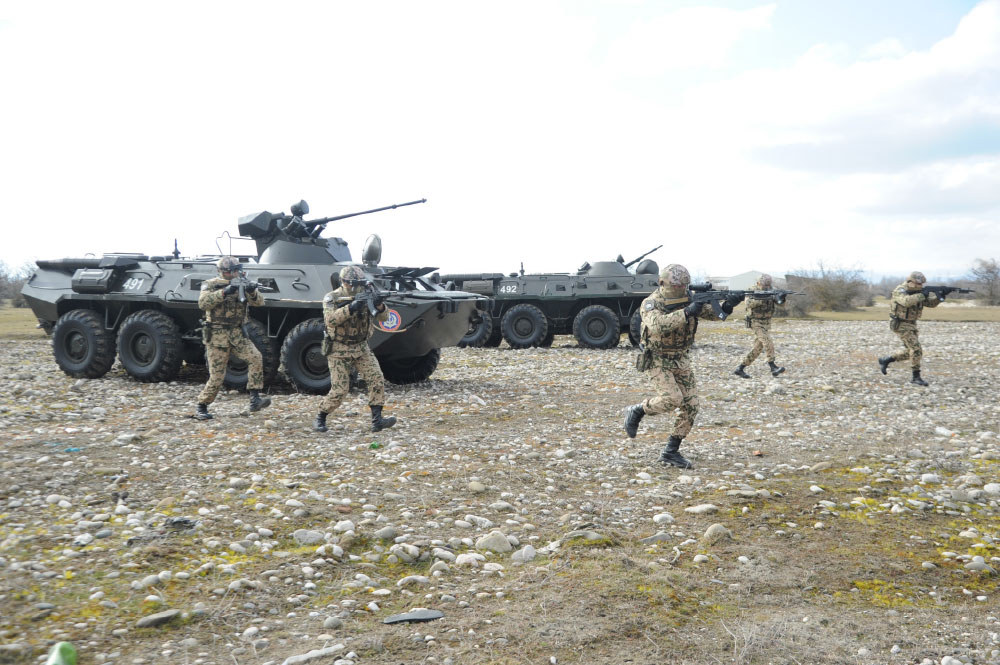
The skills and combat readiness of the Armed Forces of Azerbaijan are growing year by year, as the country’s Armed Forces regularly conduct military drills to improve its capabilities. Azerbaijan pays special attention to the professional training of its military personnel. Alongside the exercises inside the country, the Armed Forces of Azerbaijan participate in various military exercises conducted at the international level, including those with the Turkish, Russian and Georgian Armed Forces. Nowadays, the Armed Forces of Azerbaijan possess modern weapons and technical equipment for maintaining a high level of combat capability.
Over the past few years, Azerbaijan has also succeeded in modernizing and strengthening the Caspian fleet inherited from the Soviet time. Especially since a 2008 maritime clash with Turkmenistan (in 2008, gunboats from Azerbaijan’s Coast Guard threatened oil rigs operated by Malaysian and Canadian companies working for Turkmenistan near the boundary between those two countries), Azerbaijan has devoted considerable resources to a naval build-up and dual-use maritime facilities to protect its Caspian oil fields. Today, the Azerbaijan Naval Forces with some 30 naval platforms of various types and displacements, is considered one of the largest fleets in the Caspian Sea and has engaged in increasingly sophisticated naval exercises. An international tender is on-going for the local construction of a total of 16 new naval platforms in various types (including corvettes, patrol boats and FPBs) and displacements. Meanwhile in June 2018 Azerbaijan inaugurated a new naval base for its Navy on the Caspian Sea, which it calls “the largest and most modern military object in the Caspian basin.” The new base is in the town of Puta, about 30 kilometers southwest of Baku.
As part of its build-up efforts in Nakhchivan, Azerbaijan further amassed its forces in the region by adding two infantry units and boosted the rocket artillery arsenal. The Artillery Brigade is equipped with Turkish company ROKETSAN manufactured TR-300 KASIRGA (300mm, 100km range), TRG-300 KAPLAN (300mm, 120km range, INS/GPS guided version, 36+ delivered), TR-122 SAKARYA (122mm, 40km range) missiles with T-122/300 Multi Caliber and Multi Barrel Rocket Launching (MBRL) System and Russian-supplied 9K58 Smerch (300mm, 60–90km range) Multiple Launch Rocket Systems (MLRSs). Azerbaijan also procured an undisclosed number of TRLG-230 Laser Guided Artillery Rockets from ROKETSAN and deployed them successfully against Armenian Army targets during the Second Karabakh War in 2020. The BAYRAKTAR TB2 UCAVs (procured during the first half of 2020) and TRLG-230 Laser Guided Artillery Rockets (with INS+Laser Seeker) proved to be a very successful and deadly combination against Armenian Army targets during yhe Second Karabakh War.
The build-up in Nakhchivan, in which Türkiye’s assistance has played a key role, has been closely monitored in Armenia. Azerbaijan considers Nakhchivan as a location for a counter-attack to Armenia. It is believed that by deploying long-range artillery systems Azerbaijan’s main objective would be to use Nakhchivan as a platform to hit strategic targets in Armenian territory. One of these targets would be Armenia’s S-300PT (SA-10A Grumble) and S-300PS (SA-10B Grumble) long-range air defense missile system batteries, which protects the skies of Nagorno-Karabakh and also deters the Azerbaijani Air Force from their operations. The Armenian Army possessed S-300PT and S-300PS variants of S-300 Air Defense Systems which were modernized to a S-300PM standard that includes missiles with 150 kilometers range. There were two S-300 batteries in their inventory and both are deployed at Syunik province at two sites, the first one is near Goris in the north (with four 5P85S/D TELs) and Kaghnut in the south (with eight 5P85S/D TELs), both reside within seven kilometers of the border with Nagorno-Karabakh. The locations of the S-300PS batteries were permitting target track assignment from either the Yerevan-based 64N6 Battle Management Radar or a Nagorno-Karabakh-based 36D6 EW radar.
Armenia’s capital, Yerevan, is also within firing range (the border of Nakhchivan is just 60 kilometers from Yerevan) of Azerbaijan’s MLRS deployed at Nakhchivan. As a response to Armenia’s Iskander-E (export version) Tactical Ballistic Missile Systems (with 280km range) acquired from Russia in 2016, Azerbaijan procured two battery-size (more than 10 launchers) MLRS (with 301mm A200 missiles having a range of over 200km, however since the Presidential Press Service of Azerbaijan said the maximum range of this system was 300km the system can be also equipped with A300 missiles) under a US$170 Million deal from Belarus and IAI’s Long Range Artillery (LORA) Weapon System (8 launchers and 50 missiles) from Israel. On 11 June 2018 Azerbaijan showed its recently acquired Polonez-M (M stands for Upgraded) MLRS and LORA Tactical Ballistic Missile (TBM) Systems during a visit of President & Commander-in-Chief of the Armed Forces of Azerbaijan Ilham ALIYEV at a new military unit of the Missile Troops of the Ministry of Defense established at near north-west of Baku. The systems were subsequently showcased during a military parade in Baku on June 26, 2018. The new Missile Troops unit (apparently a missile brigade), with a newly built modern facility, was established to operate both Polonez-M and LORA systems. Armenian military officials and politicians regularly threaten Iskander TBM strikes on strategic objects of the oil industry of Azerbaijan, including near Baku.
With the procurement of Polonez-M and LORA Systems the Armed Forces of Azerbaijan has gained the capability to carry out destructive counter strikes against any military target not only in the occupied territories in Nagorno-Karabakh, but also in Armenia. Meanwhile new batch of Polonez-M MLRS systems arrived in Azerbaijan in September 2018. Russian-made S-300 PMU-2 (with 200km range 48N6E2 GARGOYLE Mod 1 missiles, reportedly deployed at Sumgait near Baku during the first half of 2011) and Israeli-made Barak-8 long-range SAMs have been procured to serve as an additional line of defense against Armenia’s Iskander-E ballistic missiles.
As part of its build-up effort in Nakhchivan, Azerbaijan’s focus has not been on the quantity of forces, but the quality. At present, Azerbaijan is believed to deployed about 20,000 soldiers in Nakhchivan and around 400 armored vehicles, aircraft, air defense systems, and artillery/rocket systems. “The Nakhchivan Army is capable of completing any task,” President & Commander-in-Chief of the Armed Forces of Azerbaijan Ilham ALIYEV said during a visit to the territory in January 2018. “Today, the military potential of Nakhchivan is at the highest level. The most modern equipment, weaponry, ammunition have been sent here.”
Conducted in May 2018 by the Special Combined-Arms Army deployed in Nakhchivan, the Gyunnyut Operation, which resulted in the liberation of 11,000 hectares of land seized by Armenia in the early 1990s, is accepted as evidence of the power of the Azerbaijani Army (Land Forces). In order to strengthen the defense and combat capability of the Nakhchivan Autonomous Republic (NAR) of Azerbaijan, to improve combat readiness of units and formations of the Armed Forces and to improve the centralized management the Nakhchivan Special Combined-Arms Army (Special Forces, Nakhchivan Garrison of the Armed Forces of Azerbaijan) was established by President ALIYEV in late 2013 on the basis of the Azerbaijani Army’s Fifth Army Corps. Colonel-General Kerem MUSTAFAYEV has been appointed the Army’s Commander. Nakhchivan, the ancestral home of President Ilham ALIYEV’s family, is separated from the rest of Azerbaijan by a slice of southern Armenia, and it does not border Nagorno-Karabakh. But it is the closest part of Azerbaijani territory to Yerevan and other strategic Armenian targets. So, Nakhchivan represents an “Achilles Heel” for both Armenia and Azerbaijan.
The Special Combined Arms Army (Nakhchivan Garrison) took an active part in the Second Karabakh War, which began on September 27, 2020, and lasted 44 days and ended with the victory of Azerbaijan. Along with servicemen from all other regions, Nakhchivanis also showed great heroism and selflessness in the liberation of lands that had been seized by Armenia in the early 1990s. On March 26, 2022, the Second Karabakh War participants of the Nakhchivan Garrison were awarded medals in line with the presidential order signed on June 24, 2021. Addressing the ceremony, Commander of the Special Combined Arms Army (Nakhchivan Garrison), Colonel-General Karam MUSTAFAYEV underlined that as a result of the successful continuation of the army-building policy, the Azerbaijani people fought hard for their sovereignty and territorial integrity. On May 10, 2021, President of the Republic of Azerbaijan, Victorious Commander-in-Chief Ilham ALIYEV attended the inauguration ceremony of a military aerodrome of the Special Combined Arms Army and the opening of the Nakhchivan Garrison Central Hospital in the Nakhchivan Autonomous Republic.
In order to prepare its military for possible action against Armenian forces in Nagorno (Upper)-Karabakh region, Azerbaijan signed numerous contracts to strengthen its Armed Forces and to train its military personnel. In this context, the Armed Forces of Azerbaijan were provided with modern weaponry in collaboration with the most favorable and trusted partners such as Russia, Türkiye, Israel, and the South African Republic. According to the official statements, during 2003-2018, 80% of the Armed Forces of Azerbaijan’s arsenal have been renewed. According to SIPRI data during 2009-2018 Azerbaijan military expenditure was around US$25 Billion and Armenia’s was less than US$5 Billion.
During the 2000s, a sharp increase in the oil price allowed the Azerbaijan Government to increase military spending and to start a large-scale rearmament of the Armed Forces of Azerbaijan. In 2001, the military budget of the country was US$300 Million, but in 2013, it reached US$3.7 Billion and equaled the entire budget of Armenia. Modern main tanks, combat armored vehicles, air defense systems, aircraft, helicopters, anti-tank guided missiles, artillery systems, detection equipment (night vision devices, laser reconnaissance devices, thermal imagers) and unmanned aerial vehicles were purchased in large quantities. The new capabilities of the Armed Forces of Azerbaijan, including Harop Kamikaze Drones (purchased in 2015 and deliveries carried out in 2015 and 2016), were demonstrated during the Four-Day War in April 2016, which turned into the most intense eruption of violence since the 1994 ceasefire and showed that the Azerbaijani troops, equipped with new technologies, such as loitering munitions, have an advantage in combat operations. During the Four-Day War in April 2016, despite severe losses Special Forces of Azerbaijan liberated several strategic heights and settlements on the frontline (three kilometers beyond the Line of Contact [LoC]). The War provided proof that the Armed Forces of Azerbaijan could operate its weapons systems and manage a modern close battle and clearly indicated that Azerbaijan was on the right track to modernize its Armed Forces.
A developing military industry also enables Azerbaijan to reinforce its Armed Forces with domestically produced military equipment. Azerbaijan began to produce more than 1,000 types of military products and became an exporter of the most modern weapons. Azerbaijan also used domestically produced weaponry during the Four-Day War in April 2016, which further prompted Baku to increase local production and more heavily rely on it. Azerbaijan’s limited but growing defense-industrial capabilities are centered on the Ministry of Defense Industry, which manages and oversees the production of small arms and light weapons. While the country is reliant on external suppliers for major defense-equipment platforms and systems, some defense companies have already started to export to foreign markets.
Armed Forces of Azerbaijan
The Armed Forces of Azerbaijan, which is considered the most modern Army in the Caucasus, have three branches: Land Forces, Air and Air Defense Forces and Naval Forces. The following information has been compiled from various open sources.
Military Age: 18-35 years (Regular).
Conscription: 12 (for graduates) - 18 Months for Land Forces.
Total Active Personnel: 66,950 (Military Balance 2022); Land Forces 56,850, Naval Forces 2,200 and Air Force 7,900.
Gendarmerie & Paramilitary: 15,000.
Land Forces
Personnel: 56,850.
Structure: 5 Army Corps HQ, 23 Motorized Infantry Brigades, 1 Security Brigade, 1 Artillery Brigade, 1 Artillery Training Brigade, 1 Multiple Launch Rocket Brigade and 1 Anti-tank Artillery Brigade, 1 Engineer Brigade and 1 Signal Brigade as well as 1 Logistic Brigade for Combat Service Support.
Equipment:
Fighting in and around Nagorno-Karabakh in late 2020 resulted in some combat losses as well as the capture of some equipment from Armenian and Nagorno-Karabakh forces.
MBTs: 437; 95 T-55, 244 T-72s of different versions A, B, M1, Aslan etc., 98 T-90Ss.
RECCE: 15 BRM-1s
IFV: 215; 43 BMP-1, 33 BMP-2, 88 BMP-3, 7 BTR-80A and 44+ BTR-82A.
APCs: 652+; 336 MT-LB (Tracked), 10 BTR-60, 132 BTR-70, 45 MARAUDER and 45 MATADOR mine protected vehicles, 35 COBRA, 29+ SandCat and 20 BMD-1.
Artillery: 634
SP: 102; 46 122mm 2S1, 6 2S3 152mm, 18 2S19 MSTA-S 152mm, 15 Dana-M1M 152mm, 5 ATMOS 2000 155mm and 12 S7 203mm.
Towed: 233; 129 D30 122mm, 36 M-46 130mm, 44 2A36 152mm and 24 D-20 152mm
Mortars: 267 120mm (including 18 NONA-S and 50 2S31 VENA SP versions), 50 Cardom 120mm, 107 M-1938 (PM-38) 120mm and 42 SandCat SPEAR Mk2 120mm Mortar Systems as well as undisclosed number of 60mm, 82mm mortars.
Multiple Rocket Launchers: Some 107mm T-107 MRLs, 43 BM-21 Grad 122mm, 8 RM-70 Vampir 122mm, 30 9A52 SMERCH 300mm, TR-300 KASIRGA 300mm, 36+ TRG-300 KAPLAN 300mm, TRLG-230 230mm, TR-122 SAKARYA 122mm, rockets with 72 T-122/300 MRL Systems, 16 x GRAD-LARs, 30 LYNX Launchers, based on KamAZ-6350 (8×8) with 160mm LAR-60 and 50+ 306mm EXTRA guided rockets, 60 x TOS-1A.
TBMs: 9K9 Tochka (SS-21 Scrab, 4 TELs), Polonez-M (two batteries more than 10 TELs) and 8 LORA Launchers (+50 missiles).
Air Defense: 40 SA-13 Gopher, 9 SA-4 Ganef, and 12 SA-8 Gecko/9K33-1T Osa-1T, SA-7 Grail, SA-14 Gremlin, SA-16 Gimlet and SA-24 Grinch as well as an undisclosed number of ZSU-23-4 Shilka SPAAG and ZU-23-2 (towed).
Anti-Tank/Anti-Infrastructure Missiles:
Self-Propelled; 10 9P157-2 Khrizantema-S (AT-15 Springer), COBRA Wheeled Armored Vehicles with Skif ATGM and Sand Cat Vehicles with Spike-ER
Man Portable; AT-3 Sagger, AT-4 Spigot, AT-5 Spandrel, AT-7 Saxhorn, AT-14 Spriggan/KORNET-E, and Spike-LR.
Editor’s Note: During and after the Second Karabakh War, President ALIYEV revealed Azerbaijan’s intention to strengthen the national army based on the Turkish Armed Forces (TAF) model but on a smaller scale. Following the Second Karabakh War, as part of the Armed Forces of Azerbaijan’s upgrade in line with Turkish military expertise, all-new ‘blue beret commando’ units based on similar units in the TAF were created in areas with difficult terrain. President ALIYEV inaugurated the new units in October and December 2021. As part of the harmonization of the Armed Forces of Azerbaijan with the Turkish Armed Forces, wearing a Beret and Oath Ceremony of the first Commando Brigade of the Azerbaijan Army was held on October 19, 2021. Before joining the Army’s new “blue-beret” branch, the Commando personnel had been taking weeks-long “Commando preparation” courses in Türkiye under the direct involvement and guidance of Turkish military specialists. The new ‘blue beret commando’ units are mostly trained in Türkiye both at Mountain Commando School and Training Center Command in Isparta and at the Gendarmerie Commando School and Training Center Command at Foça, Izmir. The first Commando military base was opened on December 24, 2021, at Hadrut in Karabakh. On June 26, 2022, Azerbaijan’s President ALIYEV inaugurated the second Commando military unit, which has a capacity to house some 600 blue beret commandos, in Kalbajar, Karabakh some 24km from the border of Armenia. The creation of commando brigades in Azerbaijan is described as a new stage in national army building.
Naval Forces
Personnel: 2,200
Main Naval Base: At Puta, about 30 kilometers southwest of Baku.
Naval Special Forces: SAH/SAM Teams, 641st Special Warfare Naval Unit composed of 3 reconnaissance groups, 2 groups for mountainous warfare and one diving group.
Marines: 1 Marine Battalion (Amphibious).
Editor’s Note: Within the scope of the ‘Brother Brigade Project’, that was initiated after the Second Karabakh War to ensure interoperability between Turkish Armed Forces and Azerbaijan Armed Forces, personnel of the Azerbaijan Marine Corps commands are taking the Naval Commando Basic Course in Türkiye at the Turkish Naval Forces Amphibious Mission Group Command.
Fleet:
Mine Warfare Force: 2 Sonya Class mine hunters, 2 Yevgenya Class mine sweepers.
Light Forces: One Petya-II Class light frigate, 4 Stenka Class patrol boats (G-122, G-123, G-124 and G-125, G124 is equipped with an ASELSAN 30mm SMASH RWS), a number of patrol craft including one Turk (AB-25) Class, one Brya (Project 722) Class, one Shelon (Project 1388M) Class, one Poluchat Class (Project 368), one Luga Class (Project 888), two Petrushka (Polish UK-3 class), one Wodnik Class and two Petrushka Class training ships.
Submarine: Triton-1M and Triton-2M midget submarines (number unknown) in the service of 641st Special Warfare Naval Unit.
Landing Ships: 1 Polnochny-A Class LSM and 2 Polnochny-B Class LSMs as well as 1 Vydra Class LCM and 2 T-4 LCMs.
Logistics & Support Ships: 3; 1 survey ship, 2 Neftegaz Class tug ships.
Miscellaneous: 1 depot and repair ship, 3 survey/hydrographic ships
Editor’s Note: International tender has been launched for the joint construction of a total of 16 naval platforms in various types and displacements including; 4 Fast Intervention Boats, 4 Fast Patrol Boats, 4 57m New Type Patrol Boats (NTPBs) and 4 Corvettes with anti-ship missiles.
Air and Air Defense Forces
Personnel: 7,900
Main Air Bases: Nasosnaya Air Base (fighters), Kyurdamir Air Base (bombers), Ganja International Airport/Air Base (transports), Gabala Air Base and Baku Kala Air Base (helicopters).
Spare Bases: Dollyar Air Base, Nakhchivan International Airport, Sangacal Air Base and Sitalcay Air Base, Stepanakert Air Base and Kyzylagadzh Air Base.
Forces By Role
Fighter: 1 Squadron with MiG-29 Fulcrum A & MiG-29UB Fulcrum B
Fighter/Ground Attack: 1 Regiment with Su-24 Fencer; Su-25 Frogfoot & Su-25UB Frogfoot B
Transport: 1 sqn with An-12 Cub and Yak-40 Codling
Training: 1 sqn with L-39 Albatros
Attack/Transport Helicopters: 1 Regiment with Ka-32 Helix C, Mi-8 Hip, Mi-24 Hind and PZL Mi-2 Hoplite
Equipment By Type
Combat: 13 MiG-29 Fulcrum A, 2 MiG-29UB Fulcrum Bs, 2 Su-24 Fencer, 16 Su-25Ms, 3 Su-25UBs.
Training: 24 L-39s and L-29s (in store), 10 MFI-395 Super Mushshaks (on order and under delivery process).
Transport: 2 IL-76.
Helicopters: 13 Mi-8, 71 Mi-17-1B and Mi-17-1V Hip-Hs (with LAHAT and Spike NLOS), 12 Mi-24V/P, 9 Mi-24G, 24 Mi-35Ms, 3 Ka-32As, 7 PZL Mi-2 Hoplites, 3 AB-412s, 1 Bell 401 and 1 MD-530F.
SAMs: 2 S-200 (SA-5 Gammon) batteries, 1 Barak-8 (LR, with nine launchers, each with eight missiles in two stacks and 75 Barak-8 missiles), 2 S-300 PMU-2 Favorit (SA-20B Gargoyle) batteries, some 100 SA-2 Guideline, SA-3 Goa, SA-4 Ganef (2K11 Krug & Krug M1), S-125 Pechora-2M, S-125 Pechora-2TM, SA-15 TOR M2E, 2 SA-11, BUK-MB (SA-17 Grizzly, at least 2 battalions), T-38 Stiletto (2 batteries).
MANPADS: Igla-S/SA-24, Strela 2M, 9P58M Strela-3 Launchers & 9M36-1 Strela-3 Missiles
UAVs/UCAVs: 36+ BAYRAKTAR TB2 Tactical Level UCAVs, AKINCI HALE UCAVs (one of 4 export customers), 5+ Systems Heron (15 air vehicles), 2+ Hermes 900, 10+ Hermes 450, 14 Aerostar, 40+ Orbiter-2M/3M/4, 5 Searcher-II, 100+ Orbiter-1K/ZARBA, 100+ Skystriker/QUZGUN and YARASA (locally manufactured) kamikaze drones, 50+ Harop loitering munition systems. An undisclosed number of AN-2 biplanes were also converted into remote-controlled aircraft for simultaneous use with reconnaissance and attack drones during the Second Karabakh War. According to Dutch warfare research group Oryx, 11 AN-2 aircraft were used as unmanned bait in order for Armenia to reveal the location of air defense systems.
EW, Air & Missile Defense Radars: Azerbaijan Air Force operates some 70 air surveillance and early warning radar systems in 13 different types procured from various countries such as Belarus, Ukraine, Russia, Israel and Spain and including an undisclosed number of modernized P-18, P-19R and P-14/5N84 ‘Oborona’ radars, 5 36D6-M Tin Shield mobile Early Warning radars, 2 EL/M-2288 AD-STAR, at least one EL/M-2106NG, at least one EL/M-2080 Green Pine air and missile defense radar, at least one EL/M-2084 radar, at least one LANZA LTR-25 3D radar, 2 96L6E Cheese Board, 2 30N6E2 Tomb Stone and 1 64N6E2 Big Bird-D radars (with S-300 PMU-2) as well as at least one 80K6M radar (for BUK-MB).
Within the scope of the Azerbaijan Air Force’s Integrated Air Defense Command Control System Project, the contract for the first phase covering the radar integration and the creation of an air picture, was signed during the ADEX 2018 Fair in September 2018 with ASELSAN. ASELSAN proposed a new generation Integrated Air Defense & Command Control System solution (dubbed HAKİM) to the Azerbaijan Air Force. The Project aims for the command control of Azerbaijan’s air space and the integration of a total of nearly 70 air surveillance/early warning radar systems in 13 types procured from various countries such as Belarus, Ukraine, Russia, Israel and Spain to all of the air Defense missile systems in different types (i.e. Russian origin [S-300 PMU2] and Israeli origin [Barak 8]) across the country.
Gendarmerie & Paramilitary: 15,000.
State Border Service (SBS): 5,000 (subordinated to the Ministry of Internal Affairs).
Editor’s Note: After the Second Karabakh War, which began on September 27, 2020, and lasted 44 days, Azerbaijan managed to restore its 132km border with Iran and 530km with Armenia, resulting in a completely new situation for border troops and the State Border Service (SBS). Azerbaijan will have more responsibility with the expanded international border and more required coordination with the armed forces in unstable areas of the state border. For implementation of these tasks, Azerbaijan has decided to increase (to double at first step) the number of special forces personnel.
In August 2021 at a ceremony held to mark the Service’s 102nd establishment anniversary the State Border Service shared details about the Armenian military targets destroyed by loitering munitions and kamikaze drones in the Second Karabakh War. It was stated that by using Harop and Skystriker/QUZGUN, Azerbaijani border guards destroyed a large number of strategic military targets of the Armenian Armed Forces during the war. The service reported that the destroyed targets include the Tochka-U and Elbrus OTRKs (NATO classification - Scud B), S-300, Krug, Kub and Tor anti-aircraft missile systems, electronic warfare stations, tanks, armored vehicles and other military equipment, command posts (totally 290 Armenian objects).
Equipment By Type
Armored Fighting Vehicles: 168 BMP-1/BMP-2 IFVs, 19 BTR-60/70/80 APCs, OTOKAR ZPTs (based on LandRover Defender tactical vehicle), COBRA I, COBRA II 4x4 APCs, Titan-S and Titan-DS 4x4 APCs
Artillery/MRL: 3 T-122 122mm MRLs
Aircraft: 40 AN-2 Colt (modified for use as unmanned bait for Armenia air defense systems to locate and destroy them during the Second Karabakh War)
Helicopters: 24 Mi-35M Hind
UAVs: 4+ Hermes 450; 3+ Hermes 900
Loitering Munitions Harop and Skystriker/QUZGUN (two variants)
Air Defense: ZU-23-2 (towed).
Coast Guard (The Maritime Brigade)
Established in 2005 by Presidential order, the Azerbaijan Coast Guard is a law enforcement agency and is a part of the State Border Service.
Equipment By Type
Patrol and Coastal Combatants: 20; 6 TUFAN/SAAR-62 Class OPVs (S-201 to S-206, with 1 8-cell Typhoon MLS-NLOS launcher with Spike NLOS SSM, 1 helicopter landing platform), 1 Osa II Class (its SS-N-2B missiles removed) Patrol Boat, 3 Stenka Class Patrol Boats (S-005, S-006, and S-007, all with sonar and torpedo tubes removed), 6 Shaldag MkV Patrol Boats (S-301 to S-306), 2 48-foot Silver Ships small craft (S-11 and S-12), 1 Point Class Cutter (S-14) and 1 Grif (FSU Zhuk) Class Patrol Craft (P-222).
Logistics & Support Ships: 4; 1 Iva (FSU Vikhr) Rescue and Salvage Ship, 3 Neftegaz (Project B-92) Tug Ship.
Editor’s Note: There were reports of Azerbaijan’s intention to buy 2 SAAR-72 Class Corvettes, it was even stated that the construction of the first one would start in 2016, but there is still no confirmation of this.
Internal Troops: 10,000+ (subordinated to the Ministry of Internal Affairs).
Equipment By Type
Armored Fighting Vehicles: BTR-60/BTR-70/BTR-80/BTR-80A, OTOKAR COBRA-I, KATMERCİLER Pit-Bull VX, and NUROL MAKINA TOMA (Intervention Vehicle against Social Incidents).
Karabakh Wars
Over decades Armenia and Azerbaijan had been locked in an armed conflict over the Karabakh (Garabagh) region, an internationally recognized territory of Azerbaijan. Following the Soviet Union’s collapse in 1991, Armenia launched a full-blown military operation against Azerbaijan. The bloody First Karabakh War was fought from 1992 to 1994 (the ceasefire was signed in May 1994) and resulted in the loss of the mountainous Nagorno-Karabakh, also known as Upper Karabakh and seven adjacent regions; Lachin, Kalbajar, Aghdam, Fuzuli, Jabrayil, Qubadli, and Zangilan, which constitutes 20% of Azerbaijan’s internationally recognized territories. Like the former Soviet Union, the United Nations (UN) also recognizes the region as part of Azerbaijan. During the First Karabakh War over 30,000 Azerbaijanis were killed, 3,890 went missing, and one million others were expelled from those lands in a brutal ethnic cleansing campaign carried out by Armenia. As a result of the war between Armenia and Azerbaijan in the early 1990s, Nakhchivan Autonomous Republic (NAR) of Azerbaijan became fully isolated from the Azerbaijani mainland after Armenia closed energy, electricity, and transport connections, including highways and railways to and from the region.
In June 2010, the Azerbaijani Parliament approved a military doctrine that identified the major threats facing the country as Armenia’s occupation of Nagorno-Karabakh and surrounding buffer areas, regional military imbalances, extremist religious movements and claims of neighboring states on Azerbaijan’s territory. The doctrine affirms that Azerbaijan will not start a military operation against any country unless Azerbaijan is the victim of aggression, but it also affirms Azerbaijan’s right to use all necessary means to liberate its occupied territories.
The Second Karabakh War began on September 27, 2020, as a counter-attack operation that was launched in response to Armenia’s, yet again, another large-scale military attack on Azerbaijan Army positions and civilian settlements. Armenian forces attacked the positions of the Armed Forces of Azerbaijan from several directions. They used heavy artillery to fire at Azerbaijani residential settlements. The counter-attack operation later became known as ‘Operation Iron Fist’. It lasted only 44 days but the Second Karabakh War has changed the firm status quo in the Southern Caucasus formed by the ceasefire agreement between Azerbaijan and Armenia signed in May 1994. Although the 1994 ceasefire had been repeatedly violated since its inception, none of them had a significant effect on its permanent nature. During the Second Karabakh War Azerbaijan scored an undeniable victory and the Azerbaijan Armed Forces managed to recapture a large portion of the occupied territories and secure a strategic corridor connecting the Nakhchivan Autonomous Republic (NAR) to Azerbaijan proper. During the counter-attack operations Azerbaijan Armed Forces liberated over 300 settlements, including the cities of Jabrayil, Fuzuli, Zangilan, Gubadli and Shusha, from the nearly 30-year-long illegal Armenian occupation.
The first armistice between Azerbaijan and Armenia reached on October 10, 2020, was violated within 24 hours as Armenian missile attacks on the Azerbaijani city of Ganja claimed civilian lives. Another truce on October 17, 2020, was also violated by Armenian troops. Besides other towns and villages, Azerbaijan’s liberation of the strategic city of Shusha on November 8, 2020, signaled that victory was imminent. Shusha, also known as the pearl of Karabakh, had been occupied by Armenian forces on May 8, 1992. The Second Karabakh War (also known as the Operation Iron Fist or the Patriotic War), finally came to an end on November 10, 2020, with the signing of ‘The Act of Armenia’s Capitulation’, the Statement of the President of the Republic of Azerbaijan, the Prime Minister of the Republic of Armenia and the President of the Russian Federation. Under the Statement, Armenia also returned the occupied Aghdam (on November 20, 2020), Kalbajar (on November 25, 2020), and Lachin (on December 1, 2020), districts to Azerbaijan within 20 days after the Second Karabakh War. The Statement ordered the full withdrawal of the Armenian armed forces from the Karabakh region and the deployment of the Russian peacekeepers to the region. Armenia's authorities, however, have stalled in implementing the terms of the agreement. Under the instruction of the President of the Republic of Azerbaijan, Victorious Commander-in-Chief Ilham ALIYEV, the Azerbaijan Army Units took complete control of Lachin city, as well as Zabukh and Sus settlements in August 2022.
The Armed Forces of Azerbaijan’s successful counter-attack operation (Second Karabakh War) to recover important parts of Armenian-occupied Karabakh from the Armenian Army was a resounding success. As the winner of the Second Karabakh War, Azerbaijan has been busy with projects to rebuild the devastated region after 30 years of occupation. Victory paved the way for the restoration and reconstruction work in the liberated territories in accordance with the latest standards. In this context Azerbaijan has been also opening new military units in liberated regions to ensure the better reinforcement of its borders since the second Karabakh war.
During the six weeks of fighting Armed Forces of Azerbaijan seized large amount of ammunition, missiles, ATGMs, trucks, SAM System launchers, MANPADS missiles and launchers, armored vehicles and tanks from the Armenian Army. Some of the equipment seized from the Armenian Army was displayed in a military parade in Baku held on December 10, 2020, and is also exhibited in the Spoils of War Park, which opened in Baku in April 2021.
Second Karabakh War and Drone Warfare
During the Second Karabakh War, the Armed Forces of Azerbaijan dominated the battlespace with a sophisticated technological edge in weaponry that coupled with advanced concepts of operations (CONOPS). It is widely accepted that loitering munitions (such as HAROP and Skystriker/QUZGUN procured from Israel) and Unmanned Combat Aerial Vehicles (UCAVs, such as BAYRAKTAR TB2s procured from Türkiye) have played a decisive role during the War. Armed Forces of Azerbaijan also employed STM’s KARGU-II rotary wing kamikaze drones to hunt down Armenian forces during the six weeks of fighting.
Drone (loitering attack munitions, intelligence surveillance and reconnaissance [ISR] drones, and UCAVs) warfare played an essential role in Azerbaijan’s overall war-fighting capacity and military effectiveness in Nagorno-Karabakh. Armed Forces of Azerbaijan employed their loitering munitions and UCAVs, procured mainly from Türkiye and Israel, against a broad range of Armenian targets including mobile short-range Surface-to-Air Missile (SAM) systems, S-300 strategic long-range SAM systems, armored platforms (including IFVs and MBTs), self-propelled anti-aircraft guns, military camps, towed artillery systems, multiple rocket launchers, radars, and even ballistic missile TELARs (transporter-erector-launchers). Footage of these attacks was used extensively by Azerbaijan as information warfare, disseminated over social media and shown on large screens in public areas. During the war the drones were not only used extensively in the attrition of Armenian air defenses, but also used in providing ISR support in the use of loitering munitions and also to increase the efficiency and precision of land-based artillery and crewed aircraft.
During the six weeks of fighting the Armed Forces of Azerbaijan carried out three successful attacks against Armenian S-300PT/PS SAM Systems three times. On September 29, an Armenian S-300 SAM site in the Hankendi district, was destroyed by the Armed Forces of Azerbaijan by using HAROP loitering munitions. On October 10, Azerbaijan released several videos showing the destruction of various S-300 hardware components, including two 36D6 “Tin Shield” radars and one 5P85 TEL, based in Kaghnut, Armenia. One of the radars was active and spinning during the attack. On October 17, 2020, the Ministry of Defense of Azerbaijan released footage of a strike (likely by LORA tactical ballistic missiles) against several S-300 launchers located at a military installation. The strike on the S-300 TELs was coordinated by BAYRAKTAR TB2 UCAVs by using high-tech FLIR payload and its laser designation system. According to video footage the S-300 launchers were in a firing position. On October 28, 2020, during an interview with the General Director of the Interfax-Azerbaijan Agency Anar AZIZOV, Azerbaijan President Ilham ALIYEV claimed that the country’s armed forces destroyed two S-300 surface-to-air missile systems belonging to Armenia during the fighting in Nagorno-Karabakh. “Unmanned aircraft is an important factor in our combat capability, especially in such fortified areas… Both Turkish and Israeli drones helped us a lot. We have destroyed at least Six S-300 air defense systems by using them,” ALIYEV said. In October 2020, the Azerbaijani UCAVS and loitering munitions also destroyed at least one P-17 Elbrus/Scud-B and several Tochka-U ballistic missile launchers, which were preparing to strike at the territory of Azerbaijan.
The geographical structure Nagorno-Karabakh made drones well-suited equipment in this terrain particularly for Azerbaijan. Nagorno- Karabakh comprises the Lesser Caucasus plateau which is a mountainous and densely forested area, and the front of the Line of Contact (LoC) is full of natural obstacles, besides man-made ones. As a result, the mountainous terrain of Nagorno-Karabakh necessitates wide-area surveillance. While a geographical advantage had been with the Armenian forces due to its control over many strategic heights and the extensive presence of trenches, bunkers and minefields which were supposed to deflect their numerical inferiority, with the comprehensive use of drones Armed Forces of Azerbaijan successfully prevented Armenian forces from taking this advantage and changed the balance of forces in the Karabakh terrain.
Armenia’s air defense in the territory of occupied Nagorno-Karabakh region was provided with the tactical short-range 9K33 OSA and 9K35 Strela-10 air-defense systems, designed to counter aircraft and helicopters. During the offensive, in the first phase, the Armed Forces of Azerbaijan mounted large-scale attacks against Armenian air defenses by using loitering munitions and UCAVs, primarily the Turkish-made BAYRAKTAR TB2 UCAVs and the Israeli-manufactured HAROP kamikaze drones for which Armenian forces were unprepared to counter. Thus, within the first two weeks of the Second Karabakh War Armenia had reportedly lost 60 SAM systems of a variety of types including 9K33 OSA, 9K35 Strela-10, Tor-2MKM (SA-8, SA-13, and SA-15 in NATO’s designation) and even S-300 medium-to-long-range SAM Systems. To determine where the main air defense strength of Armenian forces was located the Armed Forces of Azerbaijan utilized Antonov AN-2 biplanes (Azerbaijan purchased 60 1940s designed AN-2s from Russia and converted some of them into remote-controlled aircraft for use as decoys to locate and destroy Armenian air defense systems during the Second Karabakh War. As a result of these successful attacks/destructions overwhelming air superiority was achieved rapidly by the Armed Forces of Azerbaijan in Karabakh which had a decisive impact on the course of the conflict. As a result, the Armenian forces suffered heavy losses and were unable to launch effective counter attacks against Armed Forces of Azerbaijan targets and instead carried out ballistic missile attacks against Azerbaijani villages outside of the combat area to deter further aggression. Few days before the end of the Second Karabakh War, Armenia launched at least one SS-26 Iskander-E surface-to-surface short-range ballistic missile directly at the Azerbaijan capital Baku but it was successfully intercepted by the Barak-8 air defense missile system. Video footage, which appeared on social media hours before the declared ceasefire on November 9, 2020, indicated that Armenia launched an Iskander missile into Azerbaijani territory 24 or 48 hours before the ceasefire. On October 9, 2020, the Azerbaijan MoD in a Twitter post disclosed that a ballistic missile launched from the territory of Armenia in the direction of Mingachevir was detected by Air Defense Systems of Azerbaijan and was destroyed at an altitude of more than 20 kilometers. On October 10, 2020, Hikmet HACIYEV, Head of the Foreign Policy Department of the Presidential Administration and official assistant to the President ALIYEV, wrote in a Twitter post that the Scud-B ballistic missile launched by Armenia to Mincachevier was intercepted/destroyed by S-300 PMU-2 Favorit (SA-20B Gargoyle) SAM System.
Data prepared by the Clash Report estimated that 69.3% of the military equipment belonging to the Armenian Army directly destroyed by BAYRAKTAR TB2 UCAVs. President ALIYEV in his interview with France 24 stated that by only using the drones purchased from Türkiye, Azerbaijan inflicted damage worth US$1 Billion on the Armenian military. In his interview to TRT Haber President ALIYEV stated that “Thanks to the advanced Turkish drones owned by the Azerbaijan military, our casualties on the front have shrunk.”
As the 4th biggest UAV/UCAV/Loitering Munitions importing country in the world since 2010, Azerbaijan has been heavily investing in drones. Though the Second Karabakh War gave ground for the Armed Forces of Azerbaijan to demonstrate the substantial military and technological edge of its drones not only to Armenia but to the whole world, it was not the first time Armed Forces of Azerbaijan utilized drones against Armenian forces. Reportedly Armed Forces of Azerbaijan deployed Harop kamikaze drones for the first time during the Four-Day War in April 2016. Drones were also utilized during the July 2020 Towuz Clashes.
Azerbaijan has been heavily investing in drones since early 2000s. Azerbaijan’s first purchase of drones dates back to 2007. According to SIPRI, Azerbaijan purchased the first 4 Aeronautics Aerostar (local name SHAHIN) Tactical UAVs in 2007 and deliveries took place in 2008. In 2008 the first contract was signed with Elbit for the procurement of Hermes 450 UAVs, and as part of the 2011 deal it procured Searcher and Heron UAVs procured from IAI. UAVs and loitering munitions clearly ranked first among Israeli military supplies to Azerbaijan during 2008-2019. According to open sources during this period Azerbaijan procured 2 Hermes 900s, 5 Herons, 10 Hermes 450s, 14 Aerostars, 10 Orbiter-2M/-3s, and 5 Seracher UAVs as well as 50 Harop, 100 Orbiter 1K and 100 Skystriker loitering munitions from Israeli companies. Until early 2020 the Armed Forces of Azerbaijan were fully equipped with Israeli UAVs and loitering munitions. In January 2020, Azerbaijan took an important step and announced its plan to diversify purchases and import drones from Türkiye. On 31 May, the Azerbaijani parliament ratified a military-financial agreement and a Protocol to the Agreement “on Security Cooperation between the Government of the Republic of Azerbaijan and the Government of the Republic of Türkiye.” During the first half of 2020 the Armed Forces of Azerbaijan received BAYKAR DEFENSE’s BAYRAKTAR TB2 UCAVs and then STM’s KARGU-II rotary wing kamikaze drones were inducted into Azerbaijan special Forces (SOF) service. According to open sources Azerbaijan procured at least 36 BAYRAKTAR TB2 UCAVs along with more than 100 ROKETSAN’s MAM-L and MAM-C Smart Munitions. Azerbaijan is also one of first export customers of the AKINCI HALE UCAV. A group of Azerbaijani UAV operators have completed AKINCI UCAV training at BAYKAR DEFENSE’s Çorlu facility in Türkiye and their graduate ceremony was held on July 30, 2022. A pair of AKINCI UCAVs were put on display during TEKNOFEST in Azerbaijan in May 2022. Two AKINCI UCAVs took off from northwestern Tekirdağ’s Çorlu district on May 21, one in the morning and the other in the afternoon hours and traveled through Türkiye and Georgia before they landed at Heydar Aliyev International Airport in Baku. Having covered a distance of around 2,000 kilometers, the UCAVs thus completed a five-hour flight as they traveled through three countries, also a first in Turkish aviation history.
Mine Clearance in Karabakh Region & ASFAT’s MEMATT Vehicles
The Nagorno-Karabakh region, an internationally recognized territory of Azerbaijan, has been mined heavily during its nearly 30-year-long occupation by Armenia since the early 1990s. Shortly after the second Karabakh War, the Azerbaijani Government started full-scale mine-clearing operations in the once occupied lands in Nagorno-Karabakh to revive the region and bring the internally displaced persons back to their native lands.
Azerbaijan National Agency for Mine Action (ANAMA) leads the ongoing mine clearance operations in the liberated territories. The Agency deployed its specialists and cutting-edge mine-clearing equipment of the Turkish, British, Slovak, and Croatian production in ongoing mine clearance operations at Karabakh region. According to data compiled by ANAMA, during 2021, a total of 41,503 landmines of various types and unexploded ordnances had been found and neutralized in 20,165 hectares (around 50,000 acres) of land in the liberated territories. The agency had completed 46 out of 55 mine clearance projects assigned by the Government. In April 2022 it was reported that a total of 55,000 landmines and unexploded ordnances (29,000 anti-personnel and anti-tank mines, as well as 26,000 unexploded ordnances) have been found and neutralized in Azerbaijan’s territories liberated from Armenian occupation since the end of the Second Karabakh War. As of July 2022, more than 240 Azerbaijanis have been killed or injured by Armenian landmines since the signing of tripartite ‘The Act of Armenia’s Capitulation’ on November 10, 2020.
In January 2022 the Government of Azerbaijan announced its plans to clear 40,000 hectares (around 99,000 acres) of land in the country’s liberated territories from landmines in 2022 under a Demining Action Plan adopted by the Cabinet of Ministers. The main purpose of such rapid demining activities is to create favorable conditions in the liberated territories, to reintegrate the areas into economic turnover, to develop the tourism sector and the mining industry. ANAMA officials noted that the neutralization of unexploded ammunition, warheads, and missiles in the combat zones under current circumstances could take 5-6 years, while it is about 10-13 years for the mined areas.
Turkish authorities have been supporting the Azerbaijan National Agency for Mine Action (ANAMA) by deploying cutting-edge equipment and personnel training in the liberated lands. As of July 30, 2022, ANAMA received a total of 20 Mechanical Mine Clearing Equipment (MEMATT) vehicles, a top-notch unmanned mine-clearing equipment co-produced by ASFAT Military Factory and Shipyard Management) and the Turkish private defense companies, as part of the contract signed between ASFAT and Azerbaijan on December 9, 2020. The Turkish Ministry of National Defense (MoND) announced on July 30, 2022, that last batch of 13 MEMATT vehicles were handed over to Azerbaijan. “The number of MEMATT minesweepers supplied to Azerbaijan so far now reached 20 units,” the MoND wrote in a Twitter post on the same day. ASFAT, the manufacturer of MEMATT, has previously delivered a total of 7 MEMATT vehicles in 2021 to Azerbaijan in two batches; the first one in February (two vehicles) and the second batch (five vehicles) in May. During the tests, conducted in a testing field near Baku, MEMATT unmanned mine clearing vehicles succeeded in destroying all the mines laid in the field. After the tests, the personnel who are to operate the vehicles received their certificates. The mine-resistant and remote-controlled vehicle can clear mines to widths of 1.7m and to a depth of 25 cm and can be operated remotely from a distance up to 500m. The vehicle with a maximum speed of 4km per hour runs on steel caterpillar tracks, weighs 12,560kg and is produced from Armox 500T armour steel. The Turkish Armed Forces have so far assisted the Azerbaijani mine clearance teams in neutralizing landmines and unexploded ordnances in more than 132 square kilometers of area and trained 1,630 Azerbaijani sappers and specialists.
In addition to Turkish MEMATT, ANAMA also uses three Slovak-made Bozena-4 and two Bozena-5 minesweepers, one Croatian-made MV-4 special-purpose mine-clearing machine, and one AARDVARK mine clearance vehicle of the British production for mine-clearance. The Revival-P1 minesweeper of Azerbaijani production is also expected to join the mine action soon.
Azerbaijan Defense Budget and Military Spending
Azerbaijan was until recently one of the world’s fastest-growing economies, with Gross Domestic Product (GDP) having grown from US$1.2 Billion in 1992 and US$8.7 Billion in 2004 to US$75.2 Billion in 2014. Azerbaijan’s budget is highly dependent on oil and gas prices accounts for about 75% of state revenues and 45% of GDP. During 2018 budget discussions it was revealed that a US$1 drop in the price of oil costed the state budget 13 Million Azerbaijani Manats (AZN), or US$7.6 Million at the then exchange rate.
The country’s oil and gas wealth has allowed Baku to bankroll the purchase of expensive state-of-the-art weapon systems. During the 2000s, a sharp increase in oil prices allowed the Azerbaijan Government to increase military spending to start a massive military build-up to modernize and upgrade its Armed Forces. Azerbaijan’s military spending increased 20-fold during 2005-2012, Azerbaijan’s defense budget was worth only US$175 Million in 2004. Addressing graduates from Azerbaijan’s military schools, ALIYEV on 25 June 2005 said the country’s military spending would total US$300 Million (represents 70% increase) in 2005, up from US$175 Million in 2004. At the start of President & Commander-in-Chief of the Armed Forces of Azerbaijan Ilham ALIYEV’s rule (in office since October 2003) Azerbaijan’s military budget totaled only US$135 Million (US$160 Million given in some other source) in 2003. It boomed in the following years as the country gained the benefits of its contracts signed with a BP-led oil consortium in the late 1990s and major export oil pipeline linking Baku to the Georgian capital of Tbilisi and the Turkish Mediterranean port of Ceyhan, which brings Azerbaijan hundreds of millions of US dollars in revenues, was inaugurated on 25 May 2005. Azerbaijan has been producing AZERI LT since 1997 and exports it via various pipelines such as Baku – Grozny–Novorossiysk, Baku-Tbilisi-Ceyhan (BTC), Baku-Tbilisi-Supsa, South Caucasus Gas Pipeline (SCP, Baku–Tbilisi–Erzurum), Trans-Anatolian Natural Gas Pipeline (TANAP) and Baku-Supsa (oil) pipelines, as well as by rail to the Georgian port of Batumi.
However due to the stunning fall in oil prices, from a peak of US$115 per barrel in June 2014 to under US$35 at the end of February 2016 Azerbaijan’s oil and gas revenues decreased considerably, which had negatively affected Azerbaijan’s defense spending. The decrease in oil prices on the world market resulted in the four-fold decline in Azerbaijan’s revenues in 2016. According to State Oil Company of Azerbaijan Republic (SOCAR) and CESD calculations Azeri oil price per barrel were US$113.21 in June 2014, US$57.3 in February 2015, US$39.8 in April 2016, and US$49.34 in June 2017. But Azeri oil price per barrel in the world market slightly increased in July 2017 and reached US$53.05. The decline in Azerbaijan’s oil and gas revenues also caused considerable shrinking in the country’s GDP from US$75.2 Billion in 2014 to US$53.0 Billion in 2015, and US$37.9 Billion in 2016. As the oil prices gradually increased in 2017, the country’s GDP reached US$40.8 Billion in 2017 and during January-June 2018 Azerbaijan’s GDP volume reached almost AZN37.01 Billion (US$21.77 Billion USD).
As a result of the collapse in oil prices and sharp shrinkage in the value of the Azerbaijani national currency, the Manat (AZN), against the U.S. dollar Azerbaijan faced a large decrease in its 2016 military budget as state revenues suffered from low oil prices. Azerbaijan reportedly spent only US$1.2 Billion on defense and security in 2016.
Azerbaijan’s total national security budget was standing at US$2.15 Billion in 2010, US$3.12 Billion, surpassing Armenia’s entire state budget worth US$2.8 Billion in 2011, US$4.4 Billion (which constitutes one-fifth of the national budget and 6.2% of GDP) in 2012 and nearly US$5 Billion in 2015. This figure included expenses of the not only the Armed Forces but also other law enforcement bodies in Azerbaijan (such as the Azerbaijani National Guard, the Internal Troops, the State Border Service and the Police).
In 2017 Azerbaijan allocated AZN2.642 Billion for military spending. AZN1.269,905 Billion of this figure is for the Armed Forces, AZN11,929 Million for National Security, AZN2.642 Million for applied researches in defense and security, and AZN1.257,616,282 Billion for expenses not belonging to other categories (“defense related special projects and activities.”). Starting in 2011, the state defense budget began including a line for “defense related special projects and activities” and from 2011-2015 a total of US$6.1 Billion was allocated to fund much of the Azerbaijan’s military procurement. In the 2016 state budget, however, this line was removed due to sharp decrease in oil and gas revenues.
Thanks to the gradual increase witnessed in the oil prices in 2017, starting from 2018 Azerbaijan Government started to spend more for defense and security. In the 2018 budget AZN4.1 Billion (about US$2.4 Billion) was allocated for the total national security budget. That represents 19.5% of the total budget and a 5.2% increase over 2017. It is important to note that in the 2018 budget, which was accepted on December 29, 2017, defense spending was estimated to be AZN2.739 Billion (US$1.6 Billion), representing a 3.7% increase on 2017’s allocation of AZN2.642 Billion (US$1.56 Billion). However, the military budget was increased in July 2018 in connection to changes in the oil price per barrel (from US$45 to US$55 per barrel) and the value of the US Dollar, and reached AZN2.905 Billion.
On 30 October 2018, the Ministry of Finance of Azerbaijan published the budget plan for 2019, where military expenditure was estimated to be approximately AZN3.038 Billion (US$1.85 Billion). This represents a 10.89% increase from military expenditure in 2018. AZN1.494 Billion (around US$879 Million) of this figure was for Armed Forces, AZN156.989 Million for National Security, AZN2.8 Million for applied researches in defense and security, and AZN1.4 Billion (US$823.5 Million) for defense related special projects and activities. Azerbaijan military spending/defense budget for 2020 was US$2.2 Billion, a 20.68% increase from 2019. After the Second Karabakh War, Azerbaijan increased the country’s military budget by about 20%, from US$ 2.2 Billion to US$2.6 Billion (around AZN4.5 Billion) annually for 2021 (according to SIPRI represented 5.3% of the country’s GDP, the fifth-highest figure in the world) and 2022. In 2021, AZN1.9 Billion or US$1.1 Billion were bound for the military forces, while the same expenditures reached nearly AZN2.2 Billion or US$1.3 Billion in 2022. According to the Azerbaijan Ministry of Finance, by 2025 defense spending is budgeted to reach nearly US$2.8 Billion.
An Overview of Azerbaijan’s Indigenous Defense Industry Capabilities and International Cooperation
Although Azerbaijan continues to depend heavily on foreign military equipment purchases, the Country has also aimed at developing a strong local defense industry while developing cooperation with leading nations in the military-technical field.
Successful military reforms carried out by the President of the Azerbaijan Republic & Commander-in-Chief of the Armed Forces of Azerbaijan Ilham ALIYEV have created necessary conditions for equipping Armed Forces of Azerbaijan with state-of-the-art weapons and equipment. The successful policy pursued by the Presidency in the defense industry has resulted in not only production of indigenous weapon systems and equipment, but also the capability of exporting ‘Made in Azerbaijan’ defense products to other countries.
Building its arms industry almost from scratch, the country has been steadily building up its indigenous production capabilities thanks to the profits earned from Azerbaijani oil and gas exports. The MODIAR has played an important role in building up indigenous production capabilities. Both the Four-Day War in April 2016 and the Second Karabakh War in 2020, in which a number of domestically produced weaponry were actively used, showed that the Azerbaijani troops, equipped with modern technology, have an advantage in combat operations against Armenian forces.
Producing arms that are competitive for export is the second founding purpose of the MODIAR. Today the Ministry has the ability to manufacture products that meet international standards. As a result of this capability several locally produced military products have been exported to a number of foreign countries under the name “Made in Azerbaijan”. Currently Azerbaijan exports defense products to more than 10 foreign countries including Georgia, Iraq, Jordan, Pakistan and Türkiye.
Azerbaijan’s defense procurement model has undergone a gradual change between 2005 to 2018. Up until 2010 the direct procurement model was implemented but starting from 2010 the procurement model was altered to co-development and co-production. Baku’s active policy of pursuing joint ventures and licensed production to develop modern weapons with Israel, Türkiye, South Africa and Russia has facilitated the wider import of technology from these countries. Thanks to steadily increasing indigenous production capabilities and established cooperation with foreign companies the MODIAR has already been able to showcase a number of successful indigenously manufactured defense products. Among them are; TUFAN (Storm) 4x4 MRAP, the first fully domestically produced vehicle, featuring a stabilized remote-controlled weapons system (RWS), GURZA-1 and GURZA-2 (equipped with the ASELSAN’s SARP RCWS) armored tactical patrol vehicles, SIMSEK one-man turret/weapon station can be armed with a 23mm ZSU-23 or 30mm cannon, AT-30 automatic cannon, remote-controlled mine-explosion system, IMA-07 mine detectors, 82mm automatic mortar system (mounted on GURZA vehicle), YARASA kamikaze drone and Stellar-V patrol drone, Pegasus-120 cargo-carrying drones, Orbiter-4 and AZAD kamikaze/surveillance drones (built jointly with Israeli Aeronautics Defense Systems), 40x46mm RBG/M11 hand-held revolver grenade launcher, 40-millimeter QP-25 grenade-launcher, RPQ-26 grenade launcher, AQK-30 automatic grenade launcher, RPQ-7V2 portable anti-tank grenade launcher, BORAN 107mm Multiple Launch Rocket System (MLRS) installed on the chassis of 6x6 Ford XLT, HP-7.62 machine gun, AK-74M infantry rifle (under Kalashnikov license), AZ-7.62 (7.62x39mm) and EM-14 (5.56x45mm) infantry rifles, AZ-50 assault rifle, 23x115mm anti-material rifle IST-23, 14.5x114mm anti-material rifle ISTIGLAL-T, 12.7x108mm anti-material rifle MUBARIZ, 7.62x51mm sniper rifle YALGUZAG, 7.62x54mm sniper rifle YIRTICI, AR-80 unguided rocket, ETR-M 203mm experimental tactical missile, TAB-7, TAB-50 and TAB-100 drill air bombs, QFAB-50 ISAB gliding bomb with guidance wing kit, QFAB-25, FAB-100, FAB-5075, QFAB-100, QFAB-100SAB (guided), QFAB-250, QFAB-250-LG (with ASELSAN’s LGK-82 laser guidance kit, combat proven during Second Karabakh War) and QFAB-500 aerial bombs. Azerbaijan also procured undisclosed number of KGK wing assisted GPS/INS guidance kits that converts 1.000lb Mk-83 and 500lb Mk-82 general purpose bombs into long-range smart weapons.
In 2009, undisclosed value of a deal was signed with Israel to set up a manufacturing facility for production of UAVs in Azerbaijan. In 2011, based on the joint venture agreements established between the MODIAR and Israel’s Aeronautics Defense Systems (Aeronautics Ltd), AZAD Systems of the MODIAR started local production of 60 Orbiter 2M and Aerostar Tactical UAVs. On 21 September 2016, under license from Aeronautics Defense Systems, AZAD Systems started local production of ZARBA-1K kamikaze drone, a local version of the Israeli-made Orbiter-1K loitering munition platform. According to the MODIAR Baku ordered more than 100 ZARBA-1K drones, which “have become a nightmare for the Armenian Army.” AZAD Systems also performs local production of Orbiter 3 UAVs and expected to start local production of Orbiter 4 UAVs in the near future. Azerbaijan also procured undisclosed number of Hermes 450 Tactical and Heron and Hermes 900 MALE Class UAVs from Israel.
Similar joint ventures were subsequently set up by Azerbaijani and Turkish companies to produce submachine guns, pistols, artillery rockets, anti-tank missiles, night vision systems and other weaponry. In 2009, Turkish defense company ROKETSAN and RPE IGLIM enterprise of the MODIAR signed a deal for joint production of 107mm and 122mm rocket launcher systems. In June 2010, Azerbaijani military company Azersimtel announced that it had reached an agreement with Turkish Mechanical and Chemical Industry Corporation (MKEK) on launching a joint military facility. In January 2013 ROKETSAN started delivery of TR-300 KASIRGA long-range unguided artillery rockets to Azerbaijan ordered in 2010 under a US$244 Million contract. Azerbaijan currently has a total of 72 T-122/T-300 Multi Caliber and Multi Barrel Rocket Launching (MBRL) Systems. IGLIM also manufactures MP-5 submachine guns of the MKEK (since 2014) and five types (including ZAFER, ZAFER-K ZAFER-P and INAM) of pistols of TISAS under license. Meanwhile, MKEK’s JNG-90 sniper rifle is actively used by Azerbaijan Armed Forces but how many JNG-90s have been ordered by Azerbaijan has not been publicized yet. Since 2010 “Alov” plant of Optics-Mechanics Production Union of the MODIAR has been carried out joint manufacture of A-100 night-vision devices under a contract signed with ASELSAN. In 2011 Azerbaijan ordered 36 T-155 FIRTINA 155mm 52 caliber Self Propelled Howitzers (SPHs) from MKEK however this delivery did not take place due to Germany refused to sell MTU diesel engines (MT881 Ka-500, generating 735kW [985bhp]) for T-155 FIRTINA SHPs to be delivered to the Azerbaijan Army. Yonca-Onuk JV company, which was going to sell fast intervention boats to Azerbaijan at that time also faced similar problem.
In 2009, Paramount Group of South Africa established a joint production facility with MODIAR to produce Matador and Marauder 4x4 armored mine-protected vehicles. In 2017, Azerbaijan unveiled its first domestically developed MRAP vehicle, TUFAN, the serial production of which MODIAR is planning to start in 2018 after the final tests are completed. Within the scope of Azerbaijan Radiolink Communications System (AZRA) Project contract ASELSAN initially carried out Mobile Radiolink Communiciations Systems deliveries to Armed Forces of Azerbaijan during 2016 and 2017. Following to these deliveries, the contract was amended to continue with the Azerbaijan TASMUS-II System and Satellite Communications Systems as the second phase of the Project. Subsequently both the TASMUS-II Communications System and Satellite Communications Systems joined the inventory of the Armed Forces of Azerbaijan in 2018. In this context a Satellite Substation was established in the Armed Forces of Azerbaijan Communications, Electronics and Information Systems Command. According to ASELSAN 2020 Activity Report, company completed the delivery, installation test and acceptance activities of AZRA-2 Tactical Field Communication Systems to Armed Forces of Azerbaijan in 2020. Within the scope of the AZRA-2 Project, commissioning activities for 20 satellite SEN terminals, the TASMER Operation Center (TASMUS Management Center) and Satellite Ground Station were completed. It was stated that the integration processes of 40 systems in the AZRA-1 project, which were previously included in the inventory, with the AZRA-2 systems have been completed. The communications capabilities that gained both AZRA-I/II Projects and TASMUS-II System have played critical role in the Second Karabakh War. ASELSAN was also selected within the scope of the Azerbaijan Air Force’s Integrated Air Defense Command Control System Project. The contract for the first phase covering the radar integration and the creation of an air picture, was signed during the ADEX 2018 Fair in September 2018 with ASELSAN.
In addition to co-development and co-production efforts, in cooperation with foreign partners (South Africa, Ukraine, Israel, Belarus), the MODIAR has been also working on modernizing some of Armed Forces of Azerbaijan’s most outdated military hardware, such as main battle tanks (MBTs), attack helicopters, utility helicopters, combat aircraft, and air defense missile systems. Thanks to collaborative modernization activities considerable percentage of the Armed Forces of Azerbaijan’s outdated hardware was fitted with state-of-the-art avionics, sensor and weapon systems to meet the requirements of modern warfare. In this context T-72A and T-72M1 MBTs were modernized by Israel’s Elbit Systems and Rafael and designated as Aslan (Lion). The modernized version of the T-72A and T-72M1 MBTs is very close to Georgia’s T-72SIM1. BTR-70 and BRDM-2 armored vehicles are being modernized by Aqreqat PA. Mi-24V Hind attack helicopter fleet was upgraded in the second quarter of 2003, currently about nine Mi-24Vs are operational. An additional nine were upgraded in 2013 to Mi-24G Super Hind Mk4 (dubbed GECE [Night]) standard with the support of South African Paramount Group’s PAT (former Advanced Technologies and Engineering [ATE]) with Ukrainian companies Aviakon and Luch Design Bureau. Mi-17 helicopters are upgraded with IAI and Elbit of Israel and fitted with LAHAT and Spike/Spike NLOS anti-tank missiles. Su-25M Frogfoot aircraft avionics modernization carried out with the support of IAI Elta and ASELSAN. S-125 Pecora (dubbed S-125 Pecora-2TM after modernization) and SA-8 Gecko (dubbed 9K33-1T Osa-1T after modernization) air defense missile systems and their P-18, P-19, 5N84 Oborona and 19J6 radars were modernized with the support of Tetraedr of Belarus and its local partner Azairtechservice company. Tetraedr also sold the T-38 Stiletto short-range air defense missile system to Azerbaijan Air Force. Belarus, which previously supplied 11 Sukhoi Su-25 aircraft to Azerbaijan, also delivered 12 Pion SPHs, about 150 T-72B MBTs, up to 60 BTR-70 APCs, over 90 122-millimeter D-30 towed howitzers and at least two battalions of 9K37M Buk-MB (SA-17 Grizzly) SAM systems as well as radio-electronic warfare means to the Armed Forces of Azerbaijan during 2005 and 2014.
Azerbaijan's One of the Top 3 Suppliers: Türkiye
On November 1991, Türkiye became the first state to recognize the Republic of Azerbaijan, which declared its independence on August 30, 1991. The diplomatic relations were established on January 14, 1992, and the Consulate General in Baku was upgraded to Embassy level. Türkiye has also two Consulates General in Nakhchivan and in Ganja while Azerbaijan is represented by its Embassy in Ankara and two Consulates General in Istanbul and Kars.
Azerbaijan-Türkiye relations were described by the ex-President of Azerbaijan Republic Haydar ALIYEV as “one nation with two states”, due to the fact that both are Turkic countries. Since its independence Azerbaijan assigns the utmost importance to cooperation with Türkiye in the military sphere. As the first to recognize Azerbaijan’s independence and considers Azerbaijan as its brother, Türkiye also places utmost importance on collaboration with the Armed Forces of Azerbaijan and with the Azerbaijan Defense Industry.
Azerbaijan’s military ties to Türkiye trace back to its first years as an independent state. Since 1992 Azerbaijan and Türkiye have signed more than 100 military protocols. In the 90s, military contacts with Türkiye were limited only to assistance in training Azerbaijani military cadres in accordance with the Agreement on Military Education dated 1992. In 1993 amid the war over Nagorno-Karabakh, Türkiye imposed an economic embargo on Armenia in support of Azerbaijan and subsequently closed its border with Armenia. The military ties between Azerbaijan and Türkiye was strengthened after Azerbaijan’s defeat in the First Karabakh War. Türkiye helped rebuild, retain, reorganize, and professionalize the Armed Forces of Azerbaijan. Since 1994, when Azerbaijan joined the Partnership for Peace (PfP) Program, cooperation between Turkish and Armed Forces of Azerbaijan has become more intensive. In 1996, the Azerbaijani-Turkish Agreement on Cooperation in the Fields of Military Technology and Military Training was signed. In December 2009 an agreement on military assistance was signed by Türkiye and Azerbaijan. The agreement envisions Ankara’s supplying Azerbaijan with weapons, military equipment and, if necessary, soldiers in case war with Armenia over Upper-Karabakh resumes.
Azerbaijani-Turkish military cooperation, which was at technical level and limited only to assistance in military training since the 1990s, was shifted to the strategic level following the signing of the Strategic Partnership and Mutual Assistance (SPMA) Agreement in 2010. It was signed in August 2010, during the then Turkish President Abdullah GUL’s visit to Baku. The SPMA Agreement, which was ratified officially by the Azerbaijan’s National Assembly (Parliament) in December 2010, reportedly covers an array of issues ranging from economic to humanitarian to military-technical cooperation and consists of 23 articles and five chapters. But the two most important articles of the agreement are: “If one of the sides suffers an armed attack or aggression from a third country or a group of countries, the sides will provide reciprocal aid” and “Both countries will cooperate to eliminate threats and challenges to national security.” With the aim of further strengthening bilateral relations, the High-Level Strategic Cooperation Council (HLSC) mechanism was also established in 2010 at the Presidential level. In May 2010 the then Turkish MoND Vecdi GÖNÜL disclosed that Turkish military assistance to Azerbaijan exceeded US$200 Million.
Strategic partnership and cooperation between Azerbaijan and Türkiye that built on friendly and fraternal relations is constantly developing. In 2017 Azerbaijan and Türkiye have agreed to further boost cooperation in military sector, putting accent on the military industry. In this context the high-level talks were held during a meeting of Türkiye’s the then Turkish MoND Nurettin CANİKLİ and Azerbaijan’s Defense Minister, Colonel-General Zakir HASANOV on September 28, 2017. On October 31, 2017, following the sixth meeting of the Azerbaijan-Türkiye High-Level Strategic Cooperation Council a ceremony of signing Azerbaijan-Türkiye agreements was held with participation of Azerbaijan's President Ilham ALIYEV and his Turkish counterpart Recep Tayyip ERDOĞAN. During the ceremony, an agreement on cooperation in the field of defense industry between the Governments of Azerbaijan and Türkiye was signed by Azerbaijan Defense Minister HASANOV and his the then Turkish counterpart Nurettin CANİKLİ.
By 2020, the growing cooperation between the militaries of Azerbaijan and Türkiye had transformed the former’s military into a more modern and disciplined fighting force. It is widely accepted that with Türkiye’s help, Azerbaijan developed a professional officer corps. In this period the Russian military-trained officers in Armed Forces of Azerbaijan were purged and instead of them officers who have completed an internship or a training program in Türkiye were placed in key military positions. In addition, Turkish military advisors have been placed above them. According to retired Turkish Army Colonel Dr. Mesut UYAR, “Hundreds of Azerbaijani officers graduated from the Turkish military academies. The Azerbaijani Military Academy and General Staff College were founded by the Turkish military and for a period of time, most of the lecturers and trainers were Turkish officers.” It is important to note that over the years the Azerbaijani General Staff has been transformed from a Soviet-style General Staff to a more western NATO-style General Staff with the support of Turkish Armed Forces (TAF) through military cooperation's and officers exchange programs. During the early phase of the Second Karabakh War, the Azerbaijani Chief of the General Staff, Colonel General Najmeddin SADIKOV, was relieved on his responsibilities (it was claimed that this change was took place as per Turkiye’s request and Turkish Generals superseded SADIKOV to run Second Karabakh War) on September 29, 2020, for reasons that are unverified. Azerbaijan announced on January 28, 2021, that Sadikov had retired from the Armed Forces of Azerbaijan.
In order to complement its UCAV/ loitering munitions fleets and ballistic missile capability, Azerbaijan also invested in building a significant special operations force (SOF) capability Turkish military assistance has been instrumental in developing the Azerbaijani SOF capability. The Azerbaijani special operations capability is now composed of a SOF Command with four SOF Commando Units and a special naval warfare SOF unit. Soon after the Second Karabakh War ‘Brother Brigade Project’ has been initiated to ensure interoperability between the TAF and the Armed Forces of Azerbaijan, and to harmonize military training planning, management and execution principles”. In this context while the personnel of newly established Blue Beret Commando Units have been taking weeks-long “Commando Preparation” courses in Türkiye under the direct involvement and guidance of the Turkish military specialists. at Mountain Commando School and Training Center Command in İsparta and at the Gendarmerie Commando School and Training Center Command at Foça, İzmir, personnel of the Azerbaijan Marine Corps commands are taking Naval Commando Basic Course at the Turkish Naval Forces Amphibious Mission Group Command. The TAF continues to support the modernization and training activities of the Azerbaijan Armed Forces within the scope of the military and cooperation agreements signed between Türkiye and Azerbaijan.
The Armed Forces of Azerbaijan have regularly participated in joint bilateral (Türkiye), trilateral (“Caucasian Eagle” the Trilateral Field Exercise was held with Türkiye and Georgia since 2015) as well as multinational (Türkiye, other countries) military exercises featuring various tactical and combat tasks on Turkish, Azerbaijani, Nakhchivan and Georgian territories, with the involvement of Artillery, Air Defense, Air Force and Special Forces units. Aiming to deepen cooperation of the Armed Forces of the three countries, exchanging knowledge and experience, as well as developing the joint operations conducting capabilities the joint/trilateral military exercises are important for improving joint headquarters planning, combat capabilities and combat capabilities, the coordination of military units in mutual interactions, as well as the operational skills of pilots for reciprocal actions. Joint exercises in 2018 stressed joint interoperability and trained Azerbaijani personnel in the operation of Turkish weapons, while a 2018 “Command-Staff War Game” training exercise replicated SOF operations in mountainous terrain integrated with electronic warfare and precision munitions. Over the course of 2019, Azerbaijan forces conducted 13 joint SOF exercises with Turkish and Georgian SOF forces. In 2020 the Armed Forces of Azerbaijan and the TAF held joint exercises three times and TAF General Staff checked the combat readiness of the Azerbaijani troops before the Second Karabakh War.
The Azerbaijan and Turkish Air Forces also have been conducting TurAz Eagle joint flight and tactical exercises since 2015 both in Azerbaijan and Türkiye. It is widely accepted that thanks to interaction with Turkish Air Forces since 2015 the Azerbaijani Air and Air Defense Force (AAF) pilots’ air-combat capability has been boosted. Through years of joint exercises with its strategic partner Türkiye, Azerbaijan has been updating the Air Force’s combat readiness tactics as well as adapting its airbases to contemporary standards. During the Second Karabakh War Türkiye stationed six F-16C/D Block 50 Aircraft first in Ganja International Airport and then in Gaballa Air Base. F-16s were moved from Ganja International Airport to Gaballa air Base after an Armenian rocket attack against Ganja on October 4, 2020. Following the Türkiye-Azerbaijan Joint Air Defense and Electronic Warfare Support Exercise (TURAZ Eagle-2020) that was held between July 30 - August 14, 2020, in Azerbaijan, Turkish Air Force (TurAF) F-16s did not return to Türkiye and were deployed in Azerbaijan. In early October 2020 Azerbaijan President ALIYEV admitted that Turkish F-16 fighters were in Azerbaijan, but he said, “F-16s are on the ground. They are not flying. They are not in any way participating in any kind of battle.” F-16s were said to be deployed in Azerbaijan as a deterrent against any Armenian attacks on civilian populations and military installations in Azerbaijan territory. TURAZ Eagle-2021 was held during September 6-17, 2021 at Konya Air Base in Türkiye. The TURAZ Eagle 2022 Exercise will be held in Azerbaijan during September 2-16, 2022 with the participation of the TAF and Armed Forces of Azerbaijan units. According to statement issued by the Turkish Land Forces Command on August 26, 2022, “The purpose of the Exercise is to improve military training and cooperation between the two countries. In this context, electronic warfare, interception and profile missions will be carried out with different types of aircraft, identification/recognition methods will be tested and developed, and mutual experience will be shared.” The TurAz exercises incorporate complex concepts of operations (CONOPS). Electronic warfare, suppression of enemy air defenses (SEAD), close air support (CAS), combat search & rescue, and air-ground interdiction remain key missions in this respect.
Türkiye was a key backer of Azerbaijan during the Second Karabakh War between Azerbaijan and Armenia. The cutting-edge weapons and equipment supplied by Turkish companies gave Azerbaijan an upper hand against Armenia throughout the war. Turkish President Recep Tayyip Erdogan attended the Victory Parade of the Armed Forces of Azerbaijan in Baku on December 10, 2020. Baku and Türkiye has further strengthened its bond with Azerbaijan by elevating existing close bilateral relations to the level of alliance with the Susha Declaration, a strategic document signed during President ERDOĞAN’s visit to Azerbaijan’s liberated Shusha city on June 15, 2021. The Declaration is the first document signed between Ankara and Baku which includes the word “alliance.” The declaration affirms joint efforts by the two armies in the face of foreign threats. The parties in the declaration have pledged support for each other on significant issues at both international and regional levels. Besides, the two nations affirm to encourage the execution of joint projects with the aim of developing capabilities in the field of sea, air, and space. The Susha Declaration was approved by the Parliaments of both countries on the 1st and the 3rd of February 2022 and entered into force. President Recep Tayyip ERDOĞAN welcomed his Azerbaijani counterpart President Ilham ALIYEV in the Rize city of Türkiye, where an opening ceremony of an all-new airport took place on May 14, 2022. In his speech in Rize, President ALIYEV has highlighted the role of Türkiye in the Second Karabakh War between Azerbaijan and Armenia. “The Second Karabakh war is our common glorious history, and we have put an end to 30 years of occupation. On the first day of the War, the words of the President, my dear brother Recep Tayyip ERDĞAN that ‘Azerbaijan is not alone and that Türkiye is with Azerbaijan,’ sent a serious message to many. Until the last minute of the War, until our flag was hoisted in Susha, Türkiye was with us, Türkiye was behind us, Türkiye supported us, and the Azerbaijani people will never forget this brotherhood.”
ADEX 2022 Exhibition and Turkish Companies
Azerbaijan’s capital Baku will host ADEX 2022, Azerbaijan International Defense Exhibition (ADEX), for the 4th time on September 6-8, 2022. Previously, ADEX international defense exhibitions were held in 2014, 2016 and 2018. ADEX 2022 will take place on the initiative and with the organizational support of the Ministry of Defense Industry of the Republic of Azerbaijan and support of the Ministry of Defense of the Republic of Azerbaijan. The event’s organization has been entrusted to Caspian Event Organizers. The exhibition of modern weapons and equipment ADEX will take place after a forced break caused by the Second Karabakh War in 2020 and the pandemic in 2021 (the exhibition was supposed to be held in 2021 but was postponed due to the COVID-19 pandemic). The special significance of the exhibition is given by the fact that it is held for the first time after the glorious victory of Azerbaijan in the Second Karabakh War.
The Exhibition will demonstrate the strength and power of the country's military-industrial complex and modern weapons, which played an exceptional role in the victory of the Armed Forces of Azerbaijan. ADEX 2022 will bring together 208 companies (40 of them will be from Türkiye), occupying three pavilions and outdoor space at the Baku Expo Center, demonstrating a 5% increase in exhibition area. The exhibitors will represent the leading defense industry companies from Bulgaria, China, France, Italy, Netherlands, Türkiye and other countries. This year, companies from Jordan are first-time exhibitors. 8 countries, including Türkiye, will be represented with national stands. It should be noted that many countries have increased the area of their national expositions. The General Sponsor of the Exhibition is “Jadara Equipment & Defense Systems”, the Gold Sponsor is “Turkish Aerospace (TUSAŞ)”, and the Bronze Sponsor is “ASFAT”.
Under the auspices of the Presidency of Defense Industries (SSB), 40 companies and associations including ASELSAN, ASFAT, AYESAŞ, BMC, DEARSAN, Defense Turkey Magazine, HAVELSAN, İŞBİR, LENTATEK, MKE, MİLSOFT, NUROL TECHNOLOGY, Otokar, ROKETSAN, SAHA İstanbul, STM, TAIS, TİTRA and Turkish Aerospace will participate in the event together with the Defense and Aerospace Exporters’ Association (SSI). A considerable part of the companies will open their stands in the National Pavilion