As a Long-Term Industrial Partner, Turkey is an Integral Part of the Airbus Global Supply Chain
Defence Turkey: Could you please briefly introduce Airbus to our readers?
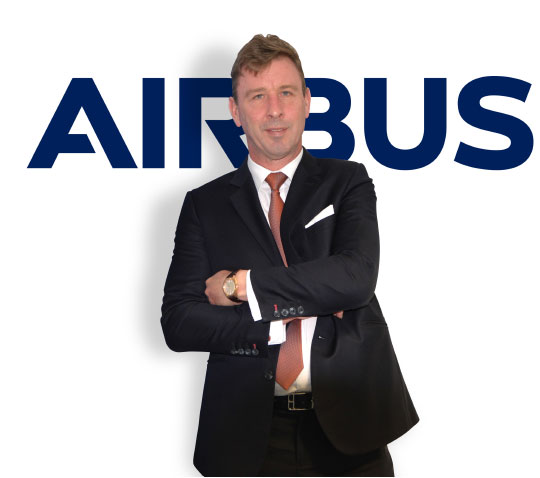
Simon WARD: Airbus named Simon WARD as its Chief Representative Turkey on April 1, 2021.
He is responsible for the development and implementation of the Airbus strategy in Turkey, expanding the company’s local presence, pursuing new growth and productivity opportunities. He coordinates company-wide business activities and leads government affairs.
Simon has worked for Airbus for more than 20 years and has been involved with supporting the growth of the Turkish aerospace industry within the Airbus supply chain since 2006. From 1998 to 2002, he held various leadership positions for Airbus in the UK in organizations such as Engineering, Operations, and Procurement services. He joined Airbus Central Entity in Toulouse, France, in 2003 as an internal consultant to SVP International Cooperation. Later, he held executive leadership roles on a wide range of Industrial Cooperation and Offset programs supporting sales campaigns for all business units across Airbus’ key regions.
Prior to joining Airbus, Simon started his career at Royal Ordnance Factories in the UK, as an apprentice machinist finishing as head of Computer Numerical Control Programming and Planning. Simon holds a HNC degree in Production and Mechanical Engineering from Trent University and a Master of Science degree in Engineering and Business Management from Warwick University, UK. In 1990, he was seconded to the Australian Department of Defense. Simon is a certified Six Sigma Green Belt professional and maintains a keen interest in supply chain development.
Defence Turkey: For nearly 40 years, Airbus has been an important solution partner for Turkey working closely with Turkish Airlines, Ministry of National Defense (MoND), Presidency of Defense Industries (SSB), Turkish Air Force (TurAF), Navy and Coast Guard. How would you summarize Airbus’ involvement in Turkey over the last four decades?
Simon WARD: Airbus has been a long-term strategic partner of Turkey for nearly 40 years. Today, the country represents one of the top international markets for Airbus. A committed partner of the Turkish aerospace and the defense industry, like Turkish Airlines, Ministry of Defense, Turkish SSB (Savunma Sanayi Başkanlığı), Turkish Air Force, Navy and Coast Guard, Airbus is contributing to and benefiting from Turkey’s industrial excellence.
The relationship with Turkey started as early as 1985 with the delivery of our first commercial aircraft (A310) to Turkish Airlines allowing them to open a route from Istanbul to Singapore. Today, Turkey is the third largest Airbus market in Europe with some 255 Airbus passenger and freighter aircraft in service with seven operators. In total, nearly 120 aircraft remain in the order book to be delivered to airlines in Turkey.
Turkish Airlines (THY) is the largest Airbus operator in the region with a fleet of more than 165 Airbus aircraft comprising single aisle and widebody aircraft. The airline has a further 69 Airbus latest generation aircraft to be delivered of which are 55 A321neo, the successful Airbus single aisle aircraft and 14 A350-900, the world’s most modern and eco-efficient widebody aircraft.
Another important operator is Pegasus Airlines, which became an Airbus customer in 2012. Since then, the low-cost carrier ordered 106 Airbus single aisle aircraft of which are the successful A321neo, the longest-fuselage member of Airbus’ best-selling, single-aisle A320 Family. Currently Pegasus operates an Airbus fleet of 57 aircraft in the A320neo family.
Airbus has also had the honor to provide aircraft to the Turkish Government.
In military transport aircraft our relationship started with the delivery of the CN235 in 1991. The first military aircraft from Airbus was the CN235, and it is noteworthy that Turkey still has the largest fleet of CN235’s anywhere in the world. The offset obligation related to this agreement launched the relationship with Turkish Aerospace. A relationship that has outgrown offset and I think both sides would agree we are now reliant on each other as design and manufacture of components for every civil aircraft as well as being a full partner in the A400M program. Today, it would be inconceivable to manufacture Airbus aircraft without Turkish manufactured components or assemblies sourced from Turkey.
Turkish telecommunications satellite operator TURKSAT selected Airbus Defence and Space for the construction of two long-awaited geostationary satellites at the end of 2017. TURKSAT 5A was launched in January 2021 and delivered in orbit in June and TURKSAT 5B launched in December 2021 with in-orbit delivery this summer. Both satellites are working well with 30-year lifetimes.
Turkey is an important partner for Airbus Helicopters too. Significant Military contracts were signed in the 1990’s for the delivery of helicopters. Turkey is the world’s largest Cougar operator with a fleet of 45 Cougar helicopters that are operated by the Turkish Land Forces and the Air Force for general purpose and Search-and-Rescue missions.
Airbus Helicopters has a strong presence in the Para public Emergency Medical Services segment in Turkey. Twelve EC-135 helicopters are operated by the Turkish Aeronautical Association for the needs of the Turkish Ministry of Health all around the country. Around ten civil Airbus Helicopters models are also flying in Turkey, such as the single engine H130 and the twin engine H145, for various purposes including private and business aviation in addition to passenger transport.
“It is very important to Airbus that Turkey becomes an integral part of our global supply chain, so we do not take a traditional ‘offset’ approach, but we have a competitive industrial partnership”
Defence Turkey: Airbus Defence and Space (ADS) has been positioned in Turkey through liaison offices since 1990 as a key partner of Turkey in military aviation and space. Airbus Defence and Space Turkey (ADSTR) was established in November 2013 as a 100% Airbus subsidiary. Can we please start with some information about the Airbus Turkey office? Why was it established and what has been accomplished? What can you tell us about your goals and expectations in Turkey?
Simon WARD: Airbus Defence and Space Turkey (ADSTR) was established in Ankara in November 2013, with the primary goal to provide in-service support to deliver the A400M to the Turkish Air Force. Over the years, Airbus has expanded its presence by developing support in sales, marketing, contracts, and material sales support services for CN-235 and Cougar helicopters.
Today, the TurAF operates the fleet of 10 A400M Atlas and with 58 aircraft owns the largest fleet of CN235 transport aircraft. With Airbus Defence and Space engineering and certification support, it is aimed to provide not only 3rd countries CN-235 aircraft maintenance but also to provide mid-life upgrade services. Project KARUM was launched to transform the Kayseri 2nd ASMC into an MRO Hub and MLU center of excellence for the region. For this purpose, a Letter of Intent was signed with the Turkish MoD Military Factories General Directorate in May 2017.
Defence Turkey: What would you like to say regarding Airbus Turkey’s activities performed in 2021 and your targets for 2022?
Simon WARD: 2021 was a difficult year for all of us as we lived through the COVID pandemic. Our commercial aircraft customers were really struggling, and it was very difficult for them to plan anything. The commercial aircraft business is one that requires long term planning for the fleet of aircraft. At Airbus, we spent a lot of time with our customers to support them during this unpredictable time.
In Turkey we also saw the financial impact of the Turkish Lira depreciation which consequently impacts government spending on defense and public services. This means that our customers are having to make difficult choices and prioritize their purchases, which in some cases has meant delaying planned acquisitions.
2021 was also marked by the devastating forest fires that raged through the south of Turkey. Airbus helicopters worked tirelessly to find helicopters and crews to support the firefighting mission. We managed to help secure a number of helicopters and most notably the Super Puma helicopter excelled in this role.
2022 is a year of recovery for us. With the COVID restrictions finally starting to be lifted there is a huge pent-up demand for commercial air travel. We are scrambling to support our customers to rapidly increase capacity. At the same time, ensure we provide not just cost-effective solutions but ones that are more environmentally friendly as the new aircraft have significantly less fuel burn and hence CO2 emissions as well as the capability to use Sustainable Aviation Fuel (SAF).
We are working with the OGM and the SSB to find mid-term cost effective solutions for fire-fighting capability in Turkey, especially focused on multi-role aircraft or helicopters which can be used for other important missions when not required for firefighting, which is generally only 3 months a year.
Defence Turkey: Could you elaborate on the structure, responsibilities and number of personnel working at the Airbus Turkey Office?
Simon WARD: All the Airbus Personnel in Turkey are essentially involved in commercial, marketing, material sales and support activities for our customers. We have more than 50 people based in three locations, Istanbul supporting airline customers, Kayseri supporting the Turkish Airforce and Ankara which is our main office.
Defence Turkey: Can you elaborate on where Turkey falls in the strategies of Airbus, in out-sourcing and building up a global supplier network and how could Turkey contribute better?
Simon WARD: Turkey has been an integral part of the Airbus supply chain for almost 20 years, being a partner in all Airbus aircraft programs, including the prestigious A350. Turkish aeronautical industries progressively embarked on high capabilities and skills in the last 10 years and Airbus is focused on the continued development of long-term cooperation projects with the Turkish aviation industry. Production increase for Airbus single aisle aircraft as well as Airbus widebodies will create further jobs in the future and Turkish aeronautical industries will benefit with additional responsibilities from a continuous development of its strategic skills. During the course of this cooperation, Airbus has generated more than 3,000 jobs in the Turkish aeronautical industry and continues to develop its sourcing in Turkey to procure a cumulative volume of $5 Billion turnover from Turkish suppliers between 2020 and 2030.
In January 2018 Airbus signed a Memorandum of Understanding with the Turkish SSB (Savunma Sanayii Başkanlığı) for the further development of industrial cooperation in Turkey.
Airbus has seven major industrial partners and subsidiaries in Turkey.
Turkish Aerospace (TUSAŞ) in Ankara is the single source supplier for Section 18 Fuselage Panels of the A320Family. In 2014, Airbus and TUSAŞ signed a contract to supply Section 18 shells for the full production rate of all A320 family aircraft. As part of Airbus’ commitment to long term partnerships and skill development, in 2008 TUSAŞ was awarded the A350 Aileron work package, including full design and build responsibility. To be noted that Airbus’ selection of TUSAŞ as a ‘Risk Sharing Partner’ for the A350 dated 2008 was done in the presence of the Prime Minister at that time, Recep Tayyip Erdogan. In this respect, Airbus is the only manufacturer who has entrusted TUSAŞ with not only the production, but also the design of certain sub-assemblies such as the ailerons of the A350. The aileron is a high technology wing component, one of the primary flight controls of the aircraft. The first A350 was delivered by TUSAŞ to Airbus in May 2012 and the first set of A350-1000 ailerons were delivered in early November 2015.
In June 2013 TUSAŞ was awarded a contract covering the build and supply of composite rudders for the A330-200 and A330-300 long-range commercial aircraft.
Another contract that TUSAŞ signed in April 2015 gives the company the responsibility to deliver panels and assemble partial rates of section 19 of the single-aisles family, reinforcing TUSAŞ’ position in fuselage manufacturing. TUSAŞ delivered the first shipset of Section 19 shells to Premium Aerotec at the end of 2016 and the first Section 19-barrel production in 2017.
TUSAŞ is also a key industrial partner on A400M, responsible for forward center fuselages, emergency exits and paratrooper doors, rear fuselage upper shells and tail cones plus ailerons and spoilers, water/waste systems and lighting systems.
During the Istanbul Airshow in September 2018, Turkish Aerospace and Airbus signed a collaborative agreement to co-develop and engage in research and experimentation in secondary structures such as movable parts for Airbus aircraft programs.
Turkish Aerospace is also a supplier for A220 with deliveries of the canopy to Airbus Atlantic (since 2019) and the Fixed Trailing Edge to Spirit (since 2014).
PFW - Havacılık Sanayi (HS) in Izmir assembles aerostructure components for the A320 Family aircraft including pressurized floor frames, auxiliary center tanks and ram air turbine housing. PFW also produces thousands of different tubes per month for the majority of Airbus aircraft types. In 2008, PFW was awarded the contract for the A321 inboard flap assembly.
All auxiliary fuel tanks for the A320 Family are now manufactured and assembled in Turkey. KaleAero in Istanbul machines the center tank walls and PFW HS assembles them to an entire unit. In 2015, PFW was awarded the Single Aisle after belly fairing assembly providing further growth to the Izmir facility.
Fokker Elmo is an Airbus industrial partner for harnesses. Since 2005, Fokker Elmo’s subsidiary in Izmir manufactures the A400M wing electrical harnesses as a single source supplier and produces the A330neo pylon harness. During the COVID period, A220 harnesses were transferred from China to Izmir to de-risk the program and sustain the workload of Turkey's manufacturing industry.
In 2012, the worldwide Airbus Maintenance, Repair & Overhaul (MRO) Network welcomed Turkish Technic as a new member. Turkish Technic, based at Istanbul Ataturk International Airport, has decades of experience in maintaining commercial aircraft, and their new HABOM maintenance facilities at Sabiha Gökçen International Airport will further enhance the customers’ choice of services in one of the fastest growing aviation regions in the world.
TSI and TCI received full support from Airbus to develop seats and galleys for the Turkish Airlines fleet. Seats from TSI and galleys from TCI are installed in the A330s and A321 ACF (Airbus Cabin Flex) version. On the basis of the experience and know-how developed by TSI and TCI, Airbus qualified TSI as catalogue suppliers for seats and galleys for new airline customers.
Airbus and Turkish Technic signed a long-term component pool agreement for the Turkish Airlines A350 aircraft fleet in April 2021. Under the agreement, Airbus will provide A350 aircraft parts with guaranteed availability facilitated by pool access service, on-site stock at Turkish Technic’s main base in Istanbul and component repairs.
The Second Air Supply and Maintenance Base (FASBAT) for A400M opened in Kayseri in July 2021. Operations called “retrofit“ of the strategic transport aircraft A400M, which increases the tactical and transport capabilities of the Turkish Armed Forces will be carried out in Kayseri. Turkey is the only country right now that can apply retrofit to A400M aircraft except Airbus. With this new step, Turkey is making a significant contribution to the country's economy by strengthening its position in the aviation maintenance and repair sector.
Airbus is supporting and enhancing Turkish Aerospace (TUSAŞ) aspirations and considers Turkey as a long-term industrial partner. Therefore, since 2014, Airbus has been partnering with TUSAŞ to develop the capabilities of the Tier 2 supply chain by contributing to audits and qualification of suppliers and special processes used for Airbus products. This has been beneficial to SMEs working for TUSAŞ and now also being suppliers of other Airbus major Tier 1 (HMS for PFW and GKN, KPA for Daher or Epsilon for Patria.)
The Turkish industry is also a key player in engine parts manufacturing with a strong presence in Airbus A320neo and A220 engines from P&W and CFM through Kale P&W, Alp Aviation and TEI.
Since the beginning of 2018, Airbus has been supporting the THY Air Transport Management System program delivered at the Turkish Aviation Academy. A support agreement is in place with THY for the next 5 years to deliver lectures of compulsory and elective modules.
Defence Turkey: Can you elaborate on the other programs that Airbus would like to pursue in Turkey and cooperate on with local industry?
Simon WARD: Airbus is currently in discussions for a variety of equipment both military and civil and with all of these programs Airbus takes a partnership approach. For Airbus it is not just about selling equipment and services, it is also about enhancing the capabilities of Turkey both in terms of the direct customer getting the best equipment and services but also about ensuring that Turkish industry is involved in the programs. It is very important to Airbus that Turkey becomes an integral part of our global supply chain, so we do not take a traditional ‘offset’ approach, but we have a competitive Industrial partnership.
Two examples of this are that all Airbus commercial aircraft currently being manufactured have significant Turkish content. The A400M is another good example where Turkey is a program partner as well as manufacturing significant elements of the Aircraft not just for Turkey but globally for the Aircraft. To my knowledge Airbus is the only OEM to have design as well as manufacture contracts. This has been an important milestone and has heavily contributed to Turkey’s strategy to develop its Aerospace capability